This study outlines a step-by-step plan for Bank BTPN to strategically navigate the growing field of ESG (Environmental, Social, and Governance) business. The main goal is to make the bank a recognized leader in sustainability. The key to success in making money from ESG initiatives is building trust and loyalty with customers. The bank also aims to become the preferred choice for a wider range of stakeholders, including government bodies and regulators. This broad vision is essential for the overall success of the bank. Our research emphasizes the need for significant changes within the bank, covering areas like business practices, financial management, employee engagement, organizational structure, and operational oversight. These changes are not just ideas; they are necessary to strengthen the bank's foundation and prepare it for future operations, marketing, and branding strategies. The success of these changes relies on the committed support of shareholders and leaders. Their commitment goes beyond agreeing with the plan; it requires active guidance and establishing clear success metrics. This commitment is crucial for the effectiveness and success of the proposed ESG strategies. The paper serves as a detailed plan for Bank BTPN's entry into the ESG business. It aims to guide both current and future leaders of the bank. The ideas and recommendations in the paper present a strategic plan for smoothly integrating ESG principles. This goes beyond practical changes in operations and finances; it also involves intangible but important aspects like leadership commitment and a shared vision. As the bank transforms, the master plan aims to lead Bank BTPN not just to compliance but to a leadership position in sustainable banking practices.
Keywords
ESG
Sustainability
Banking
Transformation
Governance
Green
Social
Strategy.
Introduction
Sustainability is a popular term in finance today, with various opinions about its meaning and importance. A traditional view comes from the 1987 UN Brundtland Report, which describes sustainable development to fulfill current needs without harming future generations. This approach aims to create harmony among economic growth, environmental preservation, and social wellbeing. Nowadays, a new understanding of sustainability is becoming more common, where it is seen as a part of business management that focuses on reducing a company's non-financial risks, such as environmental issues, social/ethical issues, and its own governance. By considering these risks, a company can lessen the damage to its reputation if problems arise. So, the initial step a company should take before creating a sustainability plan is to examine potential risks and pinpoint them. Incorporating sustainability into a company's strategy is crucial for several arguments. First, a strong reputation in sustainability can help mitigate potential risks. Second, good sustainability practices reflect effective corporate governance. Third, prioritizing sustainability signals long-term stability to customers. Fourth, government entities tend to trust companies that collaborate on national sustainability objectives. Lastly, corporations with strong sustainability performance are increasingly attracting “ESG” investments. [1]
ESG (Environmental, Social, and Governance) means thinking about the environment, society, and management while making financial choices. This approach includes more than just money matters, as it also involves considering the well-being of our world and society for a balanced and long-lasting growth. Some people argue that ESG could affect traditional financial profit, but opinions are changing. When we think about society's finances, it's clear we're experiencing a massive transfer of around 1 trillion US dollars Gross Domestic Product (GDP) from the Indonesian older generation to their children. These young people, aged 25 to 40, have different ideas about money decisions. Big investors have also started putting more importance on ESG when making decisions. [2].
Bank BTPN, a subsidiary of Sumitomo Mitsui Banking Corporation (SMBC), is a universal bank headquartered in Jakarta, Indonesia. It serves a wide range of customers, from mass market to corporate, with numerous branch offices, sub-branch offices, payment points, and ATMs across Indonesia. SMBC, as the owner of Bank BTPN, is a global financial institution with a strong presence in South East Asia, including Indonesia. It provides a wide range of banking services and has a commitment to ESG principles. While SMBC has faced scrutiny regarding its involvement in coal financing, it has taken steps to address environmental and social risks. It has established an Environmental and Social Framework, committed to reducing greenhouse gas emissions, and joined various initiatives and frameworks supporting responsible banking practices. SMBC's commitment to ESG aligns with Bank BTPN's vision, providing an opportunity for the bank to further emphasize its contributions to social values and sustainable development goals.
SMBC's involvement in coal financing previously has led to reputational risks and protests from environmental activists. To address these concerns, SMBC has established an Environmental and Social Framework and set targets to reduce greenhouse gas emissions. It has also joined various initiatives supporting responsible banking practices and sustainable development.
Bank BTPN has been impacted by SMBC's ESG timeline, which includes a phase-out plan for industries that are currently experiencing significant growth and financing opportunities. From 2023, Bank BTPN has committed to cease financing new projects related to coal-powered, oil, and gas industries, influenced by the initiatives of SMBC. By early 2024, this scope 3 restriction will extend to the steel and automobile sectors. As a result, Bank BTPN is currently undergoing a phase-out process for industries that are considered harmful to the planet. [3]
Interestingly, all the competitors in sustainable finance in the market will follow the timeline of Indonesian government in 2060 for scope 3. Meaning, there will be 10 years of gap in which all the coal financing opportunities from so-called compliance companies. While other banks could enjoy more time in market-learning on the transition, Bank BTPN must start early. Although by theory this could be an advantageous situation, otherangles might say otherwise. First, talents would seek better opportunities for jobs in creating loan deals – that impact the compensation, bonuses, and remuneration - might get attracted to join other competitor banks. Second, as the competitor assets grow over these 10 years, more investment in client-relationship can happen and slow down Bank BTPN “solution-provider” reputation. Lastly, transitional portfolio risk from majority non-green compliance to green, might impact the banks capabilities in creating higher targets. In other words, stagnant growth and performance suffering. A proposal strategy is needed to enhance Bank BTPN readiness on responding to the market and group strategy.
Literature Review
In the Indonesian banking sector, to outperform its peers in ESG, several factors must contribute to this success. PwC's report, "Indonesia’s Sustainable Transformation “highlights ESG as a top business priority in Indonesia, aligning with global trends. The Indonesian government actively supports ESG transition, creating conditions for sustainable practices. Banks, including Bank ESG, are mobilizing private funding under regulatory frameworks like OJK’s Sustainable Finance Roadmap and IDX reporting requirements. Additionally, factors like Indonesia's Carbon Tax and the EU’s Carbon Border Adjustment Mechanism further drive sustainable business practices and ESG-aligned products and services. [4]
To enhance ESG performance, Bank ESG can internally transform by integrating ESG into its corporate culture and values. The vital role of corporate culture plays a vital role in driving ESG performance when it is interpretedin a company's values. When the board of management overview includes governance in each of the operations, and communications, it is a demonstrating commitment and responsiveness to investor interests. [5] Cultural integration should span governance, operations, strategic planning, risk management, compensation, communications, and disclosure ("Integrating ESG Into Corporate Culture: Not Elsewhere, but Everywhere"). Establishing a central data platform integrated with existing systems can create a single source of truth for ESG data. [6]
The regulatory environment in Indonesia, guided by the government's proactive stance, significantly influences Bank ESG initiatives. Regulatory frameworks like OJK’s Sustainable Finance Roadmap, IDX reporting requirements, and OJK Regulation No. 51/POJK.03/2017, along with global initiatives like the Carbon Tax and Carbon Border Adjustment Mechanism, provide impetus to sustainable banking practices. [2]
Market demand and customer preferences for ESG projects impact Bank ESG's lending and funding performance. Consumers increasingly influence banking preferences based on sustainability concerns, affecting banks' ESG standards and practices. [7]. The sectoral focus and risk management strategy, guided by frameworks like the Equator Principles, contribute to Bank ESG's ESG lending and funding balance ratios, bank's approach to ESG-related financial products and marketing incentives varies, aligning with individual strategies, but Indonesia's prominence in thematic bonds offers opportunities for robust private equity demand and bank participation [8].
The Loan Market Association (LMA) provides frameworks for ESG loans, emphasizing external reviews, verification, certification, and scoring/ratings to ensure transparency and adherence to sustainability principles. Bank ESG can leverage LMA's guidance for effective ESG implementation, aligning with EU Taxonomy and promoting transparency in emerging markets. This paper aims to bridge the literature gap by providing an LMA-compliant implementation proposal tailored to Bank BTPN's context and its ESG initiatives, contributing to the knowledge base in this field. [9]
Research Methods
This research adopts a framework question of “How can Bank BTPN strategize its monetization and communication strategy to effectively convey its commitment to ESG principles and differentiate itself in the Indonesian market?”. And by using Barbara Minto's Pyramid Principle, specifically the S-C-Q framework (Situation-Complication-Key Question), to guide Bank BTPN's strategy development. It systematically analyzes the firm's current situation, constraints on profit growth, and the key questions crucial for the strategy development process. This structured approach shapes the paper's thought process.
To answer the research question and meet the study objectives, a mixed-methods approach is employed. A comprehensive literature review, drawing from Minto's Pyramid Principle, guides the understanding of monetization, communication strategies, and ESG integration in banking. Primary data collection involves semi-structured interviews with Bank BTPN's key stakeholders, focusing on their perspectives and aligning with John Kay's Distinctive Capabilities Theory. A survey among customers captures their views on ESG, awareness of the bank's efforts, and preferences. Secondary data collection from reliable sources provides insights into profitability, customer acquisition, reputation enhancement, risk management, and employee expertise. Using various theories and frameworks, including McKinsey's 7S Framework (1980) [10]. The study ensures the strategy proposal aligns with Bank BTPN's objectives and adheres to best practices. The goal is to present meaningful recommendations for Bank BTPN's strategy enhancement in the Indonesian market.
Results and Discussion
Bank BTPN has made significant contributions to ESG through its strong track record in social values. It has focused on improving the lives of the underprivileged and unbanked population by providing financial support and helping customers develop the necessary skills and capacity for a better future. Through its subsidiary, Bank BTPN Syariah, the bank has championed the Grameen model, which has positively impacted various aspects of customers' lives. This includes improving sanitation, housing quality, access to education, and providing opportunities for underprivileged individuals to undertake pilgrimages. Bank BTPN has incorporated its CSR department, Daya, into its mission to generate greater social impact. Daya has played a crucial role in supporting SME customers, teaching them financial planning and business management strategies. The bank has also provided early disbursement monitoring and complimentary health check-ups for older pension recipients. Bank BTPN's commitment to ESG extends beyond social values. It has explored green financing and green building developments, contributing to environmental sustainability. However, its notable achievements lie in its strong focus on social values and its dedication to improving the lives of individuals and communities.
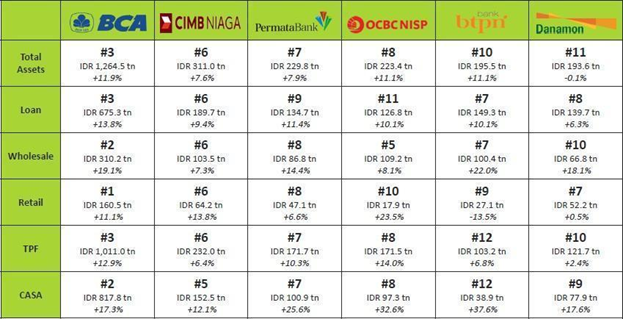
Table 1. Peer Banks Comparison
Source: company reports December 2022.
In table 1, bank BTPN has made significant contributions to ESG through its strong track record in social values. It has focused on improving the lives of the underprivileged and unbanked population by providing financial support and helping customers develop the necessary skills and capacity for a better future. Through its subsidiary, Bank BTPN Syariah, the bank has championed the Grameen model, which has positively impacted various aspects of customers' lives. This includes improving sanitation, housing quality, access to education, and providing opportunities for underprivileged individuals to undertake pilgrimages. Bank BTPN has incorporated its CSR department, Daya, into its mission to generate greater social impact. Daya has played a crucial role in supporting SME customers, teaching them financial planning and business management strategies. The bank has also provided early disbursement monitoring and complimentary health check-ups for older pension recipients. Bank BTPN's commitment to ESG extends beyond social values. It has explored green financing and green building developments, contributing to environmental sustainability. However, its notable achievements lie in its strong focus on social values and its dedication to improving the lives of individuals and communities.
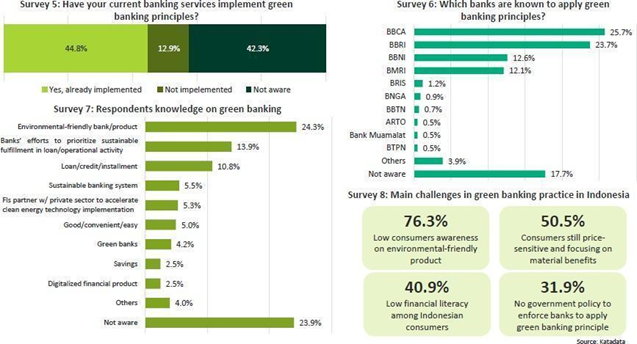
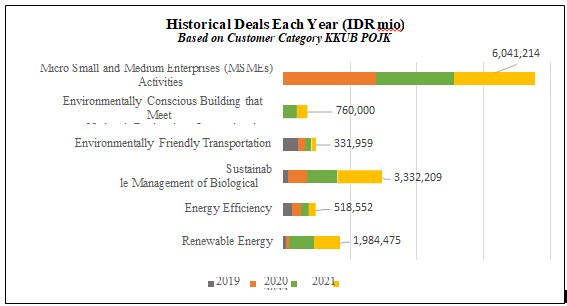
Furthermore, market survey data indicates that Bank BTPN has had limited success in conveying this story to the Indonesian market, largely due to its relatively low contribution of KKUB shares of the total loan portfolio. In contrast, many other banks, which have gained recognition for their commitment to ESG principles, have not made a firm pledge to cease coal financing, have larger assets that are in line with the KKUB of POJK 51. (Illustration 1)
Illustration 1. Market Survey Results
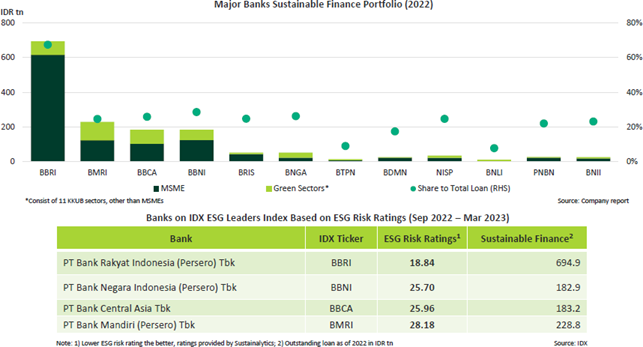
Illustration 2. Portfolio Survey Result.
Moreover, while many banks claim to provide sustainable finance for industries involved in various environmentally friendly activities, there is a concern that they do not calculate or take into account the carbon emissions of these companies. In contrast, Bank BTPN, via SMBC order, needs to conduct proper assessments by evaluating customer companies using the international indicators of LMA (Loan Market Association) Standardized Green & Social Loan Terms and Conditions. This indicates that Bank BTPN is aiming to provide sustainable financing by taking into account not only the industry but also the individual company's environmental-social impact. However, despite Bank BTPN's efforts, there seems to be a perception that the bank still lacks recognition for following true ESG (Environmental, Social, and Governance) financing or sustainable financing practices. The reasons for this may vary and could include a lack of awareness or understanding among stakeholders, limited marketing efforts, or the need for stronger communication regarding the bank's sustainable finance initiatives and the standards it adheres to. To address this problem, it is important for Bank BTPN to enhance its reputation as a bank that truly follows ESG financing practices. (Illustration 2.)
Currently, Bank BTPN has three active teams dedicated to ESG strategy, operations, and marketing. The first team, led by the Chief Finance & Planning Officer, is called the Alignment & Synergy Planning team. It comprises two members responsible for creating and consolidating action plans and initiatives. The second team, led by the Chief Compliance Officer, is known as the Data team and consists of three members. Their role is to consolidate sustainability reports and facilitate ESG governance policies. The final team, under the Wholesale Banking head, consists of two wholesale Relationship Managers (RMs). Their primary focus is on selling ESG products such as Green Financing and Sustainability Linked Loans offered by Bank BTPN. However, the other members of the sustainability committee – Led by COO as the chairman – have no dedicated roles for ESG responsibilities. Even though they serve as decision-making committee members. It is worth noting that there is no representative from BTPN Syariah in this committee due to its status as a separate entity/subsidiary.
Solution for employee expertise
Using viewpoints of Treacy and Wiersema's (2007) [11]. Value Discipline to analyze Employee Expertise, we observe Bank BTPN’s Operational Excellence, Product Leadership, and Customer Intimacy. Specifically, for A&S Planning, Daya, and Wholesale Marketing Team that became the upfront of this initiative.
A&S Planning apparently is not the official planning team of ESG business because this team only works as project management officers and treat ESG as one of the ad-hoc work. Only consisting of 1 (one) employee in charge of accompanying Wholesale Marketing Team, the work focuses only to assist the marketing team in terms of support work for the bank tracking and alignment with SMBC target. In other words, only giving a live update in regard to communication between BTPN and SMBC Group, not as a dedicated strategy. As they are located in the Finance & Planning directorate, it needs to add more responsibilities and resources to focus on ESG.
Similarly, Daya is only in charge of Sustainability Reporting, and administrative work in ESG publication, such as sustainability website, press release (ad hoc basis), and seminar organizer. The main job is to finish OJK paperwork in terms of sustainable finance reporting. As the team isin the Compliance directorate, thus the work is compliance driven. There are 2 (two) talents identified here.
The team that heavily have KPI setup for delivering ESG solution is called Wholesale Banking marketing team, in which there are 3 (three) talents that build relationships with corporate customers from various segment (state-owned, multinationals, and local private), where throughout the time building Bank BTPN reputation in providing solutions of Green Finance, Social Finance, and Sustainability-Linked Loans. The team has a social loan scope, but this is different from MSME business that belongs to the Business Banking team in Bank BTPN. In which the social loan follows LMA project-based scheme, while the Business Banking team only provides general loansthat are commonin the Indonesian market. Note that Social Loan and MSME business general loans are counted as KKUB reporting to OJK.
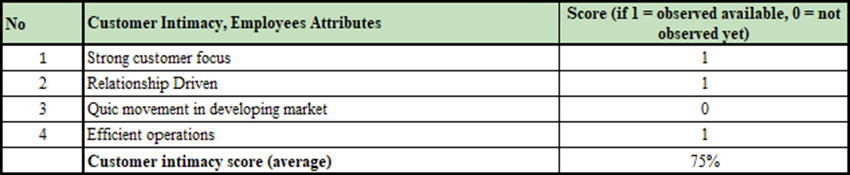
Observing in total 6 (six) talents of ESG business of Bank BTPN, later we called as “Bank BTPN ESG team”, we conduct scoring observations with the following result:
Table 2. Customer Intimacy
The Bank BTPN ESG team exhibits strong attributes when it comes to customer intimacy, with a scored average of 75%. This is evident in their strong customer focus and relationship-driven approach, as well as their efficient operations. These qualities reflect a positive and focused attitude towards understanding and meeting customer needs. The emphasis on building relationships and efficient operations suggests that the team provides high levels of personalized service to their clients, which is essential for success in the banking sector. For instance, awareness towards existing and potential customers' incoming projects are identified. But responses through policy changes or market innovation are relatively slow. No holistic insights came from any role in Bank BTPN that could bring quick responses in the market, where it is a very crucial scope to be assigned in order to keep competitive. ( Table 2.)
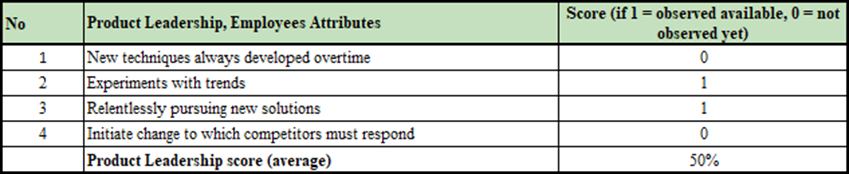
Table 3. Product Leadership
On the other hand, in Table 3, when it comes to product leadership, the average score is 50%. This suggests that there is a mixed performance in terms of developing new techniques over time and initiating changes that competitors must respond to. While the employees demonstrate a willingness to experiment with trends and pursue new solutions relentlessly, there appears to be a need for improvement in continuously developing new techniques and initiating changes that can set the bank apart from its competitors. For instance, since 2019, no other approach than canvassing and relationship building has been identified. Partnership or referral schemes, that are oftenavailable in other banks, did not appear in the observation. No holistic structure that could support the marketing team create a quick go-to-market scheme.
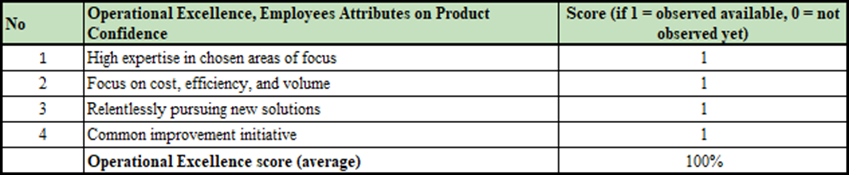
Table 4. Operational Excellence
However in Table 4, the operational excellence score, averaging at 100%, presents a bright spot. The employees' focus on high expertise in their chosen areas of focus, cost efficiency, and volume, coupled with their relentless pursuit of new solutions and commitment to common improvement initiatives, indicates a strong operational mindset within the organization. This bodes well for the bank's ability to execute its strategies effectively and efficiently, which is crucial for its overall success. For instance, support systems in operations team that always available and unnegotiable in need of perfect service level agreement is identified. Overall, the data suggests that Bank BTPN employees have a solid foundation but some homework need to be done in uncovered scope of work of research & planning.
Solution for Managing Risk
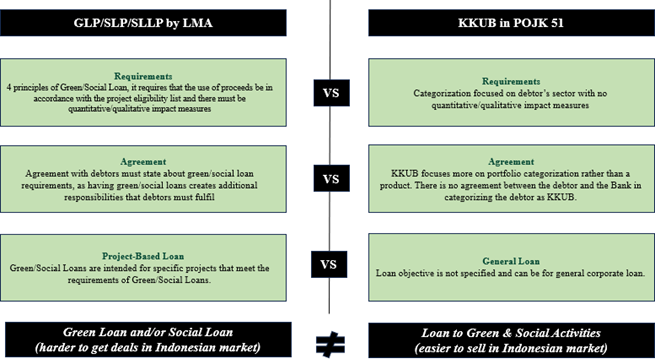
Existing understanding on OJK regulation which in order to strengthen sustainability commitments and as a form of compliance with the provisions of Financial Services Authority Regulation Number 51/POJK.03/2017 concerning the Implementation of Sustainable Finance, all banks must prepare the Sustainability Action Plan (RAKB) for 5 years plan. The problem is that the Otoritas Jasa Keuangan (OJK) requirements, specifically the Kategori Kredit Usaha Berbasis Lingkungan (KKUB) under POJK 51, predominantly focus on categorizing debtors based on sectors without incorporating detailed impact evaluation criteria. This approach does not mandate an explicit agreement between the debtor and the bank regarding the green/social criteria, nor does it require detailed quantitative and qualitative impact measures. Whetherit will be under green-washing risk is still debatable in the Indonesian market.
Moreover, compared to the LMA's comprehensive framework, the KKUB under POJK 51 presents a less prescriptive and less project-specific approach to ESG financing. Bank BTPN should consider the importance of adopting the LMA's GLP/SLP/SLLP principles. By adhering to the LMA guidelines, Bank BTPN can demonstrate a strong commitment to financing sustainable and impactful projects, ensuring transparency and accountability in the allocation of loan proceeds. This aligns with the global trend towards responsible and sustainable finance, enhancing the bank's credibility and positioning in the market. Furthermore, embracing the LMA requirements positions Bank BTPN as a responsible financial institution dedicated to driving positive environmental and social change, thus differentiating itself within the financial sector and potentially attracting environmentally and socially conscious clients and investors. (Illustration 3)
As stated in LMA – every bank must understand that in order to say Green Loan, Social Loan, Sustainability-Linked Loan have been distributed for customer, the first thing is “use of proceed must follow the fundamental determinant of a social loan is the utilization of the loan proceeds for social project (including other related and supporting expenditure) which should be appropriately described in the finance document, and if applicable, marketing materials for the financing. All the designated social projects should provide clear benefits of a social nature, which where feasible, will be assessed, quantified and measured and reposted by the borrower.”
Second is process for “project evaluation and selection where the borrower of a green & social loan should clearly communicate to its lenders such as green & social objective, process by which the borrower determine how the projects to be funded fit within the eligible social project categories and related eligibility criteria included if applicable exclusion criteria for any other process applied to identify and manage potentially material social and environmental risks associated with the proposed projects.”
However, shall the market be ready to embrace two products that Bank BTPN has, in which comply with LMA requirements in another challenge. If no customer sees that as a solution, Bank BTPN must prepare a contingencythat is much more acceptable. In which can be analyzed via Blue Ocean Strategy analysis later on this paper. Overall, we could analyze that Bank BTPN need to prepare more the emphasizing categorization of LMA & KKUB in the general ledger and public reporting, as we predict KKUB will not stand long time and adoption of LMA approach by OJK is inevitable in the future and forcing the industry players to achieve transition net zero in 2060.
Illustration 3. International’s LMA versus OJK’s KKUB
Solution to Enhance Good Reputation
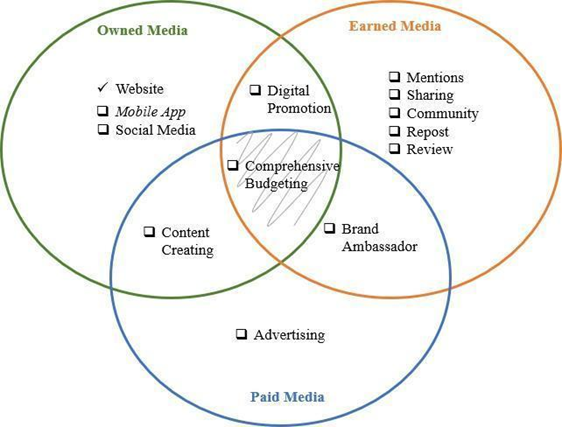
To enhance its reputation further and reach a wider audience, analyzing Bank BTPN became simpler by adopting Marketing Trifecta Theory [12]. This theory suggests that efforts in earned media, owned media, and paid media are imperative to effectively communicate ESG initiatives and build a robust reputation.
Owned media refers to the channels that a company owns and controls, such as its website, blog, or social media accounts. Paid media refers to the channels that a company pays to use, such as advertisements on social media platforms or search engines. Earned media refers to the channels that a company earns through word-of-mouth, such as customer reviews, shares, or mentions on social media platforms.
Bank BTPN has only a website section of sustainability. No other media to promote its ESG business can reach a wider audience. For instance, Bank BTPN can use its website to create a blog that provides valuable information about ESG business. The blog can be used to share insights, news, and updates about the company's ESG initiatives. This is common in competitor’s banks. Bank BTPN can also use its social media accounts to share the blog posts and engage with its followers. By doing so, Bank BTPN can establish itself as a thought leader in the ESG space and build a loyal following of customers who are interested in ESG business.
Bank BTPN can use paid media to reach a wider audience by running targeted ads on social media platforms or search engines. For example, Bank BTPN can use Google Ads to target users who are searching for ESG-related keywords. Bank BTPN can also use Facebook Ads to target users who are interested in ESG business or follow pages related to ESG. By using paid media, Bank BTPN can reach a wider audience and increase its brand awareness.
Bank BTPN can use earned media to reach a wider audience by encouraging its customers to share their experiences with the company's ESG initiatives on social media platforms. For example, Bank BTPN can create a hashtag campaign supported by reports and reviews to encourage its customers to share their stories about how they are contributing to ESG business. Overall, since we assume that it is not sustainable for Bank BTPN to rely on relationships building among its talents and customers without a systematic media platform that is independent from personal approach. (Illustration 4)
Illustration 4. Gap Analysis of ESG Business Promotion in Bank BTPN
Solution to Bring More Customer
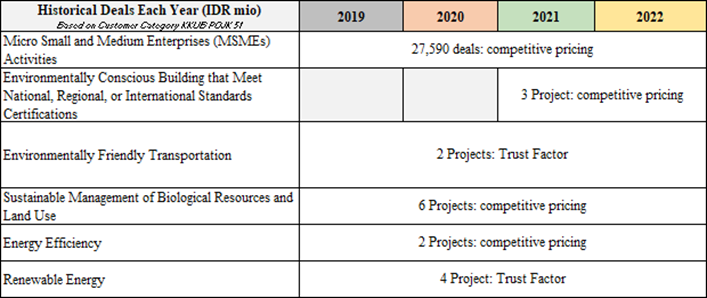
Eventually, the research continues by seeing the historical deal breaker identified in the bank when it comes to giving ESG solutions for the client. Without revealing the customers or project name, the following are proxy of the categorical deals that Bank BTPN have. Then, Bank BTPN could identify more understanding on what brings ESG business attractive for customers.
The companies in the category of Micro, Small, and Medium Enterprises (MSMEs) – Social Loan included - have resulted in 27,590 deals with Bank BTPN, primarily driven by competitive pricing. This indicates a strong emphasis on cost competitiveness within this sector. In addition, projects under the category of Environmentally Conscious Building projects meeting National, Regional, or International Standards Certifications have led to 3 project deals with the bank, and customersunder the category of Sustainable Management of Biological Resources and Land Use have seen 6 project deals. also attributed to competitive pricing. (table 6)
Similarly, Environmentally Friendly Transportation initiatives have resulted in 2 project deals, with the clients expressing trust and long-standing relationships with SMBC and at the time - Relationship Managers (RMs) and both Energy Efficiency and Renewable Energy projects have garnered 2 and 4 deals respectively, driven by the same reason. These insights provide a comprehensive overview of the explored market only, identifying the driving factors behind the deals in each environmental sector and shedding light on the importance of competitive pricing and trust- based relationships in securing deals.
However, there are also unexplored markets that present untapped opportunities for Bank BTPN (SMBC) to further expand its reach. These customer types include Pollution Prevention and Control, Conservation of Terrestrial and Aquatic Biodiversity, Sustainable Water and Wastewater Management, Climate Change Adaptation, Eco-efficient Products, and Other Environmentally Conscious business activities. It is imperative for Bank BTPN to assess and explore these markets, gaining an understanding of whether the focus should be on pricing or trust/relationship differentiation in order to make informed strategic decisions.
Table 6. Observation Table – Using Proximity Based on Observation
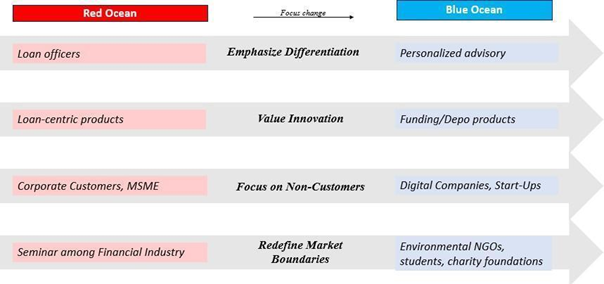
If we look at the angle of Blue Ocean Strategy principles (Kim, W. C., & Mauborgne, R. 2017) [13] can be applied to Bank BTPN's approach to the unexplored environmental markets using specific examples related to trust versus price dynamics in the context of these Bank BTPN deals.
Emphasize Differentiation
Trust-building as an existing strategy used by Bank BTPN can emphasize differentiation in the unexplored environmental markets. Rather than solely competing on price, the bank can differentiate itself by engaging in environmentally conscious activities. For instance, BTPN could implement personalized advisory services for clients in these markets, providing tailored financial guidance and support to help them navigate their unique business challenges. By prioritizing trust and relationship building, BTPN can distinguish itself from competitors and create a unique value proposition based on the quality of its advisory services rather than competing solely on price.
Value Innovation
BTPN can drive value innovation by developing tailored financial products specifically designed to address the needs of clients in the unexplored environmental markets that suit Indonesian regulatory conditions. For example, the bank could introduce ESG Deposit solutions that common in several Asian & European market that align with sustainable initiatives, such as green project loans or eco-friendly business investment packages. This type of funding products can offer unique features such as simple use of proceed structures tied to time deposit but has preferential terms for businesses committed to environmental sustainability loan channeling. By innovating products that directly cater to the needs of clients for publications, leveraging brand awareness of contributing to the society and getting good interest rates as financial gain as creation of new value while differentiating itself from competitors who may not offer such specialized financial solutions.
Focus on Non-Customers
Targeting Sustainable Start-ups BTPN can target non-customers in the unexplored environmental markets by focusing on sustainable start-ups and businesses that are not currently utilizing the bank's services. For example, the bank can reach out to emerging companies dedicated to eco-friendly innovations and provide tailored financial support to help them grow and scale their sustainable initiatives. By understanding the unique needs of these non-customers and offering specialized financial assistance, BTPN can attract new clients and expand its market reach within the environmental sectors.
Redefine Market Boundaries
Engagement Bank BTPN can redefine market boundaries by engaging with the broader ecosystem of players in the unexplored environmental markets. The bank can form strategic partnerships with environmental NGOs, industry associations, and sustainable development organizations to gain a holistic understanding of the needs and opportunities within these sectors. By participating in collaborative initiatives focused on sustainable finance and environmental stewardship, Bank BTPN can redefine its approach to serving the environmental market segments and identify new opportunities for value creation beyond traditional banking services. In summary, by applying the Blue Ocean Strategy principles with concrete examples related to trust versus price dynamics, Bank BTPN can strategically differentiate itself, drive value innovation, target non-customers, and redefine market boundaries within the unexplored environmental markets. This approach can help Bank BTPN unlock new sources of value and establish itself as a trusted financial partner for businesses engaged in environmentally conscious activities. (Illustration 5)
Illustration 5. Blue Ocean Strategy Analysis for Bank BTPN
Solution to Bring Profits.
Profit will come when net interest margins either in depo and/or loan deals are higher than the cost of funds of the given time. The problem is that generally banks use high cost of funds as the main reason or excuse to put high rates -pricing- on their services. This is a short-term mindset where bankers are known to conduct without thinking of the potential future long-term volume of the deals. From level 1 analysis at this point we already know that trusts to Bank BTPN in terms of ESG experience (and SMBC effect) can be a differentiator that could overcome this issue. Besides reputational building, a price discount might give more volume of deals in the future for some, if not all the customer categories. This is a mindset of long-term strategy.
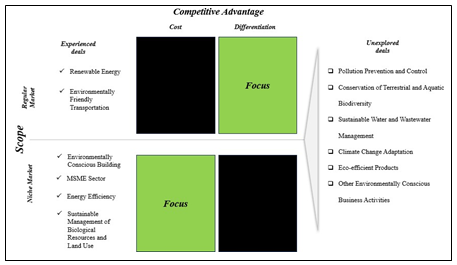
It will be easier to map the application of Michael Porter's Generic Strategies [14] within the context of Bank BTPN's involvement in the emerging Indonesian ESG market (again, we will use KKUB categorization of customer & projects). This to also finalize analysis level 1 in which the bank can maximize profit or monetize on these industries are crucial to illustrate each strategy's potential deal execution.
Cost Leadership & Cost Focus
By focusing on operational efficiency and cost optimization in customers with Environment Conscious Building, Energy Efficiency, MSME, and Biological Land Use, the bank can invest in the cost of fund streamlining processes, reduce administrative costs, and enhance overall operational efficiency only for these sectors. By leveraging alignment among business and finance departments, Bank BTPN can offer cost-effective financial solutions to businesses operating within these sectors. Additionally, by passing on these cost savings to clients in the form of lower fees and competitive interest rates, BTPN can position itself as a cost leader, attracting businesses seeking affordable financial services while still maintaining profitability.
Differentiation Focus
In implementing a differentiation strategy, Bank BTPN can focus on developing unique financial products and services tailored to the specific needs of businesses committed to environmental and social responsibility. Renewable Energy & Environmentally Friendly Transportation projects for instance, the bank can introduce all general loans such as Green Loan and Sustainability Linked Loans. However, for every of their customer value chain, it is also possible to provide ESG Deposit (funding) as the savings account in supplementing these anchor projects. Commonly these projects indeed rely on SMBC name (referral from headquarter, or endorsement-follow ups result on G2G endorsement between Indonesia and Japan) and also relationship manager reputation in the market to clients seeking to align their investments with their values. But by admitting only these two industries that are in need of this strategy, Bank BTPN can save more time and resources in canvasing other potential unexplored deals. We count there are 6 (six) unexplored potential deals that need to be experienced by Bank BTPN to know the sweet spot of its competitive advantage. (Illustration 6)
Illustration 6. Generic Strategies Mapping for Potential Market Confidence & Capabilities Test of as Justification of Implementation Plan
It is vital to align interview questions with theories that offer insightful perspectives on building and leveraging
distinctive capabilities. John Kay's Distinctive Capabilities Theory [15] - I for Innovation, R for Reputation, and A for Architecture - provides a valuable framework for understanding how organizations can excel in specific areas to achieve competitive advantage, particularly within the realm of ESG initiatives and strategy. In addressing the interview questions to the management of Bank BTPN, which plays a pivotal role in driving the bank's sustainability agenda, it is important to align the questions with the key personnel's functions and responsibilities within the sustainability committee.
For the Deputy President Director of Bank BTPN, such as Mr. F, who is involved in steering the sustainability committee, it is pertinent to pose a question relating to the bank's current structure and talent pool as enablers for future ESG initiatives and strategy (A). This question is suitable as it directly relates to the Architecture component of Kay's theory, which emphasizes the significance of organizational structure and capabilities in driving sustainable business strategies. It provides insights into how the bank is harnessing its architecture, including talent, processes, and resources, to support its ESG objectives.
He mentioned ““To ensure the cultivation of employee expertise within Bank BTPN, there must be a strategic approach, namely the establishment of an ESG-specific planning team. This initiative is crucial for facilitating agile progress in market development, fostering the continuous evolution of new techniques, and instigating changes that demand a response from competitors. The Sustainability Committee shoulders the responsibility for this endeavor, with the mandate to have it operational by the early quarter of the upcoming calendar year”
The Director of Compliance, Ms H, being the head of the Sustainability Committee, holds a critical role in ensuring transparency and accountability efforts related to ESG principles. Therefore, a question about how the bank ensures transparency and accountability, especially given the low customer priority and awareness in ESG matters (R), is directly aligned with the Reputation aspect of Kay's theory. Reputation is crucial in building trust and accountability, particularly in the context of ESG initiatives. This question aims to delve into the measures taken by the bank to uphold transparency and accountability, thereby contributing to the positive reputation vital for sustainable business practices.
She mentioned: “In order to navigate the risks associated with portfolio transition and safeguard against the taint of greenwashing on the bank's reputation, it is imperative to employ differentiator tracking. This involves assessing the ESG portfolio from two perspectives: one based on KKUB POJK 51 (loan to green and social activities) and another based on the LMA standard portfolios, encompassing green loans, social loans, and sustainability-linked loans even earlier/advanced than Indonesian regulator”
The Wholesale Banking ESG Head, Mr D, plays a key role in driving product strategies that align with the bank's commitment to ESG principles. Therefore, a question on whether the bank's ESG product strategies align with its commitment to ESG principles (I) is pertinent in gauging the level of innovation within the bank's ESG offerings. This question directly correlates with the Innovation aspect of Kay's theory, which emphasizes the importance of continual innovation to drive competitiveness and value creation within specific areas of focus, such as ESG products and services. As he mentioned “In order to sustain a consistent volume of customers, the ESG team at Bank BTPN should embark on the establishment of an ESG advisory, relationship, and partnership role within the marketing team. This integrated approach aims to provide a one-stop solution for every corporate client, positioning Bank BTPN as the top-of-mind team in Indonesia. Introducing unique products, such as an ESG-specific deposit product, tailored to the Indonesian market with adjustments based on KKUB POJK 51, could serve as a key differentiator.
Mr. K, as the Alignment & Synergy Planning Head, contributes to the strategic coordination of ESG initiatives within the bank. It may be beneficial to engage with him to gain insights into how the bank aligns its internal architecture and capabilities with its ESG objectives. The questions related to A for Architecture would be relevant to his role in ensuring that the bank's internal structures are aligned with its ESG commitment. As he mentioned “proactive planning measures to position the bank as a forward-looking enabler for ESG strategies.”
Lastly, Mr A, as the head of the CSR ESG team in Bank BTPN under the Data division, provides a valuable perspective on the operational aspects of embedding ESG principles within the bank's activities. Therefore, questions related to R for Reputation and I for Innovation would be suitable for exploring how the team ensures transparency, accountability, and continual innovation in its ESG endeavors. As he mentioned that he will support Ms H as Sustainability Chairwoman quote “In order to uphold its reputation among customers, Bank BTPN must align itself with the ESG publication practices of other banks. This involves mastering three media channels: owned media, earned media, and paid media. By creating events and focusing on the B2C mass market, particularly individual Indonesians, more than the corporate B2B realm, Bank BTPN can penetrate various channels and cultivate positive word-of-mouth reputations. The integration of digital channels that amplify community-based discussions on sustainable topics becomes paramount in achieving this objective.``
Please refer to Appendix 1 – on the interview transcript that justifies the checks - Incorporating John Kay's Distinctive Capabilities Theory into the interview questions provides a comprehensive and theoretical basis for investigating the bank's capabilities and strategies in the context of ESG initiatives. By aligning the questions with the specific roles and responsibilities of the interviewees, the research can effectively capture insights into the bank's approach to sustainability and ESG integration from various organizational perspectives, thereby enriching the analysis and understanding of the bank's distinctive capabilities in sustainable finance and business strategies.
Strategy Proposal as Proposed Implementation Plan
Step 1:
To ensure the cultivation of employee expertise within Bank BTPN, the imperative lies in implementing a strategic approach, namely the establishment of an ESG-specific planning team. This initiative is crucial for facilitating agile progress in market development, fostering the continuous evolution of new techniques, and instigating changes that demand a response from competitors. The Sustainability Committee shoulders the responsibility for this endeavor, with the mandate to have it operational by the early quarter of the upcoming calendar year, 2024. This pivotal role is expected to forge distinctive capabilities for Bank BTPN in terms of the company's architecture, a validation that will be substantiated through interviews with the management. This initiative is crucial for fostering shared values and a common strategy, aligning with McKinsey's 7S Framework, to facilitate agile progress in market development, foster continuous evolution, and instigate changes that demand a response from competitors. The Sustainability Committee shoulders the responsibility for this endeavor, focusing on shaping the company's structure (one of the 7S elements) to have it operational by the early quarter of the upcoming calendar year, 2024.
Step 2:
In order to navigate the risks associated with portfolio transition and safeguard against the taint of greenwashing on the bank's reputation, it is imperative to employ differentiator tracking. This involves assessing the ESG portfolio from two perspectives: one based on KKUB POJK 51 (loan to green and social activities) and another based on the LMA standard portfolios, encompassing green loans, social loans, and sustainability-linked loans. This meticulous approach positions Bank BTPN to effectively manage transition risks, particularly the relatively smaller opportunity loss under the KKUB POJK 51 lens compared to the LMA standard employed by the bank's parent company, SMBC Group. Consequently, the negotiable timeline between 2050 and 2060 becomes a space that can be convincingly explained to all stakeholders. While commitment is undeniably crucial, the potential for profit loss due to competition is clearer and more calculable. The meticulous approach positions Bank BTPN to manage transition risks effectively, aligning with McKinsey's 7S Framework by emphasizing strategy and structure, particularly the alignment of risk structure of the bank's parent company, SMBC Group.
Step 3:
In order to uphold its reputation among customers, Bank BTPN must align itself with the ESG publication practices of other banks. This involves mastering three media channels: owned media, earned media, and paid media. By creating events and focusing on the B2C mass market, particularly individual Indonesians, more than the corporate B2B realm, Bank BTPN can penetrate various channels and cultivate positive word-of-mouth reputations. The integration of digital channels that amplify community-based discussions on sustainable topics becomes paramount in achieving this objective. The integration of digital channels that amplify community-based discussions on sustainable topics, aligning with the McKinsey 7S Framework's style and systems, becomes paramount in achieving this objective.
Step 4:
To sustain a consistent volume of customers, the ESG team at Bank BTPN should embark on the establishment of an ESG advisory, relationship, and partnership role within the marketing team. This integrated approach aims to provide a one-stop solution for every corporate client, positioning Bank BTPN as the top-of-mind team in Indonesia. Introducing unique products, such as an ESG-specific deposit product, tailored to the Indonesian market with adjustments based on KKUB POJK 51, could serve as a key differentiator. This not only streamlines the customer's sustainable risk assessment process but also mitigates regulatory risks due to its alignment with the Indonesian ESG market. While this step necessitates thorough assessment and planning, its success in the corporate and wholesale banking market could pave the way for its application in the retail banking market. This integrated approach aims to provide a one-stop solution, aligning with McKinsey's systems and structure components. Introducing unique products, such as an ESG-specific deposit product, tailored to the Indonesian market, aligns with McKinsey's shared values and structure, serving as a key differentiator.
Step 5:
In pipelining leads, and concluding every customer interaction, it is imperative for Bank BTPN to adopt a dual approach of cost focus and differentiator focus in pre-deal negotiations among the marketing team. This requires extensive research and study from the ESG planning team, coupled with the adaptability of the marketing team to implement the recommendations. Recognizing the diverse projects, people, processes, and expected products across the 12 customer categories outlined in this strategy is essential. This strategic approach positions Bank BTPN as a market leader, ensuring sustained business and minimizing disruption from competitors. The steps outlined are essential for Bank BTPN to emerge as a cutting-edge ESG bank, building on its pioneering success in the digital banking sphere in the Indonesian market in 2016. Now is the opportune time for Bank BTPN to lead the way in transforming ESG business practices. This strategic approach positions Bank BTPN as a market leader, ensuring sustained business and minimizing disruption from competitors, reflecting the principles outlined in McKinsey's renowned 7S Framework.
Recommendations
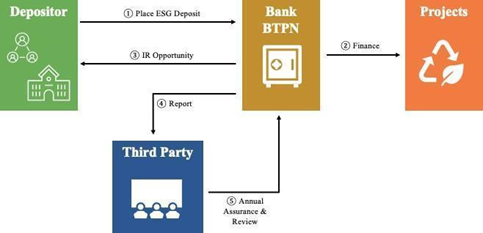
In Additionto the 6 (six) strategies outlined as recommendation in this paper, we also advocate for the development of an ESG-specific funding/deposit product, referred to as ESG Deposit, as one of the recommended offerings for Bank BTPN in the future. This product is envisioned as a key component of the future of banking, accessible to both the corporate and retail segments. However, similarly to Sharia funding and financing schemes, ensuring the directed flow of funds into ESG-specific loans (assets) requires substantial internal governance that needs extensive development.
Proposal for Management: Launching ESG Deposit
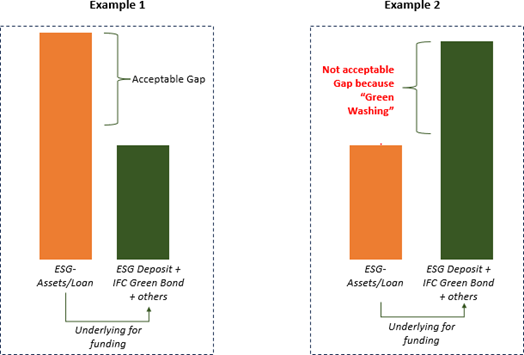
In light of the evolving landscape of ESG banking, we propose the introduction of an ESG-specific funding/deposit product, termed as the ESG Deposit, to solidify Bank BTPN's commitment to sustainable finance. This product, envisioned as a pivotal component of the future of banking, aims to cater to both corporate and retail segments, aligning with international ESG standards while adopting specific Indonesian definitions, including KKUB. To ensure the directed flow of funds into ESG-specific loans (assets), comprehensive internal governance mechanisms will be implemented. Regular third party opinion checks and validations of underlying assets will be conducted to prevent any gap between lower assets and higher deposits, mitigating the risk of greenwashing. Acceptable gaps between the bank's assets and ESG deposits, as perceived by customers, will be an integral aspect. In instances where the bank's assets are higher than ESG deposits, this gap is considered acceptable by customers of the ESG Deposit. Conversely, if the bank's assets are lower than ESG deposits, this may be viewed as greenwashing, potentially leading to concerns among customers. This underscores the importance of customers demanding accountability regarding ESG compliance, fostering transparency and trust. This strategic initiative positions Bank BTPN as a pioneer in the Indonesian banking sector, aligning with global ESG standards while addressing local nuances. (Illustration 7)
Illustration 7. Simulation of ESG Deposit Product
Proposal for Future Research: ESG Deposit Efficiency Method Study
Recognizing the underdeveloped nature of methods for delivering ESG funding products, not only in Indonesia but also internationally, this paper recommends a comprehensive study to identify the most efficient method for launching and managing the ESG Deposit. The research will delve into assessing the effectiveness of the proposed internal governance mechanisms, scrutinizing their ability to ensure the directed flow of funds into ESG-specific loans (assets). The study will also explore the challenges and opportunities associated with aligning the ESG Deposit with both international standards and Indonesian definitions, such as KKUB. Additionally, the research will investigate customer perceptions and demands regarding ESG compliance, considering the acceptable gap concept. Understanding the dynamics of acceptable gaps will contribute valuable insights to enhance the product's transparency and credibility. Through this research, Bank BTPN aims to contribute to the nascent field of ESG banking, shaping best practices and setting a benchmark for future sustainable financial initiatives. The underlying assets used to set the limit of deposits need to be regularly checked and validated because a gap between lower assets and higher deposits would be considered as greenwashing. In such cases, customers must demand accountability regarding ESG compliance of the product from the bank. The method to achieve this is still underdeveloped in the ESG market, not only in Indonesia but also internationally. This paper recommends a study to identify the most efficient method for delivering an ESG funding product for future academic study. (Illustration 8)
Illustration 8. Simulations of ESG Deposit Ideal vs Greenwashing
Conclusion
In addressing the framework question of strategizing monetization and communication to convey commitment to ESG principles and differentiate itself in the Indonesian market, Bank BTPN faces distinct challenges in responding to the competitive landscape, portfolio transition, and reputation building. As highlighted in the key questions, the bank's decision to cease coal, oil, gas, and soon automotive and steel financing, setting a target ahead of industry standards (2050 instead of 2060), and the need to elevate its ESG publication to match its merits present strategic imperatives. To counter the risk of a competitor gaining prominence through continued coal financing, Bank BTPN must leverage its commitment to ESG principles as a differentiator, emphasizing its proactive stance and encouraging other banks to follow suit. In navigating the portfolio transition challenge, the bank should uphold the strategies proposed earlier, considering differentiator tracking, and adopting a dual focus on cost and differentiator in negotiations. To bolster its reputation, Bank BTPN should intensify efforts in media channels and community engagement, aligning with the comprehensive ESG strategy outlined previously. In essence, by adhering to the 6 steps strategies proposed, Bank BTPN can assert itself as a leader in the evolving landscape of ESG banking, addressing each challenge strategically for sustainable success.
SMBC Group. "SMBC Group Strengthening Efforts Against Climate Change." (2023). https://www.smbc.co.jp/news_e/pdf/e20230515_02.pdf
PwC. "Indonesia's Sustainable Transformation." PwC, (2021), pp. 1-31.https://www.pwc.com/id/en/publications/esg/indonesia-sustainable-transformation.pdf
Park, Hyoungkun, and Jong Dae Kim. "Transition towards green banking: role of financial regulators and financial institutions." Asian Journal of Sustainability and Social Responsibility 5.1 (2020): 1-25.https://link.springer.com/article/10.1186/s41180-020-00034-3.
All papers should be submitted electronically. All submitted manuscripts must be original work that is not under submission at another journal or under consideration for publication in another form, such as a monograph or chapter of a book. Authors of submitted papers are obligated not to submit their paper for publication elsewhere until an editorial decision is rendered on their submission. Further, authors of accepted papers are prohibited from publishing the results in other publications that appear before the paper is published in the Journal unless they receive approval for doing so from the Editor-In-Chief.
Himalayan Journal of Economics and Business Management open access articles are licensed under a Creative Commons Attribution-Share A like 4.0 International License. This license lets the audience to give appropriate credit, provide a link to the license, and indicate if changes were made and if they remix, transform, or build upon the material, they must distribute contributions under the same license as the original.
Recommended Articles
Research Article
Influence of Leadership on Poverty Reduction in the Devolved Government in Trans-Nzoia County, Kenya
Kinisu Sifuna,
...
Peter Simotwo
Published: 30/06/2021
Download PDF
Cite
x
APA
Sifuna, K., Lwangale, D. W., Simotwo, P., Sifuna, K., Lwangale, D. W. & Simotwo, P. (2021). Influence of Leadership on Poverty Reduction in the Devolved Government in Trans-Nzoia County, Kenya. Himalayan Journal of Economics and Business Management, 2(1), None-None.
MLA
Sifuna, Kinisu, et al. "Influence of Leadership on Poverty Reduction in the Devolved Government in Trans-Nzoia County, Kenya." Himalayan Journal of Economics and Business Management 2.1 (2021): None-None.
Chicago
Sifuna, Kinisu, David W. Lwangale, Peter Simotwo, Kinisu Sifuna, David W. Lwangale and Peter Simotwo. "Influence of Leadership on Poverty Reduction in the Devolved Government in Trans-Nzoia County, Kenya." Himalayan Journal of Economics and Business Management 2, no. 1 (2021): None-None.
Harvard
Sifuna, K., Lwangale, D. W., Simotwo, P., Sifuna, K., Lwangale, D. W. and Simotwo, P. (2021) 'Influence of Leadership on Poverty Reduction in the Devolved Government in Trans-Nzoia County, Kenya' Himalayan Journal of Economics and Business Management 2(1), pp. None-None.
Vancouver
Sifuna K, Lwangale DW, Simotwo P, Sifuna K, Lwangale DW, Simotwo P. Influence of Leadership on Poverty Reduction in the Devolved Government in Trans-Nzoia County, Kenya. Himalayan Journal of Economics and Business Management. 2021 Jan;2(1):None-None.
Download PDF
Research Article
Modelling Structure Job Quality, Job Design and Job Satisfaction
Moch Nurhadi,
...
Avi Sunani
Published: 30/08/2022
Download PDF
Cite
x
APA
Nurhadi, M., Bisyri Effendi, M., Saiful Ulum, A. & Sunani, A. (2022). Modelling Structure Job Quality, Job Design and Job Satisfaction. Himalayan Journal of Economics and Business Management, 3(2), 1-4.
MLA
Nurhadi, Moch, et al. "Modelling Structure Job Quality, Job Design and Job Satisfaction." Himalayan Journal of Economics and Business Management 3.2 (2022): 1-4.
Chicago
Nurhadi, Moch, Moch Bisyri Effendi, Achmad Saiful Ulum and Avi Sunani. "Modelling Structure Job Quality, Job Design and Job Satisfaction." Himalayan Journal of Economics and Business Management 3, no. 2 (2022): 1-4.
Harvard
Nurhadi, M., Bisyri Effendi, M., Saiful Ulum, A. and Sunani, A. (2022) 'Modelling Structure Job Quality, Job Design and Job Satisfaction' Himalayan Journal of Economics and Business Management 3(2), pp. 1-4.
Vancouver
Nurhadi M, Bisyri Effendi M, Saiful Ulum A, Sunani A. Modelling Structure Job Quality, Job Design and Job Satisfaction. Himalayan Journal of Economics and Business Management. 2022 Jul;3(2):1-4.
Download PDF
Research Article
The Constitutional and Legislative Basis for Considering the Taxable Capacity of Taxpayers in Iraqi Tax Legislation
Hussein Kamel Wadaa
Published: 05/05/2025
Download PDF
Cite
x
APA
Wadaa, H. K. (2025). The Constitutional and Legislative Basis for Considering the Taxable Capacity of Taxpayers in Iraqi Tax Legislation. Himalayan Journal of Economics and Business Management, 6(1), 1-10.
MLA
Wadaa, Hussein Kamel. "The Constitutional and Legislative Basis for Considering the Taxable Capacity of Taxpayers in Iraqi Tax Legislation." Himalayan Journal of Economics and Business Management 6.1 (2025): 1-10.
Chicago
Wadaa, Hussein Kamel. "The Constitutional and Legislative Basis for Considering the Taxable Capacity of Taxpayers in Iraqi Tax Legislation." Himalayan Journal of Economics and Business Management 6, no. 1 (2025): 1-10.
Harvard
Wadaa, H. K. (2025) 'The Constitutional and Legislative Basis for Considering the Taxable Capacity of Taxpayers in Iraqi Tax Legislation' Himalayan Journal of Economics and Business Management 6(1), pp. 1-10.
Vancouver
Wadaa HK. The Constitutional and Legislative Basis for Considering the Taxable Capacity of Taxpayers in Iraqi Tax Legislation. Himalayan Journal of Economics and Business Management. 2025 Jan;6(1):1-10.
Download PDF
Research Article
Proposed Digital Marketing Strategy to Enhance Engineering Consultancy Company Revenue
Alfarisy, K. A.,
Wandebori, H.
Published: 30/04/2024
Download PDF
Cite
x
APA
K. A., A. & H., W. (2024). Proposed Digital Marketing Strategy to Enhance Engineering Consultancy Company Revenue. Himalayan Journal of Economics and Business Management, 5(1), 1-18.
MLA
K. A., Alfarisy, and Wandebori, H.. "Proposed Digital Marketing Strategy to Enhance Engineering Consultancy Company Revenue." Himalayan Journal of Economics and Business Management 5.1 (2024): 1-18.
Chicago
K. A., Alfarisy, and Wandebori, H.. "Proposed Digital Marketing Strategy to Enhance Engineering Consultancy Company Revenue." Himalayan Journal of Economics and Business Management 5, no. 1 (2024): 1-18.
Harvard
K. A., A. and H., W. (2024) 'Proposed Digital Marketing Strategy to Enhance Engineering Consultancy Company Revenue' Himalayan Journal of Economics and Business Management 5(1), pp. 1-18.
Vancouver
K. A. A, H. W. Proposed Digital Marketing Strategy to Enhance Engineering Consultancy Company Revenue. Himalayan Journal of Economics and Business Management. 2024 Jan;5(1):1-18.
None, E. N. & None, Y. A. (2024). Monetization Strategy Proposal for Environment, Social and Governance (ESG) Business for Bank BTPN. Himalayan Journal of Economics and Business Management, 5(1), 1-11.
MLA
None, Ershad N. and Yudo A. . "Monetization Strategy Proposal for Environment, Social and Governance (ESG) Business for Bank BTPN." Himalayan Journal of Economics and Business Management 5.1 (2024): 1-11.
Chicago
None, Ershad N. and Yudo A. . "Monetization Strategy Proposal for Environment, Social and Governance (ESG) Business for Bank BTPN." Himalayan Journal of Economics and Business Management 5, no. 1 (2024): 1-11.
Harvard
None, E. N. and None, Y. A. (2024) 'Monetization Strategy Proposal for Environment, Social and Governance (ESG) Business for Bank BTPN' Himalayan Journal of Economics and Business Management 5(1), pp. 1-11.
Vancouver
Ershad EN, Yudo YA. Monetization Strategy Proposal for Environment, Social and Governance (ESG) Business for Bank BTPN. Himalayan Journal of Economics and Business Management. 2024 Jan;5(1):1-11.



 Download PDF
 Download XML