Effect of Organizational Culture and Commitment Organization of Work Performance Through Job Satisfaction pt. Pertamina Pmarketing Operation Region ii South Sumatra
Berlian Indra Lesmana
1
,
Abdul Rivai
1
,
Iwan Kurniawan Subagja
1
1
Universitas Krisnadwipayana, Campus Unkris Jatiwaringin, PO BOX 7774/Jat CM, Jakarta 13077, Indonesia
This study aims to determine the effect of organizational culture and organizational commitment on employee performance simultaneously, determine the influence of organizational culture on employee performance partially, find out the impact of job satisfaction on employee performance partially, find out the influence of organizational culture on performance through job satisfaction and know the effect of organizational commitment on employee performance through job satisfaction variables. The study was conducted on PT. Pertamina Persero Marketing Operation Region II, South Sumatra. The sampling technique uses a random sample involving 73 employees. Data analysis uses path analysis. Based on data analysis, it is known that organizational culture variables and organizational commitment affect employee performance simultaneously. Organizational culture variables affect employee performance partially. Variable organizational commitment partially affect employee performance. The job satisfaction variable partially affects employee performance.
Keywords
Organizational Culture
Organizational Commitment
Job Satisfaction
Employee Performance
INTRODUCTION
A fast-growing company has a good organizational culture carried out by employees, company management, and stakeholders in a sustainable manner. The implementation of a good organizational culture following the wishes of employees and management will have an impact on company development.
Organizational culture is a value held by members of the organization, which will become a spirit in developing the organization. Waridin and Masrukhin [1] state that organizational culture is "a value system that is acquired and developed by the organization and the habit patterns and basic philosophy of its founders, formed into rules that are used as new thinking and acting in achieving organizational goals."
Koesmono [2] states that the organization affects employee performance, especially employees in the production division. The unit of analysis is production employees in the wood processing industry sub-sector in East Java. "Other results also affect motivation affects performance and organizational culture affects performance. Future researchers can use this study's results as research material in organizational behavior science or similar sciences.
Rashid A., Sambasivan, M and Johari, J. [3] also recognized that "culture affects employee performance. This research was conducted on several company employees in Malaysia. "Awadh and Saad [4] stated that" organizational culture affects employee performance. The research was conducted on several employees in Malaysia. "
Yusuf, Busu, Rashid, and Zulkifli [5] also researched by including organizational culture variables. "The results show that organizational culture affects the performance of employees who work at the company." Another factor that affects employee performance is an organizational commitment to Tobing's research, [6] states that "organizational commitment affects the performance of employees who work at a company.
Literature Review
Employee Performance: According to Siswanto [7], the definition of performance states that performance is "the quality and quantity of work achieved by a person in carrying out the tasks and jobs assigned to him." Rivai [8] says that "performance is a real behavior displayed by everyone as a work achievement produced by employees following their role in the company. The results of an employee's work or activities in quality and quantity in an organization to achieve goals in carrying out the tasks and jobs assigned to him. "
Measuring employee performance, according to Dharma [9] which is quoted from saying that almost all ways of measuring performance consider the following:
"Quantity is the amount that must be completed or achieved
Quality, namely the quality that must be produced (whether good or not)
The qualitative measurement of output reflects the measure or level of satisfaction, namely how well it is completed
Punctuality, which is whether or not it is according to the planned time.
Organizational Culture
Robbins [10] states that organizational culture is "a system of shared meanings within an organization that determines at a higher level how employees act." Organizational culture is a "value system that is believed by all organization members and is studied and applied and developed on an ongoing basis that functions as a whole system." Robbins [10] states: "organizational culture studies to a system of shared meaning held by members that distinguish the organization from other organizations. This system of shared meaning is. On closer analysis, a set of key characteristics that the organization value. "Furthermore, Robbins [10] argues that:" Organizational culture is the dominant values disseminated in organizations which are used as employee work philosophies which serve as guidelines for organizational policies in managing employees, and consumers.
Organizational culture is a series of values and norms that control organizational members' interaction with others and with pre-suppliers, consumers, and others outside the organization. Organizational culture consists of the organization's final states striving to achieve (terminal values) and encourages organization behavior (instrumental values). Ideally, instrumental value helps the organization reach its terminal goals. Different organizations have different cultures because they process different instrumental and terminal value arrangements.
Organizational culture has a broad meaning. According to Dessler [12], organizational culture is "a characteristic of the values, traditions, and behavior of employees in the company." According to Luthans [13], "organizational culture is the norms and values that direct behavior or organizational members. Each member will behave following the prevailing culture to be accepted by the environment. "
Schein in Luthans [13] defines "organizational culture as a pattern of basic assumptions that are found, created, or developed by a particular group with the intention that organizations learn to overcome or cope with problems that arise as a result of external adaptation and internal integration that has been going well enough, something needs to be taught to new members as the correct way to understand. Thinking and feeling pleased with these problems. " According to Robbin [10], a strong organizational culture is "a culture in which the core values of the organization are held intensively and widely shared by members of the organization."
Organizational Commitment
According to Robbins and Judge [11], organizational commitment is "a condition in which an employee siding with a particular organization and the goals and desires of maintaining membership in that organization." Thus, high job involvement means taking sides with an individual's particular job, while high organizational commitment means siding with the organization that recruits that individual.
Meanwhile, according to Moorhead and Griffin [14], organizational commitment is "an attitude that reflects the extent to which an individual knows and is bound to his organization." A highly committed individual is likely to see himself as a faithful member of the organization. Meanwhile, according to Kreitner and Kinicki [15], "that organizational commitment reflects the level at which a person recognizes an organization and is bound to its goals."
It can be concluded that organizational commitment is an individual psychological state that is related to strong belief, trust, and acceptance of the goals and values of the organization, a strong willingness to work for the organization, and the extent to which he wants to be a member of the organization.
Job Satisfaction
Job satisfaction is the level of pleasure that a person feels for his role or job in the organization. The level of individual satisfaction that they are rewarded in kind from various aspects of the organization's job situation where they work. Job satisfaction concerns the psychological individual in the organization caused by the state he feels from his environment.
Handoko [16] suggests that job satisfaction is "a pleasant or unpleasant emotional state with employees seeing their job. Time/duration of completion is a reflection of a person's feelings about his career. This can be seen from the positive attitude of employees towards work and everything in their environment. "
The level of job satisfaction is one factor that affects work performance because that ultimately affects organizational effectiveness. And also, employee job satisfaction is not enough to only be given incentives. Still, employees also need motivation, recognition from their superiors for their work results, a work situation that is not monotonous, and opportunities for initiative and creation. Resources consisting of human resources, facilities, infrastructure, and financing determine an organization's success to carry out its duties or operate appropriately in achieving its goals. The critical aspect that supports success is none other than the availability of adequate resources.
MATERIALS AND METHODS
Research Design
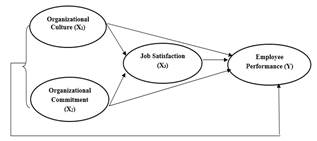
This study uses an explanatory analysis approach. This means that every variable presented in the hypothesis will be observed by testing the independent variable's causal relationship to the dependent variable. The relationship between variables can be described in the form of a path analysis diagram (Figure 1).
Figure 1: Overall, Path Analysis
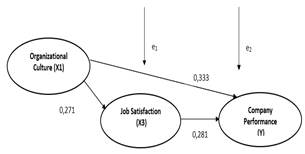
Figure 2. Path analysis of the influence of X1 on Y through X3
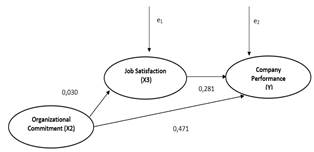
Figure 3: Path analysis of the influence of X2 on Y through X3
Object of Research
The research was conducted on employees of PT. Pertamina Persero Marketing Operation Region II South Sumatra.
Population and Sample
The population is "a generalization area consisting of objects/subjects that have a certain quantity and characteristics that are determined by the researcher to be studied and then conclude [17]." The sample is "attracting a portion of the population to represent the entire population [18].
The sample used in this study is the number of company mployees, as many as 275 people. The number of samples was taken with the formula Slovin = 275 / (1 + 275 x 0.12) = 73 people. This sample was taken using simple random sampling.
Research Results and Discussion
The Influence of Organizational Culture and Organizational Commitment on Employee Performance: The linear analysis model can be seen based on calculations using the SPSS program as follows.
Based on the Table 1 above, the simultaneous structural equation can be described as follows:
Y = 0,254X1 + 0,424X2
The calculated F value can be obtained from the Table 2. Based on the Table 2 above, it is known that the calculated F value is 13.907, and the significance is 0.05. This value is less than 0.05. This means that the variables of organizational culture and organizational commitment affect employee performance simultaneously. The magnitude of the influence of the independent variable on the dependent variable can be seen from the value of r squared as follows:
Based on the Table 3 above, it is known that the value of r squared is 28.4, meaning that the variable organizational culture and organizational commitment affect employee performance by 28.4. Simultaneously, the rest is influenced by other variables that are not included in the equation model.
Partial Analysis of the Influence of Organizational Culture on Employee Performance
The results of the partial analysis of the influence of organizational culture on performance can be seen in the Table 4.
The structural equation from the data above can be seen as follows:
Y = 0,333X1
Based on the analysis result Table 4 above, it is known that the coefficient of organizational culture is 0.333. The t value is 2,975. The significance value is 0.00. This significance value is smaller than 0.05. This means that the variable organizational culture partially affects employee performance. The magnitude of the influence of organizational culture on employee performance can be seen in the Table 5:
Based on the Table 5 above, it is known that the value of r squared is 0.111. This means that the influence of the organizational culture variable on employee performance is 11.1% and the rest is influenced by other variables that are not included in the equation model.
Partial Analysis of the Effect of Organizational Commitment on Employee Performance
The results of the partial impact analysis of organizational commitment on performance can be seen in the table 6.
The structural equation from the data above (Table 6) can be seen as follows:
Y = 0,471X2
Based on the analysis Table 6 above, it is known that the coefficient of organizational commitment is 0.471.
Table 1: The Results of the First Equation Analysis Coefficientsa
Variables
Unstandardized Coefficients
Standardized Coefficients
-
-
Model
B
Std. Error
Beta
t
Sig.
1 (Constant)
25,516
3,577
-
7,123
0,000
Organizational_Culture
0,314
0,127
0,254
2,471
0,016
Organizational_Commitment
0,544
0,132
0,424
4,120
0,000
Note: a. Dependent Variable: Employee_Performance
Table 2: F-Value of the Simultaneous Equation Anovaa
Table 3: The Value of R Squared of the First Regression Model Model Summary
Model
R
R. Square
Adjusted R Square
Std. Error of the Estimate
1
0,533*
0,284
0,264
4,53425
Note: a. Predictors: (Constant), Organizational_Commitment, Organizational_Culture
Table 4: Results of the Second Equation Analysis Coefficientsa
Variables
Unstandardized Coefficients
Standardized Coefficients
-
-
Model
B
Std. Error
Beta
t
Sig.
1(Constant)
31,332
3,638
8,612
0,000
Organizational_Commitment
0,411
0,136
0,333
2,976
0,004
Note: a. Dependent Variable: Employee_Performance
Table 5: The Value of R Squared of the Second Equation Model Summary
Model
R
R. Square
Adjusted R Square
Std. Error of the Estimate
1
0,333a
0,111
0,098
5,01837
Note: a. Predictors: (Constant), Organizational_Culture
Table 6: Results of the Analysis of the Third Regression Equation Coefficientsa
Variables
Unstandardized Coefficients
Standardized Coefficients
-
-
Model
B
Std. Error
Beta
t
Sig.
1 (Constant)
32,743
2,132
15,358
,000
Organizational_Commitment
0,604
0,134
0,471
4,500
,000
Note: a. Dependent Variable: Employee_Performance
Table 7: The Value of R Squared of the Third Equation Model Summary
Model
R
R. Square
Adjusted R Square
Std. Error of the Estimate
1
,471a
,222
,211
4,69440
Note: a. Predictors: (Constant), Organizational_Culture
Table 8: Results of the Fourth Regression Equation Analysis Coefficientsa
Variables
Unstandardized Coefficients
Standardized Coefficients
Model
B
Std. Error
Beta
t
Sig.
1 (Constant)
35,460
2,727
13,001
,000
Job_Satisfaction
,297
,121
,281
2,463
,016
Note: a. Dependent Variable: Employee_Performance
Table 9: The Value of R Squared of the Fourth Equation Model Summary
Model
R
R. Square
Adjusted R Square
Std. Error of the Estimate
1
,281a
,079
,066
5,10831
Note: a. Predictors: (Constant), Organizational_Culture
Table 10: The Influence of Organizational Culture on Job Satisfaction Coefficientsa
Unstandardized Coefficients
Standardized Coefficients
Model
B
Std. Error
Beta
t
Sig.
1 (Constant)
13,868
3,509
3,952
,000
Organizational_Culture
,316
,133
,271
2,368
,021
Note: a. Dependent Variable: Job_Satisfaction
Table 11: The Coefficient Value of the Influence of Organizational Commitment on Job Satisfaction Coefficientsa
Unstandardized Coefficients
Standardized Coefficients
Model
B
Std. Error
Beta
t
Sig.
1 (Constant)
21,513
2,282
9,426
,000
Organizational_Commitment
,036
,144
,030
,252
,002
Note: a. Dependent Variable: Job_Satisfaction
value is 4,500. The significance value is 0.00. This significance value is smaller than 0.05. This means that the variable organizational commitment partially affects employee performance. The amount of influence of organizational commitment on employee performance can be seen in the table 7.
Based on the Table 7 above, it is known that the value of r squared is 0.222. This means that the influence of the organizational commitment variable on employee performance is 22.2% and the rest is influenced by other variables that are not included in the equation model.
Analysis of the Effect of Job Satisfaction on Employee Performance Partially
The results of the partial analysis of the effect of job satisfaction on performance can be seen in the table 8.
The structural equation from the data above can be seen as follows:
Y = 0,281X3
Based on the analysis result Table 8 above, it is known that the job satisfaction coefficient is 0.281. The t value is 2.463. The significance value is 0.00. This significance value is smaller than 0.05. This means that the job satisfaction variable partially affects employee performance. The magnitude of the influence of job satisfaction on employee performance can be seen in the following table:
Based on the Table 9 above, it is known that the value of r squared is 0.079. This means that the influence of the job satisfaction variable on employee performance is 7.9% and the rest is influenced by other variables that are not included in the equation model.
Analysis of the Influence of Organizational Culture on Employee Performance through Job Satisfaction Variables
Based on the partial path analysis above, it can be described as follows. The analysis is an analysis on a path with a substructure image (Figure 2).
The coefficient of the influence of organizational culture on job satisfaction can be seen in the Table 10:
Based on the picture above, it can be seen that the influence of organizational culture on employee performance is 0.333. The impact of organizational culture on employee performance through job satisfaction is 0.271 x 0.281 = 0.076. In this case, the direct effect is greater than the indirect effect, so it can be said that the job satisfaction variable is not intervening.
Analysis of the Effect of Organizational Commitment on Employee Performance through Job Satisfaction Variables
Based on the partial path analysis above, it can be described as follows. The analysis is an analysis on a path with a substructure image (Figure 3) as follows:
The coefficient value of organizational commitment to job satisfaction can be seen in the Table 11:
Based on the picture above, it can be seen that the direct effect of job pressure on employee performance is 0.471. In comparison, organizational commitment on employee performance through job satisfaction is 0.030 x 0.281 = 0.008. In this case the direct effect is greater than the indirect effect, so it can be said that the job satisfaction variable is not intervening.
CONCLUSION
The variables of organizational culture and organizational commitment affect employee performance simultaneously. The calculated F value is 13.907 and the significance is 0.05. This value is less than 0.05. The value of r squared is 28.4%, which means that the variable organizational culture and organizational commitment affect employee performance by 28.4%. The rest is influenced by other variables that are not included in the equation model.
Variable organizational culture partially affects employee performance. The t value is 2,975. The significance value is 0.00. This significance value is smaller than 0.05. The value of r squared is 0.111. This means that the influence of the organizational culture variable on employee performance is 11.1%, and the rest is influenced by other variables that are not included in the equation model.
Organizational commitment variable partially affects employee performance. The t value is 4,500. The significance value is 0.00. This significance value is smaller than 0.05. The value of r squared is 0.222. This means that the influence of the organizational commitment variable on employee performance is 22.2% and the rest is influenced by other variables that are not included in the equation model.
Job satisfaction variables partially affect employee performance. The t value is 2.463. The significance value is 0.00. This significance value is smaller than 0.05. The value of r squared is 0.079. This means that the influence of the organizational commitment variable on employee performance is 7.9% and the rest is influenced by other variables that are not included in the equation model.
The influence of organizational culture on employee performance is 0.333. The influence of organizational culture on employee performance through job satisfaction is 0.271 x 0.281 = 0.076. In this case the direct effect is greater than the indirect effect, so it can be said that the job satisfaction variable is not intervening.
The direct effect of worker pressure on job performance is 0.471. While the impact of organizational commitment on employee performance through job satisfaction is 0.030 x 0.281 = 0.008. In this case the direct effect is greater than the indirect effect, so it can be said that the job satisfaction variable is not intervening.
Suggestions
Implementation of the correct organizational culture can improve employee performance at work. Therefore, this culture must be considered in the organization. This is done by appreciating and practicing the culture that applies to the organization and raising awareness of employee attitudes in understanding the organizational culture.
Organizational commitment also needs to be developed. Employees who have a high organizational commitment to the organization need to be appreciated both in awards and in other forms. This will allow other employees to participate in increasing their organization's commitment to the workplace.
Job satisfaction also needs to be improved so that employee performance can be better. Increasing job satisfaction can be done by meeting employees' needs for the income or salary given, giving awards to employees who excel, and increasing communication improvements in the organization.
REFERENCE
Amsyah, Zulkifli. Manajemen Sistem Informasi. PT Gramedia Pustaka Utama, 2005.
Awadh, A.M. "Impact of Organizational Culture on Employee Performance." International Review of Management and Business Research, vol. 2, no. 1, 2013, University Technology Malaysia.
Sastrohadiwiryo, B.S. Manajemen Tenaga Kerja Indonesia. 2nd ed., PT Bumi Aksara, 2003.
Basri, A.F.M. and Rivai, V. Performance Appraisal. PT Raja Grafindo Persada, 2005.
Dessler, Gary. Human Resources Management. 8th ed., Prentice Hall International, 2008.
Dharma, Surya. Manajemen Kinerja: Falsafah, Teori dan Penerapannya. Pustaka Pelajar, 2009.
Koesmono, T. "Pengaruh Budaya Organisasi Terhadap Motivasi dan Kepuasan Kerja serta Kinerja Karyawan pada Sub Sektor Industri Pengolahan Kayu Skala Menengah di Jawa Timur." Jurnal Manajemen dan Kewirausahaan, vol. 7, no. 2, 2012, pp. 171–188.
Masrukhin, and Waridin. "Pengaruh Motivasi Kerja, Kepuasan Kerja, Budaya Organisasi dan Kepemimpinan terhadap Kinerja Pegawai." Jurnal Ekonomi & Bisnis, vol. 7, no. 2, 2006.
MohdYusuff, Rosnah, et al. "Influence of Organizational Culture on Company Performance." 9th Global Congress on Manufacturing and Management (GCMM 2008), 12–14 Nov. 2008, Gold Coast, Australia.
Moorhead, Gregory, and RickyW.Griffin. Perilaku Organisasi. Salemba Empat, 2013.
Robbins, StephenP., and Mary Coulter. Manajemen. 10th ed., vol. 1–2, Penerbit Erlangga, 2010.
Rashid, M.Z.A.R., et al. "The Influence of Corporate Culture and Organisational Commitment on Performance." Journal of Management Development, vol. 22, no. 8, 2003, pp. 708–728.
Robbins, StephenP. and TimothyA.Judge. Organizational Behaviour. Pearson Education, 2008.
Sugiyono. Metode Penelitian Manajemen. Alfabeta, 2013.
Handoko, T.Hani. Manajemen Personalia dan Sumberdaya Manusia. Penerbit BPFE, 2004.
Tobing, Diana. "Pengaruh Komitmen Organisasional dan Kepuasan Kerja terhadap Kinerja Karyawan PT Perkebunan Nusantara III di Sumatera Utara." 2016.
All papers should be submitted electronically. All submitted manuscripts must be original work that is not under submission at another journal or under consideration for publication in another form, such as a monograph or chapter of a book. Authors of submitted papers are obligated not to submit their paper for publication elsewhere until an editorial decision is rendered on their submission. Further, authors of accepted papers are prohibited from publishing the results in other publications that appear before the paper is published in the Journal unless they receive approval for doing so from the Editor-In-Chief.
Himalayan Journal of Economics and Business Management open access articles are licensed under a Creative Commons Attribution-Share A like 4.0 International License. This license lets the audience to give appropriate credit, provide a link to the license, and indicate if changes were made and if they remix, transform, or build upon the material, they must distribute contributions under the same license as the original.
Recommended Articles
Research Article
Influence of Leadership on Poverty Reduction in the Devolved Government in Trans-Nzoia County, Kenya
Kinisu Sifuna,
...
Peter Simotwo
Published: 30/06/2021
Download PDF
Cite
x
APA
Sifuna, K., Lwangale, D. W., Simotwo, P., Sifuna, K., Lwangale, D. W. & Simotwo, P. (2021). Influence of Leadership on Poverty Reduction in the Devolved Government in Trans-Nzoia County, Kenya. Himalayan Journal of Economics and Business Management, 2(1), None-None.
MLA
Sifuna, Kinisu, et al. "Influence of Leadership on Poverty Reduction in the Devolved Government in Trans-Nzoia County, Kenya." Himalayan Journal of Economics and Business Management 2.1 (2021): None-None.
Chicago
Sifuna, Kinisu, David W. Lwangale, Peter Simotwo, Kinisu Sifuna, David W. Lwangale and Peter Simotwo. "Influence of Leadership on Poverty Reduction in the Devolved Government in Trans-Nzoia County, Kenya." Himalayan Journal of Economics and Business Management 2, no. 1 (2021): None-None.
Harvard
Sifuna, K., Lwangale, D. W., Simotwo, P., Sifuna, K., Lwangale, D. W. and Simotwo, P. (2021) 'Influence of Leadership on Poverty Reduction in the Devolved Government in Trans-Nzoia County, Kenya' Himalayan Journal of Economics and Business Management 2(1), pp. None-None.
Vancouver
Sifuna K, Lwangale DW, Simotwo P, Sifuna K, Lwangale DW, Simotwo P. Influence of Leadership on Poverty Reduction in the Devolved Government in Trans-Nzoia County, Kenya. Himalayan Journal of Economics and Business Management. 2021 Jan;2(1):None-None.
Download PDF
Research Article
Modelling Structure Job Quality, Job Design and Job Satisfaction
Moch Nurhadi,
...
Avi Sunani
Published: 30/08/2022
Download PDF
Cite
x
APA
Nurhadi, M., Bisyri Effendi, M., Saiful Ulum, A. & Sunani, A. (2022). Modelling Structure Job Quality, Job Design and Job Satisfaction. Himalayan Journal of Economics and Business Management, 3(2), 1-4.
MLA
Nurhadi, Moch, et al. "Modelling Structure Job Quality, Job Design and Job Satisfaction." Himalayan Journal of Economics and Business Management 3.2 (2022): 1-4.
Chicago
Nurhadi, Moch, Moch Bisyri Effendi, Achmad Saiful Ulum and Avi Sunani. "Modelling Structure Job Quality, Job Design and Job Satisfaction." Himalayan Journal of Economics and Business Management 3, no. 2 (2022): 1-4.
Harvard
Nurhadi, M., Bisyri Effendi, M., Saiful Ulum, A. and Sunani, A. (2022) 'Modelling Structure Job Quality, Job Design and Job Satisfaction' Himalayan Journal of Economics and Business Management 3(2), pp. 1-4.
Vancouver
Nurhadi M, Bisyri Effendi M, Saiful Ulum A, Sunani A. Modelling Structure Job Quality, Job Design and Job Satisfaction. Himalayan Journal of Economics and Business Management. 2022 Jul;3(2):1-4.
Download PDF
Research Article
The Constitutional and Legislative Basis for Considering the Taxable Capacity of Taxpayers in Iraqi Tax Legislation
Hussein Kamel Wadaa
Published: 05/05/2025
Download PDF
Cite
x
APA
Wadaa, H. K. (2025). The Constitutional and Legislative Basis for Considering the Taxable Capacity of Taxpayers in Iraqi Tax Legislation. Himalayan Journal of Economics and Business Management, 6(1), 1-10.
MLA
Wadaa, Hussein Kamel. "The Constitutional and Legislative Basis for Considering the Taxable Capacity of Taxpayers in Iraqi Tax Legislation." Himalayan Journal of Economics and Business Management 6.1 (2025): 1-10.
Chicago
Wadaa, Hussein Kamel. "The Constitutional and Legislative Basis for Considering the Taxable Capacity of Taxpayers in Iraqi Tax Legislation." Himalayan Journal of Economics and Business Management 6, no. 1 (2025): 1-10.
Harvard
Wadaa, H. K. (2025) 'The Constitutional and Legislative Basis for Considering the Taxable Capacity of Taxpayers in Iraqi Tax Legislation' Himalayan Journal of Economics and Business Management 6(1), pp. 1-10.
Vancouver
Wadaa HK. The Constitutional and Legislative Basis for Considering the Taxable Capacity of Taxpayers in Iraqi Tax Legislation. Himalayan Journal of Economics and Business Management. 2025 Jan;6(1):1-10.
Download PDF
Research Article
Proposed Digital Marketing Strategy to Enhance Engineering Consultancy Company Revenue
Alfarisy, K. A.,
Wandebori, H.
Published: 30/04/2024
Download PDF
Cite
x
APA
K. A., A. & H., W. (2024). Proposed Digital Marketing Strategy to Enhance Engineering Consultancy Company Revenue. Himalayan Journal of Economics and Business Management, 5(1), 1-18.
MLA
K. A., Alfarisy, and Wandebori, H.. "Proposed Digital Marketing Strategy to Enhance Engineering Consultancy Company Revenue." Himalayan Journal of Economics and Business Management 5.1 (2024): 1-18.
Chicago
K. A., Alfarisy, and Wandebori, H.. "Proposed Digital Marketing Strategy to Enhance Engineering Consultancy Company Revenue." Himalayan Journal of Economics and Business Management 5, no. 1 (2024): 1-18.
Harvard
K. A., A. and H., W. (2024) 'Proposed Digital Marketing Strategy to Enhance Engineering Consultancy Company Revenue' Himalayan Journal of Economics and Business Management 5(1), pp. 1-18.
Vancouver
K. A. A, H. W. Proposed Digital Marketing Strategy to Enhance Engineering Consultancy Company Revenue. Himalayan Journal of Economics and Business Management. 2024 Jan;5(1):1-18.
Lesmana, B. I., Rivai, A. & Subagja, I. K. (2020). Effect of Organizational Culture and Commitment Organization of Work Performance Through Job Satisfaction pt. Pertamina Pmarketing Operation Region ii South Sumatra. Himalayan Journal of Economics and Business Management, 1(1), 1-6.
MLA
Lesmana, Berlian I., Abdul Rivai and Iwan K. Subagja. "Effect of Organizational Culture and Commitment Organization of Work Performance Through Job Satisfaction pt. Pertamina Pmarketing Operation Region ii South Sumatra." Himalayan Journal of Economics and Business Management 1.1 (2020): 1-6.
Chicago
Lesmana, Berlian I., Abdul Rivai and Iwan K. Subagja. "Effect of Organizational Culture and Commitment Organization of Work Performance Through Job Satisfaction pt. Pertamina Pmarketing Operation Region ii South Sumatra." Himalayan Journal of Economics and Business Management 1, no. 1 (2020): 1-6.
Harvard
Lesmana, B. I., Rivai, A. and Subagja, I. K. (2020) 'Effect of Organizational Culture and Commitment Organization of Work Performance Through Job Satisfaction pt. Pertamina Pmarketing Operation Region ii South Sumatra' Himalayan Journal of Economics and Business Management 1(1), pp. 1-6.
Vancouver
Lesmana BI, Rivai A, Subagja IK. Effect of Organizational Culture and Commitment Organization of Work Performance Through Job Satisfaction pt. Pertamina Pmarketing Operation Region ii South Sumatra. Himalayan Journal of Economics and Business Management. 2020 Jul;1(1):1-6.


 Download PDF
 Download XML