Contents
Download PDF
pdf Download XML
2901 Views
224 Downloads
Share this article
Research Article | Volume 3 Issue 1 (Jan-June, 2022) | Pages 1 - 4
Business Model Education during COVID-19 Pandemic for Fitness Service Providers
 ,
 ,
 ,
 ,
 ,
 ,
 ,
1
Institut Teknologi Bandung, Indonesia
2
Universitas Pendidikan Indonesia, Indonesia
Under a Creative Commons license
Open Access
Received
Dec. 6, 2021
Revised
Jan. 4, 2022
Accepted
Feb. 28, 2022
Published
March 20, 2022
Abstract

The COVID-19 pandemic has hurt all economic sectors, especially physical services and fitness services are one of the affected. A solution is needed to solve the problems faced by fitness service providers; this community service activity is intended to help fitness service providers to get a business model that is per the conditions of the covid-19 pandemic. This research made three program arrangements to get the business model formulation: an educational webinar, a Group Discussion Forum and a workshop. The three activities succeeded in producing an adaptive business model module based on the views of practitioners, academics and observers. Thus, it is hoped that this business model can help fitness service providers to get out of more considerable losses.

Keywords
INTRODUCTION

The COVID-19 pandemic has become a significant obstacle to the economy in 2020. The pandemic has stopped various activities that require a direct human touch. Various services that require direct services are experiencing difficulties, such as dentists, dermatologists, music teachers and fitness trainers. Before the pandemic, all these services were always carried out directly. It was never imagined before how to perform services virtually. However, the existence of a pandemic made all aspects into adaptation. Adaptation is essential because COVID-19 cannot be predicted when controlled. Even some experts say that Covid-19 will become endemic.


The magnitude of the impact of the pandemic on all elements has led to numerous publications related to COVID-19, some of which discuss its effects on the economy. At the pandemic's beginning, all academics and practitioners were still studying how the virus spread, which led some people to speculate on implementing health protocols. Finally, some countries chose to implement a lockdown on all non-essential elements [1]. condition makes other elements of the economy that are engaged in essential sectors slump. Businesspeople experience stuttering in crisis management. New habits carried out by the community generate new needs and business opportunities, which has made several economic sectors falter, including the sports industry [2].


Everyone is trying to avoid the risk of being exposed to COVID-19. Apart from obeying the prokes, many people are looking for other ways to prevent the risk from consuming healthy and nutritious food to exercising. Research shows that light and moderate-intensity exercise improves immunity [3,4]. In addition, people who exercise regularly are less likely to be exposed to it than those who rarely exercise [5]. However, not many have literacy about excellent and safe exercise; therefore, some people still need help and assistance from fitness service providers. On the other hand, fitness service providers are still adapting to adjust how safe exercise methods are to marketing methods. So it is necessary to adapt the business model to make fitness services still able to reach the community and continue.


Business model adaptation is needed considering the many changes in behavior, habits and community needs [6]. Innovation and the entrepreneurial world are one unit, so entrepreneurs must immediately look for innovations when a pandemic occurs, including entrepreneurs or fitness service providers. Collaboration with multi-disciplines is needed, from economists, business management, public health, sports, epidemiology and medicine. With this collaboration, a researcher will find views to solve fitness business problems [7]. Previous crises such as the Global Financial Crisis in 2008 and the Great Depression of the 1930s had severe economic effects resulting in social change. However, they did not affect the sports industry like the current covid-19 crisis. Other crises, including the September 11 terrorist attacks, the Gulf War and the World War, were the result of political wars and had more economic effects than the cancellation of sporting events and the closure of sports facilities due to the social distancing requirements of the covid-19 crisis [8]. Thus, the COVID-19 crisis is likely to surpass other crises affecting the sports industry as it becomes a health pandemic resulting in economic and social turmoil. Given the need for a rapid understanding of how sports entrepreneurship can help alleviate the problems of the covid-19 crisis, this paper aims to answer the following research question: "How do sports companies create value through the entrepreneurial ecosystem of the covid-19 crisis". The following section will further detail this paper's conceptual and theoretical underpinnings based on sports entrepreneurship and shared value theory. This condition will be realized if there is a collaboration of thoughts, discussions and ideas from various multi-disciplines.


On the other hand, exercise can improve fitness which ultimately affects the body's immune level. The American College of Sports Medicine (ACSM) recommends that 30 minutes of moderate-intensity exercise (65% of maximum pulse rate) should be done three to five times a week, this record will be more optimally achieved if accompanied by the coach, where the trainer is included in the sports industry in the field of fitness service providers.


In Indonesia, especially fitness service providers, there has been an increase in line with public awareness to improve fitness and maintain their health in the last five years before the pandemic. Fitness services such as running coaches, fitness trainers and individual sports coaches have also experienced an increase in interest from the public. The various obstacles that have arisen due to COVID-19 have found a solution for fitness service providers by providing a choice of business models based on case studies among fitness service providers. On the other hand, the attention of financial and business stakeholders is still not much attention to the sector of fitness service providers. Therefore, this community service is carried out to answer the needs of fitness service providers to continue in a healthy business despite the limited conditions caused by the pandemic.

MATERIALS AND METHODS

Participants or partners in this community service are fitness service providers located in West Java, with at least two years of experience in training or managing fitness services. Participants or partners join the event by socializing through associations of fitness service providers in various regencies and cities in the West Java region.


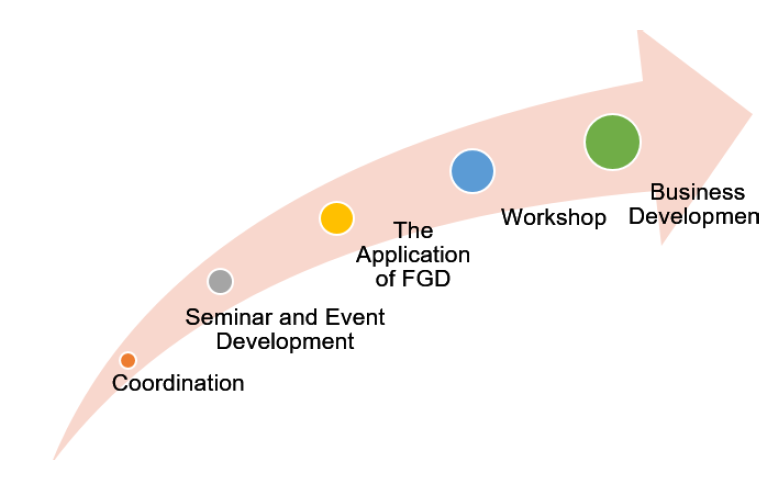
A new business model education is needed for fitness service providers to answer the problems faced by the fitness provider. Education will be carried out in three stages: webinars, FGDs and module socialization. The webinar was created to provide an overview of global economic conditions in the pandemic era. Three hundred fifty participants attended the webinar. The webinar was attended by resource persons with academic backgrounds, practitioners and community leaders. Then two weeks after that, a virtual Forum Group Discussion (FGD) was held to find out what problems partners experienced during the pandemic and what partners experienced opportunities during the pandemic. During the FGDs, accompanied by academics as FGD formulators, there is a Key Opinion Leader (KOL) who aims to lead the conversation so that it is following the objectives of the FGD. The KOL consists of 2 people from practitioners who have rich experience in obstacles and opportunities. The results of the FGD, which 57 people attended, were immediately formulated in the form of a business model, which was made in the form of a module to the participants after one month of the FGD activity. In addition, there is assistance in implementing the module for three months.


This activity aims to educate fitness service providers in West Java to develop a business model during the pandemic. The implementation of the community service program is targeted to help the economic recovery of the sports industry during the adaptation period to new habits and after. In addition to economic factors, it is hoped to help reduce the risk of exposure to COVID-19 through increased immunity obtained from regular, measured and safe exercise (Figure 1).


The impact of this program is expected to be able to stimulate the sports industry, especially those engaged in fitness services in West Java, to be more creative and enthusiastic about restoring the wheels of the economy during the adaptation period of new habits. Furthermore, the participants will be followed up to conduct coaching and development of the fitness service business for three months. Communication is carried out regularly once a week to see progress and overcome obstacles experienced by participants.


Figure 1: Research Problem Solving Steps

RESULTS AND DISCUSSION

In three series of educational events, the result was a business model module for fitness service providers to minimize losses caused by movement restrictions due to COVID-19. From the FGD, several common problems were found, namely efforts to convince prospective clients that fitness service providers are safe to accompany prospective clients to exercise, safe in this case, is safe from the risk of exposure to COVID-19. Another obstacle is the training ground that makes clients feel safe from the risk of the Covid-19 virus. In addition, the obstacle that participants often complain about is the orientation of clients and prospective clients during a pandemic is setting aside money for savings. In other words, the budget for exercising is no longer a priority. This issue makes clients stop and prospective clients do not want to use fitness service providers.


Obstacles arose because the rules regarding quarantine and health protocols issued by the government had changed, as for some misguided information that appeared on social media. This issue has increasingly raised people's doubts about starting sports and seeking assistance to exercise. In addition, the recommendation to exercise appropriately and safely has not been massively disseminated. However, entering 2021, the health protocol has begun to be understood and implemented by the community. The socialization of the importance of exercise to maintain health has often been given to the public.


During the discussion, there were not only a few complaints but also opportunities felt and implemented by fitness service providers, one of which was taking advantage of digitalization, which has been accelerated drastically by the pandemic. The digitization is made in attractive online classes, friendly and easy online consultations and relatively cheaper classes. This solution can be done because during the pandemic, the use of online meeting applications increased and the habit of the community became more widespread towards the use of these applications. The most used applications are zoom along with google meets. Zoom has better exclusivity because zoom has a time limit and the number of people for non-premium users. The use of other digital products is through Instagram, either in the Instagram Story feature or through Live Instagram. Instagram is easier to access and use by everyone because Instagram has been famous longer than Zoom and Google Meets. Besides that, Instagram is the most popular application used by the people of Indonesia [9]. Instagram is mainly used as a means of promotion, education and consultation with the general public, in contrast to Zoom, which is more private.


The existence of interaction with the community makes people's interest in using services increase. Therefore, several KOLs suggest creating more interactive educational content with the community. In addition to increasing public awareness of sports, another benefit is to build self-image and reputation [10,11].


From the webinar, a participant satisfaction questionnaire was conducted on the material provided by the resource persons, resulting in 82.7% of participants understanding well the material provided by the resource person. Furthermore, during the FGD, a satisfaction questionnaire was conducted to the participants, which showed that 92.1% of the participants were satisfied with the online FGD method. The participants' satisfaction during the FGD succeeded in bringing the discussion in a conducive and appropriate condition that was expected to explore all the problems and opportunities that arose. Finally, the making of the module is given to the participants or partners by producing guidelines for implementing business models for fitness service providers based on discussions about problems and opportunities from practitioners, academics, to policymakers.


Further than that, this activity is expected to increase public awareness of the participation rate in sports. The Sports Community Participation Rate (APMO) from 2017 to 2020 continues to increase, from 40% to now reaching 59% of the people of West Java who actively participate in sports. This activity is an illustration that people are increasingly concerned about sports. This action has resulted in a significant increase in the sports industry, especially in fitness service providers. The fitness service providers are divided into two large groups, groups of fitness studio owners and private groups at home or exercise sites. Private groups are experiencing a rapid increase due to the increase in people's busyness and the increasingly high level of congestion makes people prefer to exercise in private in a place that can be determined.


The existence of public awareness coupled with the availability of services in the community is a combination of demand and supply that will positively impact community participation in sports. Sport in Indonesia has been mandated in Law Number 3 of 2005 concerning the National Sports System. In the law, at least four types of sports need to be implemented in the community, such as educational sports, achievement sports and recreational sports. Nevertheless, in the process of developing the world of sports in Indonesia, in the last three years on every National Sports Day, the Ministry of Youth and Sports (KEMENPORA) hopes that sports tourism and the sports industry are more active because they are part of the modernization of the sports world.


If so far, the Indonesian National Sports Committee (KONI), as an organization mandated by the National Sports System Law Number 3 of 2005 as an organization responsible for sports achievements, has found it difficult because community activity towards sports is still low. This action makes the supply to sports performance minimal. 


So, to create a good sports ecosystem, it is necessary to collaborate with various elements, such as elements of the industry, community sports, achievement sports, educational sports and recreational sports. These five elements will help each other to create a better culture. For example, a good sports industry will stimulate people to be more active, which will have an impact on achievement sports and better recreation. Because all these elements are interrelated, even if one element decreases, it will affect the other four elements. So there needs to be a joint commitment from various elements to promote a better Indonesian sports culture.


The rapid development of the sports industry experienced a decline when a pandemic emerged, especially the industry in the fitness service sector that requires direct physical contact. Creativity is needed for sports industry activists in dealing with the pandemic, among others, to increase consumer confidence such as virtual sports, improving exercise procedures, to promotional methods that emphasize hygiene and health insurance. The high risk of exposure if close physical contact is the most crucial factor for this business.


This event contributes to the birth of a choice of new business methods obtained based on the problems experienced by trainers or fitness service managers so that practitioners can adjust to the obstacles experienced by each to minimize losses and the economy will bounce back soon. From the enthusiasm and impact given to the community, it is substantial. The author will carry out a broader scope, such as duplicating the program to the scope of the sports tourism industry activists, a specific example located in the Mandalika International Circuit, Lombok, West Nusa Tenggara area. It is hoped that it will further increase the economic passion of sports tourism, which has been highlighted thanks to the Mandalika International Circuit. Besides that, the program has fulfilled the Great National Sports Design (DBON) mandate.


The existence of a series of activities makes the author and his team more aware of the community's need for knowledge in higher education to be more easily implemented by the community. Thus, the community service program in the future can be a bridge between research in universities and the community's needs.

CONCLUSION

The goal to help fitness service providers get out of the variety of business risks caused by activity restrictions during the covid-19 pandemic can be solved with a new business model module that is filtered based on various activities ranging from webinars FGDs, which finally conclude a module. Activities are expected to be duplicated in a broader context and impact to improve the community's benefits.


Acknowledgment

Our gratitude goes to LPPM ITB, which has funded the implementation of the community service program for fitness service providers.


REFERENCES
  1. Ratten, V. “Coronavirus (COVID-19) and Entrepreneurship: Changing Life and Work Landscape.” Journal of Small Business and Entrepreneurship, vol. 32, no. 5, 2020, pp. 503–516. https://doi.org/10.1080/08276331.2020.1790167

  2. Kraus, S. et al. “The economics of COVID-19: Initial empirical evidence on how family firms in five European countries cope with the corona crisis.” International Journal of Entrepreneurial Behaviour and Research, vol. 26, no. 5, 2020, pp. 1067–1092. https://doi.org/10.1108/IJEBR-04-2020-0214

  3. Chesnut, W.M.  et al. “Could diet and exercise reduce risk of COVID-19 Syndemic?” Medical Hypotheses, vol. 148, Jan. 2021, pp. 2020–2022. https://doi.org/10.1016/j.mehy.2021.110502

  4. Ranasinghe, C. et al. “Exercise and Well-Being during COVID-19: Time to Boost Your Immunity.” Expert Review of Anti-Infective Therapy, vol. 18, no. 12, 2020, pp. 1195–1200. https://doi.org/10.1080/14787210.2020.1794818

  5. Yeo, T.J. “Sport and exercise during and beyond the COVID-19 pandemic.” European Journal of Preventive Cardiology, vol. 27, no. 12, 2020, pp. 1239–1241. https://doi.org/10.1177/2047487320933260

  6. Ratten, V. “Coronavirus (COVID-19) and Entrepreneurship: Cultural, Lifestyle and Societal Changes.” Journal of Entrepreneurship in Emerging Economies, vol. 13, no. 4, 2020, pp. 747–761. https://doi.org/10.1108/JEEE-06-2020-0163

  7. Ratten, V. Innovation and Entrepreneurship in Sport Management. Elgar, 2020. https://books.google.com.lb/books?hl=en&lr&id=5LMTEAAAQBAJ&oi=fnd&pg=PA57&dq=technology+impact+sports&ots=ceZr0VbBG6&sig=IL0ThReitrNXJcii_gnxL28GWfg&redir_esc=y&pli=1#v=onepage&q=technology%20impact%20sports&f=false

  8. Ratten, V. et al. “Sport entrepreneurship and value co-creation in times of crisis: The COVID-19 pandemic.” Journal of Business Research, vol. 133, Apr. 2021, pp. 265–274. https://doi.org/10.1016/j.jbusres.2021.05.001

  9. Thomas, V.L. et al. “Instagram as a tool for study engagement and community building among adolescents: A social media pilot study.” Digital Health, vol. 6, 2020, pp. 1–13. https://doi.org/10.1177/2055207620904548

  10. Elhachadi, S. and I. Karaduman. “Personal branding on instagram: the effect of influencers on consumer decision-making process.” International Journal of Recent Research in Commerce Economics and Management (IJRRCEM), vol. 6, no. 7, 2019, pp. 1–7. www.paperpublications.org

  11. Ling, G.H.T. and C.M.C. Ho. “A New Decade for Social Changes.” Technium Social Sciences Journal, vol. 7, 2020, pp. 312–320. https://techniumscience.com/index.php/socialsciences/article/view/332/124

License
CC BY-NC-ND
Creative Commons Attribution-NonCommercial-NoDerivatives 4.0 International License
Business Model Education during COVID-19 Pandemic for Fitness Service Providers © 2026 by Muhamad Fahmi Hasan, Raden Aswin Rahadi, Bagus Winata, Imam Safei, Gifran Rihla Gifarka Latief, Nur Lathfiatur Solidah, Marisa Noviyanti Fajrah Ilsya, Agung Dwi Juniarsyah licensed under CC BY-NC-ND 4.0
All papers should be submitted electronically. All submitted manuscripts must be original work that is not under submission at another journal or under consideration for publication in another form, such as a monograph or chapter of a book. Authors of submitted papers are obligated not to submit their paper for publication elsewhere until an editorial decision is rendered on their submission. Further, authors of accepted papers are prohibited from publishing the results in other publications that appear before the paper is published in the Journal unless they receive approval for doing so from the Editor-In-Chief.
Himalayan Journal of Economics and Business Management open access articles are licensed under a Creative Commons Attribution-Share A like 4.0 International License. This license lets the audience to give appropriate credit, provide a link to the license, and indicate if changes were made and if they remix, transform, or build upon the material, they must distribute contributions under the same license as the original.
Recommended Articles
Research Article
Influence of Leadership on Poverty Reduction in the Devolved Government in Trans-Nzoia County, Kenya
...
Published: 30/06/2021
Download PDF
Research Article
Modelling Structure Job Quality, Job Design and Job Satisfaction
...
Published: 30/08/2022
Download PDF
Research Article
The Constitutional and Legislative Basis for Considering the Taxable Capacity of Taxpayers in Iraqi Tax Legislation
Published: 05/05/2025
Download PDF
Research Article
Proposed Digital Marketing Strategy to Enhance Engineering Consultancy Company Revenue
Published: 30/04/2024
Download PDF
Flowbite Logo
Najmal Complex,
Opposite Farwaniya,
Kuwait.
Email: support@himjournals.com

Useful Links
Order Hard Copy
Privacy policy
Terms and Conditions
Refund Policy
Others
About Us
Team Members
Contact Us
Online Payments
Join as Editor
Join as Reviewer
Subscribe to our Newsletter
Follow us
MOST SEARCHED KEYWORDS
scientific journal
 | 
business journal
 | 
medical journals
 | 
Scientific Journals
 | 
Academic Publisher
 | 
Peer-reviewed Journals
 | 
Open Access Journals
 | 
Impact Factor
 | 
Indexing Services
 | 
Journal Citation Reports
 | 
Publication Process
 | 
Impact factor of journals
 | 
Finding reputable journals for publication
 | 
Submitting a manuscript for publication
 | 
Copyright and licensing of published papers
 | 
Writing an abstract for a research paper
 | 
Manuscript formatting guidelines
 | 
Promoting published research
 | 
Publication in high-impact journals
Copyright © Himalayan Journals . All Rights Reserved.