The study analyzed the major component determinant attributes of airport service quality in Nigeria with a view to establishing the priority service quality attributes/factors which airport authorities in Nigeria should follow in improving airport service quality and utility derivable from consumption of airport services by airlines and passengers. Using the Nnamdi Azikiwe International Airport (NAIA), Abuja and the Murtala Mohammed International Airport (MMIA), Lagos as case studies, the study employed questionnaire as a survey instrument to generate primary data used for the study. The survey instrument was calibrated to elicit responses from airlines staff and air passengers in the two airports on what service quality attributes among the five consolidated attributes of responsiveness, reliability, tangibles, empathy and assurance contribute significantly to their judgment about airport service quality in each airport in line with the SERVQUAL model. The principal component factor analysis (PCFA) was used to analyze the data obtained from the survey and the major significant determinant attributes of airport service quality where determined from the perspectives of both the airlines and air passengers as major consumers airport services in Nigeria.
Keywords
Determinant
Attributes
Airport
Service
Quality
Nigeria
INTRODUCTION
The concept of Airport service quality is the judgment or rating that airport service consumers consisting majorly of air passengers and airlines develop and/ or place on consumed airport services, by comparing their pre service expectations with the post service perceptions, as a measure of the level of satisfaction derived from airport services. The above view was the expression of the SERQUAL model which determines service quality as the gap between consumer’s post service perception (P) and pre service expectation (E). By inference, airport service quality similar to service quality in other sectors is a function of the service quality expectations of airport service consumers and their post service perception of service quality. Thus according to the SERQUAL and/or gap model of service quality:
(Q);
Where:
E= Expectation of airport service consumers (customers) before consumption of a given airport service, and;
P= Quality perception airport service consumers have about the service after consuming the airport service. This is measured based on the utility and/or level of satisfaction derived from the service.
Q = Airport service quality.
According to Apostolos [1], a negative (-) Q value is indication that the expected service (E) is higher than perceived service (P); in which case it is stated that service is of low quality; and when service expected (E) is less than perceived service (P), Q takes a positive (+) value and the overall service quality is considered to be high. Airport service quality is best assessed from airport customers’ (service consumers) perspectives and the air passengers and airlines represent the bulk of airport service consumers.
Several studies such as those of Udo [2], Adeniran and Fadare [3] and Adeniran and Fadare [4] all established that both the Nigerian airports and airlines over the years offer low quality of services to the dissatisfaction of the teaming air travelers in Nigeria. By implication, the air travelers in Nigeria are exposed to the consumption of perceived poor quality of both airport and airline services cum safety and security challenges in Nigeria airports. Similarly, the airlines too as airport service consumers are exposed to the consumption of poor airport services delivered by the Federal airport’s authority of Nigeria. The clear manifestation of this was in 2017, when aviation reports rated the port-Harcourt International Airport in Nigeria as worst International Airport in world, given the poor quality of service occasioned by the poor and obsolete infrastructure in use for service delivery in airport at that time as well as security and safety issues. The situation is similar for most airports, particularly International Airports in Nigeria such that most major airlines seem barred from delivering flights from some airports as a result of infrastructural challenges and the backlash effect of poor quality of service delivery even when it is obvious that such routes offered higher density of demand for passenger travels and air freighting. The Akanu Ibiam International Airport, Enugu in the South Eastern part of Nigeria is typical example where the air travelers must go as far as to Abuja or Lagos to access airport services. The case is not different for NAIA Abuja and MMIA Lagos as infrastructural decay is believed to have eroded the quality of service offered in those airports such that air travelers like airlines as airport users get far less value for the money they pay for airport services consumed. The perceived very poor quality of airport service delivered to consumers of aviation services leaves travelers with a feeling of avophobia. Thus, air travelers pay more to travel to distant airports perceived as offering better services than those in close proximity in search of improved quality of airport services. This increases the travel cost and risks; in most cases make accessibility of quality air travel and airport services uneasy, difficult and a herculean task. A study by Ugo [5] compared the airport service quality in both the Nnamdi Azikiwe International Airport (NAIA) Abuja and the Murtala Muhammed International Airport (MMIA) Lagos using gap model of service quality. The study found that both airports which constitute the front-line airports in Nigeria offer low/poor quality of service to the dissatisfaction of airlines and passengers. Similar to previous studies of Udo [2] and Adeniran et al [4], it recommended the development of strategies to improve airport service quality in all Nigeria airports.
It is obvious that there must exist basis for improvement of the service quality in most airports in Nigeria such that, identifying and improving the most basic factors and/or major component factors that influence airport service consumers expectations of airport service quality will at the end of the improve their post service perception and thus close and/or narrow down the service quality gap (P – E). To close the service quality gap and achieve improvement in airport service quality, there is need to consider what constitute the major determinants of airport service quality from both the perspectives of the airlines and air passengers as major consumers of airport services. This will guarantee that airlines and air passengers’ satisfaction, loyalty to service brand and service quality, and improved patronage.
Again, the gap and/or SERQUAL model of service quality identified many factors as influencing the pre service expectations of consumers, their post service perception and service quality [6]. Seth and Desh [6] in agreement with the view of Parasunamann wrote that a Gap model of service quality measurement referred to as the ‘SERVQUAL’ model has received adequate support and wide acceptance from researchers in various fields of the service industry. The skeleton of the SERVQUAL model captures and provides for consumer expectations and perceptions encompassing statements for five key identified service quality dimensions having been reduced from a set of about ten correlated attributes as identified below:
Reliability
Responsiveness
Competence
Access
Courtesy
Communication
Credibility
Security
Understanding the customer
Tangible
These set of ten determinants of service quality were later refined to have only five high order dimensions which subsume previous ten as shown in Table 1.
It is the opinion of the authors in line with the general acceptance by majority of available literature that the above five service quality attributes also influences airport service consumer behavior in Nigeria. But the extent and/or level of significance of influence of each of the identified five service quality attributes in airlines and air passengers’ service quality expectations and perceptions in Nigeria airports need to be determined as basis for airport service quality improvement efforts and drives. The major component service quality attributes and/or factors influencing airlines and passenger’s expectations and perceptions in the two frontline airports of Nnamdi Azikiwe International Airport (NAIA) Abuja and Murtala Muhammed International Airport (MMIA), Lagos are the major objective which the study is cast to determine as basis for improving airport service quality in Nigeria.
Table1: Five Service Quality Determinants/Attributes
Determinant
Description
Reliability
ability to deliver or perform the promised services dependably and accurately
Responsiveness
Willingness to help customers and provide prompt services.
Assurance
concerned with the knowledge and courtesy of employees and their ability to inspire trust and confidence.
Empathy
Caring and paying individualized attentions/services to each customer.
Tangible
Physical features of service as appearance of equipment, facilities, personnel and communication material.
Source: Modified from Parsuraman et al., (1988)
LITERATURE REVIEW
Adeniran et al [3] views the concept of service quality as the standard ascribed to service by the service consumers and which elicits consumer loyalty or disloyalty to the service type and brand. As aforementioned, we view the concept of airport service quality (Q), as the difference between airport service consumers (airlines and air passengers) pre service expectation (E) and their post service Perception (P). Thus, Q is a function of the service quality expectations of airport service consumers and their post service perception of service quality. The SERQUAL and/or gap model of service quality presents that
.
According to Parasunaman the attributes and/or factors influencing service quality from the perspectives of service consumers has been narrowed down to include five service quality attributes of:
Reliability
Tangible
Empathy
Responsiveness, and;
Assurance.
The current study is in agreement with the above views presented by Parasunamman that each of the above identified dimensions and attributes of service quality as earlier described in the introduction of the study reflect as the factors that determines and influences airport service quality in Nigeria. Our concept and definition of determinants of airport service quality also takes perspectives from the attributes of service quality already identified in the SRVQUAL model [7,8].
A number of theories such as the total quality management (TQM), SERVQUAL model and customer satisfaction theories were used over the years in explaining the service quality concept and how service quality motivate and/or de-motivate service consumers’ patronage of particular service types. We will limit our review of service quality theories to the consumer/customer satisfaction theories used that explain consumer satisfaction and service paradigm, and provide understanding on the influence of service quality on consumer’s satisfaction levels and judgments. Satisfaction in this case is viewed as a measure of the utility derived from the consumption of services and/or goods and this has been identified to have a relationship with quality of service and /or goods offered [9,10].
The consumer satisfaction theories are classified under three (3) groups namely:
Expectancy disconfirmation Theories
Equity theories, and;
Attribution theories.
Expectancy disconfirmation theory argues that service consumers form satisfaction judgments by evaluating actual service products. Anderson [11]identifies four psychological theories in use today in explaining the impact of expectancy on satisfaction. These include:
Assimilation
Contrast
Generalized Negativity, and;
Assimilation-Contrast [12,13].
Consumer satisfaction is determined by comparing what was expected (expectancy) with the service’s performance. This approach to satisfaction measurement is termed the ‘confirmation / disconfirmation’ process [9]. In the use of the approach, service consumers would form expectations prior to purchasing a product or service. Subsequently, the consumption of or experience with the service produces a level of perceived service quality that is influenced by expectations. If perceived performance is only slightly less than expected performance, assimilation will occur, perceived performance will be adjusted upward to equal expectations. If perceived performance lags expectations substantially, contrast will occur, and the shortfall in the perceived performance will be exaggerated.
Choi and Chu [14] note that as performance exceeds expectations, satisfaction increases, and the service consumer develops greater additive behavior to consuming the brand. As perceived performance falls short of expectations, the disconfirmation is more and consumers lose confidence in the service which may negatively affect demand for it.
It is also important to note that satisfaction can be measured by using subjective factors (e.g. customer needs, emotions) and objective factors (e.g. product and service features). Service quality and customer satisfaction though are found to be distinct concepts, but they are closely correlated.
Atkinson [15] found out that cleanliness, security, value for money and courtesy of staff determine customer satisfaction while also revealing that room cleanliness and comfort, convenience of location, prompt service, safety and security, and friendliness of employees are determine service quality.
In Nigeria, empirical studies have been carried out to assess the airport service quality and airlines service quality in the local aviation sector. Most of these studies have continually found the existence and/or provision of low quality aviation services in the sector. For example, Udo [2] measured service quality of Nigerian airlines using a survey method to obtain passengers’ responses to a well-structured questionnaire on a five likert scale regarding expectations and perception of quality of services offered by the airlines. It found the provision of low quality of aviation services to air passengers by airlines in Nigeria. By implication, passengers were dissatisfied with the poor quality of aviation services offered by airlines in Nigeria.
Similarly, studies by Adeniran and Fadare [3] on the airport service quality in in Murtala Muhammed International airport (MMIA), Lagos, Nigeria using SERQUAL model adopted air passengers’ perspective in determining the airport service quality in the domestic wing of the MMIA, Lagos. The study emphasized the need for improvement in airport service quality in the domestic wing of the airport as available empirical evidences shows the provision of poor and/or low quality of airport services.
Adeniran and Fadare [4] also measured the relationship between passengers’ satisfaction and Service Quality in Murtala Muhammed International Airport, Lagos, Nigeria with a view to determining how passenger satisfaction in the consumption of airport services is related to the service quality offered by airport operators. The study found the existence of about 71.1 percent positive correlation between service quality and passenger satisfaction in the airport. The study also revealed a strong positive relationship between passengers’ satisfaction and airport service quality. The implication is that high service quality leads to passengers’ satisfaction.
From the empirical literature reviewed; it is obvious that there is need to improve the airport service quality in Nigeria. The basis for improvement in the quality of services will be based on the identified 5 consolidated service quality attributes and/or factors which influence the expectations and perceptions of service consumers (airlines and air passengers). There is a gap in literature therefore of what constitute the most significant and/or major component service quality factor/attribute which influences the most the quality perceptions and expectations of the airlines and the passengers. Improving the conditions of the identified most significant service quality attributes by the airport authorities will at the end of the day improve the airport service quality in most Nigeria airports. The study is therefore setup to close the literature gap by determining the major component airport service quality attributes/factors as basis for improving airport service quality in local airports in Nigeria.
MATERIALS AND METHODS
Method used data analysis
Major Component Factor Analysis
The five consolidated service quality attributes, namely - reliability, assurance, tangibles, empathy and responsiveness as explained in the introduction were adopted and passengers and airlines staff were made to rate the percentages of the significance of each service quality attribute in determining their individual perceptions of airport service quality using questionnaire. These attributes are also believed to have influence on the passengers and airlines perceptions of airport service quality. Factor analysis was thus used to determine the significances of the service quality attributes in influencing the airport service quality ratings and perceptions of the airport customers. It can be used to determine which component attributes constitute the most significant and/or major component attribute of airport service quality.
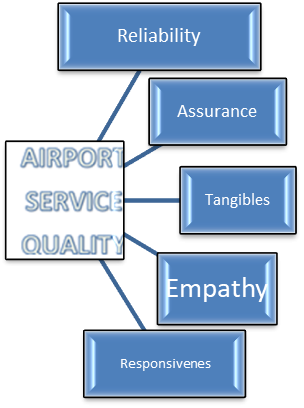
Factor analysis is a statistical method used to describe variability among observed, correlated variables in terms of a potentially lower number of unobserved variables called factors/attributes. For example, it is possible that variations in six observed variables mainly reflect the variations in two unobserved (underlying) variables. Factor analysis searches for such joint variations in response to unobserved latent variables. The observed variables are modeled as linear combinations of the potential factors, plus "error" terms. Factor analysis aims to find independent latent variables. The theory behind factor analytic methods is that the information gained about the interdependencies between observed variables can be used later to reduce the set of variables in a dataset. Proponents of factor analysis believe that it helps to deal with data sets where there are large numbers of observed variables that are thought to reflect a smaller number of underlying/latent variables. It allows researchers to investigate concepts that are not easily measured directly by collapsing a large number of variables into a few interpretable underlying factors. Factor analysis will be used in this study as a data reduction technique to determine the significance and/or extent to which each of the identified five service quality attributes constitute influencing factors in the passengers and airlines perceptions of airport service quality in Nigeria. See Figure1.
Figure1: Factor attributes of airport service quality
Source: Authors preparation
RESULTS AND DISCUSSION
Factor Analysis
The result of the principal component factor analysis presented in Table 2 indicates that two service quality attributes constitute the principal attributes or major components factors considered by airlines as significantly influencing airport service quality in the airport in Nigeria. These principal components airport service quality attributes in the perspective of the airlines as shown by the result of the principal component factor analysis (PCFA) include Tangibles with Eigen value of 2.515 and reliability with Eigen value of 1.33. Assurance, empathy and responsiveness as service attributes show Eigen values of 0.72, 0.58 and 0.05 respectively and which are all less than 1, they are therefore not considered by airlines as very significant in influencing the service quality expectation and perception in Nnamdi Azikiwe International Airport, Abuja. By implication, the tangles which represent investment by the airport authorities in physical navigation infrastructure and the ability of the airport authority to always provide reliable services without fail remain the major significant service quality attributes that influences the airport service quality expectations and perceptions of airline operators.
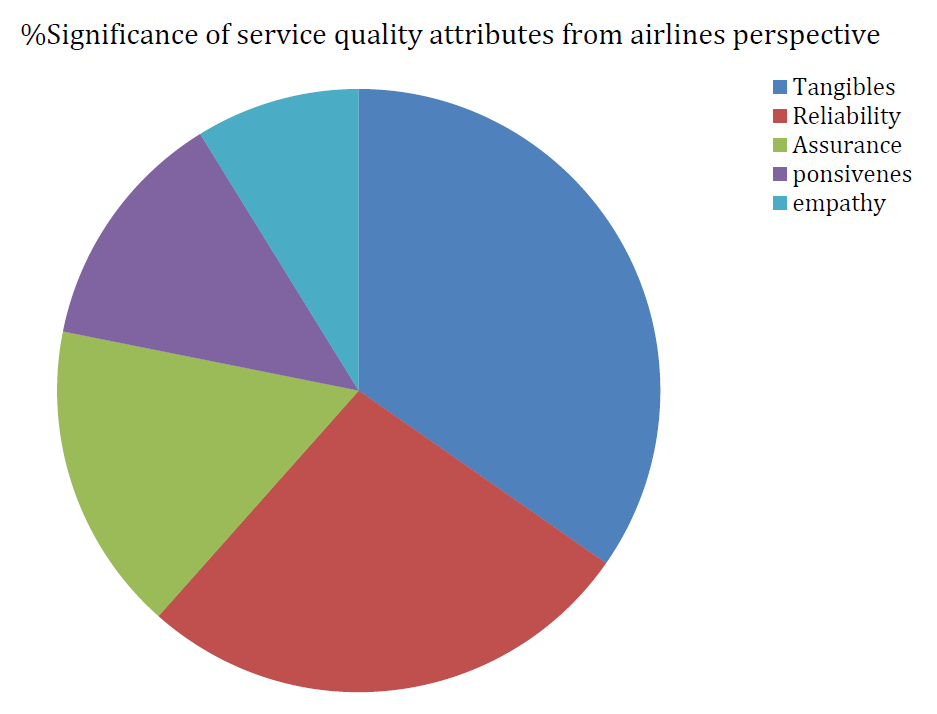
The chart indicates that while tangibles has a mean percentage influence on airlines rating of airport service quality of 34.52%, reliability has a mean percentage significant influence of 26.71%. Assurance, empathy and responsiveness have no significant mean percentage influences of 16.50%, 8.76% and 12.95 respectively. The percentage influences of the attributes in airlines airport service quality expectations and perception decisions are as shown in the chart below. Figure 2
By implication, in order to improve the satisfaction of airlines from airport services consumed, the Federal Airport Authority of Nigeria should prioritize investment in improving tangibles, followed by reliability which contributes very significantly in influencing the service quality perceptions of airlines as consumers of airport services. This is followed by assurance, empathy and responsiveness which have no significant influences in airlines service quality perceptions. Figure 1
The result of the principal component factor analysis presented in Table 3 indicates that two service quality attributes constitute the principal attributes or major components factors considered by air transport passengers as significantly influencing the perception of the airport service quality in the airport in Nigeria. These principal components airport service quality attributes from the perspective of the air transport passengers are Reliability with Eigen value of 1.74 and Tangibles with Eigen value of 1.59. This also implies that both the airlines and air transport passengers’ service expectations and perceptions are being influence most by the same airport service quality attributes of tangibles and reliability. While tangibles influence the airlines expectations and perceptions decisions most significantly, reliability influences the expectations and perceptions of the air transport passengers most significantly. However, sum of squared Eigen loadings cumulative for both tangibles and reliability attributes from the perspectives of the airlines and the air transport passengers stand at 72.9% and 66.2% respectively. This implies that tangibles and reliability jointly influences the service quality perceptions of the airlines more than it does for air transport passengers. Responsiveness, assurance and empathy with Eigen values of 0.99, 0.67 and 0.003 respectively show no significant influences on the airlines and air passengers’ airport service quality ratings/judgments, having Eigen values less than one.
Table2: Major Determinant Attributes Of Airport Service Quality in NAIA, Abuja, Nigeria – Airlines Perspectives
Factor Analysis
Initial
Extraction
Reliability
1.000
.739
Assurance
1.000
.665
Tangibles
1.000
.917
Empathy
1.000
.669
Responsiveness
1.000
.658
Component
Initial Eigenvalues
Extraction Sums of Squared Loadings
Total
% of Variance
Cumulative %
Total
% of Variance
Cumulative %
Tangibles
2.515
50.301
50.301
2.515
50.301
50.301
Reliability
1.133
22.669
72.970
1.133
22.669
72.970
Assurance
.717
14.334
87.304
Responsiveness
.582
11.639
98.943
Empathy
.053
1.057
100.000
Component Matrixa
Component
1
2
Reliability
.858
.048
Assurance
-.596
-.557
Tangibles
-.842
.457
Empathy
.567
.590
Responsiveness
.627
-.515
Extraction Method: Principal Component, Source: Authors calculation, *Extraction Method: Principal Component Analysis
Figure 2: Signifiance of Service Quality Attributes from Airlines Perspective
Source: Authors presentation
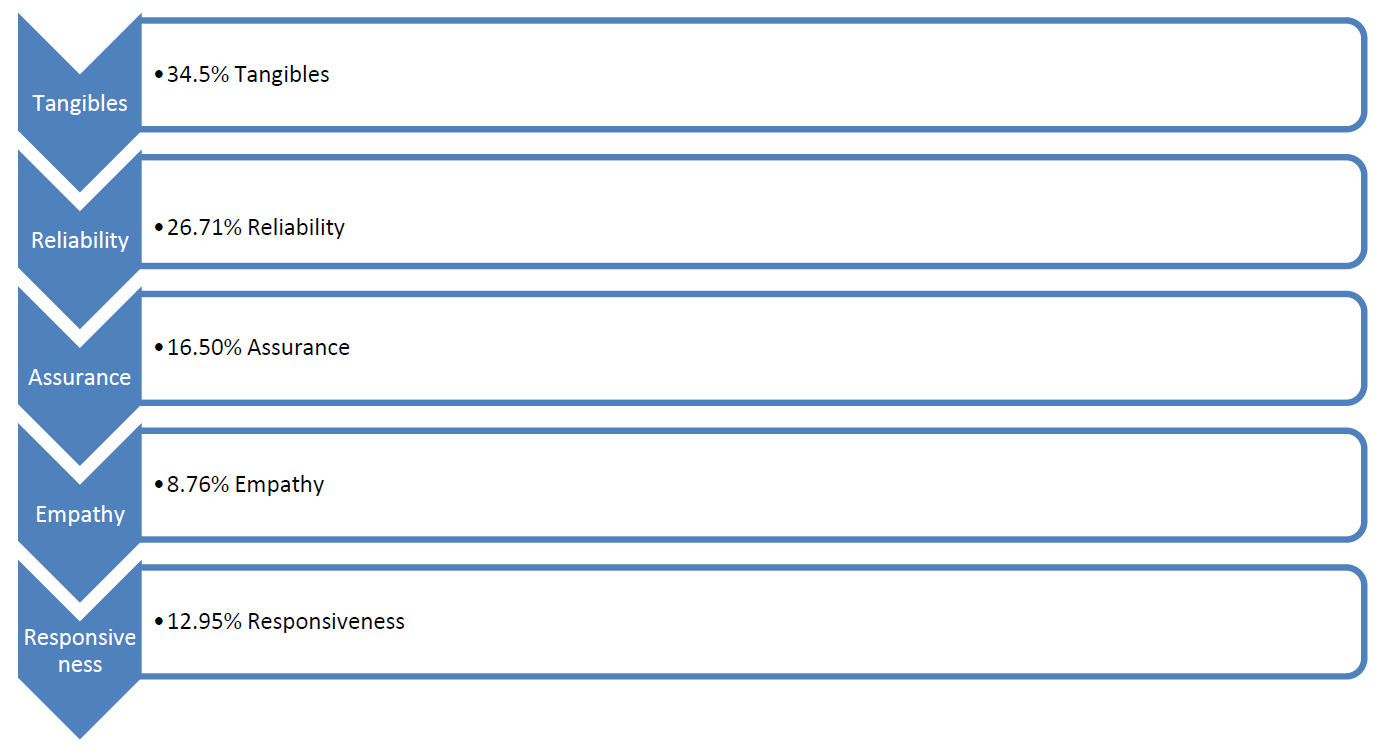
Figure 3 :
Source: Authors presentation
The chart shows in figure 3 is a summary of the percentage significances of the influences of the service quality attributes on air transport passengers airport service quality judgment in NAIA, Abuja. The increasing order sequence of influence and percentage of influence of the airport service quality attributes from the perspectives of air transport passengers is as illustrated below using the progress chart.
The policy implication is that the airport authority in order to improve the quality of services offered to air passengers and increase the level of utility derivable from consumption of airport services by passengers, investments that significantly improve service reliability followed by tangibles should be prioritized. This may be followed by investments that improve responsiveness, assurance and empathy.
The result of the principal component factor analysis presented above further indicates that two service quality attributes constitute the principal dominant attributes or major components factors considered by airlines as significantly influencing their airport service quality expectation and perception decisions in MMIA, Lagos Nigeria. The first major determinant or principal component airport service quality attributes from the perspective of the airlines as shown by the result of the PCFA is Tangibles which shows Eigen values of 2.52. This is followed by Reliability with Eigen value of 1.37. The remainder service quality attributes of assurance, empathy and responsiveness show Eigen values of 0.77, 0.25 and 0.31 respectively and does not significantly influence airlines airport service quality expectation and perception decisions as each has Eigen value less than 1. This when compared with the result obtained for airlines operating in NAIA, Abuja confirms that the judgments of airlines about airport service quality are mostly influenced by Tangibles which has to do with the level of investment made by the airport authorities in physical aviation infrastructure and reliability which has to do with the capacity of the airport authority to always provide reliable services without fail, disappointment and excuses. Table 4
The pie chart in Figure 4 is a summary of the percentage significances of the influences of the service quality attributes on airlines judgment of airport service quality in MMIA, Lagos.
Table3: Determinant Attributes of Airport Service Quality in NAIA, Abuja- Air passengers’ perspective
Factor Analysis
Initial
Extraction
Reliability
1.000
.923
Assurance
1.000
.862
Tangibles
1.000
.724
Empathy
1.000
.202
Responsiveness
1.000
.625
Component
Initial Eigenvalues
Extraction Sums of Squared Loadings
Total
% of Variance
Cumulative %
Total
% of Variance
Cumulative %
1
1.745
34.903
34.903
1.745
34.903
34.903
2
1.591
31.822
66.725
1.591
31.822
66.725
3
.987
19.743
86.468
4
.673
13.468
99.936
5
.003
.064
100.000
Component Matrixa
Component
1
2
Reliability
-.901
-.334
Assurance
.572
.732
Tangibles
.631
-.571
Empathy
.221
-.392
Responsiveness
-.400
.682
Extraction Method: Principal Component, a.2 components extracted, Total Variance Explained
Figure 4:
Source: Author
Table3: Major Determinant Attributes of Airport Service Quality in MMIA, Lagos – Airlines Perspectives
Communalities
Initial
Extraction
Lagairline Reliability
1.000
.858
Lagairline Assurance
1.000
.682
Lagairline Tangibles
1.000
.958
Lagairline Empathy
1.000
.560
Lagailine Responsiveness
1.000
.828
Component
Initial Eigenvalues
Extraction Sums of Squared Loadings
Total
% of Variance
Cumulative %
Total
% of Variance
Cumulative %
1
2.511
50.228
50.228
2.511
50.228
50.228
2
1.374
27.473
77.701
1.374
27.473
77.701
3
.777
15.530
93.232
4
.313
6.264
99.496
5
.025
.504
100.000
Component Matrixa
Component
1
2
Lagairline Reliability
.916
.134
Lagairline Assurance
-.517
.644
Lagairline Tangibles
-.740
-.640
Lagairline Empathy
-.211
.718
Lagailine Responsiveness
.901
-.125
Extraction Method: Principal Component Analysis.a , a. 2 components extracted., Source: Authors Calculation, Total Variance Explained
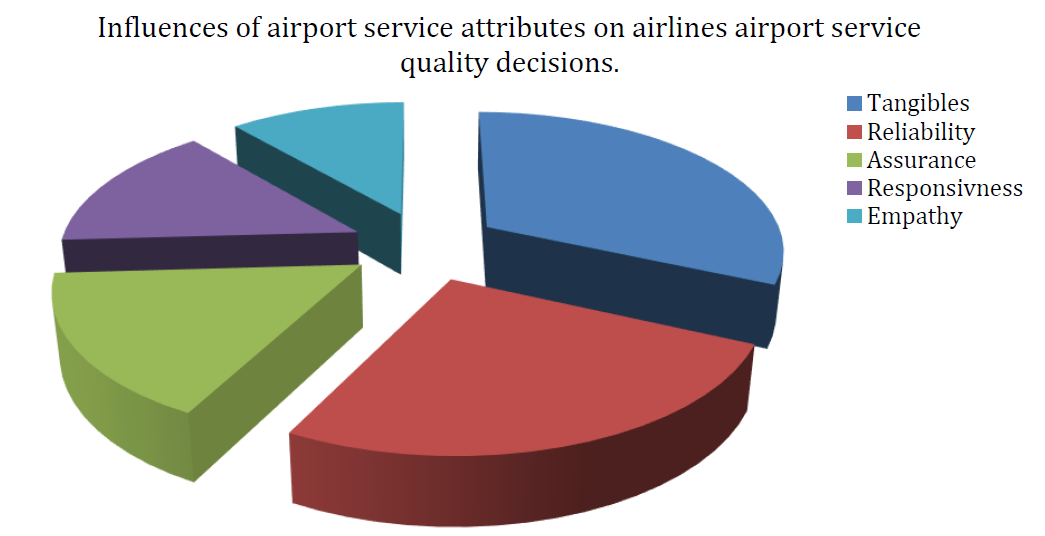
Thus Tangibles and reliability show about 31.4% and 25.67% influences respectively while assurance, responsiveness and empathy show respective influences of 16.23%, 14.5% and 11.16% respectively. (Figure 5)
The principal component factor analysis result on the significance of the five service quality attributes in influencing air transport passengers judgment of airport service quality ad satisfaction in MMIA, Lagos presented above indicates that three service quality attributes constitute the principal attributes or major components factors that significantly influence passengers satisfaction and judgment of airport service quality in MMIA, Lagos, Nigeria. These in their order of increasing significance are: Tangibles with 27.08% mean influence and Eigen value of 1.72, Reliability with 26.67% influence and Eigen value of 1.49; and Responsiveness with 17.97% influence and Eigen value of 1.06. (Table 5)
The service quality attributes of Assurance and Empathy with respective mean influences of 16.36% and 13.25% with Eigen values of 0.67 and 0.05respectively show no significant influences on the air passengers’ airport service quality judgment.
The policy implication that the management Murtala Muhammed International airport should drive to improve the airport service quality by concentrating more on the principal or major component service quality attributes of tangibles, reliability, and responsiveness which are most significantly considered by air transport passengers in forming judgment about what constitute the service quality offered by the airport.
Figure5: Influences of airport service attributes on airlines airport service
Source: Author
Table6: Service Quality Attributes and the Percentage Contributions on the airlines judgment of airport service quality in Nigeria Airports in Decreasing Order of Significance.
Airport
Airport Service Quality Attribute(s)
%Mean Influence(s)
Eigen Value(s)
Remarks
MMIA, LAGOS
Tangibles
31.42
2.51
Significant
Reliability
25.67
1.37
Significant
Assurance
16.32
0.78
Non Significant
Responsiveness
14.50
0.31
Non Significant
Empathy
11.16
0.025
Non Significant
NAIA, ABUJA
Tangibles
34.52
2.53
Significant
Reliability
26.71
1.13
Significant
Assurance
16.50
0.72
Non significant
Responsiveness
12.95
0.58
Non significant
Empathy
8.76
0.53
Not Significant
Source: Authors Calculation
Table7: Service Quality Attributes and the Percentage Contributions on the Passengers judgment of airport service quality in Nigeria Airports in Decreasing Order of Significance.
Airport
Airport Service Quality Attribute(s)
%Mean Influence(s)
Eigen Value(s)
Remarks
MMIA, LAGOS
Tangibles
27.08
1.72
Significant
Reliability
26.67
1.45
Significant
Responsiveness
16.77
1.06
Significant
Assurance
16.36
0.67
Non significant
Empathy
13.25
0.51
Non significant
NAIA, ABUJA
Reliability
28.66
1.75
Significant
Tangibles
27.00
1.59
Significant
Responsiveness
16.26
0.99
Non significant
Assurance
14.73
0.67
Non significant
Empathy
13.33
0.003
Non Significant
Source: Authors calculation
In summary, Table 6 shows that only tangles and reliability attributes significantly influence airlines judgments of what constitute the airport service quality in Nigeria airports. This implies that airlines in both Lagos and Abuja airports are in agreement that tangible investment in navigational facility and other physical facilities and infrastructure in the airports and provision of reliable airport services are the major component factors that motivate their judgment about service quality expectations and perceptions in Nigeria. See also table5 below for the summary of major component determinant attributes that influences air passengers’ airport service quality judgments in Nigeria airport.
In summary, reliability, tangibles and responsiveness are the three major component significant factors that influence air passengers’ judgment of airport service quality expectations and perceptions in Nigeria airports. [Table 7]
CONCLUSION
While tangibles and reliability are the major component service quality attributes that significantly determines airlines service quality expectation and perception judgments, passengers service quality expectations and perceptions judgments are significantly influenced by tangibles, reliability and responsiveness. The airport authorities should thus prioritize investment in the three significant service quality attributes in order to improve airport service quality in Nigeria and improve consumers’ satisfactions from the consumption of airport services.
REFERENCE
G. Apostolos N., T. Petros, Z. Dimitris. Suppliers Logistics Service Quality Performance and its Effect on Retailers’ Behavioral Intentions. Procedia - Social and Behavioral Sciences, vol. 73, 2013, pp. 302–309.
O. Udo. Service quality measurement of Nigerian airlines. M.Sc. thesis, Department of Transport Management, Federal University of Technology, Owerri, Nigeria, 2018.
S.O. Adeniran, A. Fadare. Comparative analysis of public operated airport terminal and concessioned airport terminal in Lagos, Nigeria. Discovery, vol. 54, no. 272, 2018a, pp. 304–318.
A.O. Adeniran, S.O. Fadare. Assessment of Passengers’ Satisfaction and Service Quality in Murtala Muhammed Airport (MMA2), Lagos, Nigeria: Application of SERVQUAL Model. J. Hotel Bus. Manage., vol. 7, 2018b, p. 188, https://doi.org/10.4172/2169-0286.1000188.
J. Ugo. Assessment of airport service quality in Nigeria. Unpublished M.Sc. thesis, Department of Transport Management Technology, Federal University of Technology, Owerri, 2020.
N. Seth, S.G. Deshmukh, P. Vrat. Service quality models: a review. International Journal of Quality & Reliability Management, vol. 22, no. 9, 2004, pp. 913–949.
J.C. Smith, J. Aronson. “Some Hedonic Consequences of the Confirmation and Disconfirmation of Expectations.” Journal of Abnormal and Social Psychology, vol. 66, no. 2, 1963, pp. 151–156.
K.R. Teas, L. Aggralwal. “Expectations as a Comparison Standard in Measuring Service Quality: An Assessment of a Reassessment.” Journal of Marketing, vol. 58, January 1994, pp. 132–139.
C. Hovland, O. Harvey, M. Sherif. “Assimilation and contrast effects in reaction to communication and attitude change.” Journal of Abnormal and Social Psychology, vol. 55, no. 7, 1957, pp. 244–252.
S. Nyeck, M. Morales, R. Ladhari, F. Pons. 10 Years of Service Quality Measurement: Reviewing the use of the SERVQUAL Instrument. Cuadernos de Difusión, vol. 7, no. 13, 2002, pp. 101–107.
E.W. Anderson, M.W. Sullivan. The Antecedents and Consequences of Customer Satisfaction for Firms. Marketing Science, vol. 12, no. 2, 2003, pp. 125–143.
J. Olson, P. Dover. “Disconfirmation of consumer expectations through product trial.” Journal of Applied Psychology, vol. 64, 1979, pp. 179–189.
R.M. Peyton, S. Pitts, H.R. Kamery. “Consumer Satisfaction/Dissatisfaction (CS/D): A Review of the Literature Prior to the 1990s.” Proceedings of the Academy of Organizational Culture, Communication and Conflict, vol. 7, no. 2, 2003, p. 42.
T.Y. Choi, R. Chu. “Determinants of Hotel Guests’ Satisfaction and Repeat Patronage in the Hong Kong Hotel Industry.” International Journal of Hospitality Management, vol. 20, 2001, pp. 277–297.
Atkinson. “Answering the eternal question: What does the Customer Want?” The Cornell Hotel and Restaurant Administration Quarterly, vol. 29, no. 2, 1988, pp. 12–14.
License
Creative Commons Attribution-NonCommercial-NoDerivatives 4.0 International License
All papers should be submitted electronically. All submitted manuscripts must be original work that is not under submission at another journal or under consideration for publication in another form, such as a monograph or chapter of a book. Authors of submitted papers are obligated not to submit their paper for publication elsewhere until an editorial decision is rendered on their submission. Further, authors of accepted papers are prohibited from publishing the results in other publications that appear before the paper is published in the Journal unless they receive approval for doing so from the Editor-In-Chief.
Himalayan Journal of Economics and Business Management open access articles are licensed under a Creative Commons Attribution-Share A like 4.0 International License. This license lets the audience to give appropriate credit, provide a link to the license, and indicate if changes were made and if they remix, transform, or build upon the material, they must distribute contributions under the same license as the original.
Recommended Articles
Research Article
Influence of Leadership on Poverty Reduction in the Devolved Government in Trans-Nzoia County, Kenya
Kinisu Sifuna,
...
Peter Simotwo
Published: 30/06/2021
Download PDF
Cite
x
APA
Sifuna, K., Lwangale, D. W., Simotwo, P., Sifuna, K., Lwangale, D. W. & Simotwo, P. (2021). Influence of Leadership on Poverty Reduction in the Devolved Government in Trans-Nzoia County, Kenya. Himalayan Journal of Economics and Business Management, 2(1), None-None.
MLA
Sifuna, Kinisu, et al. "Influence of Leadership on Poverty Reduction in the Devolved Government in Trans-Nzoia County, Kenya." Himalayan Journal of Economics and Business Management 2.1 (2021): None-None.
Chicago
Sifuna, Kinisu, David W. Lwangale, Peter Simotwo, Kinisu Sifuna, David W. Lwangale and Peter Simotwo. "Influence of Leadership on Poverty Reduction in the Devolved Government in Trans-Nzoia County, Kenya." Himalayan Journal of Economics and Business Management 2, no. 1 (2021): None-None.
Harvard
Sifuna, K., Lwangale, D. W., Simotwo, P., Sifuna, K., Lwangale, D. W. and Simotwo, P. (2021) 'Influence of Leadership on Poverty Reduction in the Devolved Government in Trans-Nzoia County, Kenya' Himalayan Journal of Economics and Business Management 2(1), pp. None-None.
Vancouver
Sifuna K, Lwangale DW, Simotwo P, Sifuna K, Lwangale DW, Simotwo P. Influence of Leadership on Poverty Reduction in the Devolved Government in Trans-Nzoia County, Kenya. Himalayan Journal of Economics and Business Management. 2021 Jan;2(1):None-None.
Download PDF
Research Article
Modelling Structure Job Quality, Job Design and Job Satisfaction
Moch Nurhadi,
...
Avi Sunani
Published: 30/08/2022
Download PDF
Cite
x
APA
Nurhadi, M., Bisyri Effendi, M., Saiful Ulum, A. & Sunani, A. (2022). Modelling Structure Job Quality, Job Design and Job Satisfaction. Himalayan Journal of Economics and Business Management, 3(2), 1-4.
MLA
Nurhadi, Moch, et al. "Modelling Structure Job Quality, Job Design and Job Satisfaction." Himalayan Journal of Economics and Business Management 3.2 (2022): 1-4.
Chicago
Nurhadi, Moch, Moch Bisyri Effendi, Achmad Saiful Ulum and Avi Sunani. "Modelling Structure Job Quality, Job Design and Job Satisfaction." Himalayan Journal of Economics and Business Management 3, no. 2 (2022): 1-4.
Harvard
Nurhadi, M., Bisyri Effendi, M., Saiful Ulum, A. and Sunani, A. (2022) 'Modelling Structure Job Quality, Job Design and Job Satisfaction' Himalayan Journal of Economics and Business Management 3(2), pp. 1-4.
Vancouver
Nurhadi M, Bisyri Effendi M, Saiful Ulum A, Sunani A. Modelling Structure Job Quality, Job Design and Job Satisfaction. Himalayan Journal of Economics and Business Management. 2022 Jul;3(2):1-4.
Download PDF
Research Article
The Constitutional and Legislative Basis for Considering the Taxable Capacity of Taxpayers in Iraqi Tax Legislation
Hussein Kamel Wadaa
Published: 05/05/2025
Download PDF
Cite
x
APA
Wadaa, H. K. (2025). The Constitutional and Legislative Basis for Considering the Taxable Capacity of Taxpayers in Iraqi Tax Legislation. Himalayan Journal of Economics and Business Management, 6(1), 1-10.
MLA
Wadaa, Hussein Kamel. "The Constitutional and Legislative Basis for Considering the Taxable Capacity of Taxpayers in Iraqi Tax Legislation." Himalayan Journal of Economics and Business Management 6.1 (2025): 1-10.
Chicago
Wadaa, Hussein Kamel. "The Constitutional and Legislative Basis for Considering the Taxable Capacity of Taxpayers in Iraqi Tax Legislation." Himalayan Journal of Economics and Business Management 6, no. 1 (2025): 1-10.
Harvard
Wadaa, H. K. (2025) 'The Constitutional and Legislative Basis for Considering the Taxable Capacity of Taxpayers in Iraqi Tax Legislation' Himalayan Journal of Economics and Business Management 6(1), pp. 1-10.
Vancouver
Wadaa HK. The Constitutional and Legislative Basis for Considering the Taxable Capacity of Taxpayers in Iraqi Tax Legislation. Himalayan Journal of Economics and Business Management. 2025 Jan;6(1):1-10.
Download PDF
Research Article
Proposed Digital Marketing Strategy to Enhance Engineering Consultancy Company Revenue
Alfarisy, K. A.,
Wandebori, H.
Published: 30/04/2024
Download PDF
Cite
x
APA
K. A., A. & H., W. (2024). Proposed Digital Marketing Strategy to Enhance Engineering Consultancy Company Revenue. Himalayan Journal of Economics and Business Management, 5(1), 1-18.
MLA
K. A., Alfarisy, and Wandebori, H.. "Proposed Digital Marketing Strategy to Enhance Engineering Consultancy Company Revenue." Himalayan Journal of Economics and Business Management 5.1 (2024): 1-18.
Chicago
K. A., Alfarisy, and Wandebori, H.. "Proposed Digital Marketing Strategy to Enhance Engineering Consultancy Company Revenue." Himalayan Journal of Economics and Business Management 5, no. 1 (2024): 1-18.
Harvard
K. A., A. and H., W. (2024) 'Proposed Digital Marketing Strategy to Enhance Engineering Consultancy Company Revenue' Himalayan Journal of Economics and Business Management 5(1), pp. 1-18.
Vancouver
K. A. A, H. W. Proposed Digital Marketing Strategy to Enhance Engineering Consultancy Company Revenue. Himalayan Journal of Economics and Business Management. 2024 Jan;5(1):1-18.
Ugo, J., Ejem, E. A., Chinonyerem, N. T., L.I, O. & Chigozie, M. J. (2022). Major Component Determinants of International Airport Service Quality in Nigeria. Himalayan Journal of Economics and Business Management, 3(1), 1-9.
MLA
Ugo, James, et al. "Major Component Determinants of International Airport Service Quality in Nigeria." Himalayan Journal of Economics and Business Management 3.1 (2022): 1-9.
Chicago
Ugo, James, Ejem A. Ejem, Nwokedi T. Chinonyerem, Okoroji L.I and Mabachu Justice Chigozie. "Major Component Determinants of International Airport Service Quality in Nigeria." Himalayan Journal of Economics and Business Management 3, no. 1 (2022): 1-9.
Harvard
Ugo, J., Ejem, E. A., Chinonyerem, N. T., L.I, O. and Chigozie, M. J. (2022) 'Major Component Determinants of International Airport Service Quality in Nigeria' Himalayan Journal of Economics and Business Management 3(1), pp. 1-9.
Vancouver
Ugo J, Ejem EA, Chinonyerem NT, L.I O, Chigozie MJ. Major Component Determinants of International Airport Service Quality in Nigeria. Himalayan Journal of Economics and Business Management. 2022 Jan;3(1):1-9.


 Download PDF
 Download XML





 .
.