This paper examined the impacts of entrepreneurship education on sustainable security in Nigeria. Using secondary data from the Global Competitiveness Report from 2007 to 2020, the study analyzed the relationship between entrepreneurship education and sustainable security and the extent to which the problems associated with entrepreneurship education influence Nigerian security. Multivariate analysis of covariance (MANCOVA) was adopted to test the hypotheses formulated for the study with the aid of a statistical package for social sciences (SPSS). The findings indicate that Inadequate entrepreneurship education does not significantly impact sustainable security while poor technological absorption, inadequate infrastructure, and unstable tax rate do. The study established that technological absorption and stable tax rate improvement will result in a significant increase in security, holding other variables constant. The results also indicate that inadequate entrepreneurship Education, unstable tax rate, and inadequate infrastructure negatively influence the skills for establishing a successful entrepreneurial venture. Furthermore, poor technological absorption and the unstable tax rate significantly positively influence sustainable security. This implies that when Poor technological absorption and unstable tax rate increases, insecurity will also witness a significant increase. The paper recommended that the government should, as a matter of urgency, identify these forces that militate against technological-based entrepreneurship education by integrating all stakeholders in the pursuant of entrepreneurship education-related policies to ensure that insecurity problems are completely surmounted.
Keywords
Entrepreneurship Education
Global Competitiveness Report
Infrastructure
Insecurity
Stakeholders
Technology
Unemployment
INTRODUCTION
Education has been one of the fundamental and frontline pillars of the nation’s sustainable development. It is listed as the fourth among the seventeen Sustainable Development Goals (SDGs), and a quality education that includes entrepreneurial knowledge is the foundation of sustainable development [1]. Education is the process through which an individual acquires knowledge, special skills, and experiences for effective conquering and adaptation to his environment. Entrepreneurship education, on the other hand, aims at raising individuals with the knowledge, skills, capabilities, and motivation that encourages entrepreneurial success in various settings [2-3]. It acquaints the graduates with skills and competencies that enable them to become capable of thriving in society and contributing to its economic development and sustainable security.
However, a cursory look at Nigeria on the global education, entrepreneurial and security indices indicates that the country lacks entrepreneurial ability and that the government policies are ineffective. The International Education Database Goal, which measures and ranks the impact each nation's education system has had in stabilizing its economy and developing its social environment, placed Nigeria at 185th out of 201 countries in the ranking for 2018. The 2018 and 2019 Global Entrepreneurship Index also placed Nigeria at the rank 101 and 92, respectively, out of 137 countries, and the 2020 Human Development Statistical Update placed Nigeria under the low human development category ranking 161 out of 189 countries [4].
Similarly, Nigeria, which has been ranked the 16th least peaceful country in the 2018 and 2019 editions of the Global Peace Index (GPI), had moved to the 18th position as of 2021[5]. However, using terrorism as a measure, GPI placed Nigeria at 146 out of 163 countries surveyed in 2021 and the number 3 most terrorized country out of 163 countries studied according to the global terrorism index of 2020 [5-6]. In the Prosperity Pillar rankings, Nigeria scored very low in the Safety and Security pillar, having the rank of 151th out of 167 countries in 2020.
Unachukwu [7] asserts that introducing entrepreneurial education into tertiary institutions would lead to acquiring skills that would enable its graduates to be self-reliant and consequently reduce unemployment and associated problems. Despite the emphasis on the profound benefits of entrepreneurship education, it is still not entirely leading to the establishment of successful entrepreneurial ventures in Nigeria [1,8-10]. As a result, there is still a high level of unemployment, leading to a high level of poverty which breeds a high level of insecurity [11]. The study, therefore, contributes to the limited literature on the impacts of entrepreneurial education on sustainable security in Nigeria.
Conceptual Framework
Entrepreneurship: Entrepreneurship is a multidimensional phenomenon whose exact meaning has no consensus as scholars and practitioners have tried to define it in various forms. Chukwuemeka, Chikezie, and Okolo [12] defined entrepreneurship as the willingness and ability of an individual to seek out investment opportunities and establish and run an enterprise successfully. Entrepreneurship is the term used broadly in connection with innovative and creative modern industrial business leaders [13].
Generally, entrepreneurship should be seen as the special attribute of the entrepreneur, which reinforces creative and innovative ideas for effectively harnessing and managing successful business ventures. Thus, an entrepreneur is a person with the perceptive ability to see innovation and the capability to bring it to market: it is about job creation and growth through innovation [14].
Most small business owners and traders in the markets of most cities around the world are not entrepreneurs and therefore are not included in this definition. The GEI [14] emphasized that TEA (total early-stage entrepreneurial activity) primarily captures self-employment and negatively correlates with economic growth, freedom, and global competitiveness. The higher the number of small business start-ups (TEA) in a country, the poorer the economy. This study is concerned with entrepreneurship quality: entrepreneur driven by opportunity perception who generates commercial success, yielding high growth and serious job creation. Opportunity entrepreneurship positively correlates with economic growth [4] and requires skills acquired through higher education. According to Stevenson [15], being an entrepreneur isn't necessarily about starting companies but about having the skills and mindset driven by the perception of opportunity regardless of the resources currently available. For the true entrepreneur, perceiving opportunities and harnessing them, often amid challenges, becomes a way of life to secure their future and the futures of several others.
According to the Global Entrepreneurship Index, 2019, Sub-Saharan Africa’s lowest average scores in the global entrepreneurial index are in Startup Skills, Risk Acceptance, and Risk Capital. Tertiary education is also a drag and not as broadly accessible as in other regions, while entrepreneurial skills are less common. Unfavorable general risk climate and capital availability lag behind other regions [4].
Entrepreneurship Education
Entrepreneurship education is the purposeful intervention by an educator in the learner's life to impact entrepreneurial qualities and skills that will enable the learner to survive in the business world. Entrepreneurship education is described as a form of education that aims at raising individuals capable of starting new businesses. It develops in students the skills necessary as an entrepreneur, stimulating and challenging the students into creative and innovative ideas that result in setting up and growing business ventures. [2,16-17]. Without a functional education the manifestation of entrepreneurship skills in individuals may be difficult [18].
The Federal government of Nigeria directed all higher education institutions to introduce entrepreneurship education as a compulsory course for all students irrespective of their disciplines with effect from the 2007/2008 academic session. This is to curb the soaring unemployment rate, declining per capita income, youth restiveness, and insecurity in various parts of the country [16]. By making entrepreneurship education compulsory, the Nigerian government seeks to produce graduates with the required knowledge-based entrepreneurs that will drive the growth of the country's economy.
Although the Federal Government made entrepreneurship education compulsory in our tertiary institutions, most universities are not yet ready for complete implementation and are therefore not serious about the programme [19]. Thus, the study of entrepreneurship education in the country's tertiary institutions is marred by many internal and external environmental problems [19-20].
Empirical Review
Entrepreneurship education continues to attract considerable attention from policymakers and academics globally. Thus the study of entrepreneurship education has yielded a vast body of literature, especially with regard to its influence on economic development. However, most of the research papers did not quantify and empirically analyze the variables influencing entrepreneurship education. There is also a dearth of literature on entrepreneurship education and its influence on sustainable security in Nigeria.
Ohagwu, Ugwu, and Ezeilo [21] adopted a descriptive survey research design to identify the strategies for improving entrepreneurship skill acquisition among tertiary institution students for sustainable national security in Enugu State. They established the need for prospective teachers to acquire contemporary skills which would help improve entrepreneurial knowledge among graduates of higher institutions. They believe this recommendation would promote national security, especially with reference to Enugu State in particular.
Sanjo, Eze and Worimegbe [22] conducted a questionnaire-based study within the same period. Descriptive statistics and Pearson correlation coefficient was employed to determine the relationship between entrepreneurship education and security challenges in Nigeria using the SPSS 21.0 version. The result revealed that the crime and insecurity rates are reduced as more people are trained and equipped in entrepreneurship. Their study suggested that government and other relevant bodies should gear up the training of idle individuals and those with disguised employment as well as students in secondary and tertiary institutions to reduce crime [22].
Similarly, Edokpolor [23] examined the relationship between entrepreneurship education and the core values of sustainable development. A correlational method was adopted in the study using a structured questionnaire for quantitative data collection. The result of the study confirmed the statistically significant and positive relationship between entrepreneurial education and the core value of sustainable development.
Onyido and Duru [24] studied entrepreneurship education as a mechanism for achieving sustainable development in Nigeria and identified a dire requirement for a comprehensive orientation of institutions with the sole aim of improving the entrepreneurship mentality of the youths. They recommended the provision of adequate resources for teaching and well-equipped empowerment development towards entrepreneurship development. In the same vein, Ogbondah and Nwogu [25], affirmed that one of the greatest social challenges in Nigeria today is large-scale youth unemployment due to the non-empowerment of the youths through entrepreneurship education.
The Economic predicament of the Nigerian youth has made them ruthless in crimes. Using system theory to examine Nigeria’s education vis-a-vis national security, maintains that unless Nigeria’s education is reformed in such a manner that will make youth self-reliance, then the end of insecurity perpetrated by youth is not yet in sight. Okoro [20] assessed strategies for curbing insecurity in Nigeria through the Business Education programme. Using quantitative statistical method, the result showed, among others the need for provision of adequate laboratory for Business Education for skill acquisition, provision of sufficient classrooms for effective teaching of Business Education students, improving students' attitude to skills acquisition through orientation and regular supervision of Business education prograrnme. He stressed that this would help the students to develop skills to enable them to set up their own businesses, thus, helping to curb insecurity [20].
Kaizer [8] sees Entrepreneurship education as a possible change agent for equipping unemployed youths to become self-reliant and contribute to national security. The research findings indicated that entrepreneurship education could be used to combat youth unemployment and foster Nigeria's national security. The paper recommended that entrepreneurship education should be utilized to equip the youth with relevant skills on how to start and manage their own businesses. Olanipekun, Brimah and Rabiu [10] affirmed that entrepreneurship and vocational education would provide students with skills with which they can be self-reliant.
Diyoke [9], in his study, provided an entrepreneurship education framework as a tool for securing employment and emancipation of people through knowledge and skills acquisition for gainful life. He argued that the youths would eschew violence if stakeholders ensure that the entrepreneurial policy in education is fully implemented.
Sofoluwe, Shokunbi, Raimi, and Ajewole [26], in their empirical paper, investigated the prospect of repositioning entrepreneurship education as a strategy for boosting human capital development and employability in Nigeria. Adopting a quantitative research method, [26] significantly found that entrepreneurship education is leeway to job creation, wealth creation, youth empowerment, peaceful society, and economic development. Osakwe [1], in a descriptive statistical analysis of entrepreneurship education in Delta State tertiary institutions as a means of national growth and development, revealed that entrepreneurship education is beneficial to national development despite its challenges in tertiary institutions. Orikpe [27] critically identified reform of the education system as a panacea to the lingering security challenges confronting the nation.
Ossai and Nwalado [28] emphasize the need and importance of entrepreneurship education for sustainable development in Nigeria. They argued that entrepreneurship education would equip the students with the skills to be self-reliant and recommended that educational programmes at all levels of education should be made relevant to provide the youths with the needed entrepreneurial skills. Anho [11] argued that Entrepreneurship education can be used for wealth creation, poverty reduction, ensuring social-economic empowerment, and sustained self and national development. He recommended embracing entrepreneurship education to address the challenges of unemployment with its multivariant and national consequences of poverty, insecurity, Economic wastage, and acute reduction in the nation's Gross Domestic Product (GDP), among others [11].
Olugbeko and Asagha [29] examined the importance of national security to the development of a nation and the roles of quality education in addressing security challenges and recommended the re-invention of entrepreneurship education at all levels with the aim of providing the right entrepreneurship skills to the people. Ogbuanya [30] confirmed that the rate of unemployment in Nigeria is alarming and could promote social vices which could, in no small measure, constitute a threat to national security. Therefore, developing a workable Technical and Vocational Education and Training (TVET) programme in the country is the needed panacea to creating Job opportunities for the teeming youths because youth employment is a vehicle for enhancing national security.
From the above review, the researchers hypothesized that entrepreneurship education does not significantly influence sustainable security in Nigeria.
Theoretical Framework
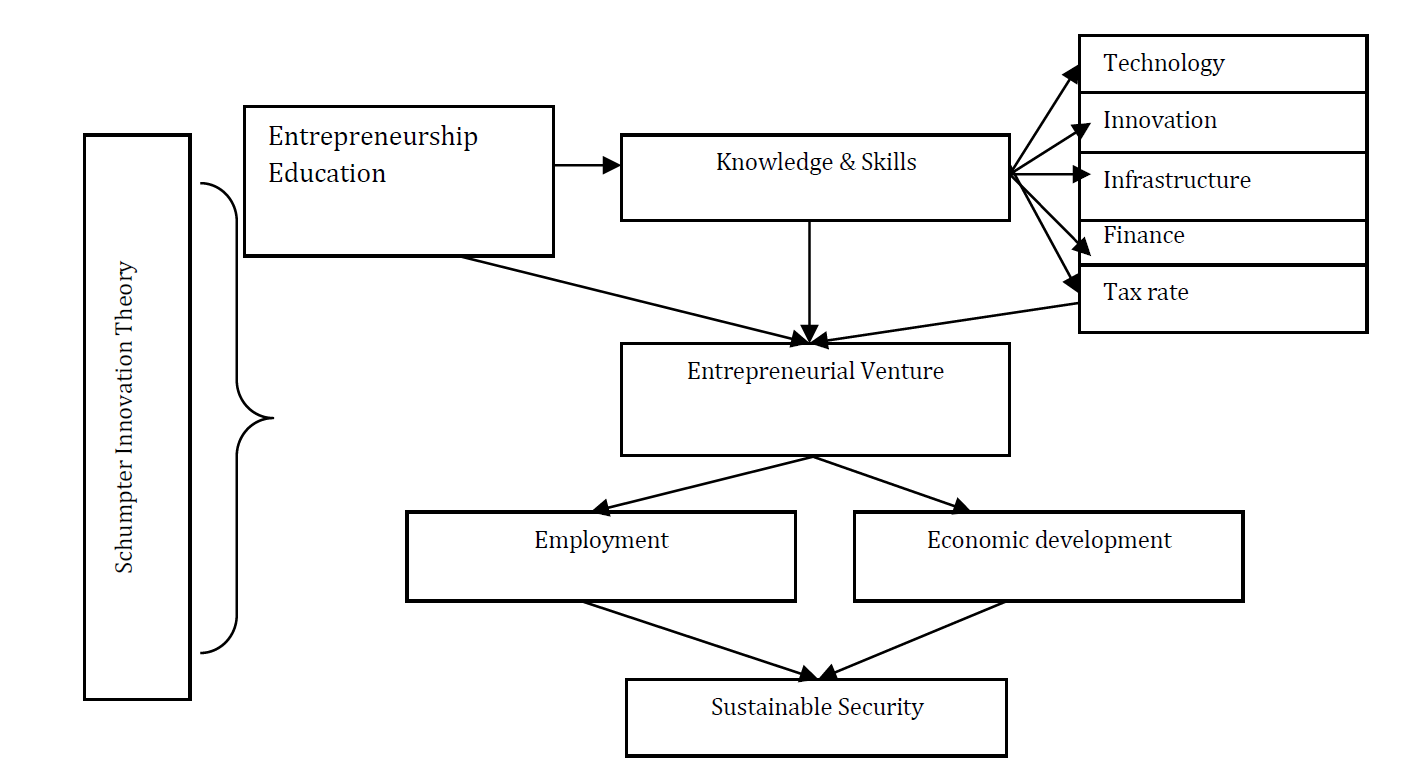
This study adopts the Schumpeterian innovation theory, which states that a Schumpeterian innovation entrepreneur is that economic actor who applies inventions and discoveries to produce newer and better goods which yield economic development and significantly ensure that fundamental changes in the economy take place in the process [31-32]. These innovations arising from new combinations are the systematic production of new, economically useful knowledge out of existing knowledge [26,32]. The implication of the above theory is that to be highly innovative, Entrepreneurs are highly dependent upon the knowledge infrastructure (educational facilities, technologies, social infrastructure etc.) and the supporting actors (the government, finance etc.). They are equally affected by the capabilities of the lecturers within innovation systems and rely heavily upon the channels through which knowledge is communicated, shared, or generated. Thus, the entrepreneurship education system provides the context of learning in terms of knowledge and capabilities shared through practicals, which are of paramount importance for the formation and development of entrepreneurship [32,33]. After acquiring new knowledge via technologically and well-experienced educators in the institutions, the entrepreneur acts as a disruptive, disequilibrium force, which drives wider processes of economic change, leading to economic growth and societal well-being (sustainable security). Ferreira, Reis, and Pinto: Malerba and McKelvey [32], and Śledzik [34] provided empirical justification for the theory in their studies establishing a correlation between the level of education and new product development in knowledge-based economies that invested massively in education, technology, and related growth elements.
Therefore, Schumpeter’s innovative model provides logical explanation that increase in entrepreneurship activities in the economy sustainably reduces unemployment and by extension insecurity situation [26]. As new businesses are established, unemployment reduces and sustainable security is achieved in the economy [26] and is therefore pertinent to this study.
Figure 1: A Theoretical Framework of Entrepreneurship Education as a Panacea to Sustainable Security
Source: Researchers' construction 2021
Theoretical Framework
Figure 1, is a theoretical framework representing the linkages between entrepreneurship education and sustainable security. The quest for innovation and better life pushes an individual to acquire Entrepreneurship education from the educational sector. This motivation results in the acquisition of new knowledge and skills. The new knowledge-intensive ventures from the educational sector require resources linked to the new ideas, insights, finance and technology, infrastructure, and the capacity to innovate. The availability of the resources mentioned above makes creating entrepreneurial innovation possible.
Development of knowledge and learning in relation to technological and innovative opportunities is needed for entrepreneurial activities. To this, the universities are required to play an important role in generating opportunities by creating advancements in new knowledge and technologies. Malerba and McKelvey [32]
The linkage between the continuous acquisition of entrepreneurship education and skill is the creation of entrepreneurial opportunities, which leads to economic development and a high rate of employment, and subsequently sustainable security in the system.
MATERIALS AND METHODS
This study adopted a quantitative descriptive research design. Using descriptive-quantitative research combines both descriptive and inferential statistical analyses, and the quantitative research paradigm gives greater objectivity and accuracy as it disallows authors' personal bias [35]. Data used on this study were collected from The Global Competitiveness Report, National Bureau of Statistics and other mainstream publications of the World Bank from 2007 to 2020.
Table 1: Operational Definition of Variables
Variable
Proxies
Sign
Measurement
Sources
Categorical Independent Variable
Continuous Independent Variables
Education
EDUC
the quantity and quality of the education system
GCI 2020
Technology
TECH
The private sector's capacity to generate and adopt new technologies/firm-level technology absorption
GCI [36]
Infrastructure
INFR
Quality of overall infrastructure.
GCI [36]
Tax Rate
TAXR
Total tax rate, % profits*
GCI [36]
Dependent
Variables
Unemployment
Skills
UNEMPLO
skill
Unemployment Rate In Nigeria
Quality of vocational training
National Bureau of Statistics GCI [36]
Compiled by Authors
Model Specification
In an attempt to examine the impact of entrepreneurship education on sustainable security in Nigeria, The models specified below form the framework for the study:
The estimation model for the above is as stated below:
UNEMPLO = ƒ(EDUC, TECH, INFR, TAXR,)et
(1)
This can be restated thus:
UNEMPLO = a0+a1LEDUC+a2LTECH+a3INFR+a4LTAXR+et
(2)
Where:
et: error term
a0-a6: parameter estimates/structure
UNEMPLO: Unemployment (a proxy of insecurity)
EDUC: inadequate education
TECH: poor technology absorption
INFR: Inadequate infrastructure
TAXR: unstabletax rate
Insecurity proxied by the unemployment rate assumes the position of a dependent variable and has a functional relationship with inadequate education, poor technology absorption, inadequate infrastructure, and unstable tax rate, which are the explanatory variables.
The operational definition of the variables used in this study is given in Table 1.
RESULTS AND DISCUSSION
Table 2 shows that the probability values of all the Shapiro-wilk tests carried out on all the dependent variables are more than the critical value of 0.05for this study. Hence, the normality assumption that the dependent variables were drawn from normal distribution has been met. The test result also indicates that the F-statistics of all the dependent variables are not significant at thecritical value of 0.05: hence the assumption of homogeneity of variance was also met.
Table 2: Shapiro-Wilk Tests of Normality
Parameters
Kolmogorov-Smirnova
Shapiro-Wilk
Statistic
df
Sig.
Statistic
Df
Sig.
Education
0.287
13
0.004
0.858
13
0.036
Technology
0.237
13
0.045
0.842
13
0.023
Infrastructure
0.203
13
0.146
0.822
13
0.013
Tax_Rate
0.443
13
0.000
0.504
13
0.000
Unemployment
0.225
13
0.071
0.856
13
0.134
Skills
0.172
13
0.200*
0.939
13
0.447
*. This is a lower bound of the true significance. A. Lilliefors Significance Correction
While Table 3 captures the descriptive statistics of the key variables in this study for the period 2007–2020. Insecurity proxied by unemployment is hindered greatly by problems in the entrepreneurial education system as the mean is the greatest 10.9692. Skills (for successful ventures) came second in terms of their influence on entrepreneurial education 3.5077. This is followed by technology and education numerically. Infrastructure came last with a mean of 2.3846. The mean for Tax Rate was 5.6308 with a higher standard deviation of 9.50635(signaling that the negative impact of the tax rate is higher than the benefits within the period under study). These figures are for the period 2007–2020
Table 3: Descriptive Statistics
Parameters
N
Range
Minimum
Maximum
Mean
Std. Deviation
Education
13
1.10
2.70
3.80
3.1154
0.34119
Technology
13
1.90
2.90
4.80
3.6615
0.74335
Infrastructure
13
1.20
2.00
3.20
2.3846
0.43941
Tax_Rate
13
25.90
1.10
27.00
5.6308
9.50635
Unemployment
13
17.50
5.10
22.60
10.9692
5.71845
Skills
13
4.40
1.60
6.00
3.5077
1.30987
Valid N (listwise)
13
-
-
-
-
-
Table 4 revealed the appropriateness of the model using Tests of Between-Subjects Effects statistic. The outcome of the result indicates that the model is a good fit for testing all the hypotheses because the F-statistic of all the dependent variables is significant at a 0.05 critical value. The table further reveals that the model used in testing the hypotheses accounted for approximately 84% of the changes that occurred in unemployment (insecurity) and 81% of the changes that occurred in skills (for successful ventures) required for the establishment of successful entrepreneurship venture when error terms have not been factored in. When error terms are considered, the impact of the model on the dependent variables becomes 76% and 71%, unemployment, and skills, respectively. The model has the greatest impact on unemployment (insecurity), followed by skills for a successful venture.
Table 4: Tests of Between-Subjects Effects
Source
Dependent Variable
F
Sig.
R Squared
Adjusted R Squared
Corrected Model
Unemployment
10.458
.003
0.839
0.759
Skills
8.247
.006
0.805
0.707
Source: Authors f. Computed using alpha = 0.05
Table 5 shows the result of the multivariate analysis carried out to examine the influence of entrepreneurship education on sustainable national security.
Dependent variable:unemployment (insecurity)
Method: multivariate multiple regression
Sample: 2007-2019
No of observation: 13
R2 = 0.839
Adjusted R2 = 0.759
F-Statistics = 10.458
Prob (F-Stat) = 0.003
The result indicates that the influence of entrepreneurship education on national security is positive 8.060 and is statistically not significant at 0.362 percent. The implication is that unemployment (insecurity) will increase by 8.060 when all the other variables are constant. The regression coefficient of poor technological absorption and unstable tax rate records a positive sign and is statistically significant at 0.039 and 0.002, respectively. That suggests an inherent positive relationship exists between poor technological absorption, unstable tax rate, and insecurity. This is akin to apriori expectation: if poor technological absorption and unstable tax rate increase by 1 unit, it is clear that the unemployment rate (insecurity) would also increase by 5.609 and 0.411 units, respectively. This is so because sustainable security is eluded as the nation continues to lack adequate technological absorption and a stable tax rate. Also, our empirical evidence suggests that as the rate of inadequate infrastructure decreases, unemployment (insecurity) increases over the years by -13.102 units. Since the higher the level of inadequate infrastructure variable, the lower the level of unemployment (insecurity), the results are actually in the opposite direction we had hypothesized. The estimated coefficient of -13.102 for infrastructure shows that a unit decrease in inadequate infrastructure will cause a 13 percent increase in unemployment (insecurity), meaning that adequate infrastructure increases unemployment (insecurity): this is contrary to our a priori expectation.
From the results above, the R2 is 0.839, indicating that about 84 percent variation in unemployment (insecurity) was accounted for by all the variables (inadequate education, poor technology absorption, inadequate infrastructure, and unstable tax rate). At the same time, the error term captures the remaining variation. Therefore, we conclude that the estimated model is of good fit and reliable for making policy decisions. The f-statistics is 10.458, and the p-value for the f statistics is 0.003, which is less than 0.05 at a 5 percent significant level; therefore, we conclude that our estimated model is statistically significant. Therefore, the paper concludes that entrepreneurship education significantly influences employment (a proxy of national security) in Nigeria.
Conclusively, the study found that poor technological absorption and the unstable tax rate have a positive relationship with insecurity, implying that poor technological absorption and unstable tax rate are major causes of insecurity proxied by unemployment in Nigeria. This is in line with the findings of Sanjo, Eze and Worimegbe [22] Ogbondah and Nwogu [25] Kaizer [8] Diyoke [9] who found that technological-based entrepreneurship education framework is a tool for securing employment, wealth creation, youth empowerment, peaceful society, and economic development.
It is established that this study examined the influence of entrepreneurship education on security in Nigeria. The results of the analysis emerging from the study indicate that there exists a functional affiliation between entrepreneurship education and sustainable security and also affirms that the adoption of entrepreneurship education in Nigeria tertiary institutions does not wholesomely translate to the establishment of a successful entrepreneurial venture as a result of the problems associated with education in the country.
The paper, therefore, recommends that Nigeria needs an improved and extended pedagogic entrepreneurial educational system. This environment is conducive to innovative activity in terms of institutional policies to foster employment and sustainable security. As urgent, the government should identify forces that militate against entrepreneurship education (poor technological absorption, poor infrastructural facilities, unstable tax rate, inadequate education etc) and deal with them accordingly to enhance the establishment of successful entrepreneurial ventures and curb insecurity in Nigeria.
REFERENCE
Osakwe, R.N. (2015). Entrepreneurship education in Delta State tertiary institution as a means of achieving national growth and development. International Journal of Higher Education, 4(1), 182–186.
Mbiewa, O.L. (2011). Entrepreneurship education in Nigerian education institution. Journal of Technology and Education in Nigeria, 16(2). https://www.ajol.info/index.php/joten/article/view/78583
Sulaiman, U.O. (2017). Challenges of entrepreneurship education in Nigeria universities. https://olabisiblog.wordpress.com/2017/07/08/challenges-of-entrepreneurship-education-in-nigeria-universities/
GEI. (2019). The global entrepreneurship index 2019. Global Entrepreneurship and Development Institute, Washington DC. https://doi.org/10.13140/RG.2.2.17692.64641
GPI. (2021). Global peace index 2021: Measuring peace in a complex world. Institute for Economics and Peace, Sydney. http://visionofhumanity.org/reports
GTI. (2020). Global terrorism index 2020: Measuring the impact of terrorism. Institute for Economics and Peace, Sydney. http://visionofhumanity.org/reports
Unachukwu, G.O. (2009). Issues and challenges in the development of entrepreneurship education in Nigeria. An International Multi-Disciplinary Journal, 3(5), pp213–226.
Kaizer, A.N. (2017). Entrepreneurship education: A driving force against youth unemployment for national security in Nigeria. Nigerian Journal of Business Education, 4(2),pp 338–348.
Diyoke, C.I. (2016). Entrepreneurship education in Nigerian tertiary institutions: Implication for security and national development. International Journal of Management and Applied Science, 2(11), pp178–181.
Olanipekun, W.D., Brimah, A.N. and Rabiu, R.O. (2015). Entrepreneurial and vocational education revolution: A catalyst for sustainable development. Arabian Journal of Business and Management Review, 4(12),pp 32–40.
Anho, J.E. (2014). Entrepreneurship education: A panacea for unemployment poverty reduction and national insecurity in developing and underdeveloped countries. American International Journal of Contemporary Research, 4(3), pp124–136.
Chukwuemeka, E., Chiekezie, O. and Okolo, P. (2012). Government policy and entrepreneurship in Nigeria: The nexus. Faculty of Management Science Conference Proceedings, Nnamdi Azikiwe University Awka, pp296–309.
Alabi, T., Alanana, O.O. and Bahal, M. (2014). Entrepreneurship education: A panacea to graduate unemployment in Nigeria. Journal of Sustainable Development in Africa, 16(3), pp36–44.
GEI. (2018). Global entrepreneurship and development index 2018. http://thegedi.org/global-entrepreneurship-and-development-index
Stevenson, H. (2007). A perspective on entrepreneurship. Harvard Business Review, pp103–108.
Nwekeaku, C. (2013). Entrepreneurship education and challenges to Nigerian universities. Journal of Education and Practice, 4(3), 51–58.
Timmons, H.A., Eisenman, E. and O’Connor, A. (2015). Entrepreneurship education: A global consideration from practice to policy around the world. WISE Research Report Executive Summary, Qatar Foundation. https://www.abacademies.org/articles
Ojeifo, S.A. (2012). Entrepreneurship education in Nigeria. Journal of Education and Practice, 3(14), 78–82.
Akinbami, C.A. (2011). Preliminary issues in entrepreneurship education development: Nigeria context. Centre for Industrial Research and Development, Obafemi Awolowo University, Ile-Ife.
Okoro, P.E. (2018). Strategies for curbing insecurity in Nigeria through business education programme. International Journal of Innovative Education Research, 6(3), 40–46.
Ohagwu, G.C., Ugwu, I.V. and Ezeilo, C.A. (2021). Improving entrepreneurship skill acquisition among tertiary institution students for sustainable national security in Enugu State. International Journal of Vocational and Technical Education Research, 7(2), 1–12.
Sanjo, O.M., Eze, B.U. and Worimegbe, P. (2020). Effect of entrepreneurial education on the security challenges in Nigeria. Conference Proceedings, Lagos State University, 135–139. https://www.researchgate.net/publication/346487187
Edokpolor, J.E. (2020). Entrepreneurship education and sustainable development: Mediating role of entrepreneurial skills. Asia Pacific Journal of Innovation and Entrepreneurship, 14(3), 329–339.
Onyido, J.A. and Duru, D.I. (2019). Entrepreneurship education for sustainable development in Nigeria. British Journal of Education, 7(2), 58–72.
Ogbondah, L. and Nwogu, G.A.I. (2017). Entrepreneurship education and sustainable youth empowerment in Nigeria. International Journal of Education and Evaluation, 3(2), 43–53.
Sofoluwe, A.O., Shokunbi, M.O., Raimi, L. and Ajewole, T. (2013). Entrepreneurship education as a strategy for boosting human capital development and employability in Nigeria. Journal of Business Administration and Education, 3(1), 25–50.
Orikpe, E.A. (2013). Education and national security: Changes and the way forward. Journal of Educational and Social Research, 3(10), 53–59.
Ossai, A.G. and Nwalado, E.N. (2012). Entrepreneurship education: A panacea for sustainable development in Nigeria. Journal of Resourcefulness and Distinction, 1(1), 78–86.
Olugbeko, S.O. and Asagha, E.N. (2014). Quality education as a panacea to global security challenges: A case study of Nigeria. International Conference on Arts Economics and Management Proceedings, 47–49.
Ogbuanya, T.C. and Ofonmbuk, M. (2015). Achieving youth employment and national security in Nigeria: TVET imperatives. Journal of Education and Practice, 6(33), 157–161.
Schumpeter, J.A. (1934). The theory of economic development. Harvard University Press.
Malerba, F. and McKelvey, M. (2018). Knowledge-intensive innovative entrepreneurship integrating Schumpeter evolutionary economics and innovation systems. Small Business Economics, 54, 503–522. https://doi.org/10.1007/s11187-018-0060-2
Schumpeter, J.A. (1942). Capitalism socialism and democracy (3rd ed.). George Allen and Unwin.
Śledzik, K. (2013). Schumpeter’s view on innovation and entrepreneurship. In S. Hittmar (Ed.), Management: Trends in theory and practice. University of Žilina. https://www.researchgate.net/publication/256060978
Wahua, L. and Ezeilo, F.I. (2021). Effects of environmental social and governance imperatives on the performance of selected listed mortgage banks in Nigeria. Journal of Global Economics Management and Business Research, 13(4), 34–48.
GCI. (2018). The global competitiveness report 2018. World Economic Forum. www.weforum.org/gcr
License
Creative Commons Attribution-NonCommercial-NoDerivatives 4.0 International License
All papers should be submitted electronically. All submitted manuscripts must be original work that is not under submission at another journal or under consideration for publication in another form, such as a monograph or chapter of a book. Authors of submitted papers are obligated not to submit their paper for publication elsewhere until an editorial decision is rendered on their submission. Further, authors of accepted papers are prohibited from publishing the results in other publications that appear before the paper is published in the Journal unless they receive approval for doing so from the Editor-In-Chief.
Himalayan Journal of Economics and Business Management open access articles are licensed under a Creative Commons Attribution-Share A like 4.0 International License. This license lets the audience to give appropriate credit, provide a link to the license, and indicate if changes were made and if they remix, transform, or build upon the material, they must distribute contributions under the same license as the original.
Recommended Articles
Research Article
Resonant leadership and its role in achieving organizational success: An Exploratory study of the opinions of a sample of employees of the Baghdad Municipality-Baghdad Water Department-Southern Reservoir
Muthana M. Saeed
Download PDF
Cite
x
APA
Saeed, M. M. (2026). Resonant leadership and its role in achieving organizational success: An Exploratory study of the opinions of a sample of employees of the Baghdad Municipality-Baghdad Water Department-Southern Reservoir. Himalayan Journal of Economics and Business Management, 7(2), 1-14.
MLA
Saeed, Muthana M.. "Resonant leadership and its role in achieving organizational success: An Exploratory study of the opinions of a sample of employees of the Baghdad Municipality-Baghdad Water Department-Southern Reservoir." Himalayan Journal of Economics and Business Management 7.2 (2026): 1-14.
Chicago
Saeed, Muthana M.. "Resonant leadership and its role in achieving organizational success: An Exploratory study of the opinions of a sample of employees of the Baghdad Municipality-Baghdad Water Department-Southern Reservoir." Himalayan Journal of Economics and Business Management 7, no. 2 (2026): 1-14.
Harvard
Saeed, M. M. (2026) 'Resonant leadership and its role in achieving organizational success: An Exploratory study of the opinions of a sample of employees of the Baghdad Municipality-Baghdad Water Department-Southern Reservoir' Himalayan Journal of Economics and Business Management 7(2), pp. 1-14.
Vancouver
Saeed MM. Resonant leadership and its role in achieving organizational success: An Exploratory study of the opinions of a sample of employees of the Baghdad Municipality-Baghdad Water Department-Southern Reservoir. Himalayan Journal of Economics and Business Management. 2026 Jul;7(2):1-14.
Download PDF
Research Article
Modelling Structure Job Quality, Job Design and Job Satisfaction
Moch Nurhadi,
...
Avi Sunani
Published: 30/08/2022
Download PDF
Cite
x
APA
Nurhadi, M., Bisyri Effendi, M., Saiful Ulum, A. & Sunani, A. (2022). Modelling Structure Job Quality, Job Design and Job Satisfaction. Himalayan Journal of Economics and Business Management, 3(2), 1-4.
MLA
Nurhadi, Moch, et al. "Modelling Structure Job Quality, Job Design and Job Satisfaction." Himalayan Journal of Economics and Business Management 3.2 (2022): 1-4.
Chicago
Nurhadi, Moch, Moch Bisyri Effendi, Achmad Saiful Ulum and Avi Sunani. "Modelling Structure Job Quality, Job Design and Job Satisfaction." Himalayan Journal of Economics and Business Management 3, no. 2 (2022): 1-4.
Harvard
Nurhadi, M., Bisyri Effendi, M., Saiful Ulum, A. and Sunani, A. (2022) 'Modelling Structure Job Quality, Job Design and Job Satisfaction' Himalayan Journal of Economics and Business Management 3(2), pp. 1-4.
Vancouver
Nurhadi M, Bisyri Effendi M, Saiful Ulum A, Sunani A. Modelling Structure Job Quality, Job Design and Job Satisfaction. Himalayan Journal of Economics and Business Management. 2022 Jul;3(2):1-4.
Download PDF
Research Article
Influence of Leadership on Poverty Reduction in the Devolved Government in Trans-Nzoia County, Kenya
Kinisu Sifuna,
...
Peter Simotwo
Published: 30/06/2021
Download PDF
Cite
x
APA
Sifuna, K., Lwangale, D. W., Simotwo, P., Sifuna, K., Lwangale, D. W. & Simotwo, P. (2021). Influence of Leadership on Poverty Reduction in the Devolved Government in Trans-Nzoia County, Kenya. Himalayan Journal of Economics and Business Management, 2(1), None-None.
MLA
Sifuna, Kinisu, et al. "Influence of Leadership on Poverty Reduction in the Devolved Government in Trans-Nzoia County, Kenya." Himalayan Journal of Economics and Business Management 2.1 (2021): None-None.
Chicago
Sifuna, Kinisu, David W. Lwangale, Peter Simotwo, Kinisu Sifuna, David W. Lwangale and Peter Simotwo. "Influence of Leadership on Poverty Reduction in the Devolved Government in Trans-Nzoia County, Kenya." Himalayan Journal of Economics and Business Management 2, no. 1 (2021): None-None.
Harvard
Sifuna, K., Lwangale, D. W., Simotwo, P., Sifuna, K., Lwangale, D. W. and Simotwo, P. (2021) 'Influence of Leadership on Poverty Reduction in the Devolved Government in Trans-Nzoia County, Kenya' Himalayan Journal of Economics and Business Management 2(1), pp. None-None.
Vancouver
Sifuna K, Lwangale DW, Simotwo P, Sifuna K, Lwangale DW, Simotwo P. Influence of Leadership on Poverty Reduction in the Devolved Government in Trans-Nzoia County, Kenya. Himalayan Journal of Economics and Business Management. 2021 Jan;2(1):None-None.
Download PDF
Research Article
Analysis Of the Influence of Leadership Style and Organizational Culture on Teacher Performance State Vocational School 4 Pontianak City
Yesti Rahmadani,
...
Ilzar Daud
Published: 07/08/2024
Download PDF
Cite
x
APA
Rahmadani, Y., Fauzan, R., Rosnani, T. & Daud, I. (2024). Analysis Of the Influence of Leadership Style and Organizational Culture on Teacher Performance State Vocational School 4 Pontianak City. Himalayan Journal of Economics and Business Management, 5(2), 1-10.
MLA
Rahmadani, Yesti, et al. "Analysis Of the Influence of Leadership Style and Organizational Culture on Teacher Performance State Vocational School 4 Pontianak City." Himalayan Journal of Economics and Business Management 5.2 (2024): 1-10.
Chicago
Rahmadani, Yesti, Rizky Fauzan, Titik Rosnani and Ilzar Daud. "Analysis Of the Influence of Leadership Style and Organizational Culture on Teacher Performance State Vocational School 4 Pontianak City." Himalayan Journal of Economics and Business Management 5, no. 2 (2024): 1-10.
Harvard
Rahmadani, Y., Fauzan, R., Rosnani, T. and Daud, I. (2024) 'Analysis Of the Influence of Leadership Style and Organizational Culture on Teacher Performance State Vocational School 4 Pontianak City' Himalayan Journal of Economics and Business Management 5(2), pp. 1-10.
Vancouver
Rahmadani Y, Fauzan R, Rosnani T, Daud I. Analysis Of the Influence of Leadership Style and Organizational Culture on Teacher Performance State Vocational School 4 Pontianak City. Himalayan Journal of Economics and Business Management. 2024 Apr;5(2):1-10.
Ezeilo, F. I. & Okolobi, A. N. (2022). Entrepreneurship Education and Sustainable Security in Nigeria. Himalayan Journal of Economics and Business Management, 3(2), 1-7.
MLA
Ezeilo, Florence I. and Augustine N. Okolobi. "Entrepreneurship Education and Sustainable Security in Nigeria." Himalayan Journal of Economics and Business Management 3.2 (2022): 1-7.
Chicago
Ezeilo, Florence I. and Augustine N. Okolobi. "Entrepreneurship Education and Sustainable Security in Nigeria." Himalayan Journal of Economics and Business Management 3, no. 2 (2022): 1-7.
Harvard
Ezeilo, F. I. and Okolobi, A. N. (2022) 'Entrepreneurship Education and Sustainable Security in Nigeria' Himalayan Journal of Economics and Business Management 3(2), pp. 1-7.
Vancouver
Ezeilo FI, Okolobi AN. Entrepreneurship Education and Sustainable Security in Nigeria. Himalayan Journal of Economics and Business Management. 2022 Jul;3(2):1-7.


 Download PDF
 Download XML