Contents
Download PDF
pdf Download XML
1696 Views
330 Downloads
Share this article
Research Article | Volume 2 Issue 2 (July-Dec, 2021) | Pages 1 - 8
The Influence of Ownership Structure, Debt Policy and Company Growth Toward Company Value through Financial Performance (Empirical Study on Manufacturing Company Listed on Indonesia Stock Exchange)
 ,
 ,
1
Management Science Doctoral Program Student, Sekolah Tinggi Ilmu Ekonomi Indonesia, Indonesia
2
Sekolah Tinggi Ilmu Ekonomi Indonesia, Indonesia
Under a Creative Commons license
Open Access
Received
June 18, 2021
Revised
July 3, 2021
Accepted
Aug. 29, 2021
Published
Sept. 20, 2021
Abstract

This study was conducted on manufacturing companies listed on Indonesia Stock Exchange in 2013-2019. This study aimed to determine the effect of capital structure and company growth toward the company value with profitability as an intervening variable. The population in this study are169manufacturing companies. Samples gathered from 24 companies determined by purposive sampling method with predetermined criteria. The analysis technique used was path analysis with regression and the classical assumption test was carried out first. Testing the intervening variables used as the clausal step strategy and the Sobel test. The results of this study indicate that 1) Institutional Ownership (KI) has a significant effect on Company Value (NP) 2) Managerial Ownership (KM) has a significant effect on Company Value (NP) 3) Debt Policy (KH) has a significant effect on Company Value (NP) 4) Company Growth (PP) has a significant effect on Company Value (NP) 5) Institutional Ownership (KI) has a significant effect on Company Value (NP) through Financial Performance (KK) 6) Managerial Ownership (KM) has a significant effect on Company Value (NP) through Financial Performance (KK) 7) Debt Policy (KH) has no effect on Company Value (NP) through Financial Performance (KK) 8) Company Growth (PP) has a significant effect on Company Value (NP) through Financial Performance (KK).

Keywords
INTRODUCTION

In the practice of modern financial management, the leader or manager of a company is required to be principal in achieving company goals. The company's goal has a relationship between a manager in managing his company in order to achieve an increase in company performance, in this case is financial performance. Financial performance is related to company value. Company value is considered important because in this case the higher the value of the company it will affect the prosperity of shareholders [1]. According to Sartono [2], he stated that the value of the company can be determined based on the value of its own capital and the value of debt. This can show a positive signal for the company, if the company is managed properly, it is able to continue to grow and compete. In this stage, the owner delegates authority to the manager or agent to take action in pursuing the company's goals. The value of the company during the observation period decreased so that the company became unable to increase the value of the company which was the purpose of establishing a company.


In the research done by Sofyaningsih and Hardiningsih [3], stated that a company that has high institutional ownership can indicate its ability to control the management of a company, so that in its operations, the company runs efficiently and can make the best use of company assets. Institutional ownership will encourgae maximum supervision. The same results also obtained in research done by Nuraina [4], Borolla [5], stated that institutional ownership has an influence toward company value. But, different from Putri and Chabachib [6,7], Warapsari and Suaryana [8], stated that institutional ownership has no influence to company. Whereas Ruan and Tian [9], stated that managerial ownership has a positive influence toward company value which means that the higher the manageria ownership of the company, the higher the company value. Different findings was done in Suastini et al. [10], Sukirni [11] and Jusrian and Rahardjo [12], research, they stated that managerial ownership has no influence on company value.


Research about debt policy conducted by Sukirni [11], Yuniati et al. [13], Hamidy et al. [14], Bukit [15], explained that debt policy has an influence on company value. Different findings was done by Putri and Chabachib [6], Mangantar and Sumanti [16], Mardiyati [17], Sofyaningsih and Hardiningsih [3], stated that there is no effect of deby policy on company value.


In research conducted by Dewi et al. [18], Dhani and Utama [19], Suastini et al. [10], Sofyaningsih and Hardiningsih [3], stated that company growth has an influence on company value. Different findings put forward by Pakpahan, Andrian [20], Yuanita et al. [21], they stated that the company growth has no influence on company value.


Research conducted by Rasyid et al. [22], Mahpudin and Suparno [23] and [24], stated that profitability influenced the company value. But different findings was stated by Herawati [25], Rusiah et al. [26], Thaib Dewantoro [27], They said that profitability did not influence the company value. Based on problems faced by company about the decreasing of manufacturing company value which was recorded at BEI since 2013-2019 and the controversion in previous studies, this research aimed to test the effect of ownership structure, debt policy, company growth, financial performance and company value in manufacturing company.


Literature Review and Hypothesis

The Influence of Institutional Ownership on Company Value: Institutional ownership has a positive effect on company value. The greater the institutional ownership, the more efficient the utilization of company assets which is expected to act as a prevention against waste and profit manipulation by management so that it will increase the value of the company [11].


Nuraina [4], and Borolla [5], stated that the institutional ownership has a significanct positive influence toward the company value. But, Sofyaningsih and Hardiningsih [3] and Damayanti and Suartana [28], stated that companies that have high institutional ownership indicate their ability to control the management.


  • H1: There is a significant influence of institutional ownership on the manufacturing company’s value listed on BEI


Influence of Managerial Ownership on Company Value

Managerial ownership has a positive and significant influence on company value. This showed that the increasing of managerial ownership will increase the company value [29].


Managerial ownership has a positive and significant influence on company value. This showed that the increasing of managerial ownership will increase the company value [30].


  • H2: There is a significant influence of ownership on manufacturing company’s value listed on BEI

Influence of Debt Policy on Company Value

Debt policy is a company's funding policy produced by external parties. Some companies consider that the use of debt is better than issuing new shares. It means that the debt policy that is carried out, the higher the company value obtained. The company value will be maximized if the company uses the debt which is called the corner optimum debt decision.


Brigham dan Houston [1], think that the use of debt (leverage) will increase company value, due to the debt interest cost which reduce the tax expenses.Yuniati et al., [13], Hamidy et al. [14], Bukit [15], stated that the debt policy has a positive and significant influence on company value.


  • H3: There is a significant influence of debt policy on manufacturing company’s value listed on BEI


Iinfluence of Company Growth on Company Value

The company growth is a goal of every internal and external party of the company, because with the growth of the company, it can give a sign for the development of the company. The company growth can be measured using changes in total sales and changes in total assets. The greater the expected assets, the greater the operational results generated by the company, meaning that the higher the asset growth rate, the higher the company value.


Rasyid et al. [22], Hestinoviana et al. [31], Nasihahand Widyarti, claimed that the company growth has a positive and significant influence on company value.


  • H4: There is a significant influence of company growth on manufacturing company’s value listed on BEI


Influence of Institutional Ownership on Company Value

The ownership structure, especially institutional ownership, is the most important part for every company in conducting business with the aim of maximizing the value of the company's ownership shares, or maximizing the share price. With a high institutional ownership, company will be able to increase the value of the company through a company's financial performance such as the profitability achieved by the company, so that it can increase the company's stock price which results in the company's value increasing as well.


Putra, Wulandari et al. [32], Nurkhin et al. [33], claimed that the institutional ownership indirectly influenced the company value (PBV) through financial performace (ROA). 


  • H5: There is a significant influence of institutional ownership on manufacturing company’s value listed on BEI


Influence of Managerial Ownership on Company Value Through Financial Performance

Managerial ownership in company is a crucial part for every company to conduct business ventures with the aim of maximizing financial performaces. A good financial performaces will determine the company value.


Putra, Ramadhani, Wahyudi and Pawestri [34], stated that the managerial ownership indirectly influenced the company value (PBV) through financial performace (ROA). 


  • H6: There is a significant influence of institutional ownership through financial performance on manufacturing company’s value listed on BEI


Influence of Debt Policy on Company Value Through Financial Performance

Trade-off theory on capital structure explained that, company with small risk tend to use bigger debt for operational cost and investigaation, one of its criteria is company with high profit. In another name, it is called profitable, which means that the company has a high optimism to choose the bigger debt alternative. This is because the company has financial strength and considered that debt should be used as another option to keep increasing company’s profitability.


Mardiyati [17], Andrian [20], Hamidy et al., [14], stated about the influence of debt policy on company value through financial performance. The higher the company's debt policy as operational, the higher the company's stock price due to increased profits.


  • H7: There is a significant influence of debt policy through financial performance on manufacturing company’s value listed on BEI


Influence of Company Growth on Company Value Through Financial Performance

The growth of the company can be described by the growth of assets owned by the company. Assets show the assets used for the company's operational activities. The higher the assets owned by the company can be expected as greater results obtained from the operations generated by the company through its financial performance in the form of profitability. An increase in assets followed by an increase in operating results or profitability will further increase the confidence of outsiders in the company. So the higher the growth rate of assets, the higher the value of the company.


Mahendra et al., [35], Kusumajaya [36], Andrian [20], Utomo [37], stated that the company growth has a positive and significant influence on company value through financial performace/profitability.


  • H8: There is a significant influence of company growth through financial performance on manufacturing company’s value listed on BEI

MATERIALS AND METHODS

Population is a generalization of área which consist of object/subject and has a certain characteristic and quality which have been set to be studied and then concluded [38]. Population used in this research are all the manufacturing Company listedon BEI since 2013-2019, which in total there are 168samples. There are 24 companies based on the sample’s criteria.


Sample is a part of the characteristic which is owned by the population [38]. The sampling technique used in this research is saturated sampling. This is in line with Sugiyono [38], which stated that saturated sampling is a technique to determine sample where the part of the population is used as the sample.


Operational Variable Definition

Company value is the result of financial decisions which include investment decisions, funding decisions and dividend policies [30]. Every companies’s dream are to have a high company value. The higher the level of corporate governance on the value of the company, it will build a good image for investors [11]. In this research, researcher used Price to Book Value (PBV) to measure company value. The high ratio of Price to Book Value(PBV)indicates that the company have created a good value [39].


Financial performace of the company proxied by ROA, where this ratio is used to measure the rate of return of assest [40].


Institutional ownership reffered in this study is based on the sum of the percentage of company shared from domestic and abroad. Institutional ownership is the party that has the task to supervise the performace of a company and the shares ownership which is owned by a certain agency or institution [41]. Debt policy which is used by the company can be seen on company’s DER value. DER value can be obtained using formula as follows [42]. The company growth variable is measured using the total change in asset (PTA). Dewi et al., [18], stated that company growth is a result obtained from the the difference between the total assets owned by the company in the current period and the previous period to the total assets of the previous period.


Data Analysis Technique

Descriptive Statistical Analysis: Sugiyono in Priyatno [43], stated that descriptive analysis is the analysis used to analyze data by describing or depicting data gathered without making the general conclusion. Descriptive statistical is related to explaining or just give a description about a picture of the data or condition of certain problems. In another words, descriptive statistical is used to explain the condition, symptom, or problem.


Inferential Statistical Analysis

In analyzing the research data, an inferential statistical analysis model can be used, namely the Path Analysis model, which is formed through a structural equation model or also called a structural model, namely if each endogenous variable is uniquely determined by a set of exogenous variables. The path analysis steps are


Path Diagram

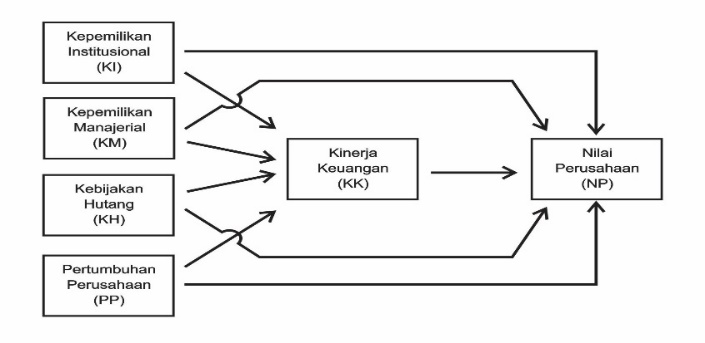
This study used a path diagram depicted by one-way arrows, one arrow shows the direct influence of an exogenous variable or a variable that causes an endogenous variable or an effect variable to occur. As for the two-way arrows show the relationship between exogenous variables. Based on the problems that are in accordance with the theoretical framework, the path diagram can be described as Figure 1.


Based on the path diagram abive, it can be the structural equation formulated for this study namely:


Where:


  • NP: Company Value

  • KK: Financial Performance

  • KI: Institutional Ownership

  • KM: Managerial Ownership 

  • KH: Debt Policy

  • PP: Company Growth

  • ρyx1, ... ρyx4, ρzx1, .... ρzx4 dan ρzy: Coefficient Standardize

  • ε: Standard Error


Steps to do the path analysis in this study are:


  • Classic Assumptions Test

  • Multicollinearity Test

  • Autocorrelation

  • Heteroscedasticity

  • Normality Test

  • Model Feasibility Test (Goodness of Fit)

  • Determinate Coefficient (R2)

  • F Statistic Test

  • Hypothesis Test


Intervening Variable Analysis Procedure

This study used sobel test as the analysis procedure with Sobel Test Calculator as an online helping tools which is aimed to see the indirect effect based on the z value provision which is z-value >1,96 at up-value < α = 0,05. Ghozali [44], stated that, if you want the results in a lare sample size and normally distributed coefficient values, the sobel test can be done with several steps as follows:


  • See the correlation between independent variable and intervening variable (coefficient A)

  • See the correlation between intervening variable and independent variable (coefficient B)

  • See the general error value of A

  • See the general error value of B

RESULTS

Influence of Institutional Ownership on Company Value

From the influence of institutional ownership on company value, it is obtained that the significance value of t is 0.010 < 0.05, it can be concluded that institutional ownership has a significant influence on company value in manufacturing companies listed on the BEI, so hypothesis 1 is accepted.


Influence of Managerial Ownership on Company Value

From the influence of managerial ownership on company value, it isobtained that the significance value of t is 0.003 < 0.05, it can be concluded that managerial ownership has a significant influence on company value in manufacturing companies listed on the BEI, so hypothesis 2 is accepted.


Influence of Debt Policy on Company Value

From the influence of debt policy on company value, it is obtained that the significance value of t is 0.000<0.05, it can be concluded that debt policy has a significant influence on company value in manufacturing companies listed on the BEI, so hypothesis 3 is accepted.


KERANGKA KONSEPTUAL

Figure 1: Path Diagram


Influence of Company Growth on Company Value

From the influence of company growth on company value, it is obtained that the significance value of t is 0.005<0.05, it can be concluded that company growth has a significant influence on company value in manufacturing companies listed on the BEI, so hypothesis 4 is accepted.


Influence of Institutional Ownership on Company Value through Financial Performance

From the influence of institutional ownership on company value through financial performance, it is obtained that the significance value of t is 2.102>1.654, it can be concluded that institutional ownership has a significant influence on company value through financial performance in manufacturing companies listed on the BEI, so hypothesis 5 is accepted.


Influence of Managerial Ownership on Company Value through Financial Performance

From the influence of managerial ownership on company value through financial performance, it is obtained that the significance value of t is 3.296 >1.654, it can be concluded that managerial ownership has a significant influence on company value through financial performance in manufacturing companies listed on the BEI, so hypothesis 6 is accepted.


Influence of Debt Policy on Company Value through Financial Performance

From the influence of debt policy on company value through financial performance, it is obtained that the significance value of t is -2.444<1.654, it can be concluded that debt policy has a significant influence on company value through financial performance in manufacturing companies listed on the BEI, so hypothesis 7 is accepted.


Influence of Company Growth on Company Value through Financial Performance

From the influence of company growth on company value through financial performance, it is obtained that the significance value of t is 2.281 >1.654, it can be concluded that company growth has a significant influence on company value through financial performance in manufacturing companies listed on the BEI, so hypothesis 8 is accepted.

DISCUSSION

Influence of Institutional Ownership on Company Value

The results of the analysis of the hypothesis test proved that there was a direct influence of institutional ownership (KI) on company value (NP). These results indicate that institutional ownership has a significant influence on company value. The negative correlation contained in the influence of institutional ownership variable on company value, means that large institutional ownership can reduce the company's stock price resulting in a decrease in company value and vice versa.


This result supports results by Nuraina [4], Sukirni [11], Borolla [5] and Damayanti and Suartana [28]. However, this is in contrast to Putri dan Chabachib [6], Suryani [7], Warapsari and Suaryana [8], which claimed that the institutional ownership has no influence on company value.


Influence of Managerial Ownership on Company Value

The results of the analysis of the hypothesis test proved that there was a direct influence of managerial ownership (KM) on company value (NP). It showed that the managerial ownership has a significant influence on company value. The negative correlation contained in the influence of managerial ownership variable on company value means that, large managerial ownership can reduce the company's stock price resulting in a decrease in company value.


This result supports results by Sofyaningsih and Hardiningsih [3], Sukirni [11], Ruan and Tian [9], Din and Javid [45]. However, this is in contrast to Suastini et al., [10], Jusrian and Rahardjo [12], Wardani and Hermuningsih [39], which claimed that the managerial ownership has no influence on company value.


Influence of Debt Policy on Company Value

The results of the analysis of the hypothesis test proved that there was a direct influence of debt policy (KH) on company value (NP). It showed that the debt policy has a significant influence on company value. The positive correlation contained in the influence of debt policy variable on company value means that, large debt policy can increase the company's stock price resulting in an increase in company value.


This result supports results by Yuniati et al. [13], Hamidy et al. [14] and Bukit [15]. However, this is in contrast toPutri dan Chabachib [6], Mangantar dan Sumanti [16], Mardiyati [17], which claimed that the debt policy has no influence on company value.


Influence of Company Growth on Company Value

The results of the analysis of the hypothesis test proved that there was a direct influence of company growth (PP) on company value (NP). It showed that the company growth has a significant influence on company value. The negative correlation contained in the influence of company growth variable on company value means that, large debt policy can decrease the company's stock price resulting in a decrease in company value.


This result supports results by Nasihahdan Widyarti, Dewi et al. [18], Hestinoviana et al. [31]. However, this is in contrast to Andrian [20], Pakpahan, Yuanita et al., [21], which claimed that company growth has no influence on company value.


Influence of Institutional Ownership on Company Value through Financial Performance

The results of the analysis of the hypothesis test proved that there was an indirect influence of institutional ownership (KI) on company value (NP) through financial performance (KK). This is because the institutional is able to maximize in controlling the company more thoroughly, thus enabling the management to make changes in improving the company's performance, in the end, the ownership of institutional shares can increase the value of the company because the performance of a company manager is able to manage the company well.


This result supports results by Alipour and Amjadi, Latham and Locke [46] and Nurkhin et al. [33]. However, this is in contrast to Listiyowati and Indarti [47], Azis, Julianti which claimed that of institutional ownership has no influence on company value through financial performance.


Influence of Managerial Ownership on Company Value through Financial Performance

The results of the analysis of the hypothesis test proved that there was an indirect influence of managerial ownership (KM) on company value (NP) through financial performance (KK). The result proved that managerial ownership has a positive influence on company value through financial performance. The higher the managerial ownership in the company, the higher the value of the company because a manager is able to take management policies with full responsibility. This is because a manager has maximized in managing the company more thoroughly, thus enabling the management to make changes in improving the company's performance because it is able to generate company value in front of investors which results in an increase in company value.


This result supports results by Wardani and Hermuningsih [39], Putra, Wahyudi and Pawestri [34]. However, this is in contrast to Puspaningrum [48], Wulandari et al. [32], Hakim and Priantinah [49], they did not find the influence of managerial ownership on company value through financial performance.


Influence of Debt Policy on Company Value through Financial Performance

The results of the analysis of the hypothesis test do not prove that there is an indirect influence of debt policy (KH) on company value (NP) through financial performance (KK). The results of hypothesis testing conducted in this study state that debt policy has no influence on company value through company performance.


This result does not support results by Mardiyati [17], Sudiyatno and Puspitasari [50] and Hamidy et al., [14]. However, this is in line with Pratama dan Wiksuana [51], Ardianto et al. [24], Sutrisno dan Yulianeu [52], they did not find the influence of debt policy on company value through financial performance.


Influence of Company Growth on Company Value through Financial Performance

The results of the analysis of the hypothesis test prove that there is an indirect influence of firm growth (PP) on firm value (NP) through financial performance (KK), then the hypothesis which stated that there is an influence of company growth (PP) on company value through the financial performance of manufacturing companies that listed on the BEI is accepted as correct. The results of this study indicate that the higher the company's growth achieved, it will be able to improve the company's financial performance which can have implications for increasing company value. The higher the value of the company, the higher the value of the shares outstanding


This result supports results byKusumajaya [36], Mahendra et al., [35] and Utomo [37]. However, this is in contrast to Dessyana, Nasihahdan Widyarti, Suastini et al. [10], they did not find the influence of company growth on company value through financial performance.

CONCLUSION

Partial institutional ownership has a significant influence on company value in manufacturing companies listed on BEI in 2013-2019. The results of this study indicate that high institutional ownership will increase the value of the company, because it will provide more supervision. So, it is able to minimize the occurrence of agency conflicts which is a positive signal to investors and this will have a good impact on the progress of the company in the future. 


Managerial ownership partially has a significant influence on company value in manufacturing companies listed on BEI in 2013-2019. The results of this study indicate that higher managerial ownership will increase company value, because an effective and efficient mechanism is able to overcome agency conflicts that occur due to interest between manager and owner. A structured increase in stock market value will provide capital gains for managers, so that managers get two sources of income at once, namely salaries/bonuses and capital gains. 


Debt policy partially has a significant influence on company value in manufacturing companies listed on the BEI in 2013-2019. The results of this study indicate that the use of higher debt will increase the value of the company, because the use of debt is considered by investors that the company has a good business prospects in the future.


The company's growth partially has a positive influence on the value of the company in manufacturing companies listed on the BEI in 2013-2019. This means that information that caused an increase in company growth caused by asset growth can provide a positive signal for investors because it provides high profits. It is good for investors who will invest and also beneficial for the value of the company.


Institutional ownership has a significant influence on company value through the financial performance of manufacturing companies listed on BEI in 2013-2019. The results of this study indicate that higher institutional ownership will increase the company's performance in achieving maximum profitability to increase the value of the company's shares.


Managerial ownership has a significant influence on company value through the financial performance of manufacturing companies listed on BEI in 2013-2019. The results of this study indicate that high managerial ownership will improve the performance of managers in carrying out their duties so that the target of achieving profit can run well, resulting an increase in company shares.


Debt policy has no influence on company value through the financial performance of manufacturing companies listed on BEI in 2013-2019. The results of this study indicate that the use of higher debt is not necessarily able to increase the company's profitability or company profits in the future.


The growth of the company has a significant influence on the value of the company through the financial performance of manufacturing companies listed on the BEI in 2013-2019. The results of this study indicate that growth has a direct influence on profitability which in turn affects firm value. When assets are increased, productivity and sales results are also increased, so it has an impact on increasing company profits, which in turn will have an impact on increasing company value. This means that profitability can support company growth in increasing company value.

REFERENCES
  1. Brigham, E.F. and J.F. Houston. Dasar-Dasar Manajemen Keuangan. Edisi 11, Buku 1, Salemba Empat, 2014.

  2. Sartono, A. Manajemen Keuangan Teori dan Aplikasi.Edisi 4, BPFE, 2014.

  3. Sofyaningsih, S. and P. Hardiningsih. “Struktur Kepemilikan, Kebijakan Dividen, Kebijakan Hutang dan Nilai Perusahaan.” Dinamika Keuangan dan Perbankan, vol. 3, no. 1, 2011, pp.68–87.

  4. Nuraina, E. “Pengaruh Kepemilikan Institusional dan Ukuran Perusahaan terhadap Kebijakan Hutang dan Nilai Perusahaan (Studi pada Perusahaan Manufaktur yang Terdaftar di BEI).” Akrual: Jurnal Akuntansi, vol. 4, no. 1, 2012, pp.51–70. https://doi.org/10.26740/jaj.v4n1.p51-70.

  5. Borolla, J.D. “Analisis Pengaruh Struktur Kepemilikan terhadap Nilai Perusahaan.” Jurnal Prestasi, vol. 7, no. 1, 2011, pp.11–24.

  6. Putri, G.A.P. and M. Chabachib. “Analisis Pengaruh Kepemilikan Institusional, Free Cash Flow, Investment Opportunity Set terhadap Nilai Perusahaan dengan Kebijakan Hutang sebagai Variabel Intervening.” Diponegoro Journal of Management, vol. 2, no. 2, 2013, pp.202–216. https://ejournal3.undip.ac.id/index.php/djom/article/view/9027/8773.

  7. Suryani, K.R. “Pengaruh Struktur Kepemilikan terhadap Nilai Perusahaan dengan Keputusan Keuangan sebagai Variabel Intervening pada Perusahaan dalam Industri Manufaktur yang Terdaftar di Bursa Efek Indonesia Tahun 2009.” Jurnal Wawasan Manajemen, vol. 4, no. 1, 2016, pp.75–90.

  8. Warapsari, A.A.A.U. and I.G.N.A. Suaryana. “Pengaruh Kepemilikan Manajerial dan Institusional terhadap Nilai Perusahaan dengan Kebijakan Utang sebagai Variabel Intervening.” E-Jurnal Akuntansi Universitas Udayana, vol. 16, no. 3, 2016, pp.2288–2315.

  9. Ruan, W. and G. Tian. “Managerial ownership and firm value: Evidence from china’s civilian-run firms.” Journal of Chinese Economic and Business Studies, vol. 5, no. 3, 2011, pp.73–92.

  10. Suastini, N.M. et al. “Pengaruh Kepemilikan Manajerial dan Pertumbuhan Perusahaan terhadap Nilai Perusahaan pada Perusahaan Manufaktur di Bursa Efek Indonesia.” E-Jurnal Ekonomi dan Bisnis Universitas Udayana, vol. 5, no. 1, 2016, pp.143–172.

  11. Sukirni, D. “Kepemilikan Manajerial, Kepemilikan Institusional, Kebijakan Dividen dan Kebijakan Hutang.” Accounting Analysis Journal, vol. 1, no. 2, 2012, pp.1–12. https://journal.unnes.ac.id/sju/index.php/aaj/article/view/703.

  12. Jusriani, I.F. and S.N. Rahardjo. “Analysis Profitabilitas, Kebijakan Dividen, Kebijakan Utang, dan Kebijakan Manajerial terhadap Nilai Perusahaan.” Jurnal Akuntansi Diponegoro, vol. 2, no. 2, 2013, pp.1–10.

  13. Yuniati, M. et al. “Pengaruh Kebijakan Dividen, Kebijakan Hutang, Profitabilitas, dan Struktur Kepemilikan terhadap Nilai Perusahaan.” Journal of Accounting, vol. 2, no. 2, 2016, pp.1–15.

  14. Hamidy, R.R. et al. “Pengaruh Struktur Modal terhadap Nilai Perusahaan dengan Profitabilitas sebagai Variabel Intervening pada Perusahaan Properti dan Real Estate di Bursa Efek Indonesia.” E-Jurnal Ekonomi dan Bisnis, vol. 4, no. 10, 2015, pp.665–682.

  15. Bukit, R.B. “Pengaruh Struktur modal terhadap nilai perusahaan melalui profitabilitas: Analisis data panel perusahaan manufaktur di bursa efek Indonesia.” Jurnal Keuangan dan Bisnis, vol. 4, no. 3, 2012, pp.205–218.

  16. Mangantar, M. and J.C. Sumanti. “Analisis Kepemilikan Manajerial, Kebijakan Hutang dan Profitabilitas terhadap Kebijakan Dividen dan Nilai Perusahaan Manufaktur yang Terdaftar di BEI.” Jurnal Riset Ekonomi, Manajemen, Bisnis dan Akuntansi, vol. 3, no. 1, 2015, pp.1141–1151. https://doi.org/10.35794/emba.v3i1.7928.

  17. Mardiyati, U. “Pengaruh Kebijakan Dividen, Kebijakan Hutang dan Profitabilitas terhadap Nilai Perusahaan yang Terdaftar di Bursa Efek Indonesia Periode 2005–2010.” Jurnal Riset Manajemen Sains Indonesia (JRMSI), vol. 8, no. 4, 2012, pp.448–456.

  18. Dewi, P.Y.S.D. et al. “Pengaruh Struktur Modal, Pertumbuhan Perusahaan dan Profitabilitas terhadap Nilai Perusahaan pada Perusahaan LQ45 di BEI Periode 2008–2012.” E-Jurnal S1 Ak Universitas Pendidikan Ganesha, vol. 4, no. 4, 2014, pp.58–70.

  19. Dhani, I.P. and A.G.S. Utama. “Pengaruh Pertumbuhan Perusahaan, Struktur Modal, dan Profitabilitas terhadap Nilai Perusahaan.” Jurnal Riset Akuntansi dan Bisnis Airlangga, vol. 2, no. 1, 2017, pp.135–146. https://doi.org/10.31093/jraba.v2i1.28.

  20. Andrian, J. “Pengaruh Struktur Modal, Pertumbuhan Perusahaan, Capital Expenditure dan Insentif Manajer.” Jurnal Bisnis Strategi, vol. 21, no. 2, 2012, pp.18–49.

  21. Yuanita, Missy, Budiyanto and S. Riyadi. "Influence of capital structure, size and growth on profitability and corporate value." International Journal of Business and Finance Management Research, 2016.

  22. Rasyid, A. et al. "Effect of ownership structure, company size and profitability on dividend policy and manufacturing company’s value in indonesia stock exchange." Australian Journal of Basic and Applied Sciences, vol. 9, no. 20, 2015, pp. 618–624.

  23. Mahpudin, E. and Suparno. "Faktor Faktor Yang Mempengaruhi Nilai Perusahaan (Studi empiris Pada Perusahaan Manufaktur yang terdaftar di Bursa Efek Indonesia)." Jurnal Riset Keuangan dan Akuntansi, vol. 2, no. 2, 2016, pp. 56–75. https://doi.org/10.25134/jrka.v2i2.456.

  24. Ardianto, M.J. et al. "Pengaruh Kepemilikan Institusional, DER, ROA, Dan Current Ratio Terhadap Nilai Perusahaan Dengan Kebijakan Dividen Sebagai Variabel Intervening (Studi Pada Perusahaan Manufaktur di BEI Periode Tahun 2011–2015)." Journal Universitas Diponegoro, vol. 8, no. 2, 2017, pp. 1–10.

  25. Herawati, T. "Pengaruh Kebijakan Dividen, Kebijakan Hutang Dan Profitabilitas Terhadap Nilai Perusahaan." Jurnal Ekonomi Bisnis Universitas Negeri Padang, vol. 2, no. 1, 2014, pp. 1–13.

  26. Rusiah, N. et al. "Pengaruh Struktur Modal, Pertumbuhan Perusahaan, Ukuran Perusahaan, dan Profitabilitas Terhadap Nilai Perusahaan Pada Perusahaan yang terdaftar di Bursa Efek Indonesia." E-Journal Riset Manajemen Prodi Manajemen Unisma, vol. 6, no. 6, 2017, pp. 108–203.

  27. Thaib, I. and A. Dewantoro. "Pengaruh Profitabilitas dan Likuiditas terhadap Nilai Perusahaan dengan Struktur Modal sebagai Variabel Intervening (Studi pada Perusahaan Transportasi Laut Di Bursa Efek Indonesia)." Jurnal Riset Perbankan Manajemen dan Akuntansi, vol. 1, no. 1, 2017, pp. 25–44.

  28. Damayanti, N.P.W.P. and I.W. Suartana. "Pengaruh Kepemilikan Manajerial Dan Kepemilikan Institusional Pada Nilai Perusahaan." E-Jurnal Akuntansi, vol. 21, no. 3, 2014, pp. 1903–1932.

  29. Nurwahidah, N. et al. "Pengaruh Kepemilikan Manajerial terhadap Nilai Perusahaan dengan Struktur Modal dan Profitabilitas sebagai Variabel Intervening pada perusahaan real estate di Bursa Efek Indonesia." JMM Unram - Master of Management Journal, vol. 8, no. 4, 2019, pp. 363–377. https://doi.org/10.29303/jmm.v8i4.460.

  30. Dewi, L.S. and N. Abundanti. "Pengaruh Profitabilitas, Likuiditas, Kepemilikan Institusional Dan Kepemilikan Manajerial Terhadap Nilai Perusahaan." E-Jurnal Manajemen Universitas Udayana, vol. 8, no. 10, 2019, pp. 6099–6118. https://doi.org/10.24843/ejmunud.2019.v08.i10.p12.

  31. Hestinoviana, V. et al. "The influence of profitability, solvability, asset growth and sales growth toward firm value." Jurnal Administrasi Bisnis S1 Universitas Brawijaya, vol. 4, no. 1, 2013, pp. 1–11.

  32. Wulandari, N. et al. "Pengaruh Struktur Kepemilikan dan Keputusan Keuangan Terhadap Nilai Perusahaan: Profitabilitas Sebagai Variabel Moderating." E-Jurnal Riset Manajemen, 2017, pp. 37–51.

  33. Nurkhin, A. et al. "Relevansi Struktur Kepemilikan terhadap Profitabilitas dan Nilai Perusahaan Barang Konsumsi." Jurnal Akuntansi Multiparadigma, vol. 8, no. 1, 2017, pp. 35–46. https://doi.org/10.18202/jamal.2017.04.7038.

  34. Wahyudi, U. and H.P. Pawestri. "Implikasi Struktur Kepemilikan Terhadap Nilai Perusahaan: Dengan Keputusan Keuangan Sebagai Variabel Intervening." Simposium Nasional Akuntansi 9 Padang, 2006. https://doi.org/10.1017/CBO9781107415324.004.

  35. Mahendra, A. et al. "Pengaruh Kinerja Keuangan Terhadap Nilai Perusahaan Pada Perusahaan Manufaktur di Bursa Efek Indonesia." Jurnal Manajemen, Stategi Bisnis, dan Kewirausahaan, vol. 6, no. 2, 2012, pp. 130–138.

  36. Kusumajaya, D.K.O. "Pengaruh Struktur Modal dan Pertumbuhan Perusahaan terhadap Profitabilitas dan Nilai Perusahaan pada Perusahaan Manufaktur di Bursa Efek Indonesia." Universitas Udayana, vol. 9, no. 2, 2011, pp. 1–16.

  37. Utomo, H.P. "Pengaruh Partisipasi Anggaran Terhadap Kinerja Manajerial Dengan Gaya Kepemimpinan dan Locus of Control Sebagai Variabel Moderasi." E-Jurnal Akuntansi, vol. 2, no. 2, 2016, pp. 1–20.

  38. Sugiyono. Metode Penelitian Kuantitatif, Kualitatif dan RandD. Bandung: PT Alfabet, 2017.

  39. Kurniawan, K. et al. "Pengaruh Ukuran Perusahaan, Struktur Modal, dan Pertumbuhan Perusahaan terhadap Nilai Perusahaan." Statera: Jurnal Akuntansi dan Keuangan, vol. 1, no. 1, 2019, pp. 1–15. https://doi.org/10.33510/statera.2019.1.1.1-15.

  40. Wardani, D.K. and S. Hermuningsih. "Pengaruh Struktur Kepemilikan terhadap Nilai Perusahaan dengan Kinerja Keuangan dan Kebijakan Hutang sebagai Variabel Intervening." Jurnal Siasat Bisnis, vol. 15, no. 1, 2011, pp. 27–36. https://doi.org/10.20885/jsb.vol15.iss1.art3

  41. Tarjo. "Pengaruh Konsentrasi Kepemilikan Institusional dan Leverage terhadap Manajemen Laba, Nilai Pemegang Saham serta Cost of Equity Capital." Simposium Nasional Akuntansi XI Pontianak, 2008, pp. 1–45.

  42. Rizqia, D.A. et al. "Effect of managerial ownership, financial leverage, profitability, firm size and investment opportunity on dividend policy and firm value." Journal of Finance and Accounting, vol. 4, no. 11, 2013, pp. 120–130.

  43. Priyatno, D. SPSS untuk Analisis Korelasi, Regresi, dan Multivariate. Yogyakarta: Gava Media, 2009.

  44. Ghozali. Aplikasi Analisis Multivariate dengan IBM SPSS 25. Forum Ilmiah Pendidikan Akuntansi Universitas PGRI Madiun, 2018.

  45. Din, S.U. and A. Javid. "Impact of managerial ownership on financial policies and the firm’s performance: Evidence from Pakistani manufacturing firms." International Research Journal of Finance and Economics, no. 81, 2011, pp. 13–29.

  46. Latham, G.P. and E.A. Locke. "A theory of goal setting and task performance self-regulation." Organizational Behavior and Human Decision Processes, 1991.

  47. Listiyowati and I. Indarti. "Analisis Pengaruh Good Corporate Governance Terhadap Nilai Perusahaan Dengan Profitabilitas Sebagai Variabel Intervening." Jurnal Sosial Ekonomi dan Humaniora, vol. 4, no. 2, 2018, pp. 1–16.

  48. Puspaningrum, Y. "Pengaruh Corporate Social Responsibility Dan Kepemilikan Manajerial Terhadap Nilai Perusahaan Dengan Profitabilitas Dan Ukuran Perusahaan Sebagai Variabel Moderating." Jurnal Profita, vol. 2, no. 1, 2017, pp. 1–14.

  49. Hakim, L. and D. Priantinah. "Faktor-Faktor Yang Mempengaruhi Nilai Perusahaan Pada Perusahaan Manufaktur Yang Terdaftar Di Bursa Efek Indonesia." Profita: Kajian Ilmu Akuntansi, vol. 6, no. 18, 2018, pp. 1–15.

  50. Sudiyatno, B. and E. Puspitasari. "Tobin’s Q dan Altman Z-Score sebagai Indikator Pengukuran Kinerja Perusahaan." Kajian Akuntansi, vol. 8, no. 2, 2010, pp. 9–21.

  51. Pratama, A.A. and I.G.B. Wiksuana. "Pengaruh Firm Size dan Profitabilitas Terhadap Nilai Perusahaan Dengan Struktur Modal Sebagai Variabel Mediasi." E-Jurnal Ekonomi dan Bisnis Universitas Udayana, vol. 7, no. 5, 2018, pp. 1289–1318. https://doi.org/10.24843/eeb.2018.v07.i05.p03.

  52. Sutrisno, W.A. and Yulianeu. "Pengaruh CR, DER DAN TATO Terhadap PBV Dengan ROA Sebagai Variabel Intervening (Studi Pada Perusahaan Property and Real Estate Yang Terdaftar Pada BEI Tahun 2010–2014)." Journal of Management, vol. 3, no. 3, 2017, pp. 1–8.

License
CC BY-NC-ND
Creative Commons Attribution-NonCommercial-NoDerivatives 4.0 International License
The Influence of Ownership Structure, Debt Policy and Company Growth Toward Company Value through Financial Performance (Empirical Study on Manufacturing Company Listed on Indonesia Stock Exchange) © 2026 by Bambang Soemarsono, Budiyanto, Nur Fadjrih Asyik licensed under CC BY-NC-ND 4.0
All papers should be submitted electronically. All submitted manuscripts must be original work that is not under submission at another journal or under consideration for publication in another form, such as a monograph or chapter of a book. Authors of submitted papers are obligated not to submit their paper for publication elsewhere until an editorial decision is rendered on their submission. Further, authors of accepted papers are prohibited from publishing the results in other publications that appear before the paper is published in the Journal unless they receive approval for doing so from the Editor-In-Chief.
Himalayan Journal of Economics and Business Management open access articles are licensed under a Creative Commons Attribution-Share A like 4.0 International License. This license lets the audience to give appropriate credit, provide a link to the license, and indicate if changes were made and if they remix, transform, or build upon the material, they must distribute contributions under the same license as the original.
Recommended Articles
Research Article
Influence of Leadership on Poverty Reduction in the Devolved Government in Trans-Nzoia County, Kenya
...
Published: 30/06/2021
Download PDF
Research Article
Modelling Structure Job Quality, Job Design and Job Satisfaction
...
Published: 30/08/2022
Download PDF
Research Article
The Constitutional and Legislative Basis for Considering the Taxable Capacity of Taxpayers in Iraqi Tax Legislation
Published: 05/05/2025
Download PDF
Research Article
Proposed Digital Marketing Strategy to Enhance Engineering Consultancy Company Revenue
Published: 30/04/2024
Download PDF
Flowbite Logo
Najmal Complex,
Opposite Farwaniya,
Kuwait.
Email: support@himjournals.com

Useful Links
Order Hard Copy
Privacy policy
Terms and Conditions
Refund Policy
Others
About Us
Team Members
Contact Us
Online Payments
Join as Editor
Join as Reviewer
Subscribe to our Newsletter
Follow us
MOST SEARCHED KEYWORDS
scientific journal
 | 
business journal
 | 
medical journals
 | 
Scientific Journals
 | 
Academic Publisher
 | 
Peer-reviewed Journals
 | 
Open Access Journals
 | 
Impact Factor
 | 
Indexing Services
 | 
Journal Citation Reports
 | 
Publication Process
 | 
Impact factor of journals
 | 
Finding reputable journals for publication
 | 
Submitting a manuscript for publication
 | 
Copyright and licensing of published papers
 | 
Writing an abstract for a research paper
 | 
Manuscript formatting guidelines
 | 
Promoting published research
 | 
Publication in high-impact journals
Copyright © Himalayan Journals . All Rights Reserved.