The research aims to analyze monetary variables and inflation uncertainty towards foreign debt policy towards macroeconomic stability in Asia's Five Emerging Markets country. The data analysis method used is the ARDL Panel data analysis using times series data from 2005-2019 and cross-section Five Emerging Markets Asia (India, Indonesia, Philippines, China, Malaysia) obtained from the World Bank and CEIC data. The ARDL Panel's estimated data results show that in the long term inflation, money supply, interest rates, foreign debt, stock price indexes significantly affect economic growth whereas in the short term inflation significantly affects economic growth in Five Emerging Markets Asia. Recommended to the Government through the Central Bank to maintain the inflation rate in the short term towards macroeconomic stability in Five Emerging Markets Asia towards the long term during the research period.
Keywords
Emerging Markets
Foreign Debt
GDP
Macroeconomics
Policy
INTRODUCTION
Economic stability as a condition is reflected in improving macroeconomic fundamentals. In supporting more optimal macroeconomic stability and creating a strong and anticipatory monetary policy framework, appropriate monetary policy is needed in achieving the stability goals in the long term. The ultimate goal of monetary policy is to maintain and maintain the stability of the rupiah value, one of which is reflected in Russia's low and stable inflation rate [1].
Economic growth is a process by which the state of a country's economy continues to change for a better situation within a certain period. Economic growth can also be understood as the process of increasing the production capacity of an economy, which is realized as an increase in national income. The higher the rate of economic growth, the faster the process of increasing regional output and the better the prospects for regional development. There are three main factors or components that affect economic growth, namely capital accumulation, population growth and technical progress [2].
The experience of many countries, including Five Emerging Markets Asia (FEMA), shows that a country's economic situation is deteriorating because its central bank has implemented a double-aimed monetary policy. For this reason, the majority of central banks both in industrialized countries and in developing countries including Indonesia (Bank Indonesia) reoriented their monetary policy into a single objective monetary policy. Inflation has a positive influence on the formation of gross domestic product in countries and has the most role in affecting the gross domestic product. Several studies have proven a strong negative link between inflation and economic growth (Bruno and Easterly, 1996 in Ismail [3]. Rising interest rates negatively affect the aggregate demand component (consumption, investment and net exports). That is, rising interest rates will lead to a decrease in GDP which in turn leads to an economic slowdown [4]. The influence of the money supply on gross domestic product only applies in the short term. But in the long run, it will not affect gross domestic product (money is neutral), even if forced then the increase in JUB will eventually only push up prices (inflation). A country must keep inflation from negatively impacting a country's gross domestic product. Inflation has a positive influence on the formation of gross domestic product in countries.
By looking at the response of economic variables to the effectiveness of macroeconomic policies of Emerging Market countries, especially to the five emerging markets in Asia included in the research period. Focusing on the phenomenon of rising inflation of emerging market countries in 2008, there was a decrease in the gross domestic product in those countries in 2019, which is the impact of the economic crisis that occurred in "Europe especially America". Given the importance of economic stability in a country, it is necessary to control the economy properly with the policies set by a country.
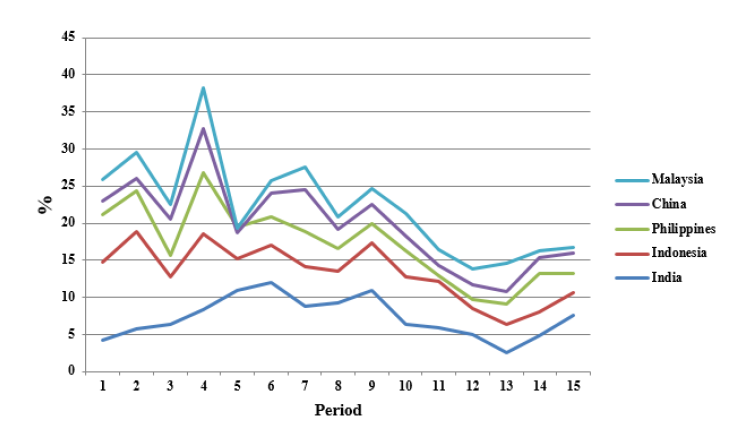
The development of foreign debt from 2005-2019 experienced various fluctuations in Five Emerging Markets Asia. Foreign debt or foreign loans are a portion of a country's total debt earned from creditors outside that country. Recipients of foreign debt can be governments, companies, or individuals. This form of debt can be money obtained from private banks, other countries' governments, or international financial institutions such as the IMF and the World Bank. In 2019 data from the five countries namely India amounted to USD 560034518482.5; Indonesia amounting to USD 402083881043.8; Philippines amounted to USD 83660996210.4; China amounting to USD 2114162881662.2 and Malaysia amounting to USD 2433898565.7 overall, the amount of foreign debt increased from a few years earlier.
Figure 1: The Inflation Rate at Five Emerging Markets Asia, 2005-2019
Source: World Bank
Literature Review
Inflation is a general and sustainable increase in the price of goods and services. In another sense, inflation is the percentage increase in the price of some goods and services that households typically consume. There are goods or services whose prices go up and there are goods or services whose prices go down. According to Boediono in Natsir [5], inflation is an increase in the price of common goods and this increase is continuous. This definition is following the definition put forward by Suseno and Astiyah [6]. Inflation is the tendency to increase the price of goods and services in general and continuously.
An exchange rate is the price of a country's currency measured or expressed in another currency. Exchange rates play an important role in spending decisions because they allow us to translate prices in different countries into the same language. If all other conditions remain, the depreciation of the currency of one country against all other currencies (the increase in foreign exchange prices for the country concerned) causes its exports to be cheaper and imports more expensive. While appreciation (decrease in foreign exchange prices in the country concerned) makes exports more expensive and imports cheaper.
The positive impact of foreign debt on economic development and increased public savings. This is because mobility can increase income and savings in the country, thus making foreign debt have a positive multiplier effect on the economy. The reason put forward by Ayuningsih [7], is that the flow of foreign aid can increase investment, thereby increasing domestic income and savings.
Stock price indices are used for analytical purposes and to avoid the negative impact of rupiah stock prices. A stock price index is an indicator or reflection of stock price movements. Indices are one of the guidelines for investors to invest in the capital market, especially stocks. Information about stock market performance is usually collected in an index called a stock market index. A stock market index is an index put forward by Tandelilin [8], to reflect the performance of the stock market. The stock price index is a summary of the complex influence of various factors that affect the stock price put forward by Johan [9], on the stock exchange at the same time. The current stock price index can be used as a barometer that shows the economic health of a country and is used as a basis for statistical analysis of current market conditions.
According to Hubbard [10], the money supply is the total quantity of money in the economy. If it is interpreted freely, then the money supply is the amount of total money in an economy. The monetary authority of central banks and commercial banks are institutions that can create money. Central banks issue and distribute money while commercial banks issue and distribute demand deposits and quasi-money. Both institutions are included in the monetary system because these two institutions have a monetary function that is to create money [5].
According to Sukirno [11], the determining factors of interest rates include 2 factors, namely internal factors and external factors. Internal factors include national income, money supply and inflation expectations. While external factors are the sum of foreign interest rates and the level of expectation of changes in foreign exchange rates. As is the case in any economic balance analysis, the talk of balance in the money market will also involve its main elements, namely the demand and supply of money. If the market mechanism can run unimpeded then in principle the balance in the money market can occur and is a form of attraction between demand and supply of money.
Large trade indices, which measure gross domestic product inflation rate, are considered the best economic indicators for evaluating a country's economic development. This calculation of national income is a major macro indicator for measuring the state of a country. Mankiw [12], believes that this indicator will be achieved if the country can produce high-quality materials and sell them for value. Mankiw [13], GDP is one of the most important macroeconomic variables by economists because GDP is a leading indicator for measuring a country's prosperity. GDP itself can be interpreted as the market value of all goods and services manufactured by an economy within a certain time.
MATERIALS AND METHODS
This study using panel data that uses data between time and data between countries. The ARDL panel is used to obtain the estimation results of each individual's characteristics separately by assuming the presence of cointegration in the long-term lag of each variable. Autoregressive Distributed Lag (ARDL) was introduced by Pesaran et al. [14], in Rusiadi [15]. This technique examines each variable lag located at I(1) or I(0). In contrast, the ARDL Panel results are test statistics that can compare with two critically asymptotic values. Here are the stages in this research method.
Stationary Test
Time series data usually has problems, especially stationary or stationary. When analyzed on data that is not stationary will produce spurious regression results and conclusions taken less meaningful [16]. Therefore, the first step is to test and make the data stationary. This stationarity test is done to see if the time series data contains the root unit (root unit). To that end, the commonly used methods are the Dickey-Fuller (DF) test and the Dickey-Fuller Augmented test (ADF). The data is said to be stationary assuming the mean and its variance is constant. In conducting the stationarity test the analysis tool used is with the root unit test. The root test unit was first developed by Dickey-Fuller and is known as the Dickey-Fuller (DF) root test unit.
Cointegration Test
In using the cointegration technique, it is necessary to determine the cointegration rules of each variable. However, as stated in previous studies, the difference in tests gives different decision results and depends on the pre-test of the root unit. Pesaran and Shin [17] and Pesaran et al. [14], introduced a new test methodology for cointegration. This approach is known as the border test cointegration or autoregression distributed lag (ARDL) procedure. The main advantage of this approach is that it eliminates the need for variables into I (1) or I(0). This ARDL test has three steps. First, we estimate each of the 6 equations using the usual smallest square technique (OLS). Second, we calculate the Wald test (statistic F) to look at the long-term relationships between variables. The Wald test can be done with limitations to see long-term coefficients. The accepted ARDL Panel model is a model that has a lag indraught, where the main assumption is that the coefficient value has a negative slope with a significant rate of 5%. ARDL Panel Model Requirements: negative and significant value (<0.05) then the model is accepted.
The equation of the ARDL Panel for this research is as follows:
The accepted ARDL Panel model is a model that has an integrated lag, where the main assumption is that the coefficient value in the Short Run Equation has a negative slope with a significant rate of 5%. ARDL Panel Model Requirements: the value is negative (-0.597) and significant (0.012 <0.05) then the model is accepted.
Table 1: Operational Definition Variables
Variables
Operational Definition
Source
Gross Domestic Product (GDP)
The value of the gross domestic product of the five emerging markets Asia in per cent per year
World Bank
The Inflation (INF)
Value of the consumer prices of the five emerging markets Asia in per cent per year
World Bank
Money Supply (MS)
The amount of M1 of the five emerging markets Asia in per cent per year
CEIC Data
The Interest Rate (IR)
Value of the interest rate of Central Bank for five emerging markets Asia in per cent per year
CEIC Data
The Exchange Rate (ER)
The value of exchange rate for five emerging markets Asia in LCU per year
World Bank
Foreign Debt (FD)
The value of debt service on the external debt of five emerging markets Asia in current US$ per year
World Bank
Stock Price Index (SPI)
The amount of stock price for five emerging markets Asia in per cent per year
Yahoo Finance
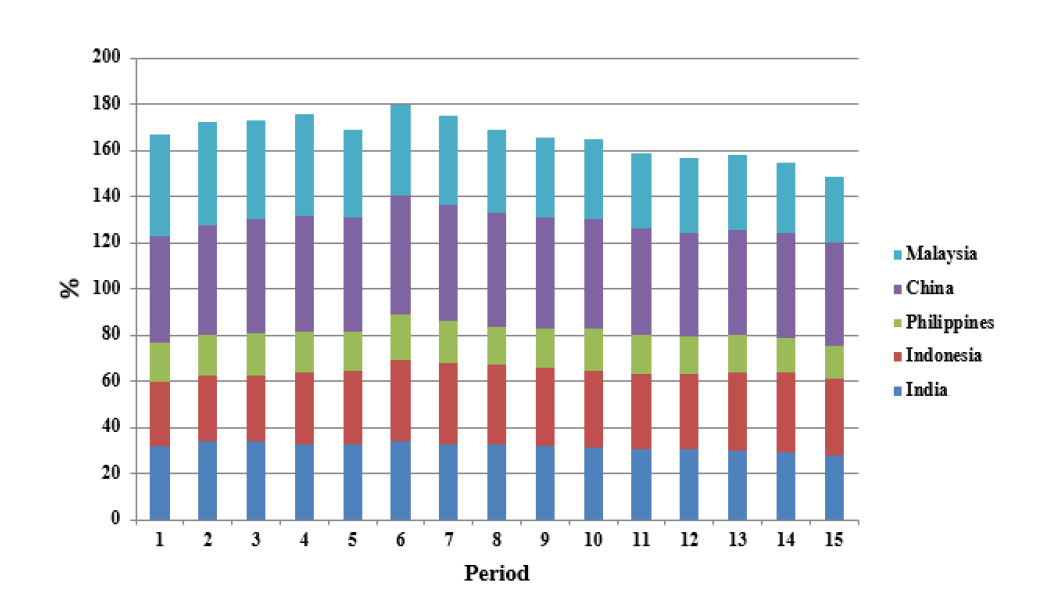
Figure 2: The GDP at Five Emerging Markets Asia, 2005-2019
Source: World Bank
RESULTS
Macroeconomic policies discussed in this study are a monetary policy of money supply and interest rates to suppress the rate of inflation to maintain the rupiah against USD exchange rate on international trade transactions in the stock market and foreign debt policy towards high economic growth. So the analysis can be seen in five emerging markets.
Gross Domestic Product is the total one-year public income generated by the Five Emerging Markets Asia country each year and is measured in units of %. In this study, GDP data was obtained from 2005 to 2019. Here's the GDP data.
Based on tables and graphs it is known that the decline in the gross domestic product of India and Indonesia occurred in 2019, India's gross domestic product fell to 27.99% from 29.58% a year earlier, Indonesia fell to 33.32% from 34.01% a year earlier, the Philippines' gross domestic product fell to 14.26% from 15.41% the previous year and China's gross domestic product fell to 44.34% from 44.94% the previous year, Malaysia’s gross domestic product fell to 28.51% from 30.62%. This is the result of the economic crisis that occurred in European countries, especially in the United States.
Inflation has a positive influence on the formation of gross domestic product in countries and the variables of government spending have the most role in influencing gross domestic product. Several studies have proven a strong negative link between inflation and economic growth (Bruno and Easterly, 1996 in Ismail [3]. Meanwhile, inflation also negatively affects the distribution of income through disproportionate changes in the value of profit and at the same time decreases the welfare of the community [3]. That is, rising interest rates will lead to a decrease in GDP which in turn leads to an economic slowdown [4]. The effect of the money supply on gross domestic product only applies in the short term. But in the long run, money will not affect gross domestic product (money is neutral), even if forced then the increase in the money supply will eventually only push up prices (inflation).
Therefore, a country must keep inflation from negatively impacting a country's gross domestic product. Inflation has a positive influence on the formation of gross domestic product in countries in influencing gross domestic product [18]. The stages of research results can be explained Table 2.
Table 2: The Results of Stationary Test
Variables
level
1st difference
GDP
-1.796561
(-2.901217)
0.3795
-8.242268
(-2.901779)
0.0000*
INF
-3.759250
(-2.901217)
0.0050*
-
MS
-4.609244
(-2.901217)
0.0003*
-
IR
-2.716183
(-2.902358)
0.0762
-11.89949
(-2.902358)
0.0001*
ER
-1.935364
(-2.901217)
0.3146
-8.427578
(-2.901779)
0.0000*
FD
-8.640721
(-2.901217)
0.0000*
-
SPI
-2.688697
(-2.901217)
0.0808
-9.294405
(-2.901779)
0.0000*
*Denote significance at 5% level, respectively
Source: data processed (2021)
The results of the Dickey-Fuller Augmented test showed that there were four variable data not stationary at the level or in actual data namely gross domestic product, interest rates, exchange rates and stock price indexes, while there were three variables stationary at levels namely inflation, money supply and foreign debt, as indicated by Dickey Fuller's value of statistics that are below Mc Kinnon's critical value of 5% confidence. Variables that are not stationary at the solution level are creating new variables by first difference, then retested with the ADF test. Data variable gross domestic product, interest rate, exchange rate, stock price indexes are stationary at 1st difference. Thus all variable data is stationary, so that data analysis can be continued.
The next stage is the cointegration test, the results of the test can be seen in Table 3.
Table 3: The Results of Cointegration Test
Hypothesized No. of CE(s)
(1)
None*
128.1234
(111.7805)
0.0031*
*Denote significance at 5% level, respectively
Source: data processed (2021)
From the results of the cointegration test in the Table 3, it can be known that the variable data in this study occurred cointegration which is characterized by a significant value of 0.0031 at a 5% level. This means that there is a long-term balance relationship between the variables in the study.
The accepted ARDL Panel model is a model that has integrated lag, where the main assumption is that the coefficient value has a negative slope with a significant rate of 5%. ARDL Panel Model Terms: the value is negative (-0.64) and significant (0.00<0.05) then the model is accepted. Based on the acceptance of the model, the data analysis is carried out with panels per country (Table 4).
Table 4: Summary of the Results of ARDL Panel
(1)
Short Run
(2)
Long Run
COINTEQ01
-0.268874
(-2.253954)
0.0319
-
-
D(INF)
-0.181775
(-0.885750)
0.0330*
INF
0.500072
(3.302066)
0.0026*
D(MS)
-0.085897
(-0.759455)
0.4537
MS
0.335603
(8.473608)
0.0000*
D(IR)
-0.214648
(-0.835009)
0.4105
IR
0.754050
(2.506730)
0.0180*
D(ER)
-0.104169
(-0.231459)
0.8186
ER
-0.000137
(-0.232705)
0.8176
D(LOGFD)
-1.061449
(-0.314304)
0.7555
LOGFD
-2.256810
(-1.900300)
0.0674
D(SPI)
-0.003889
(-0.761920)
0.4523
SPI
-0.003532
(-1.768079)
0.0876
C
7.487892
(1.483042)
0.1489
-
-
*Denote significance at 5% level, respectively
Source: data processed (2021)
The results of the ARDL Panel study showed that in the short term, only inflation variables significantly affect gross domestic products in five emerging markets Asia while in the long term inflation variables, money supply, interest rates significantly affect gross domestic products in five emerging markets Asia at 5% level. The results of the ARDL Panel per country can be explained in Table 5.
The interpretation of the ARDL Panel's results on five Emerging Markets in Asia is described as Follow:
Table 5: Summary of ARDL Panel for Five Emerging Markets Asia
(1)
India
Indonesia
Philippines
China
Malaysia
COINTEQ01
-0.302953
(-10.97477)
0.0016
-0.186009
(-35.32869)
0.0000
-0.270615
(-37.08573)
0.0000
-0.663518
(-108.8436)
0.0000
0.078727
(64.63795)
0.0000
D(INF)
-0.162923
(-10.64994)
0.0018*
-0.071236
(-8.766221)
0.0031*
-0.909322
(-10.08896)
0.0021*
-0.129197
(-16.94519)
0.0004*
0.363803
(63.90373)
0.0000*
D(MS)
0.107277
(33.28703)
0.0001*
-0.482074
(-27.27557)
0.0001*
-0.045149
(-69.02156)
0.0000*
-0.157664
(-113.3658)
0.0000*
0.148123
(93.92058)
0.0000*
D(IR)
-0.981893
(-7.377467)
0.0051*
-0.034702
(-1.485714)
0.2340
0.601610
(1.100054)
0.3517
-0.265608
(-20.74703)
0.0002*
-0.392647
(-92.74847)
0.0000*
D(ER)
-0.042101
(-10.09167)
0.0021*
-0.001386
(-13812.29)
0.0000*
0.123988
(8.918398)
0.0030*
-1.698400
(-7.052456)
0.0059*
1.097054
(2.914108)
0.0618
D(LOGFD)
7.008054
(0.720244)
0.5234
-1.614435
(-1.174533)
0.3249
-13.33795
(-0.226689)
0.8352
0.753930
(5.814856)
0.0101*
1.883156
(9.441033)
0.0025*
D(SPI)
0.006323
(2137.543)
0.0000*
-0.016188
(-178.7629)
0.0000*
0.003370
(566.1343)
0.0000*
0.003510
(2487.629)
0.0000*
-0.016459
(-276.5991)
0.0000*
C
6.677444
(0.432844)
0.6944
5.165206
(2.281269)
0.1068
2.619824
(2.139214)
0.1219
26.45663
(2.357329)
0.0996
-3.479643
(-2.705535)
0.0734
*Denote significance at 5% level, respectively
Source: data processed (2021)
India
Inflation significantly affects the gross domestic product. This can be seen from the value at the sig probability of 0.00<0.05. Rising inflation will increase gross domestic product. The money supply significantly affects the gross domestic product. It can be seen from the value at the sig probability of 0.00<0.05. The increase in the money supply will increase the gross domestic product. Interest rates significantly affect the gross domestic product. It can be seen from the sig probability value of 0.00<0.05. Rising interest rates will boost gross domestic product. The exchange rate significantly affects the gross domestic product. Can be seen from the probability value sig of 0.00<0.05. Rising exchange rates will increase gross domestic product. Foreign debt does not significantly affect the gross domestic product. It can be seen at the sig probability value of 0.52>0.05. Foreign debt does not affect the gross domestic product. The stock price index significantly affects the gross domestic product. It can be seen in the sig probability value of 0.00<0.05. Rising stock price indexes will increase gross domestic product.
Indonesia
Inflation significantly affects the gross domestic product. It can be seen from the value at the sig probability of 0.00<0.05. Rising inflation will increase gross domestic product. The amount of money supply significantly affects the gross domestic product. It can be seen from the sig probability of 0.00<0.05. The increase in the money supply will increase the gross domestic product. Interest rates do not significantly affect the gross domestic product. Can be seen at a sig probability value of 0.23>0.05. Interest rates do not affect the gross domestic product. The exchange rate significantly affects the gross domestic product. It can be seen from the probability value of sig of 0.00<0.05. A rising exchange rate will increase gross domestic product. Foreign debt does not significantly affect the gross domestic product. It can be seen at a sig probability value of 0.32>0.05. Foreign debt does not affect the gross domestic product. The stock price index significantly affects the gross domestic product. It can be seen in the sig probability value of 0.00 <0.05. Rising stock price indexes will increase gross domestic product.
Philippine
Inflation significantly affects the gross domestic product. It can be seen from the value at the sig probability of 0.00<0.05. Rising inflation will increase gross domestic product. The money supply significantly affects the gross domestic product. It can be seen from the value at sig probability of 0.00<0.05. The increase in the money supply will increase the gross domestic product. Interest rates do not significantly affect the gross domestic product. Can be seen at a sig probability value of 0.83>0.05. Interest rates do not affect the gross domestic product. The exchange rate significantly affects the gross domestic product. It can be seen from the probability value of sig of 0.00<0.05. A rising exchange rate will increase gross domestic product.
Foreign debt does not significantly affect the gross domestic product. It can be seen at a sig probability value of 0.32>0.05. Foreign debt does not affect the gross domestic product. The stock price index significantly affects the gross domestic product. It can be seen in the sig probability value of 0.00<0.05. Rising stock price indexes will increase gross domestic product.
China
Inflation significantly affects the gross domestic product. It can be seen from the sig probability value of 0.00<0.05. Rising inflation will increase gross domestic product. The money supply significantly affects the gross domestic product. It can be seen from the sig probability value of 0.00<0.05. The increase in the money supply will increase the gross domestic product. Interest rates significantly affect the gross domestic product. It can be seen from the sig probability value of 0.00<0.05. Rising interest rates will boost gross domestic product. The exchange rate significantly affects the gross domestic product. Can be seen from the probability value sig of 0.00<0.05. Rising exchange rates will increase gross domestic product. Foreign debt significantly affects the gross domestic product. Can be seen from the probability value sig of 0.00<0.05. Rising foreign debt will increase gross domestic product. The stock price index significantly affects the gross domestic product. It can be seen in the sig probability value of 0.00<0.05. Rising stock price indexes will increase gross domestic product.
Malaysia
Inflation significantly affects the gross domestic product. It can be seen from the sig probability value of 0.00<0.05. Rising inflation will increase gross domestic product. The money supply significantly affects the gross domestic product. It can be seen from the value at the sig probability of 0.00<0.05. The increase in the money supply will increase the gross domestic product. Interest rates significantly affect the gross domestic product. It can be seen from the value at the sig probability of 0.00<0.05. Rising interest rates will boost gross domestic product. The exchange rate does not significantly affect the gross domestic product. It can be seen in the sig probability value of 0.06>0.05. The exchange rate does not affect the gross domestic product. Foreign debt significantly affects the gross domestic product. Can be seen from the probability value sig of 0.00<0.05. Rising foreign debt will increase gross domestic product. The stock price index significantly affects the gross domestic product. It can be seen in the sig probability value of 0.00<0.05. Rising stock price indexes will increase gross domestic product.
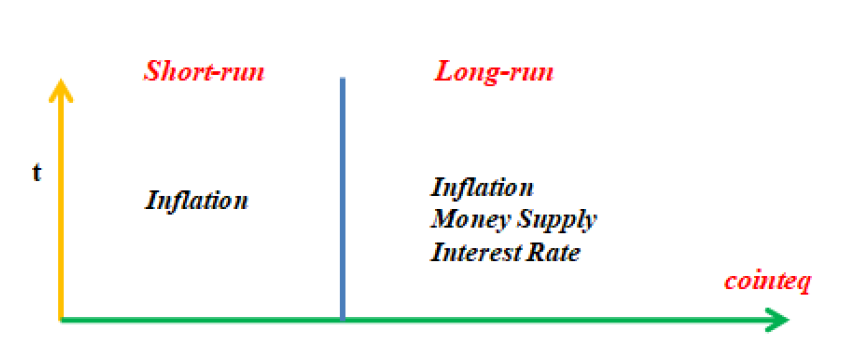
Based on the results of the overall analysis it is known that significant variables in the long term affect macroeconomic stability in Emerging Markets in Asia, namely inflation, money supply and interest rates. Then in the short term, only inflation affects macroeconomic stability. Leading indicators of variable effectiveness in macroeconomic stability control in Emerging Markets Asia are inflation seen from a short-run and long-run stability, where inflation variables in the long and short term significantly control economic stability. Leading indicators of the effectiveness of the country in controlling the stability of Asian emerging markets, namely India (inflation, money supply, interest rates, exchange rates and stock price index), Indonesia (inflation, money supply, stock price index), Philippines (inflation, money supply, exchange rate and stock price index), China (inflation, money supply, interest rate, exchange rate, foreign debt and stock price index) and Malaysia (inflation, money supply, interest rates, foreign debt and stock price indexes). In a panel, it turns out that interest rates and money supply can also be a leading indicator for the control of India, Indonesia, the Philippines, China and Malaysia, but its position is unstable in the short-run and long run (Table 6).
Table 6: The Summary
Variables
India
Indonesia
Philippines
China
Malaysia
Short-Run
Long-Run
Inflation
1
1
1
1
1
1
1
Gross Domestic Product
0
0
0
0
0
0
0
Money Supply
1
1
1
1
1
0
1
Interest Rate
1
0
0
1
1
0
1
Exchange Rate
1
1
1
1
0
0
0
Foreign Debt
0
0
0
1
1
0
0
Stock Price Indexes
1
1
1
1
1
0
0
Source: Data processed, 2021
Figure 3: The Summary
Source: Table 6
The Results of the ARDL Panel Prove
A leading indicator of the effectiveness of the country in controlling the stability of the five emerging markets Asia, namely India control price stability carried out by Inflation, Money Supply, Interest Rate, Exchange Rate and Stock Price Index. While Indonesia and the Philippines are still strong in controlling price stability through inflation, money supply, exchange rates and stock price index. Then for the Chinese state control price stability through Inflation, Money Supply, Interest Rates, Exchange Rates, Foreign Debt and Stock Price Index. Lastly for the country, Malaysia controls price stability through Inflation, Money Supply, Interest Rates, Foreign Debt and Stock Price Index. Monetary policy with a monetary price approach can have an effective effect on controlling the inflation rate through the channels of interest rates and exchange rates [19]. Contractive monetary policy has a strong and negative effect on output, suggesting that it can lean on unexpected macroeconomic shocks even when financial markets are not well developed. In this case, it is also shown that such monetary policy shocks are likely to stabilize inflation in Asia's five emerging markets albeit at higher levels due to supply-driven inflation amid large spikes in food and fuel prices while producing very persistent negative effects on real equity prices [20].
The panel turned out that the Money Supply and Exchange Rate were also able to be the leading indicators for the control of the countries of India, Indonesia, Philippines, China and Malaysia, but their position was unstable in the short run and long run. It is stated that the Money Supply on a panel can be the leading indicator of economic growth control in five emerging markets in Asia but its position is unstable in the short run and long run. This is under the Money Supply amount is positively related to Indonesia's economic growth. There is a stable long-term relationship between government policy and economic growth. In the short term, the Money Supply and Exchange Rate as monetary variables have a short-term relationship with economic growth. This means that in the same period, the Money Supply will have a positive effect on economic growth. The exchange rate relationship with economic growth can be seen from the exchange rate is one of the important indicators for a country's economy. Fluctuating exchange rate movements will affect people's behaviour in holding money and also affect a country in stabilizing its economy. Exchange rates or exchange rates have an important role in a country's economy. Appreciation and depreciation of a country's currency exchange rate will greatly affect the activity and stability of the country's economy. The opinion of Simorangkir and Suseno [21], explained that based on empirical data it can be concluded that the exchange rate crisis negatively affects a country's economy, as the phenomenon has been felt by some countries.
Inflation is the process of an event, not a high level of price. That is, the price level that is considered high does not necessarily indicate inflation. Inflation can be caused by various factors, among others, increased public consumption, excess liquidity in the market that triggers consumption or even speculation, including the lack of distribution of goods. Inflation can also occur because the money supply is more than needed. Inflation is an economic symptom that is difficult to overcome completely. Efforts made to overcome inflation are usually only limited to reducing and controlling it. By the study of Webster's New Universal Complete Dictionary [22], states that Inflation is an increase in the number of currencies in circulation that results in a sharp and sudden decline in the value of a currency as well as an increase in prices; This could be due to an increase in the number of banknotes issued or gold mined or an increase in relative spending such as when the supply of goods fails to meet demand affecting economic growth in five emerging markets Asia.
CONCLUSION
The results of the ARDL panel data estimate according to variables that can be the Leading Indicator according to variables in five emerging markets Asia, namely the money supply (there is a money supply in all results) in five emerging markets Asia (India, Indonesia, Philippines, China and Malaysia). Meanwhile, according to the country that is the Leading Indicator instability control in five emerging markets Asia, namely India (inflation, money supply, interest rates, exchange rates and stock price index) against gross domestic product in five emerging markets Asia.
The main leading indicator of variable effectiveness instability control in five Emerging Markets Asia is inflation in terms of short-run and long-run stability, where inflation variables in both the long and short term significantly control economic stability. So, do not assume that the high price level means high inflation, inflation occurs if the process of continuous price increases and mutual influence influences. In general, inflation is an economic situation in which prices in general increase continuously over a long time. Generally, inflation is the cause of the continuous decline in the value of the currency. It is said that the price level in general is a condition of inflation because there are many types of goods on the market. The rising price of one or two goods alone cannot be called inflation, called inflation if most goods increase. It is also said that the continuous increase in prices is a condition of saying Inflation, this is because prices can rise only temporarily, this temporary price increase cannot be called Inflation. So, when the increase lasts for a long time and occurs in almost all goods and services in general, then this symptom is called Inflation.
For related institutions such as Bank Indonesia, Central Banks of countries that are the object of research or the Ministry of Finance, researchers feel that in general inflation and inflation uncertainty have a causal relationship. This indicates that the development of inflation does not stand alone as one of the macroeconomic indicators. In addition, governments that direct low and stable inflation rates need to design fiscal policies and economic indicator targets in a measured, realistic and consistent manner so that the decline in foreign debt ratios can be optimized.
REFERENCES
Atmojo, R.W. “Analisis Efektivitas Kebijakan Moneter dan Kebijakan Fiskal terhadap Produk Domestik Bruto Indonesia.” Economics Development Analysis Journal, vol. 7, no. 2, 2018, pp.194–202.
Todaro, Michael. Pembangunan Ekonomi di Dunia Ketiga. Edisi Kedelapan, Erlangga, 2004.
Ismail, M. “Inflation Targetting dan Tantangan Implementasinya di Indonesia.” Jurnal Ekonomi dan Bisnis Indonesia, vol. 21, no. 2, 2006.
Littleboy, B. and John B. Taylor. Macroeconomics. 3rd ed., Wiley, 2002.
Natsir, M. Ekonomi Moneter dan Kebanksentralan. Mitra Wacana Media, 2014.
Suseno and Siti Astiyah. Inflasi. Pusat Pendidikan dan Studi Kebanksentralan (PPSK) Bank Indonesia, 2009.
Ayuningsih, Anisa. “Pengaruh Earning Per Share (EPS), Price Earning Ratio (PER), Return On Equity (ROE) dan Debt to Quality Ratio (DER) terhadap Harga Saham pada Perusahaan Sektor Pertambangan di Bursa Efek Indonesia Periode 2007–2010.” Skripsi, Fakultas Ekonomi Universitas Trisakti, 2012.
Tandelilin, Eduardus. Portofolio dan Investasi: Teori dan Aplikasi. Edisi Pertama, Kanisius, 2010.
Johan, Harun. “Analisis Pengaruh Bursa Efek Jakarta.” Tesis, Pasca Sarjana Universitas Dipenogoro, 2007.
Hubbard, R.Glenn. Money, the Financial System and the Economy. 4th ed., Pearson Education, 2002.
Sukirno, S. Makroekonomi Modern. Raja Grafindo Persada, 2004.
Mankiw, N.Gregory. Pengantar Teori Ekonomi Makro. Edisi Ketiga, Salemba Empat, 2006.
Pesaran, M.H. et al. “Bounds Testing Approaches to the Analysis of Level Relationships.” Journal of Applied Econometrics, vol. 16, no. 3, 2001, pp.289–326. https://doi.org/
Rusiadi, N.S. Metode Penelitian-Manajemen, Akuntansi dan Ekonomi Pembangunan: Konsep, Kasus, dan Aplikasi SPSS, Eviews, Amos, Lisrel. USU Press, 2015.
Enders, W. Applied Econometric Time Series. John Wiley and Sons, 1995.
Pesaran, M.H. Interactive Ekonomic Analysis. Oxford University Press, 1997.
Yuliadi, I. “Inflasi di Indonesia Seleksi Model Ekonometrika.” Volume 14, no. 1, April 2013, pp.26–34.
Nguyen, Tuan. “The Effectiveness of Online Learning: Beyond No Significant Difference and Future Horizons.” MERLOT Journal of Online Learning and Teaching, vol. 11, no. 2, June 2015, pp.309–319.
Mallick, Sushanta. “Source of Financing, Profitability and Productivity: First Evidence from Matched Firms.” Financial Markets, Institutions and Instruments, vol. 20, no. 5, 2011, pp.221–252.
Simorangkir, I. and Suseno. Sistem dan Kebijakan Nilai Tukar. Seri Kebanksentralan No. 12, Bank Indonesia, 2005.
Gove, Philip Babcock. Webster’s Third New International Dictionary of the English Language Unabridged. Merriam-Webster Inc., 2002.
License
Creative Commons Attribution-NonCommercial-NoDerivatives 4.0 International License
All papers should be submitted electronically. All submitted manuscripts must be original work that is not under submission at another journal or under consideration for publication in another form, such as a monograph or chapter of a book. Authors of submitted papers are obligated not to submit their paper for publication elsewhere until an editorial decision is rendered on their submission. Further, authors of accepted papers are prohibited from publishing the results in other publications that appear before the paper is published in the Journal unless they receive approval for doing so from the Editor-In-Chief.
Himalayan Journal of Economics and Business Management open access articles are licensed under a Creative Commons Attribution-Share A like 4.0 International License. This license lets the audience to give appropriate credit, provide a link to the license, and indicate if changes were made and if they remix, transform, or build upon the material, they must distribute contributions under the same license as the original.
Recommended Articles
Research Article
Influence of Leadership on Poverty Reduction in the Devolved Government in Trans-Nzoia County, Kenya
Kinisu Sifuna,
...
Peter Simotwo
Published: 30/06/2021
Download PDF
Cite
x
APA
Sifuna, K., Lwangale, D. W., Simotwo, P., Sifuna, K., Lwangale, D. W. & Simotwo, P. (2021). Influence of Leadership on Poverty Reduction in the Devolved Government in Trans-Nzoia County, Kenya. Himalayan Journal of Economics and Business Management, 2(1), None-None.
MLA
Sifuna, Kinisu, et al. "Influence of Leadership on Poverty Reduction in the Devolved Government in Trans-Nzoia County, Kenya." Himalayan Journal of Economics and Business Management 2.1 (2021): None-None.
Chicago
Sifuna, Kinisu, David W. Lwangale, Peter Simotwo, Kinisu Sifuna, David W. Lwangale and Peter Simotwo. "Influence of Leadership on Poverty Reduction in the Devolved Government in Trans-Nzoia County, Kenya." Himalayan Journal of Economics and Business Management 2, no. 1 (2021): None-None.
Harvard
Sifuna, K., Lwangale, D. W., Simotwo, P., Sifuna, K., Lwangale, D. W. and Simotwo, P. (2021) 'Influence of Leadership on Poverty Reduction in the Devolved Government in Trans-Nzoia County, Kenya' Himalayan Journal of Economics and Business Management 2(1), pp. None-None.
Vancouver
Sifuna K, Lwangale DW, Simotwo P, Sifuna K, Lwangale DW, Simotwo P. Influence of Leadership on Poverty Reduction in the Devolved Government in Trans-Nzoia County, Kenya. Himalayan Journal of Economics and Business Management. 2021 Jan;2(1):None-None.
Download PDF
Research Article
Modelling Structure Job Quality, Job Design and Job Satisfaction
Moch Nurhadi,
...
Avi Sunani
Published: 30/08/2022
Download PDF
Cite
x
APA
Nurhadi, M., Bisyri Effendi, M., Saiful Ulum, A. & Sunani, A. (2022). Modelling Structure Job Quality, Job Design and Job Satisfaction. Himalayan Journal of Economics and Business Management, 3(2), 1-4.
MLA
Nurhadi, Moch, et al. "Modelling Structure Job Quality, Job Design and Job Satisfaction." Himalayan Journal of Economics and Business Management 3.2 (2022): 1-4.
Chicago
Nurhadi, Moch, Moch Bisyri Effendi, Achmad Saiful Ulum and Avi Sunani. "Modelling Structure Job Quality, Job Design and Job Satisfaction." Himalayan Journal of Economics and Business Management 3, no. 2 (2022): 1-4.
Harvard
Nurhadi, M., Bisyri Effendi, M., Saiful Ulum, A. and Sunani, A. (2022) 'Modelling Structure Job Quality, Job Design and Job Satisfaction' Himalayan Journal of Economics and Business Management 3(2), pp. 1-4.
Vancouver
Nurhadi M, Bisyri Effendi M, Saiful Ulum A, Sunani A. Modelling Structure Job Quality, Job Design and Job Satisfaction. Himalayan Journal of Economics and Business Management. 2022 Jul;3(2):1-4.
Download PDF
Research Article
The Constitutional and Legislative Basis for Considering the Taxable Capacity of Taxpayers in Iraqi Tax Legislation
Hussein Kamel Wadaa
Published: 05/05/2025
Download PDF
Cite
x
APA
Wadaa, H. K. (2025). The Constitutional and Legislative Basis for Considering the Taxable Capacity of Taxpayers in Iraqi Tax Legislation. Himalayan Journal of Economics and Business Management, 6(1), 1-10.
MLA
Wadaa, Hussein Kamel. "The Constitutional and Legislative Basis for Considering the Taxable Capacity of Taxpayers in Iraqi Tax Legislation." Himalayan Journal of Economics and Business Management 6.1 (2025): 1-10.
Chicago
Wadaa, Hussein Kamel. "The Constitutional and Legislative Basis for Considering the Taxable Capacity of Taxpayers in Iraqi Tax Legislation." Himalayan Journal of Economics and Business Management 6, no. 1 (2025): 1-10.
Harvard
Wadaa, H. K. (2025) 'The Constitutional and Legislative Basis for Considering the Taxable Capacity of Taxpayers in Iraqi Tax Legislation' Himalayan Journal of Economics and Business Management 6(1), pp. 1-10.
Vancouver
Wadaa HK. The Constitutional and Legislative Basis for Considering the Taxable Capacity of Taxpayers in Iraqi Tax Legislation. Himalayan Journal of Economics and Business Management. 2025 Jan;6(1):1-10.
Download PDF
Research Article
Proposed Digital Marketing Strategy to Enhance Engineering Consultancy Company Revenue
Alfarisy, K. A.,
Wandebori, H.
Published: 30/04/2024
Download PDF
Cite
x
APA
K. A., A. & H., W. (2024). Proposed Digital Marketing Strategy to Enhance Engineering Consultancy Company Revenue. Himalayan Journal of Economics and Business Management, 5(1), 1-18.
MLA
K. A., Alfarisy, and Wandebori, H.. "Proposed Digital Marketing Strategy to Enhance Engineering Consultancy Company Revenue." Himalayan Journal of Economics and Business Management 5.1 (2024): 1-18.
Chicago
K. A., Alfarisy, and Wandebori, H.. "Proposed Digital Marketing Strategy to Enhance Engineering Consultancy Company Revenue." Himalayan Journal of Economics and Business Management 5, no. 1 (2024): 1-18.
Harvard
K. A., A. and H., W. (2024) 'Proposed Digital Marketing Strategy to Enhance Engineering Consultancy Company Revenue' Himalayan Journal of Economics and Business Management 5(1), pp. 1-18.
Vancouver
K. A. A, H. W. Proposed Digital Marketing Strategy to Enhance Engineering Consultancy Company Revenue. Himalayan Journal of Economics and Business Management. 2024 Jan;5(1):1-18.
Rangkuty, D. M., None, R., Efendi, B. & Cahyani, A. R. (2021). The Macroeconomic Policy: An Analysis at Five Emerging Markets Asia. Himalayan Journal of Economics and Business Management, 2(2), 1-8.
MLA
Rangkuty, Dewi M., et al. "The Macroeconomic Policy: An Analysis at Five Emerging Markets Asia." Himalayan Journal of Economics and Business Management 2.2 (2021): 1-8.
Chicago
Rangkuty, Dewi M., Rusiadi , Bakhtiar Efendi and Adinda R. Cahyani. "The Macroeconomic Policy: An Analysis at Five Emerging Markets Asia." Himalayan Journal of Economics and Business Management 2, no. 2 (2021): 1-8.
Harvard
Rangkuty, D. M., None, R., Efendi, B. and Cahyani, A. R. (2021) 'The Macroeconomic Policy: An Analysis at Five Emerging Markets Asia' Himalayan Journal of Economics and Business Management 2(2), pp. 1-8.
Vancouver
Rangkuty DM, Rusiadi R, Efendi B, Cahyani AR. The Macroeconomic Policy: An Analysis at Five Emerging Markets Asia. Himalayan Journal of Economics and Business Management. 2021 Jul;2(2):1-8.


 Download PDF
 Download XML