Succession planning is a critical component in the current competitive environment because the process of identifying and developing key successors for key positions in an organization ensures that the organization has qualified employees for future critical vacancies of management positions. Further in the modern world, major business organizations have recognized an effective implementation of succession planning as one of the key strategies to manage employee retention. Thus, the purpose of this research was to examine the relationship between effective succession planning practices and employee retention in the information communication industry in Sri Lanka. Using a survey strategy, this study administered cross sectional questionnaires to collect the data from executive level employees in the information communication technology industry in Sri Lanka. Simple random sampling was utilized to collect data from 100 employees. The overall hypotheses were tested using correlation and regression analysis with SPSS version twenty. The results of correlation analysis indicated that there is a relationship between succession planning and employee retention in the ICT Industry in Sri Lanka with special reference to ABC RandD International (PVT) Ltd. Further, organization culture was identified as the most impactful factor affecting employee retention of the company. The findings also revealed that effective open communication by management, training and development, performance appraisals and good corporate culture also play a significant role in implementation of succession planning in order to retain the workers within the organization.
In the contemporary business world, organizations depend on three fundamental resources: physical resources, financial resources and human resources. Undoubtedly the organization’s survival highly depends on its human resources. But with competition, modern companies fear losing their valuable human talent over a period of time. Hence, employee retention has become a prominent issue in the twenty-first century. Most importantly, companies face two realities which are, the loss of experience rich talent and the changing trends in the talent market [1]. Chipunza et al. [2], state that in the face of ever growing high rate of employee turnover, the retention of eligible workers worldwide has been of significant concern to managers. The market climate today has become very competitive, making trained workers the key distinguishing factor for most organizations. In empirical studies, Stovel and Bontis [3], have shown that employees, on average, switch employers every six years. This situation requires management to recognize the reason(s) for this regular shift in the jobs of employees. If these factors are identified, management can incorporate retention measures that will help to keep critical workers for a longer tenure.
According to Mehrabani and Mohamed [4], the secret to an organization's potential success is defined by how it evaluates and recognizes the importance of the individuals it has and what resources it will require in the future. A well-planned succession planning will help the organization cope with the retirement of key staff, business development and promotions, as it offers confidence that the company is able to fill vacancies as needed by utilizing its talent pool [5]. Moreover, Lewis [6], asks the question as to why more organizations are not instituting succession planning if there are so many benefits. Considering the fact, it is very tempting to believe that all companies can excel in succession planning and practice various ways to resolve talent shortages, but in practice, only a few organizations are able to practically plan for the gaps and fill them on time.
The Information and Communication Technology (ICT) sector is one of the most important sectors of the world, but unfortunately the employee retention is low in comparison to other sectors [7, 8]. The development of the ICT industry has posed challenges for ICT companies that seek to recruit and retain professionals. Considering the fact that the success of a company depends on human capital, Bhati et al. [9], stated talented employees are seen as a factor impacting the growth of a firm and as the potential to generate organizational rents. On the other hand, skill shortage has driven high employee turnover, which is seen as the issue for IT firms. As per many scholars, practicing succession planning will boost employee retention while increasing employee performance. Therefore, the purpose of this paper is to examine the relationship between succession planning and employee retention in the ICT industry in Sri Lanka. [10,11].
Nuru et al. identified that since the 1990s the ICT Industry cannot escape the problems prevailing in the labor market which is that the ICT industry has suffered a high turnover rate of employees. This crucial event has occurred due to the constant scenario of workers entering and leaving in a limited period of time. Indeed, global ICT organizations such as Russia, the United States, Singapore, Taiwan, India, China and Switzerland have struggled to attract and retain their talented workers [12]. According to Edirisooriya [13], high turnover rate among Sri Lankan ICT professionals is inevitable due to various reasons which lead to the increase of recruitment and selection of employees. In order to minimize the costs associated with the turnover, organizations are adapting different strategies including competitive salaries and benefits, empowerment and flexi working hours [14]. However, the reasons for employee shortage in the ICT industry are still unknown.
Further, Madhushani and Mudalige [8], also mention that ICT professionals’ intention to leave organizations in Sri Lanka due to job dissatisfaction is relatively high. Having understood the fact, ICT companies in Sri Lanka have to investigate staff turnover and retention issues in order to address the employee shortage. There have been a number of studies on succession planning and employee retention in different industries [15,16]. Moreover, Armstrong and Rollins [17,18] state succession planning as one of the key retention strategies. By supporting their idea, Bolander et al. [16], state that succession planning is expected to manage, develop and retain their talent pipeline.
According to Garretson [19] succession planning in the ICT industry is crucial because it ensures that the organization and its employees are always prepared and protected. But the majority of the companies in the ICT sector do not have much knowledge about the human resource management practices that facilitate succession planning and the long term impact of ignoring succession planning in their respective organizations [20].
Similarly, this is a common phenomenon for all the ICT companies in Sri Lanka that are struggling to retain their top talent because of the recruitment of external candidates without giving an opportunity for internal employees for vacant positions. This has caused major frustrations among existing employees in the ICT industry in Sri Lanka which diminishes the capability of grooming for next levels. Although, it is assumed that all organizations practice succession planning and practices, only a few organizations are able to practically plan and implement it [15]. Hence, developing and implementing succession planning in the ICT industry is crucial in order to retain the ICT professionals within the industry.
There are many studies conducted in between succession planning practices and different business contexts, especially family businesses and corporate businesses [21]. Most interestingly researchers have conducted studies on succession planning and different organizational outcomes including organizational performance [22,23]. Moreover, studies are carried out in different sectors, especially in banking industry [24], higher education sector [25], agricultural sector [26] and private sector organization in Sri Lanka [27]. According to researchers’ knowledge, no scholar has empirically addressed the relationship between succession planning and employee retention in the ICT industry in Sri Lanka. Therefore, doing research connecting succession planning and employee retention is indispensable.
Therefore, to bridge this gap, the current study focused on studying the relationship between succession planning and employee retention in the ICT industry in Sri Lanka. So, the main objective of this research was to examine the extent to which succession planning encourages employees to retain in the ICT industry in Sri Lanka. Further, this study aims to investigate the most impactful factor affecting employee retention in the ICT Industry in Sri Lanka.
Significance of the Study
This study helps to identify the importance of practicing succession planning in an organization to increase employee retention. Through this research, readers can gain knowledge about the different factors which drive succession planning in an organization and the strong positive relationship between succession planning and employee retention. Moreover, readers can gain knowledge about the current situation in relation to employee turnover in the ICT industry in Sri Lanka and find out the reasons for this high turnover. Furthermore, researchers have identified the limitations of this study and concluded the study with emphasizing the value of succession planning to overcome the challenge of high turnover in the ICT industry in Sri Lanka and through that the organization can increase the satisfaction of employees and retain them in the organization for a longer period. Throughout the research, the researchers have identified the real need of succession planning practices for all organizations to increase employee’s motivation, commitment and interest toward their job to retain them in the long run.
Literature Review
Succession Planning: Armstrong [28], refers to succession planning as a mechanism by which an organization ensures that workers are hired and continually trained to fill each key position within the business. The term succession refers to a systematic process of identifying and developing candidates for leadership or management positions [29].
Charan [30], defines succession planning as a process of identifying and developing internal people with the potential to fill key business leadership positions in the company. According to Armstrong [31], succession planning is a method of selecting successors for key roles and then planning career movements or growth programs for prospective career successors and thus career management is complementary to management of succession planning.
According to Desslier [32] succession planning is the method of ensuring an adequate supply for current and potential main job successors such that the career of individuals can be handled to optimize the needs of organizations and their individual inspirations. Armstrong [31] describes management succession planning as the process of evaluating and auditing talent within the company in order to address three main questions: are there enough possible successors available to take on future roles? are they capable of performing their roles? Will they remain in the company with their new role?
Hadelman and Spitaels-Genser [11] claimed that succession plans are like fingerprints, no two are identical and anything they touch leaves an impression. In addition, complete management support needs to be provided for a successful succession plan to materialize. The inability of top managers to train junior workers is one of the greatest obstacles in succession planning. This is because those who are educated are seen as a challenge to senior management in each aspect. In addition, in the efforts and activities of succession planning, support from the general staff is also important. The effort and spirit of succession planning in the organization are likely to be jeopardized by workers who are unable to take on new and superior tasks.
There are several factors that affect succession planning in order to be sustainable and effective, even though each organization will be very unique in its specific features. According to Mehrabani and Mohamed and Tunje [1,4] the following factors have been listed out as the most significant factors which effect of succession planning:
Training and Development: Training programs help workers learn new techniques and expertise and thereby give them new skills. Educated people are more empowered; thus, training programs should be made available for any successful succession planning
Supervisor Support: In order to implement a successful succession planning system, there is a need for a lot of support from the supervisors and managers
Performance Appraisal: Conducting performance appraisals and supporting employees to build their career is another factor organization should focus on. It eventually helps employees to better understand the career objectives and also help towards a better implementation of succession planning
Organizational Culture: It would also influence successful succession planning to provide a clear organizational culture that includes principles, beliefs, expectations and paradigms for all employees. These principles, ideals, expectations and paradigms may be viewed by workers as a guideline for their daily success
Bernardin [10] Cites Two Forms of Succession Planning, namely: formal and informal succession planning where the former manager selects and grooms his or her own successor and the latter includes a study of strategic plans and projection of human resources, talent pool and policy promotion implementation. However, more importantly, Michelson [33], said that succession planning involves putting the right people on the bus, getting the wrong people off the bus and positioning the right people in the right seats. Meanwhile, others such as Conger and Fulmer and Rothwell [34, 35] also argue that succession planning is simply having the right people in the right place at the right time. Also, according to Sobol et al. [36], the typical succession plan includes four phases:
Understanding the vision of the future and needs of the organization
Analyzing and choosing the right nominee
Prepare the candidate's advancement strategy
Transitioning people into new positions
However, it is important to note that while these basic steps summarize succession planning in four phases, the strategy of each organization to mitigate the effect of change in different degrees of complexity would be different.
Employee Retention
According to Milkovich and Boundrea [37] employee retention entails paying attention to efficiency and equity. In this regard, the simplest way to retain employees is to increase satisfaction levels of employees [38]. Further, employee retention requires a clear definition of the organization’s culture and its effective implementation. Abassi and Hollman [39] refer to employee retention as the ability of an organization to retain its employees or the practice of reducing turnover of employees.
Turnover is very costly to the organization in terms of financial bearings, its implications on employee morale and customer satisfaction [40]. Tunje [1], therefore, refers to employee retention as a company's ability to prevent its employees from leaving the company while reducing employee turnover. Chitsaz-Isfahani and Boustani [41], on the other hand states that employee retention is commonly considered to mean the ability to maintain a stable human resource. The above-mentioned authors further refer to employee retention as all that energy exerted by the organization to alleviate the chances of an individual to remain longer within the company.
Instead of concentrating on the financial incentives, the most significant predictors of retention include intrinsic fulfillment and working conditions. In addition, rather than providing a balance between life and work, the lack of professional growth and development also affects the turnover rate. Past research of Iqbal and Hashmi [42] focused on employee retention have clarified that workers will focus mainly on their jobs and more on making a positive contribution to improving the level of customer satisfaction in the workplace. In connection with this, other scholars have added that an organization is expected to inspire its workers in order to retain them and this can be achieved by different methods [43].
According to Hong [44] workers are looking forward to their career advancement from their employer in terms of giving priority to career growth, skills attainment and successful performance management. The study found that for retaining the employees, training and development accompanied with performance management and organizational culture is very important. However, it can be noted that several studies have explained the significance of increasing the involvement of employees and how they could be improved in their retention. In conclusion, it can be stated that the idea of retention has been defined in previous studies as a constant relationship between employees and the workplace.
Relationship between Succession Planning and Employee Retention
Employee retention and organizational effectiveness are considered as main aims which all organizations try to accomplish. Inability to accomplish these aims can occur as a result of poor organizational policies and programs [45]. Succession planning and career development programs are which affect organizational survival in the long run. The implementation of succession planning may be limited in todays’ more flexible and rapidly changing organizations where intricate succession plans become obsolete as soon as they are made.
Most organizations rely a lot on talent acquisition and development processes, ignoring that skilled and determined workers do not want to wait long for management roles to be secured [40]. Currently, most businesses do not adopt succession practices that are intended to help them establish "a feeder system" of highly prospective employees in management and supervisory posts. This makes them struggle to fill vacancies, particularly at the level of management and tends to lead to deep discontent among employees, leading to poor performance and low retention of talented employees [40].
In reality, Huselid, [46] found that by stimulating trained labor, HR policies play a strategic role in employee retention. Succession planning systems were included in the HR policies they listed as playing a key role in employee retention. Rosemary-Batt [47] also acknowledged in her analysis that an effective succession planning policy greatly impacts the decision of workers to quit or remain in an organization. Though there is little study looking at the influence of succession planning on employee retention, available ones’ points to the fact that the presence of succession planning programs in organizations have a significant impact on employee retention [40].
Conceptual Framework
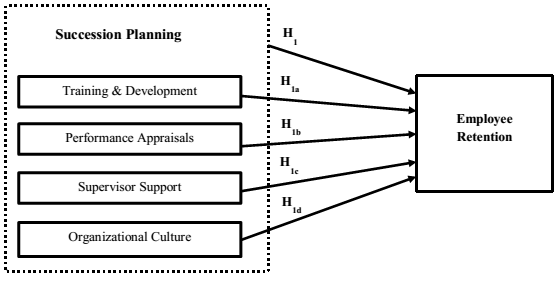
Based on past literature and research findings, the conceptual framework was developed to evaluate the relationship between succession planning and employee retention. Here, training and development, performance appraisal, supervisor support and organizational culture were taken as independent variables whereas employee retention was considered as the dependent variable. Further, hypotheses were developed accordingly.
Hypotheses
H1: There is a significant positive relationship between succession planning and employee retention
H1a: There is a significant positive relationship between training and development and employee retention
H1b: There is a significant positive relationship between performance appraisal and employee retention
H1c: There is a significant positive relationship between supervisor support and employee retention
H1d: There is a significant positive relationship between organizational culture and employee retention
The current study was based on positivism philosophy and deductive approach. Further, researchers utilized the survey strategy and the mono method to investigate the relationship between succession planning and employee retention. Out of 1200 permanent employees, 120 were taken as the sample using a simple random sampling method. Researchers utilized a questionnaire with five point Likert scale to measure succession planning (including training and development, supervisor support, performance appraisal and organizational culture) and employee retention developed by [1] and it can be viewed under Table 1.
Table 1: Operationalization of Study Variables
| Construct | Dimensions | No. of Items | Source |
| Succession Planning | Training and Development | 04 | [1] |
| Performance appraisals | 03 | [1] | |
| Supervisor support | 05 | [1] | |
| Organizational Culture | 05 | [1] | |
| Employee Retention | 03 | [1] |
Kenya Audience Research Foundation (KARF), 2014
The questionnaire consisted of three parts, with succession planning practices in section one, employee retention strategies in section two and background details in section three. For this study, researchers distributed hard copies of the questionnaire and simultaneously created a Google form using Google online survey system and the link of the questionnaire were sent to respondents via email.

Figure 1: Conceptual Framework Developed by Author, 2020
Most importantly due to the time constraint, researchers had to utilize the cross sectional method in data collection. However, only 100 questionnaires were usable for data analysis. Descriptive statistics were used to analyze demographic factors of the questionnaire and the hypotheses of the study were analyzed using correlation and regression with the support of SPSS version 20. Initially, researchers conducted a pilot study using 30 participants in order to check the reliability of the instruments. The Cronbach’s α values of independent and dependent variables were more than 0.7 (Table 2) and it showed that measurement scales used in this study are highly reliable [48].
Table 2: Reliability Test
| Variables | Dimensions | No. of Items | Cronbach’s α |
Succession Planning | Training and Development | 04 | 0.721 |
| Performance appraisals | 03 | 0.710 | |
| Supervisor support | 05 | 0.813 | |
| Organizational Culture | 05 | 0.798 | |
| Employee Retention | 03 | 0.759 |
Survey Data, 2020
Normality
Researchers discovered Skewness and Kurtosis values in order to ensure that the data set has been distributed normally during the period of the study.
According to Table 3, it was visible that the Skewness and Kurtosis values of each variable are somewhat closer to 0 and this means the data has been normally distributed in this study.
Table 3: Normality Test
| Variables | Dimensions | Skewness | Kurtosis |
Succession Planning | Training and Development | -0.007 | -0.610 |
| Performance Appraisal | -0.560 | 0.430 | |
| Supervisor Support | -0.346 | -0.079 | |
| Organizational Culture | -0.402 | -0.220 | |
| Employee Retention | - | 0.109 | -0.567 |
Survey Data, 2020
Linearity
Further, researchers used the sig value of “Deviation from Linearity” of the ANOVA table to identify the linear relationship between independent and the dependent variable. According to Table 4, all the values related to deviation from linearity were greater than 0.05. Therefore, it can be concluded that there was a linear relationship between independent variables and the dependent variable of the study.
Table 4: Linearity Test
| Variables | Deviation from Linearity (Sig) |
| Training and Development and Employee Retention | 0.263 |
| Performance Appraisal and Employee Retention | 0.596 |
| Supervisor Support and Employee Retention | 0.161 |
| Organization Culture and Employee Retention | 0.122 |
| Succession Planning and Employee Retention | 0.123 |
Survey Data, 2020
Respondents Profile
The table 5 provides a summary of the respondents of the current study. In this study, the majority of the participants were male ICT employees and as a percentage it was 54%. Based on the age category, the majority of the respondents were in between 18-29 years. Moreover, with respect to work experience, the majority of the respondents had less than 2 years (52%) of experience in the company. Finally, according to educational level, the majority of the respondents had a degree (54%) during the period of study.
Table 5: Respondents Profile
| Demographic Factor | Category | Frequency | % |
| Gender | Male | 54 | 54 |
| Female | 46 | 46 | |
| Age | 18 – 29 years | 64 | 64 |
| 30- 39 years | 24 | 24 | |
| 40 – 49 years | 08 | 08 | |
| 50 years and above | 04 | 04 | |
| Work Experience | 0 - 2 years | 52 | 53 |
| 3 -5 years | 32 | 32 | |
| 6 -10 years | 08 | 08 | |
| 11 years and above | 08 | 08 | |
| Level of Education | Diploma | 06 | 06 |
| Degree | 54 | 54 | |
| Masters | 38 | 38 | |
| Phd. | 02 | 02 |
Survey Data, 2020
Hypotheses Testing
H1: There is a significant positive relationship between succession planning and employee retention
As displayed in Table 6, the correlation between succession planning and employee retention indicated Pearson correlation coefficient (r) value of 0.605, which specified a moderate positive association between the two variables. Also, the Sig value of the relationship was 0.000 and it was less than 0.01 level. This confirmed that the correlation between succession planning and employee retention was significant. With the above findings, researchers accepted the alternative hypothesis of H1 where; “There is a significant positive relationship between succession planning and employee retention”.
Table 6: Correlations
| Succession Planning | Employee Retention | ||
| Succession Planning | Pearson Correlation | 1 | 0.605** |
| Sig. (2-tailed) | - | 0.000 | |
| N | 100 | 100 | |
**. Correlation is significant at the 0.01 level (2-tailed), Survey Data, 2020
H1a: There is a significant positive relationship between training and development and employee retention
According to Table 7, the correlation between training and development and employee retention gave Pearson correlation coefficient (r) value of 0.606, which indicated a moderate positive association between the two variables. Also, the Sig value of the relationship was 0.000 and it was less than 0.01 level. This confirmed that the correlation between training and development and employee retention was significant. With the above findings, researchers accepted the alternative hypothesis of H1a where; “There is a significant positive relationship between training and development and employee retention”.
Table 7: Correlations
| Variables | Training and Development | Employee Retention | |
| Training and Development | Pearson Correlation | 1 | 0.606** |
| Sig. (2-tailed) | 0.000 | ||
| N | 100 | 100 | |
| Employee Retention | Pearson Correlation | 0.606** | 1 |
| Sig. (2-tailed) | 0.000 | ||
| N | 100 | 100 | |
**. Correlation is significant at the 0.01 level (2-tailed), Survey Data, 2020
H1b: There is a significant positive relationship between performance appraisal and employee retention
The Table 8 shows the correlation between performance appraisal and employee retention, which indicated Pearson correlation coefficient (r) value of 0.547, which indicated a moderate positive association between the two variables. Also, the Sig value of the relationship was 0.000 and it was less than 0.01 level. This confirmed that the correlation between performance appraisal and employee retention was significant. With the above findings, researchers accepted the alternative hypothesis of H1b where; “There is a significant positive relationship between performance appraisal and employee retention”.
Table 8: Correlations
Performance Appraisal | Employee Retention | ||
| Performance Appraisal | Pearson Correlation | 1 | 0.547** |
| Sig. (2-tailed) | - | 0.000 | |
| N | 100 | 100 | |
| Employee Retention | Pearson Correlation | 0.547** | 1 |
| Sig. (2-tailed) | 0.000 | - | |
| N | 100 | 100 | |
**. Correlation is significant at the 0.01 level (2-tailed), Survey Data, 2020
H1c: There is a significant positive relationship between supervisor support and employee retention
The correlation between supervisor support and employee retention gave Pearson correlation coefficient (r) value of 0.661 (Table 9), which indicated a moderate positive association between the two variables. Also, the Sig value of the relationship was 0.000 and it was less than 0.01 level. This confirmed that the correlation between supervisor support and employee retention was significant. With the above findings, researchers accepted the alternative hypothesis of H1c where; “There is a significant positive relationship between supervisor support and employee retention”.
H1d: There is a relationship between organizational culture and employee retention

Table 9: Correlations
Supervisor Support | Employee Retention | ||
| Supervisor Support | Pearson Correlation | 1 | 0.661** |
| Sig. (2-tailed) | - | 0.000 | |
| N | 100 | 100 | |
| Employee Retention | Pearson Correlation | 0.661** | 1 |
| Sig. (2-tailed) | 0.000 | - | |
| N | 100 | 100 | |
**. Correlation is significant at the 0.01 level (2-tailed), Survey Data, 2020
According to Table 10, the correlation between organizational culture and employee retention gave Pearson correlation coefficient (r) value of 0.650, which indicated a moderate positive association between the two variables. Also, the Sig value of the relationship was 0.000 and it was less than 0.01 level.

The above findings confirmed that the correlation between organizational culture and employee retention was significant. With the above findings, researchers accepted the alternative hypothesis of H1d where; “There is a significant positive relationship between organizational culture and employee retention”.

Table 10: Correlations
| Organizational Culture | Employee Retention | ||
| Organizational Culture | Pearson Correlation | 1 | .650** |
| Sig. (2-tailed) | - | .000 | |
| N | 100 | 100 | |
| Employee Retention | Pearson Correlation | .650** | 1 |
| Sig. (2-tailed) | .000 | - | |
| N | 100 | 100 | |
**. Correlation is significant at the 0.01 level (2-tailed), Survey Data, 2020
Further, the current research has identified the most impactful factor affecting employee retention of ABC Company by analyzing the data using multiple regression. According to Table 11, the R square value of 0.654 displays, training and development, supervisor support, performance appraisal and organizational culture can collectively account for 65.4% of variance in employee retention of ABC Company.
Table 11: Model Summary
| Model | R | R Square | Adjusted R Square | Std. Error of the Estimate |
| 1 | 0.809a | 0.654 | 0.640 | 0.50531 |
a: Predictors: (Constant), Organizational Culture, Training and Development, Performance Appraisal, Supervisor Support, Survey Data, 2020
Based on ANOVA table (Table 12) the Sig value was 0.000 (p value is less than 0.01) and F value was 44.978 and it showed the goodness of fit. This indicated that the combination of these variables can significantly predict employee retention.
Table 12: ANOVA
| Model | Sum of Squares | df | Mean Square | F | Sig. | |
| 1 | Regression | 45.939 | 4 | 11.485 | 44.978 | 0.000a |
| Residual | 24.258 | 95 | 0.255 | - | - | |
| Total | 70.197 | 99 | - | - | - | |
a: Predictors: (Constant), Organizational Culture, Training and Development, Performance Appraisal, Supervisor Support, b: Dependent Variable: Retention, Survey Data, 2020
According to the Table 13, out of training and development, supervisor support, performance appraisal and organizational culture the highest Beta value was available with organization culture (Beta value of organization culture was 0.436). Therefore, the researchers concluded that, organizational culture is the most impactful factor affecting employee retention of ABC International (PVT) Ltd, Sri Lanka.
Table 13: Coefficients
| Model | Unstandardized Coefficients | Standardized Coefficients | t | Sig. | |
| B | Std. Error | Beta | |||
| (Constant) | -0.215 | 0.267 | - | -0.803 | 0.424 |
| Training and Development | 0.226 | 0.111 | 0.209 | 2.034 | 0.045 |
| Performance Appraisal | -0.007 | 0.116 | -0.006 | -0.059 | 0.953 |
| Supervisor support | 0.316 | 0.123 | 0.272 | 2.572 | 0.012 |
| Org. Culture | 0.436 | 0.116 | 0.407 | 3.745 | 0.000 |
a: Dependent Variable: Retention, Survey Data, 2020
Study Limitations and Future Research Directions
First, more studies can be implemented in the different industries to enhance the findings of the study. Second, the current study used cross-sectional data collected from comparatively smaller sample size based on multiple indicators model developed by Hair et al. [49] but future researchers can use Cochran’s formula, Slovins’s formula or Morgan table and increase the sample size in future studies. Thirdly, this study focuses on the ICT industry while other studies can be done on other sectors such as hospitality, insurance and banking to compare the relationship between succession planning and employee retention. In addition to these limitations, future studies can incorporate the other variables such as automation, emotional intelligence, personality traits and reward strategies to predict the turnover intentions of employees.
This study aimed to identify the relationship between employee succession planning practices and employee retention in the ICT industry in Sri Lanka. Moreover, researchers have analyzed how employee succession planning practices directly or indirectly related to employee retention and how performance appraisals, supervisor support, training and development and organizational culture mediated this relationship.
The findings of this study indicate that there is a strong relationship between effective succession planning practices and employee retention. Based on the results obtained from correlation analysis, researchers concluded that, there is a significant positive relationship between succession planning and employee retention in IVT industry in Sri Lanka. Moreover, researchers have examined the other factors affecting succession planning and identified that there is a significant positive relationship between training and development, performance appraisal, supervisor support, organizational culture and employee retention in ICT industry in Sri Lanka. Based on the regression analysis, researchers have identified, organizational culture is the most impactful factor affecting employee retention.
Ali and Mehreen, [50] also stated that succession planning is a significant strategy which is combating with employee turnover intentions and Ahmad, [51] highlighted that any organization looking to develop succession planning must pay attention to its organizational culture as it can be a key enabler or a significant obstacle based on organizational values. Therefore, implementing succession planning in an organization with a strong organizational culture which consists of core principles such as team work, flexibility, people care and transparency will lead to high employee retention.
Every organization identifies their employees as the key assets to drive the business hence no organization can afford losing their top performers. Therefore, organizations need to identify and implement appropriate retention strategies which their employees preserve to be effective. Implementing succession planning is an effective retention strategy for any organization because it enables in bringing the right person forward to the key positions where all the business-related decisions are to be taken.
Tunje, Grace S. Relationship Between Succession Planning Practices and Employee Retention in Large Media Houses in Kenya. Diss., University of Nairobi, 2014. http://hdl.handle.net/11295/75863.
Samuel, Michael O. and Crispen Chipunza. “Employee retention and turnover: Using motivational variables as a panacea.” African Journal of Business Management, vol. 3, no. 9, 2009, pp. 410. https://doi.org/10.5897/AJBM09.125.
Stovel, Meaghan and Nick Bontis. “Voluntary turnover: Knowledge management—friend or foe?” Journal of Intellectual Capital, vol. 3, no. 3, 2002, pp. 303–322. https://doi.org/10.1108/14691930210435633.
Mehrabani, Shadi Ebrahimi and Noor Azmi Mohamad. “Brief review of succession planning and management approach.” 3rd International Conference on Advanced Management Science, vol. 19, 2011, IACSIT Press.
Hall-Ellis, Sylvia D. “Succession planning and staff development—A winning combination.” The Bottom Line, vol. 28, no. 3, 2015, pp. 95–98. https://doi.org/10.1108/BL-05-2015-0007.
Lewis, Darcy. “Who’s next? Succession planning paves a path to your organization’s future.” Biomedical Instrumentation and Technology, vol. 43, no. 6, 2009, pp. 438–443. https://doi.org/10.2345/0899-8205-43.6.438.
Ertürk, Alper and Levent Vurgun. “Retention of it professionals: Examining the influence of empowerment, social exchange and trust.” Journal of Business Research, vol. 68, no. 1, 2015, pp. 34–46. https://www.sciencedirect.com/science/article/pii/S0148296314001945.
Madhushani, M.D.T. and D.M. Mudalige. “Impact of knowledge management practices on job satisfaction and employee retention in banking and it industries in Sri Lanka.” 2020. http://repository.ou.ac.lk/bitstream/handle/94ousl/1712/SLJMS%20Final%20Version_%204th%20Paper.pdf.
Bhati, Abhishek and Mathew J. Manimala. “Talent acquisition and retention in social enterprises.” Journal of Security and Sustainability Issues, vol. 1, no. 1, 2011, pp. 37–51. https://www.academia.edu/download/33104249/Journal_of_Security_and_Sustainability_Issues_1_1_su_DOI_4_straipsnis.pdf.
Negrea, S. “Succession planning: A necessity for community colleges.” Institute for Community College Development, New York, 2008.
Hadelman, Jordan and Elaina Spitaels-Genser. “Succession planning: The art of transferring leadership.” Trustee: The Journal for Hospital Governing Boards, vol. 58, no. 8, 2005, pp. 4–14. https://pubmed.ncbi.nlm.nih.gov/16196398/.
Alias, Nurul Ezaili et al. “Towards effective employee retention strategy: implementation of talent management in information, communication and technology companies.” Advanced Science Letters, vol. 23, no. 8, 2017, pp. 7857–7860. https://doi.org/10.1166/asl.2017.9594.
Edirisooriya, Waruni Ayesha. “The impact of transformational leadership on talent retention: With special reference to information communication technology industry in Sri Lanka.” 2020. http://repository.ou.ac.lk/bitstream/handle/94ousl/1715/SLJMS%20Final%20Version_%207th%20Paper.pdf.
James, Leena and Lissy Mathew. “Employee retention strategies: IT industry.” SCMS Journal of Indian Management, vol. 9, no. 3, 2012. https://www.academia.edu/download/30315431/scms_journal_july-september_2012.pdf.
Avanesh, N. “A study on succession planning and its impact on organizational performance in the it sector.” Journal of Arts, Science and Commerce, vol. 2, no. 1, 2011, pp. 1–12.
Bolander, Pernilla et al. “The practice of talent management: A framework and typology.” Personnel Review, vol. 46, no. 8, 2017, pp. 1523–1551. https://doi.org/10.1108/PR-02-2016-0037.
Armstrong, Michael. A Handbook of Human Resource Management Practice. Kogan Page Publishers, 2006. https://books.google.com/books?hl=enandlr=andid=D78K7QIdR3UC.
Rollins, Gina. “Succession planning: Laying the foundation for smooth transitions and effective leaders.” Healthcare Executive, vol. 18, no. 6, 2003, pp. 14–18. https://europepmc.org/article/med/14603806.
Garretson, C. “Succession planning for IT: Get some depth to your bench.” Computerworld, 2010. https://www.computerworld.com/article/2515979/succession-planning-for-it--get-some-depth-to-your-bench.html.
Pandey, Suruchi and Deepesh Sharma. “Succession planning practices and challenges: Study of indian organizations.” Procedia Economics and Finance, vol. 11, 2014, pp. 152–165. https://doi.org/10.1016/S2212-5671(14)00185-3.
Yadav, Surendra S. and Ravi Shankar. “Succession planning: Some lessons.” Journal of Advances in Management Research, vol. 14, no. 4, 2017, pp. 406–407. https://doi.org/10.1108/JAMR-07-2017-0081
Huang, Tung-Chun. “Succession management systems and human resource outcomes.” International Journal of Manpower, vol. 22, no. 8, 2001, pp. 736–747. https://doi.org/10.1108/EUM0000000006508
Fenner, Douglas E. Linking Succession Planning to Employee Training: A Study of Federal Employees. https://search.proquest.com/openview/6c4749df7171d92c9e247b9b8e78d6c1/1?pq-origsite=gscholarandcbl=18750anddiss=y
Ali, Zulqurnain et al. “Impact of succession planning on employee’s performance: Evidence from commercial banks of Pakistan.” European Journal of Social Sciences, vol. 44, no. 2, 2014, pp. 213–220. https://doi.org/10.5296/ijhrs.v10i2.16339
Luna, Gaye. “Planning for an American higher education leadership crisis: The succession issue for administrators.” International Leadership Journal, vol. 4, no. 1, 2012, pp. 56–79. https://www.researchgate.net/profile/Jennifer-Strong-3/publication/344340729_Barriers_to_the_attainment_of_global_leadership_competencies/links/628d07036773462154d503ab/Barriers-to-the-attainment-of-global-leadership-competencies.pdf
Mhlongo, S.B. and M. Harunavamwe. “Exploring management’s perceptions of succession planning and its impact on staff retention at an agricultural company.” International Journal of Research in Business Studies and Management, vol. 4, no. 3, 2017, pp. 7–26. https://doi.org/10.22259/ijrbsm.0403002
Poornima, W.A.D.N. et al. “A study on the impact of effective succession planning practices on employee retention of private business organizations in Sri Lanka.” Journal of Management and Tourism Research (JMTR), 2018, p. 21. https://www.researchgate.net/profile/Ruwan-Ranasinghe/publication/336020655_Journal_of_Management_and_Tourism_Research/links/5d8b139c299bf10cff0b3832/Journal-of-Management-and-Tourism-Research.pdf
Armstrong, M. A Handbook of Human Resource Management Practice. 9th ed., Cambrian Printers Ltd., 2003.
Rioux, Sheila M. and Paul Bernthal. Succession Management Practices Survey Report. Development Dimensions International, 1999.
Charan, Ram et al. Succession Management Practices. Survey report, 2001.
Armstrong, Michael and Stephen Taylor. Human Resource Management Practice. 10th ed., Distributed Computing, 2006. https://doi.org/10.1002/9781118802717
Dessler, Gary. Human Resource Management. 8th ed., Prentice Hall Inc., 2000.
Michelson, Rick. “Preparing future leaders for tomorrow: succession planning for police leadership.” Police Chief, vol. 73, no. 6, 2006, p. 16. https://www.ojp.gov/ncjrs/virtual-library/abstracts/preparing-future-leaders-tomorrow-succession-planning-police
Conger et al. “Developing your leadership pipeline.” Harvard Business Review, vol. 81, no. 12, 2003, pp. 76–85. http://ereserve.library.utah.edu/Annual/MGT/5510/Koerner/conger.pdf
Rothwell, William. Effective Succession Planning: Ensuring Leadership Continuity and Building Talent from Within. Amacom, 2010. https://books.google.com/books?hl=enandlr=andid=S31wa8sb6rkCandoi=fndandpg=PR7anddq=35.%09Rothwell,+W.+J.+(2005).+Effective+succession+planning:+Ensuring+leadership+continuityand+building+talent+from+within.+(3rd+ed.).+New+York:+American+Management+Association.andots=Ns_1vdkDSMandsig=Q0dx1BoZlFpVLAt-teL7UkTUY74
Sobol, Mark R. et al. Linkage Inc.'s Best Practices for Succession Planning: Case Studies, Research, Models, Tools. 2007. https://cir.nii.ac.jp/crid/1130282272813895168
Milkovich, R. and J.W. Boudreau. “The unfolding model of voluntary turnover and job embeddedness: Foundations for a comprehensive theory of attachment.” Research in Organizational Behavior, vol. 23, no. 1, 1988, pp. 189–246.
Denisi, A.S. and R.W. Griffin. Human Resource Management. Houghton Mifflin Company, 2008.
Abassi, S.M. and K.W. Hollman. “Turnover: The Real Bottom Line.” Public Personnel Management, vol. 2, no. 3, 2000, pp. 333–342. https://doi.org/10.1177/009102600002900303
Eshiteti, Stephen Nyikuli et al. “Effects of succession planning programs on staff retention.” Mediterranean Journal of Social Sciences, vol. 4, no. 6, 2013, pp. 157–162. https://doi.org/10.5901/mjss.2013.v4n6p157
Chitsaz-Isfahani, Ali and Hamid Reza Boustani. “Effects of talent management on employee’s retention: The mediate effect of organizational trust.” International Journal of Academic Research in Economics and Management Sciences, vol. 3, no. 5, 2014, pp. 114–128. https://doi.org/10.6007/IJAREMS/v3-i5/1196
Iqbal, Sehresh and Maryam Saeed Hashmi. “Impact of perceived organizational support on employee retention with mediating role of psychological empowerment.” Pakistan Journal of Commerce and Social Sciences (PJCSS), vol. 9, no. 1, 2015, pp. 18–34. https://hdl.handle.net/10419/188180
Mendes, Fallen and Marius W. Stander. “Positive organization: The role of leader behaviour in work engagement and retention.” SA Journal of Industrial Psychology, vol. 37, no. 1, 2011, pp. 1–13. http://www.scielo.org.za/scielo.php?pid=S2071-07632011000100003
Hong, Eric Ng Chee et al. “An effectiveness of human resource management practices on employee retention in institute of higher learning: A regression analysis.” International Journal of Business Research and Management, vol. 3, no. 2, 2012, pp. 60–79. https://www.researchgate.net/profile/Charles-Ramendran/publication/267725979_An_Effectiveness_of_Human_Resource_Management_Practices_on_Employee_Retention_in_Institute_of_Higher_learning_-A_Regression_Analysis/links/54d0dacf0cf298d6566937a0/An-Effectiveness-of-Human-Resource-Management-Practices-on-Employee-Retention-in-Institute-of-Higher-learning-A-Regression-Analysis.pdf
Waleed, A. The Relationship Between Human Resource Practices and Employee Retention in Public Organization. PhD thesis, The United Arab Emirates University, 2011.
Huselid, Mark A. “The impact of human resource management practices on turnover, productivity and corporate financial performance.” Academy of Management Journal, vol. 38, no. 3, 1995, pp. 635–672. https://journals.aom.org/doi/abs/10.5465/256741
Batt, Rosemary et al. “Employee voice, human resource practices and quit rates: Evidence from the telecommunications industry.” ILR Review, vol. 55, no. 4, 2002, pp. 573–594. https://doi.org/10.1177/001979390205500401
Sekaran, Uma and Roger Bougie. Research Methods for Business: A Skill Building Approach. John Wiley and Sons, 2016. https://books.google.com/books?hl=enandlr=andid=Ko6bCgAAQBAJandoi=fndandpg=PA19
Hair, Joseph F. Multivariate Data Analysis. 2009. https://digitalcommons.kennesaw.edu/facpubs/2925/
Ali, Zulqurnain and Aqsa Mehreen. “Understanding succession planning as a combating strategy for turnover intentions.” Journal of Advances in Management Research, vol. 16, no. 2, 2019, pp. 216–233. https://doi.org/10.1108/JAMR-09-2018-0076
Ahmad, A.R. and N. Keerio. “The culture-succession model: the factors affecting implementation of succession planning in Malaysian public universities.” International Journal of Engineering and Advanced Technology (IJEAT), vol. 4, no. 1, 2019, pp. 213–220. https://doi.org/10.35940/ijeat.A1356.109119