During this pandemic period, call centers became people’ s first point of contact to get in touch with companies they get services and products from. How can then A.I. help increase customer satisfaction and efficiency of your Call Center Agents? What is the role of A.I. in this new era? In which way is A.I. going to change the very nature of call centers as we know it?.
Keywords
A.I.
Artificial Intelligence
Call Center
Efficiency
Customer
Satisfaction
Agent
Pandemic
NPS
Net promoter score
INTRODUCTION
Call Center-a centralised office used for receiving or transmitting a large volume of enquiries by telephone, other than that call centres administers centralised handling of individual communications, including live support software, social media, instant message and e-mail [1]. We can by definition say that there’s two types of call centers:
Inbound call centers-administer incoming product or service support or information enquiries from consumers
Outbound call centers-for telemarketing, for solicitation of charitable or political donations, debt collection, market research, emergency notifications and urgent/critical needs blood banks
The contact centre is a central point from which all customer contacts are managed. Through contact centres, valuable information about the company is routed to appropriate people, contacts to be tracked and data to be gathered. It is generally a part of a company's customer relationship management infrastructure. The majority of large companies use contact centres as a means of managing their customer interactions. These centres can be operated by either an in-house department responsible or outsourcing customer interaction to a third-party agency (known as Outsourcing Call Centres) [2].
Call center’s technologies include speech recognition software which allowed Interactive Voice Response (IVR) systems to handle first levels of customer support, text mining, natural language processing to allow better customer handling, agent assistance via interactive scripting and automatic mining using past interactions, support automation and many other technologies to improve agent productivity and customer satisfaction (CX) [3]. Automatic lead selection or lead steering is also intended to improve efficiencies, both for inbound and outbound campaigns. This allows inbound calls to be directly routed to the appropriate agent for the task, whilst minimising wait times and long lists of irrelevant options for people calling in.
For outbound calls, lead selection allows management to designate what type of leads go to which agent based on factors including skill, socioeconomic factors, past performance and percentage likelihood of closing a sale per lead.
The universal queue standardised the processing of communications across multiple technologies such as instant message, phone and email. The virtual queue provides callers with an alternative to waiting on hold when no agents are available to handle inbound call demand.
Impact of Artificial Intelligence
Artificial Intelligence has fundamentally changed the landscape for dozens of industries, enabling significant improvements in data collection and analysis. The goal is to drive sales, boost employee engagement and improve customer satisfaction.
Two major types of AI or Artificial Intelligence can be seen in the call centers:
The first can evaluate huge volumes of data and provide just-in-time insights for agents to improve their performance on a call. This AI will learn how to provide the right information at the right time during a call and can ensure agents are always one step ahead of the needs of a client calling
The other type, conversational AI analyzes the speech of the participants and identifies emotions. It forecasts the impact of a conversation based on the emotional state, vocal tics and overall engagement level of the caller and the agent. The resulting analysis provides valuable real-time feedback on the emotional state of the customer and the agent. Without the need to wait for a customer to ask for escalation, the AI recognizes when an intervention is needed and automates the process
This is where call center AI has the opportunity to really transform the way the work is done. With the combination of general and conversational AI, call centers will see actionable business insights that can be rapidly implemented throughout the organization to drive results. By the end of the year 2020, Gartner estimates that around 85% of customer service interactions will be handled or supported by AI. Accenture estimates that there will be a 40% increase in business productivity by 2035 from these technologies [4].
AI will have a long-lasting effect on the modern call center in unequal several ways. Some examples are:
Revenue Impact - The lack of data and systems to follow-up with individual interactions can be incredibly costly. AI changes that by closing the loop on the missing variables and improving our ability to prospect insights from every call
Increase of Customer Satisfaction-Agent performance scores are based on how long a call takes, whether the issue was resolved and what the customer says in their post-call survey. It’s all quantitative data that can be captured and evaluated automatically. Customer satisfaction is often the last thing on our checklist because it’s so difficult to measure at a high level. AI is changing that by providing insights into a lot more factors, as well as the emotional state of the customer during a call. What was only available qualitatively, through the supervisor’s review of calls, can now be captured passively with an AI. The result is higher Net Promoter Scores (NPS) and better customer satisfaction
Increased Debt Repayment- It’s possible to drive greater results from calls, the happier are customers and more data are available. It includes a higher debt repayment rate on all outstanding accounts. Calls are routed to the appropriate agent almost immediately and potential solutions for a specific issue are developed almost instantly with support from agents and AI
Agent Happiness/Customer Happiness-Customer’s happiness is the primary goal for any company, but equally as important as agent engagement and happiness. Agents are often underappreciated, overworked and disengaged at work. They spend hours dealing with upset customers who have been on hold for 30 minutes if not longer. By improving the matching between customers and agents and also providing relevant data as a supplement for the agent, a lot of this friction is removed and this will lead the agents to feel better about their work. It can lead to lower turnover and higher performances
Behavioral Profile Matching-AI can paint a detailed picture of each customer from an analysis of their previous calls and purchase activity. The resulting behavioral profiling ensures faster and accurate matching of customers when they call by routing to the right agent
Contact Center Reputation-When customers are happy, agents are happier and resolution rates are up, the contact center’s reputation will improve as well
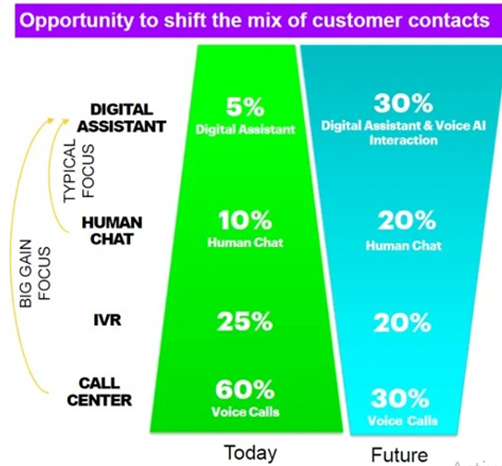
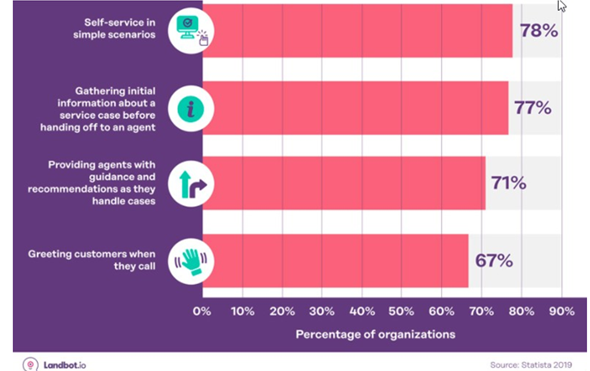
Although chatbots and automated phone systems can guide customers to answers for simple questions that may not need a human agent, they are only the front line in customer service technology. AI can have the most profound impact not by replacing human agents but by supporting them, monitoring them and extracting valuable information from their calls. As rapidly as AI has advanced, we're still far from a system that can replicate the human touch on a phone call. We need our customer service agents, but we can empower them to do better with the right combination of technology. Take, for example, how agents are currently measured. Customer service scoring and agent performance scoring is based heavily on human observation. Calls are monitored and listened to only in part, often by a small number of human agents who have their own biases that could impact their evaluations. Call analysis can be inaccurate and the scoring of agents can be directly impacted. Traditional call monitoring lacks the ability to pull data from multiple sources in real time. Agents only receive feedback and support after the call and there's no automation or assistance implemented to guide customers to the correct agent. Customers may talk to half a dozen agents before they reach the right individual and by then it's difficult to have a smooth call with a good outcome (figures 1 & 2).
AI improves this situation by performing those basic functions (monitoring, analysis and support) in real time and at scale. Every call is monitored and recorded [5]. Speech patterns are analyzed to determine the mood and response of both the customer and the agent on each call. The outcome is recorded and compared against the actions taken by the agent on the call.
Much of this data can be delivered in real time to the customer service agent, enabling them to respond in the most effective way. It also ensures that customers are matched with the right agent much faster.
Figure 1: Place of AI today and future in the industry
source: https://insuranceblog.accenture.com/
Figure 2: Different Use case of AI (Chat bot)
This makes customers happier because it resolves their issue more directly. It makes customer service agents happier because they are working on cases that they are uniquely suited to. When they succeed at a higher rate, they will be happier in their work and continue to succeed.
AI is capable of actively analyzing data from a customer call to predict when someone is likely to get angry and to facilitate a change before that happens. By capturing data points related to their vocal characteristics, their previous call history, the nature of their concern and the response of the customer service agent, the system can flag a potential issue well before a human operator would and intervene more rapidly [6].
Imagine being able to analyze every interaction you have across all your customer-facing channels in real time and create a picture of a larger problem. Customers don't just call support anymore. They leave reviews on Google. They tweet at brands. They attempt to use chatbots on websites or submit support tickets. This data can be captured and integrated into a single profile, enabling rapid assignment of the correct customer service agent who can proactively address their problem before it escalates. AI-driven call quality monitoring is making that possible.
To summarize, AI and analytics can offer:
Automation: AI automatically captures call data, routes individuals to the correct customer service agents based on both input and mood and creates a profile for future reference that can be used in the call center and other business areas. This requires no human intervention and is done automatically for every call
Analysis: Call center AI provides in-depth analysis of individual calls at a scale that human managers and quality control specialists cannot. Each call is measured and compared against performance benchmarks and integrated with outside data to provide a clear picture and actionable insights
Support: AI is directly integrated with call center service agent workstations, giving them immediate insight into the data being captured, the potential outcome of a call and more. The result is faster response times, a higher first-call-resolution rate and happier customer service agents who now have the tools to do their job at a higher level
Call center AI is not new; the largest companies have been integrating these tools for several years and realizing substantial benefits. The onset of a global pandemic has accelerated plans for many companies.
What was once a centralized process that allowed close monitoring of customer service agents has now been decentralized, with service agents and quality staff often working from home. AI is helping to bridge the gap in efficiency, keep everyone connected remotely and provide real-time support for both customer service agents and the managers who need to monitor and evaluate call quality data.
Call centers across almost every industry are weathering this storm; from the travel industry representatives helping upset customers process cancelations and refunds to the IT and software company representatives seeing unprecedented demand for their services as a large percentage of the population works at home. AI allows for 24/7 response rates, social distancing in the office by sending most people home and balanced responses that would not have been possible even a decade ago.
CONCLUSION
Call centers are already data-driven entities. The most efficient call centers are considered effective when they can identify accurately the common causes of customer concerns, train agents to respond preemptively and then evaluate the outcomes of calls and improve. The problem is that these processes were lacking the data to be fully accurate. How the customer feels and actively responds to these tactics can have a huge impact on the outcome. With AI, we can now close the gap and fully understand where challenges exist and solve them before they impact on the revenue or customer satisfaction. A.I is not there to replace humans but mostly like a helper that increases the efficiency of your Call Center Agents, decreases Average Handle Time and increases First Call Resolution rate.
REFERENCES
"How AI Is Changing the World of Call Centers." Medium, https:// medium. com/ behavioral- signals- ai/ how- ai- is-changing-the-world-of-call-centers-b78e1720b1a5.
"How AI Is Revamping the Call-Center." Forbes, 25 June 2020, https:// www. forbes. com/ sites/ insights- ibmai/ 2020/ 06/ 25/ how- ai- is- revamping- the- call-center/?sh=43c55e6934b2.
"How AI Will Change the Nature of Contact Center Work." Contact Center Pipeline, Nov. 2018, https:// blog. contactcenterpipeline. com/ 2018 / 11/ how- ai- will-change -the-nature-of-contact-center-work/.
"How AI Can Help Call Centers in Crisis." Customer Think, https:// customerthink. com/ 5- ways- ai -can -help -call -centers -in-crisis/.
"Top Trends on the Gartner Hype Cycle for Artificial Intelligence, 2019." Gartner, https:// www. gartner. com/ smarterwithgartner/ top- trends- on- the- gartner- hype-cycle-for-artificial-intelligence-2019/.
All papers should be submitted electronically. All submitted manuscripts must be original work that is not under submission at another journal or under consideration for publication in another form, such as a monograph or chapter of a book. Authors of submitted papers are obligated not to submit their paper for publication elsewhere until an editorial decision is rendered on their submission. Further, authors of accepted papers are prohibited from publishing the results in other publications that appear before the paper is published in the Journal unless they receive approval for doing so from the Editor-In-Chief.
Himalayan Journal of Economics and Business Management open access articles are licensed under a Creative Commons Attribution-Share A like 4.0 International License. This license lets the audience to give appropriate credit, provide a link to the license, and indicate if changes were made and if they remix, transform, or build upon the material, they must distribute contributions under the same license as the original.
Recommended Articles
Research Article
Resonant leadership and its role in achieving organizational success: An Exploratory study of the opinions of a sample of employees of the Baghdad Municipality-Baghdad Water Department-Southern Reservoir
Muthana M. Saeed
Download PDF
Cite
x
APA
Saeed, M. M. (2026). Resonant leadership and its role in achieving organizational success: An Exploratory study of the opinions of a sample of employees of the Baghdad Municipality-Baghdad Water Department-Southern Reservoir. Himalayan Journal of Economics and Business Management, 7(2), 1-14.
MLA
Saeed, Muthana M.. "Resonant leadership and its role in achieving organizational success: An Exploratory study of the opinions of a sample of employees of the Baghdad Municipality-Baghdad Water Department-Southern Reservoir." Himalayan Journal of Economics and Business Management 7.2 (2026): 1-14.
Chicago
Saeed, Muthana M.. "Resonant leadership and its role in achieving organizational success: An Exploratory study of the opinions of a sample of employees of the Baghdad Municipality-Baghdad Water Department-Southern Reservoir." Himalayan Journal of Economics and Business Management 7, no. 2 (2026): 1-14.
Harvard
Saeed, M. M. (2026) 'Resonant leadership and its role in achieving organizational success: An Exploratory study of the opinions of a sample of employees of the Baghdad Municipality-Baghdad Water Department-Southern Reservoir' Himalayan Journal of Economics and Business Management 7(2), pp. 1-14.
Vancouver
Saeed MM. Resonant leadership and its role in achieving organizational success: An Exploratory study of the opinions of a sample of employees of the Baghdad Municipality-Baghdad Water Department-Southern Reservoir. Himalayan Journal of Economics and Business Management. 2026 Jul;7(2):1-14.
Download PDF
Research Article
Modelling Structure Job Quality, Job Design and Job Satisfaction
Moch Nurhadi,
...
Avi Sunani
Published: 30/08/2022
Download PDF
Cite
x
APA
Nurhadi, M., Bisyri Effendi, M., Saiful Ulum, A. & Sunani, A. (2022). Modelling Structure Job Quality, Job Design and Job Satisfaction. Himalayan Journal of Economics and Business Management, 3(2), 1-4.
MLA
Nurhadi, Moch, et al. "Modelling Structure Job Quality, Job Design and Job Satisfaction." Himalayan Journal of Economics and Business Management 3.2 (2022): 1-4.
Chicago
Nurhadi, Moch, Moch Bisyri Effendi, Achmad Saiful Ulum and Avi Sunani. "Modelling Structure Job Quality, Job Design and Job Satisfaction." Himalayan Journal of Economics and Business Management 3, no. 2 (2022): 1-4.
Harvard
Nurhadi, M., Bisyri Effendi, M., Saiful Ulum, A. and Sunani, A. (2022) 'Modelling Structure Job Quality, Job Design and Job Satisfaction' Himalayan Journal of Economics and Business Management 3(2), pp. 1-4.
Vancouver
Nurhadi M, Bisyri Effendi M, Saiful Ulum A, Sunani A. Modelling Structure Job Quality, Job Design and Job Satisfaction. Himalayan Journal of Economics and Business Management. 2022 Jul;3(2):1-4.
Download PDF
Research Article
Influence of Leadership on Poverty Reduction in the Devolved Government in Trans-Nzoia County, Kenya
Kinisu Sifuna,
...
Peter Simotwo
Published: 30/06/2021
Download PDF
Cite
x
APA
Sifuna, K., Lwangale, D. W., Simotwo, P., Sifuna, K., Lwangale, D. W. & Simotwo, P. (2021). Influence of Leadership on Poverty Reduction in the Devolved Government in Trans-Nzoia County, Kenya. Himalayan Journal of Economics and Business Management, 2(1), None-None.
MLA
Sifuna, Kinisu, et al. "Influence of Leadership on Poverty Reduction in the Devolved Government in Trans-Nzoia County, Kenya." Himalayan Journal of Economics and Business Management 2.1 (2021): None-None.
Chicago
Sifuna, Kinisu, David W. Lwangale, Peter Simotwo, Kinisu Sifuna, David W. Lwangale and Peter Simotwo. "Influence of Leadership on Poverty Reduction in the Devolved Government in Trans-Nzoia County, Kenya." Himalayan Journal of Economics and Business Management 2, no. 1 (2021): None-None.
Harvard
Sifuna, K., Lwangale, D. W., Simotwo, P., Sifuna, K., Lwangale, D. W. and Simotwo, P. (2021) 'Influence of Leadership on Poverty Reduction in the Devolved Government in Trans-Nzoia County, Kenya' Himalayan Journal of Economics and Business Management 2(1), pp. None-None.
Vancouver
Sifuna K, Lwangale DW, Simotwo P, Sifuna K, Lwangale DW, Simotwo P. Influence of Leadership on Poverty Reduction in the Devolved Government in Trans-Nzoia County, Kenya. Himalayan Journal of Economics and Business Management. 2021 Jan;2(1):None-None.
Download PDF
Research Article
Analysis Of the Influence of Leadership Style and Organizational Culture on Teacher Performance State Vocational School 4 Pontianak City
Yesti Rahmadani,
...
Ilzar Daud
Published: 07/08/2024
Download PDF
Cite
x
APA
Rahmadani, Y., Fauzan, R., Rosnani, T. & Daud, I. (2024). Analysis Of the Influence of Leadership Style and Organizational Culture on Teacher Performance State Vocational School 4 Pontianak City. Himalayan Journal of Economics and Business Management, 5(2), 1-10.
MLA
Rahmadani, Yesti, et al. "Analysis Of the Influence of Leadership Style and Organizational Culture on Teacher Performance State Vocational School 4 Pontianak City." Himalayan Journal of Economics and Business Management 5.2 (2024): 1-10.
Chicago
Rahmadani, Yesti, Rizky Fauzan, Titik Rosnani and Ilzar Daud. "Analysis Of the Influence of Leadership Style and Organizational Culture on Teacher Performance State Vocational School 4 Pontianak City." Himalayan Journal of Economics and Business Management 5, no. 2 (2024): 1-10.
Harvard
Rahmadani, Y., Fauzan, R., Rosnani, T. and Daud, I. (2024) 'Analysis Of the Influence of Leadership Style and Organizational Culture on Teacher Performance State Vocational School 4 Pontianak City' Himalayan Journal of Economics and Business Management 5(2), pp. 1-10.
Vancouver
Rahmadani Y, Fauzan R, Rosnani T, Daud I. Analysis Of the Influence of Leadership Style and Organizational Culture on Teacher Performance State Vocational School 4 Pontianak City. Himalayan Journal of Economics and Business Management. 2024 Apr;5(2):1-10.
Shchurovska, А. Y. & Inabanza Herisatry, L. (2021). Impact of Artificial Intelligence in Call Centers. Himalayan Journal of Economics and Business Management, 2(1), 1-4.
MLA
Shchurovska, А. Yu. and Lubaba Inabanza Herisatry. "Impact of Artificial Intelligence in Call Centers." Himalayan Journal of Economics and Business Management 2.1 (2021): 1-4.
Chicago
Shchurovska, А. Yu. and Lubaba Inabanza Herisatry. "Impact of Artificial Intelligence in Call Centers." Himalayan Journal of Economics and Business Management 2, no. 1 (2021): 1-4.
Harvard
Shchurovska, А. Y. and Inabanza Herisatry, L. (2021) 'Impact of Artificial Intelligence in Call Centers' Himalayan Journal of Economics and Business Management 2(1), pp. 1-4.
Vancouver
Shchurovska АY, Inabanza Herisatry L. Impact of Artificial Intelligence in Call Centers. Himalayan Journal of Economics and Business Management. 2021 Jan;2(1):1-4.



 Download PDF
 Download XML