Customer-oriented marketing is about engaging the customer in the epicenter of all marketing plans. This study conceptually focuses on the role of customer-oriented marketing in rebuilding business-customer relationship with respect to Post-COVID-19. The study was prompted by the fact that the novel COVID-19 pandemic negatively affected nations’ economies, devastated business-customer relationships, made personal contacts and interactions challenging. Being an empirical study, the researchers made use of bo th primary and secondary data. Data gathered with the aid of questionnaire were analyzed using descriptive statistics. To test the stated hypotheses, customer oriented marketing variables (trust, friendliness, feedback, responsiveness, value creation and convenience) were regressed to find out the extent of association between each of them and repeat purchase which, to some extent, is an evidence of customer satisfaction. Findings revealed a strong relationship between customer-oriented marketing variables and repeat purchase, hence the researchers recommended that marketing managers should create value for their customers, build trust in them, be friendly with them, get regular feedback from them, respond promptly to their requests, and ensure that they make purchases conveniently. All these customer-oriented marketing approaches will ultimately help rebuild businesscustomer relationship so threatened by the pandemic.
Keywords
Marketing
Customer-oriented marketing
Business-customer relationship
Relationship marketing
INTRODUCTION
The Coronavirus pandemic (COVID-19), like the thief “cometh not, but for to steal, and to kill, and to destroy” (John 10:10). Its sudden arrival caught the world unawares, unprepared, and ultimately ravaged not only Nigerian economy, but the world at large. The most powerful countries of the world, such as the United States of America, China, England, among others, came to a halt, as most businesses and families were affected. The rate at which people were affected and lives were lost made the World Health Organisation (WHO) to come up with strict protocols. The most common Covid-19 protocols were the wearing of face masks, regular hand washing and maintenance of social distancing. Due to the escalating world death toll, most businesses insisted on COVID-19 protocols compliance, a situation that minimized personal contacts and interactions, and ultimately affected business relationships.
In addition to the reduction in the level of interactions, the pandemic created unprecedented uncertainties and anxieties in business environment, as most businesses that encourage personal contacts or crowd generation like schools, banks, markets, cinemas, religious centres, among others were shut down. Despite the measures put together by Nigerian government led by President Muhammadu Buhari, the crisis degenerated to community transmission. While the government felt that they were shielding their citizens from impending health hazard by shutting down businesses, the economic devastation in the country degenerated to economic recession, as the country witnessed two consecutive negative GDP. In the view of Acee-Eke & Ogonu, all those measures culminated into economic shock that made small and medium scale enterprises (SMEs) not to play their economic role meant to sustain the livelihood of customers with changing consumption patterns and consumer buying behaviour. Similarly, Waldron and Wetherbe [1] opined that businesses are now facing tension between generating sales during a period of extreme economic hardship and respecting the threats to life and livelihood that have altered consumer priorities and preferences.
Most businesses, which before now were booming, lost customer patronage due to Covid-19 pandemic, hence theneed to rebuild and maintain business-customer relationship. It is against this backdrop that we operationalized business-customer relationship construct to examine the extent to which each of these variables affect repeat purchase, which is an output of positive business-customer relationship.
Research Hypotheses
The following hypotheses shall be tested in this study:
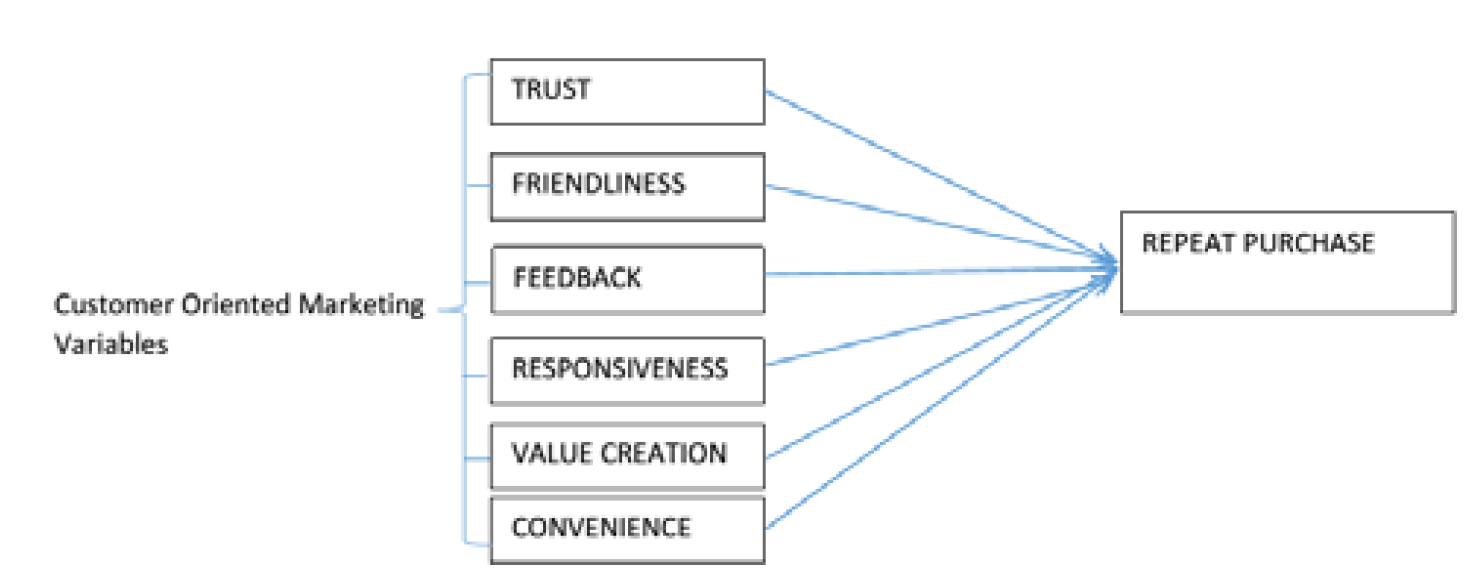
Ho1: Trust does not significantly relate with repeat purchase
Ho2: There is no significant relationship between friendliness and repeat purchase
Ho3: Having a good feedback mechanism does not significantly increase repeat purchase
Ho4: Responsiveness does not have any significant effect on repeat purchase
Ho5: Offering value to customers does not significantly increase repeat purchase
Ho6: Convenience does not have any significant relationship with repeat purchase
The conceptual framework above succinctly shows the customer oriented marketing variables that constitute the independent variables. They are trust, friendliness, feedback, responsiveness, value creation, and convenience. These are drivers of repeat purchase, which is the dependent variable of this study. The extent to which each of these variables contributes to repeat purchase shall be considered in the analysis section of this study.
Customer Oriented Marketing
Customer oriented marketing is a marketing philosophy that prioritized the needs of the customer over the needs of the business. Customer-oriented business recognizes that customers are the business. It emphasizes on understanding consumers' real needs, and satisfying them better than competitors. Customer-oriented marketing is focused on the perception of products or services and how they are fulfilling consumers’ needs [2].
Trust
Trust, according to most researchers in the field of marketing is seen as one of the key constructs of relationship marketing [3]. Trust constitutes the belief, attitude or expectation of a party that the relationship partner's behavior or its outcomes will be for the trusting party's own benefit [4]. It is the degree of confidence or certainty that a customer has in exchange relationships
Friendliness
Friendliness is the tendency to convey an affective customer-employee social interaction [5].
Feedback
Feedback is part of the receiver’s response communicated back to the sender [6].
Responsiveness is the willingness to provide prompt services. It is the ability respond speedily to customer’s request.
Value Creation
This is a process of identifying new customer’s benefits; it is how a company efficiently creates new value offerings.
Convenience
This is the ease at which products are purchased by customers.
Marketing
Marketing is an evolving and dynamic profession that transverse across every aspect of human endeavor. Marketing is a strategic function of a business that serves as a process through which the economy is integrated into the society serving the consumers’ needs satisfactorily. Laymen view Marketing as selling. That is why authors like Peter Drucker, a management guru made outstanding efforts to clear the air. Drucker [7] defined marketing as a business function that is unique, goes beyond selling, and includes all areas of the organization with the customer’s point of view as a guide. Similarly, Baker opined that the goal of marketing is to create and maintain mutually satisfying exchange relationships. This exchange relationship must be mutually beneficial to all stakeholders for it to thrive.
Consumers
Consumers are people, either individuals or groups who use goods and services to satisfy their personal or non-personal consumption needs. Customers are buyers or potential buyers of products. From the assertions above, it is obvious that a customer can also be a consumer, hence business efforts are geared towards satisfaction of ultimate consumer/customer. According to Akpoveta et al. [8], customers, whether members of the public or organizations, are crucial to the success of any business since they represent its fundamental source of revenue and profitability.
Customer Value
Interest in the creation of customer value has grown in recent years and has been discussed intensively ever since the view has shifted from product and sales to a market orientation, which implies that value originates from solutions that address and satisfy the customers’ needs [9]. It is important to note that businesses are focusing more on profit and market share without considering the strategic position of the customer. Many companies are not product or sales-oriented but are focusing on financial gains. They believe that the primary goal is to achieve the greatest possible financial result from the existing resources [10]. According to Bhasin [11], the customer is the one who can help the businessman achieve his objectives. Customers are the hinge that is responsible for the survival of businesses.
Peter Ducker is one of the world's leading writers in the field of marketing management, he makes it clear when he said it is the customer who determines what a business is [12]. Pointedly, the customer is the reason for the existence of every business. Everything an organization does should be an all-encompassing consideration of the customer value. According to Vinka et al. [10] the best orientation is the one that is focused on the creation of the values for the customers. The advantages of applying the customer value strategy are enormous in terms of long term profitability.
Customer Service
Customer service is the ability of a firm to provide prompt and guaranteed delivery of products in the right form and at the right time. According to Ako-Nai [13], customer service is the provision of service to customers before, during, and after a purchase. Customers are no longer concerned about service, but the quality of the service. The role of service quality as an indicator of customer satisfaction and organizational performance is now widely acknowledged and has led to a major research thrust in recent years [14]. Kurtenbach, cited in Ako-Nai [13] explains that those who are successful in customer service rank their customers' experience as the top priority.
The essence of marketing is to create and maintain satisfied and profitable customers. It takes little effort to lose a customer. By neglecting their concerns, treating them with disrespect, and failing to follow through with results, customers will be tempted to exit [15]. To have a competitive advantage in the marketplace, businesses must constantly focus on and provide top-notch customer service. Customer service embodies the key competitive benefits that a firm can offer customers to attract and retain them. However, customers are attracted and retained when their unique needs are satisfactorily met.
Customer service can be expressed in personal and interpersonal skills such as communication skills, listening skills, language, gestures, and Posture, telephone techniques [13]. According to Olannye [16], quality customer service is essential to build customer relationships. He further stated the following as factors which contribute to good customer service: friendly and help staff, staff with the ability to listen, appropriate tone of voice, staff with good product knowledge, understanding the customers’ needs, good quality products/services provided, delivery services. According to Olannye [16] potential gains of good customer service include customer satisfaction; increase sales; better organization’s reputation; customer retention, positive word of mouth.
Customer Satisfaction
Businesses must come to understand that customers are their most valuable long-term strategic partners [17]. Customer satisfaction is a customer’s reaction to the state of satisfaction and customer’s judgment of satisfaction level [18].
Maintaining customer satisfaction is economical, considering that attracting new customers can be five times costlier than providing customers with satisfaction [19]. To sustain or retain your customers, you are not only expected to satisfy them, but also delight them. Many marketing organizations are battling with how to satisfy their customers but only a few are getting their customers delighted [8].
Customer satisfaction is the perceived satisfaction of customers from the usage of a particular product. A satisfied customer is a person who is happy with the entire experience of dealing with an organization. As the environment is becoming highly competitive, the best practice and strategy for increasing sales output is customers’ want satisfaction. Customer satisfaction may be defined as a feeling of pleasure or contentment of a customer experience regarding his/her expectations about the quality of a product or performance [19]. It involves forming a relationship with customers by meeting their needs and honouring commitments rather than chasing short-term profits. Therefore, marketers should focus on customer satisfaction because when marketers see themselves as selling products, customers see themselves as buying solutions or value. The temporary improvements that satisfy customers now may become permanent improvements to your company’s business model in the future [1].
Business-Customer Relationship
For businesses to have a strong relationship with their customers is key in the business world. It enables businesses to serve their customers better and keep them loyal forever. This is the main theme of Customer Relationship Management [20]. Customer relationship management is regarded as a set of processes and systems which support the business structure in sustaining profitability and maintaining relationships with key customers [19]. The constantly changing market conditions accompanied by the global economic crisis and recession have brought about the need for closer links between entities in the value network to achieve a faster and more flexible response to the needs and desires of customers [21]. According to Chittaie [19], the principal and ultimate objective of customer relationship management are to be able to know the customers well to provide more efficient service for keeping them forever. Keeping existing customers satisfied is just as important as attracting new ones. According to Lostakova et al. [21], in a time of recession, it is necessary to maintain and further strengthen relations.
To succeed in today’s dynamic and rapidly evolving marketplace, marketers endeavour to know everything about the consumers [22]. According to Waldron et al. [1], let consumers know that your company understands the dire social circumstances at play, and care about more than simply reaping profit during this difficult time. The key to business success is to develop good customer relationships, bridging the gap between producers and customer/consumers.
A customer relationship is reflected when a customer keeps buying the same product without going for other substitutes over a while. Wisdom suggests that long-term customers have the strongest and highest-paying relationships. According to Chakiso [23], well-managed organizations work hard to develop relationships with desirable customers and to grow the volumes of business that they conduct.Rasul [24] averred that when customers feel a positive connection with a business, they are less likely to switch brands. Marketing oriented organizations are mostly poised to think carefully about what benefits they can offer to consumers to secure relationships over time.
Theoretical Review
Relationship Marketing Theory: Relationship marketing theory was propounded by Berry [25] in the early 1980s. According to him, relationship marketing is a tool used by leaders to secure customer loyalty, actualize customer satisfaction, and ultimately, attain higher competitiveness. Payne and Frow [26] defined relationship marketing as the strategic management of relationships with all relevant stakeholders including customers, suppliers, and referral sources. Relationship marketing is the act of building a strong relationship with customers and other stakeholders of a business concern. Sheth [27] averred that relationship marketing has changed the marketing paradigm from a transactional to a relational perspective, leading to greater understanding of the lifetime value of customers and partnerships with customers. Implementation of relationship marketing helps oriented firms to identify, establish, maintain, enhance, and modify relationships to create value for customers and increase sales for organizations through a series of relational exchanges [28].
Relationship marketing aims at building mutually satisfying long-term relationships with key constituents, so as to earn and retain their business. The four constituents for relationship marketing are customers, employees, marketing partners (channels, suppliers, distributors, dealers, agencies), and members of the financial community (shareholders, investors, analysts). The ultimate outcome of this relationship is a unique company asset, marketing network that consists of the company and its supporting stakeholders – customers, employees, suppliers, distributors, retailers and others [9].
Empirical Review
Gbenga and Osotimehin [29] conducted a study titled “determinants of repeat Buy in the hospitality industry, evidence from hotel business” in Lagos State.
The study examined the determinants of repeat buy and its relationship with service perception with a view to improving customer base in hotel business in Lagos state. The survey research design, primary data were used for the study. Eight local government areas (LGAs) were purposively selected out of the twenty (20) LGAs, representing 40% of the LGAs in Lagos State. Two of the biggest hotels in terms of room capacity, were chosen from each LGA. Twenty respondents (20) were sampled from each hotel totaled 320 using simple random technique. The data were collected with the aid of questionnaire and analyzed using both descriptive and inferential statistics. The questionnaire had a high rate of response of 89.4%. The result shows that friendly staff (t = 6.924, p<0.05) had significant impact on repeat buy. Based on the findings, the study concluded among others that for a hotel to have competitive edge over its competitors and remain in business as well as improve its customer’s base; it must be customer friendly.
Alao, Akinola and Akinbobola [30] also conducted a study titled: “factors affecting customers’ repeat Patronage of fast-food restaurants” in South-West Nigeria. The study examined the factors affecting customers’ repeat patronage in South-West Nigerian fast-food restaurants. The study employed primary data through questionnaire administration. Six hundred copies of questionnaire were distributed to customers of selected fast-food restaurants using purposive and systematic random sampling techniques. These were acquired from customers of fast-food restaurants located in the capital cities of three South-West Nigerian states: Ikeja (Lagos), Abeokuta (Ogun) and Ibadan (Oyo). Five hundred and seventy-five copies of questionnaires were retrieved, giving a 95.83% response rate. Data collected were analyzed using descriptive statistical methods. The results showed that some of the factors enhancing customers’ repeat patronage of fast-food restaurants in South-West Nigeria were convenience and trustworthiness.
MATERIALS AND METHODS
Data were collected from primary and secondary sources. The research instrument used in this study was a structured questionnaire. A five point Likert scale used in the questionnaire was ranked as follows: Strongly agree – 5, agree – 4, undecided – 3, disagree – 2, and strongly disagree – 1. Given that the study population is not known, the researchers used proportion method of sample size determination to determine a sample size of 121 respondents used for this study. Simple random survey research design method was adopted for the study. The data collected were analyzed using descriptive statistics such as frequency tables and simple percentage. Multiple regression analysis via the use of statistical package for social science (SPSS) software version 21 was used to measure the relationship between the independent and dependent variables.
Data Analysis and Interpretation
The correlation analysis as shown in Table 1, revealed positive correlation ranging from (.004 to .170). The implication is that, there is a significant positive association between the variables of customer-oriented marketing and repeat purchase.
Table 1: Correlation Matrix between Study Variables
Parameters
Trust
Friendliness
Feedback
Responsiveness
Value
Creation
Convenience
Repeat Purchase
Trust
Pearson Correlation
1
0.072
0.320**
0.069
0.146
0.113
0.049
Sig00. (2-tailed)
-
0.433
0.000
0.449
0.111
0.216
0.593
N
121
121
121
121
121
121
121
Friendliness
Pearson Correlation
0.072
1
0.111
0.022
0.175
0.133
0.084
Sig00. (2-tailed)
0.433
-
0.225
0.811
0.055
0.145
0.362
N
121
121
121
121
121
121
121
Feedback
Pearson Correlation
0.320**
0.111
1
0.001
0.041
0.088
0.004
Sig00. (2-tailed)
0.000
0.225
-
0.988
0.653
0.339
0.966
N
121
121
121
121
121
121
121
Responsiveness
Pearson Correlation
0.069
0.022
0.001
1
0.050
0.022
0.099
Sig00. (2-tailed)
0.449
0.811
0.988
-
0.590
0.812
0.282
N
121
121
121
121
121
121
121
Value-Creation
Pearson Correlation
0.146
0.175
0.041
0.050
1
0.207*
0.170
Sig00. (2-tailed)
0.111
0.055
0.653
0.590
-
0.023
0.062
N
121
121
121
121
121
121
121
Convenience
Pearson Correlation
0.113
0.133
0.088
0.022
0.207*
1
0.045
Sig00. (2-tailed)
0.216
0.145
0.339
0.812
0.023
-
0.627
N
121
121
121
121
121
121
121
Repeat
Purchase
Pearson Correlation
0.049
00.084
0.004
0.099
0.170
0.045
1
Sig00. (2-tailed)
0.593
00.362
0.966
0.282
0.062
0.627
-
N
121
121
121
121
121
121
121
**. Correlation is significant at the 00.01 level (2-tailed). *. Correlation is significant at the 00.05 level (2-tailed)
Table 2: Regression Analysis of Customer-Oriented Marketing and Repeat Purchase Coefficientsa
Unstandardized Coefficients
Standardized Coefficients
t
Sig0.
B
Std0. Error
Beta
70.654
20.615
-
20.927
0.344
0.045
0.095
0.046
10.475
0.006
0.128
0.088
0.137
10.451
0.000
0.226
0.091
0.220
20.061
0.001
0.092
0.092
0.091
10.999
0.000
0.203
0.094
0.206
20.157
0.033
0.107
0.090
0.113
10.194
0.004
a: Dependent Variable: Repeat Purchase
Table 3: Model Summary
Model
R
R Square
Adjusted R Square
Std0. Error of the Estimate
1
0.251a
0.063
0.014
10.697
A: Predictors: (Constant), Convenience, Feedback, Trust, Value Creation, Responsiveness, Friendliness
From the findings based on the correlation analysis, the predictors of customer-oriented marketing exhibited significant positive correlation with repeat purchase0. This simply means that the predictors: trust (ß = 1.475, p<0.01), friendliness (ß = 1.451, p<0.01), feedback ß = 2.061, p<0.01, responsiveness (ß = 1.999, p<0.01), value creation (ß = 2.157, p<0.01) and convenience (ß = 1.194, p<0.01) are strong elements of repeat purchase. However, the result from the multiple regression showed that all the predictors have a positive effect on repeat purchase (Table 2-4).
The findings indicated that trust possess a significant positive relationship with repeat purchase (ß = 1.475, p<0.01). The result provided support for the H1 test result (r = .006<0.05). This is supported by Aloa, Akniola and Akinbobola [30] that asserted that restaurants should ensure trustworthiness. Chakiso [23] also lent credence to the findings when they averred that trustworthy is enough for customers. That means the businesses should create trust in transactions with their customer, keeping promises and be reliable in discharging obligations. Customers consider trust as a prime factor in determining a repeat purchase.
The findings revealed that friendliness was found to have a significant positive relationship with repeat purchase (ß = 10.451, p<00.01). The findings provided support for the H2 test result (r = .000 <0.05).These findings are consistent with Sharmin [31] that opined that friendliness is one of the factors affecting customer satisfaction.
The findings revealed that feedback is found to possess a significant positive relationship with repeat purchase (ß = 2.061, p<0.01). The findings provided support for the H3 test result (r = .001<0.05). This finding is supported by Khadka and Maharjan [32] that averred that customer feedback is an important tool for a business organization to improve their business and product services0. Lack of feedback culture was seen as a weakness in Trivsel.
The findings revealed that responsiveness found to hold a significant positive relationship with repeat purchase (ß = 1.999, p<0.01). The findings provided support for the H4 test result (r = .000<0.05). This is in agreement with Agbor [33] that responsiveness was significantly related to customer satisfaction0. A satisfied customer will always maintain a repeat purchase0. Responsiveness is the willingness to help customers and provide immediate service.
The findings revealed that value creation found to hold a significant positive relationship with repeat purchase (ß = 2.157, p<0.01). The findings provided support for the H5 test result (r = .033<0.05). This is in line with Rahmani, Ranjbar, Gara and Gorji [34] that asserted that value creation has a positive and significant effect on customer of Sari city private hospital. Similarly,Flint, Blocker and Boutin [35] showed that customer value is a strong predictor of customer satisfaction.
The findings indicated that convenience possess a significant positive relationship with repeat purchase (ß = 1.194, p<0.01). The findings provided support for the H6 test result (r = .004<0.05). The finding is in line with Okoro. Okolo and Mmamel [18] that found that convenience had a significant influence on patronage.
Recommendation
Since Covid-19 pandemic seriously impacted negatively on most businesses, it becomes imperative for rebuilding efforts to be made to rebuild these businesses. It is obvious that adopting a customer oriented marketing approach will definitely serve as a competitive tool for rebuilding these broken business-customer relationships, thus marketing managers should ensure that genuine efforts are made to build trust in their customers, develop friendly attitudes toward their customers, endeavor to get customers feedback so as to get them satisfied, endeavour to respond rapidly to customers’ requests, create value for their customers, and ensure that products and related services are obtained conveniently. In the words of Waldron and Wetherbe [1], with the right customer-centric attitude and an awareness of what people need right now, companies can emerge from this crisis, strengthening their relationships with customers.
CONCLUSION
Having established a strong association between customer-oriented marketing variables (trust, friendliness, feedback, responsiveness, value creation and convenience) and repeat purchase, this paper concludes that a satisfying business-customer relationship will thrive if customer oriented marketing approach is adopted.
REFERENCE
Waldron, T. et al. “Ensure that your customer relationships outlast coronavirus.” Harvard Business Review, April 2020, Harvard Business School Publishing, https://hbr.or g/2020/04/ensure-that-your-customer-relationships-outlast-coronavirus.
Buttenberg, K. “Development of customer orientation, brand-orientation and business performance within the first ten years of the firm.” Transnational Marketing Journal, vol. 5, no. 1, 2017.
Ribbink, D. et al. “Comfort your online customer: Quality, trust and loyalty on the internet.” Managing Service Quality: An International Journal, vol. 14, 2004, pp. 446–456.
Andaleeb, S.S. “The trust concept: Research issues for channel of distribution.” Research in Marketing, vol. 11, 1992, pp. 1–34.
Boninsegni, M. et al. “Dimensionality of frontline employee friendliness in service encounters.” Journal of Service Management, vol. 32, no. 3, 2004, pp. 346–382.
Kotler, P. et al.Principles of marketing. 14th ed., Pearson Education Limited, 2012.
Drucker, P.F. The practice of management. Harper and Brothers, 1954.
Akpoveta, E.E. et al.Strategic marketing communication: Advertising and public relations. Rupee–Com Publishers, 2018.
Kotler, P. et al.Marketing management. Prentice Hall, 2012.
Vinka, V. et al. “Customer oriented marketing concept and strategic enterprise development in Balkan economies.” Economics and Organization, vol. 1, no. 8, 2000, pp. 9–16.
Bhasin, H. “Customer oriented marketing.” Marketing91, 2020, https://www.marketing91.com/customer-oriented -marketing/.
Wirtz, B.W. et al. “Business model development: A customer-oriented perspective.” Journal of Business Models, vol. 6, no. 3, 2018, pp. 24–44.
Ako-Nai, E.A. Effect of customer service on customer satisfaction: A case study of Fidelity Bank, Adum, Kumasi. Master’s thesis, Kwame Nkrumah University of Science and Technology, 2011.
Lewis, B.R. et al. “Defining and measuring the quality of customer service.” Marketing Intelligence & Planning, vol. 8, no. 6, 1990, pp. 11–17, https://doi.org/10.1108/EUM00 00000001086.
Haris, E.K. Customer services: A practical approach. Prentice Hall, 1996.
Olannye, P.A. Marketing principles and management. Pee Jee Publications, 2016.
McFarlane, D.A. “The strategic importance of customer value.” Atlantic Marketing Journal, vol. 2, no. 1, 2013.
Okoro, D. et al. “Determinants of shopping mall patronage among consumers in Enugu metropolis.” International Journal of Academic Research in Business and Social Sciences, vol. 9, no. 11, 2019.
Chittaie, R. “Customer relationship management and business strategies.” International Journal of Organizational Leadership, vol. 1, no. 1, 2012.
Rababah, K. et al. “Customer relationship management (CRM) processes from theory to practice.” International Journal of e-Education, e-Business, e-Management and e-Learning, vol. 1, no. 1, 2011.
Lostakova, H. et al. “The role of partnership and flexibility in strengthening customer relationships in the B2B market.” Procedia – Social and Behavioral Sciences, vol. 150, 2014.
Mmamel, Z.U. Consumer behaviour: The behavioural aspects of marketing. John Jacob’s Classic Publishers, 2009.
Chakiso, C.B. “The effect of relationship marketing on customers’ loyalty.” Emerging Markets Journal, vol. 5, no. 2, 2015.
Rasul, T. “Relationship marketing: Key components, impact, applications, and future directions.” First Asia Pacific Conference on Contemporary Research, 2015.
Berry, L.L. “Relationship marketing.” Emerging Perspectives on Services Marketing, edited by L.L. Berry et al., American Marketing Association, 1983, pp. 25–28.
Payne, A. et al. “Relationship marketing: Looking backwards towards the future.” Journal of Services Marketing, vol. 31, 2017, pp. 11–15.
Sheth, J.N. “The future evolution of relationship marketing.” Handbook on Research in Relationship Marketing, Edward Elgar Publishing, 2015.
Kanagal, N. “Role of relationship marketing in competitive marketing strategy.” Journal of Management and Marketing Research, vol. 2, 2009, pp. 1–17.
Gbenga, O. et al. “Determinants of repeat buy in the hospitality industry.” American Journal of Marketing Research, vol. 1, no. 2, 2015.
Alao, O.O. et al. “Factors affecting customers’ repeat patronage of fast-food restaurants in Southwest Nigeria.” Global Journal of Management and Business Research: E-Marketing, vol. 20, no. 2, 2020.
Sharmin, W. Customer satisfaction in business: A case study of Moon Travel Ltd., Finland. Bachelor’s thesis, Laurea University of Applied Sciences, 2012.
Khadka, K. et al.Customer satisfaction and customer loyalty. Centria University of Applied Sciences, 2017.
Agbor, J.M. The relationship between customer satisfaction and service quality. Master’s thesis, Umeå School of Business, 2011.
Rahmani, Z. et al. “The relationship between value creation and customer loyalty.” The Electronic Physician, vol. 9, no. 6, 2017.
Flint, D.J. et al. “Customer value anticipation, customer satisfaction and loyalty.” Industrial Marketing Management, vol. 40, no. 2, 2011.
License
Creative Commons Attribution-NonCommercial-NoDerivatives 4.0 International License
All papers should be submitted electronically. All submitted manuscripts must be original work that is not under submission at another journal or under consideration for publication in another form, such as a monograph or chapter of a book. Authors of submitted papers are obligated not to submit their paper for publication elsewhere until an editorial decision is rendered on their submission. Further, authors of accepted papers are prohibited from publishing the results in other publications that appear before the paper is published in the Journal unless they receive approval for doing so from the Editor-In-Chief.
Himalayan Journal of Economics and Business Management open access articles are licensed under a Creative Commons Attribution-Share A like 4.0 International License. This license lets the audience to give appropriate credit, provide a link to the license, and indicate if changes were made and if they remix, transform, or build upon the material, they must distribute contributions under the same license as the original.
Recommended Articles
Research Article
Influence of Leadership on Poverty Reduction in the Devolved Government in Trans-Nzoia County, Kenya
Kinisu Sifuna,
...
Peter Simotwo
Published: 30/06/2021
Download PDF
Cite
x
APA
Sifuna, K., Lwangale, D. W., Simotwo, P., Sifuna, K., Lwangale, D. W. & Simotwo, P. (2021). Influence of Leadership on Poverty Reduction in the Devolved Government in Trans-Nzoia County, Kenya. Himalayan Journal of Economics and Business Management, 2(1), None-None.
MLA
Sifuna, Kinisu, et al. "Influence of Leadership on Poverty Reduction in the Devolved Government in Trans-Nzoia County, Kenya." Himalayan Journal of Economics and Business Management 2.1 (2021): None-None.
Chicago
Sifuna, Kinisu, David W. Lwangale, Peter Simotwo, Kinisu Sifuna, David W. Lwangale and Peter Simotwo. "Influence of Leadership on Poverty Reduction in the Devolved Government in Trans-Nzoia County, Kenya." Himalayan Journal of Economics and Business Management 2, no. 1 (2021): None-None.
Harvard
Sifuna, K., Lwangale, D. W., Simotwo, P., Sifuna, K., Lwangale, D. W. and Simotwo, P. (2021) 'Influence of Leadership on Poverty Reduction in the Devolved Government in Trans-Nzoia County, Kenya' Himalayan Journal of Economics and Business Management 2(1), pp. None-None.
Vancouver
Sifuna K, Lwangale DW, Simotwo P, Sifuna K, Lwangale DW, Simotwo P. Influence of Leadership on Poverty Reduction in the Devolved Government in Trans-Nzoia County, Kenya. Himalayan Journal of Economics and Business Management. 2021 Jan;2(1):None-None.
Download PDF
Research Article
Modelling Structure Job Quality, Job Design and Job Satisfaction
Moch Nurhadi,
...
Avi Sunani
Published: 30/08/2022
Download PDF
Cite
x
APA
Nurhadi, M., Bisyri Effendi, M., Saiful Ulum, A. & Sunani, A. (2022). Modelling Structure Job Quality, Job Design and Job Satisfaction. Himalayan Journal of Economics and Business Management, 3(2), 1-4.
MLA
Nurhadi, Moch, et al. "Modelling Structure Job Quality, Job Design and Job Satisfaction." Himalayan Journal of Economics and Business Management 3.2 (2022): 1-4.
Chicago
Nurhadi, Moch, Moch Bisyri Effendi, Achmad Saiful Ulum and Avi Sunani. "Modelling Structure Job Quality, Job Design and Job Satisfaction." Himalayan Journal of Economics and Business Management 3, no. 2 (2022): 1-4.
Harvard
Nurhadi, M., Bisyri Effendi, M., Saiful Ulum, A. and Sunani, A. (2022) 'Modelling Structure Job Quality, Job Design and Job Satisfaction' Himalayan Journal of Economics and Business Management 3(2), pp. 1-4.
Vancouver
Nurhadi M, Bisyri Effendi M, Saiful Ulum A, Sunani A. Modelling Structure Job Quality, Job Design and Job Satisfaction. Himalayan Journal of Economics and Business Management. 2022 Jul;3(2):1-4.
Download PDF
Research Article
The Constitutional and Legislative Basis for Considering the Taxable Capacity of Taxpayers in Iraqi Tax Legislation
Hussein Kamel Wadaa
Published: 05/05/2025
Download PDF
Cite
x
APA
Wadaa, H. K. (2025). The Constitutional and Legislative Basis for Considering the Taxable Capacity of Taxpayers in Iraqi Tax Legislation. Himalayan Journal of Economics and Business Management, 6(1), 1-10.
MLA
Wadaa, Hussein Kamel. "The Constitutional and Legislative Basis for Considering the Taxable Capacity of Taxpayers in Iraqi Tax Legislation." Himalayan Journal of Economics and Business Management 6.1 (2025): 1-10.
Chicago
Wadaa, Hussein Kamel. "The Constitutional and Legislative Basis for Considering the Taxable Capacity of Taxpayers in Iraqi Tax Legislation." Himalayan Journal of Economics and Business Management 6, no. 1 (2025): 1-10.
Harvard
Wadaa, H. K. (2025) 'The Constitutional and Legislative Basis for Considering the Taxable Capacity of Taxpayers in Iraqi Tax Legislation' Himalayan Journal of Economics and Business Management 6(1), pp. 1-10.
Vancouver
Wadaa HK. The Constitutional and Legislative Basis for Considering the Taxable Capacity of Taxpayers in Iraqi Tax Legislation. Himalayan Journal of Economics and Business Management. 2025 Jan;6(1):1-10.
Download PDF
Research Article
Proposed Digital Marketing Strategy to Enhance Engineering Consultancy Company Revenue
Alfarisy, K. A.,
Wandebori, H.
Published: 30/04/2024
Download PDF
Cite
x
APA
K. A., A. & H., W. (2024). Proposed Digital Marketing Strategy to Enhance Engineering Consultancy Company Revenue. Himalayan Journal of Economics and Business Management, 5(1), 1-18.
MLA
K. A., Alfarisy, and Wandebori, H.. "Proposed Digital Marketing Strategy to Enhance Engineering Consultancy Company Revenue." Himalayan Journal of Economics and Business Management 5.1 (2024): 1-18.
Chicago
K. A., Alfarisy, and Wandebori, H.. "Proposed Digital Marketing Strategy to Enhance Engineering Consultancy Company Revenue." Himalayan Journal of Economics and Business Management 5, no. 1 (2024): 1-18.
Harvard
K. A., A. and H., W. (2024) 'Proposed Digital Marketing Strategy to Enhance Engineering Consultancy Company Revenue' Himalayan Journal of Economics and Business Management 5(1), pp. 1-18.
Vancouver
K. A. A, H. W. Proposed Digital Marketing Strategy to Enhance Engineering Consultancy Company Revenue. Himalayan Journal of Economics and Business Management. 2024 Jan;5(1):1-18.
kpighe, S. G. O. .. O., Ikechi, A. & Uzoma, E. I. (2021). Rebuilding Business - Customer Relationship in Post Covid-19 Era: Customer-Oriented Marketing Approach. Himalayan Journal of Economics and Business Management, 2(1), 1-7.
MLA
kpighe, Spencer G. O. .. O., Ann Ikechi and Eunice I. Uzoma. "Rebuilding Business - Customer Relationship in Post Covid-19 Era: Customer-Oriented Marketing Approach." Himalayan Journal of Economics and Business Management 2.1 (2021): 1-7.
Chicago
kpighe, Spencer G. O. .. O., Ann Ikechi and Eunice I. Uzoma. "Rebuilding Business - Customer Relationship in Post Covid-19 Era: Customer-Oriented Marketing Approach." Himalayan Journal of Economics and Business Management 2, no. 1 (2021): 1-7.
Harvard
kpighe, S. G. O. .. O., Ikechi, A. and Uzoma, E. I. (2021) 'Rebuilding Business - Customer Relationship in Post Covid-19 Era: Customer-Oriented Marketing Approach' Himalayan Journal of Economics and Business Management 2(1), pp. 1-7.
Vancouver
kpighe SGO.O, Ikechi A, Uzoma EI. Rebuilding Business - Customer Relationship in Post Covid-19 Era: Customer-Oriented Marketing Approach. Himalayan Journal of Economics and Business Management. 2021 Jan;2(1):1-7.


 Download PDF
 Download XML