The tourism sector in Indonesia has the potential to compete with tourism around the world. One of them is the province of the Bangka Belitung Islands, which is known as a tin-producing area. This study aims to determine whether the tourism marketing mix consisting of products, prices, places, promotions, people, and partnerships has an effect on the decision to visit the tourist area of Pangkalpinang city during the covid-19 pandemic area. The type of research used is quantitative research using data analysis techniques which include descriptive analysis, validity test, reliability test, classical assumption test, and hypothesis testing. The result of the study showed that product, price, place, promotion, people, and partnership partially and simultaneously influence the decision to visit.
Keywords
Marketing Strategy
Marketing Mix
Visit Decision
Tourism
INTRODUCTION
Indonesia is a country with geographical position is flanked by 2 continents, the Asian continent and the Australian continent, so that Indonesia has a strategic location. With this strategic location, Indonesia potentially has the opportunity to become a country that is rich of beautiful tourist areas. Therefore the tourism sector in Indonesia has the potential to be able to compete with tourism around the world. One of them is the province of the Bangka Belitung Islands which is known as a tin producing area. The Bangka Belitung Islands area has 2 large islands, Bangka Island and Belitung Island. Bangka Island has 4 regencies and 1 city, including Bangka Regency, Central Bangka Regency, South Bangka Regency, West Bangka Regency and Pangkalpinang City. Belitung Island has 2 regencies, including Belitung Regency and East Belitung Regency.
Pangkalpinang City is the capital of the Province of Bangka Belitung Islands, known as the City of Thousands Smiles. The tourism sector in Pangkalpinang includes historical tours such as tin museums, Jamik Mosques, Kwan Tie Miaw temples, Dutch cemeteries, Wangka orphanages, and Sentosa cemeteries. Cultural Tourism that can be visited are Tige Oerang Kampoeng, Tunu Malay Village, Kelekak Community. Coastal tourism includes Pasir Padi Beach, Bangka Botanical Garden, Sea Goddess Temple, Jagadnatha Surya Kencana Temple, Tanjung Bunga Beach, and Taman Kolong Wisata. Artificial tourism includes the inspirational window house, 0 kilometer monument, Pasir padi bay, Babel Bhay park. Culinary Tours such as Waroeng Tung Tau, Koba Iskandar Noodle Stalls, Pantiaw, Brains. Sports Tourism such as Girimaya golf course, Depati Amir Stadium, Gor depati Bahrein.
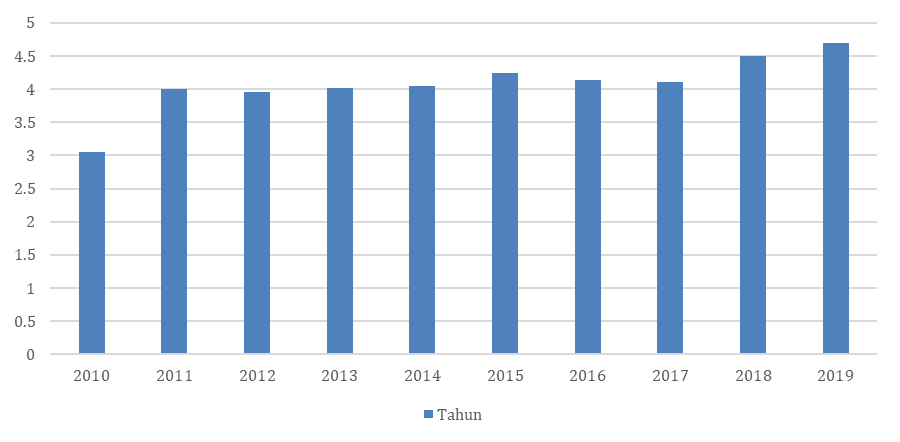
Figure 1 shows that the Tourism Sector is one of the sectors that contributes to state revenue. In 2019 the tourism sector contributed to the Gross Domestic Product (GDP) of 4.7% and was the highest since 2010, so it is expected that in 2020 there will be an increase compared to 2019. However, in early 2020 the world was shaken by the outbreak of the Covid -19 virus, and Indonesia was also affected by the covid-19 pandemic. The existence of the Covid-19 pandemic has had a downward impact on the tourism sector.
The World Health Organization (WHO) officially announced that as of March 9, 2020 the Covid-19 pandemic had spread throughout the world. In Indonesia on July 4, 2021 there were 2,284,084 cases and in the Bangka Belitung Islands as of July 2, 2021 there were 21,643 cases. In Pangkalpinang City as of July 1, 2021 there were 6372 cases. Due to the COVID-19 pandemic, social interaction had been limited, so the Indonesian government implemented large-scale social restrictions (PSBB). With the existence of large-scale social restrictions (PSBB) the tourism sector was limited.
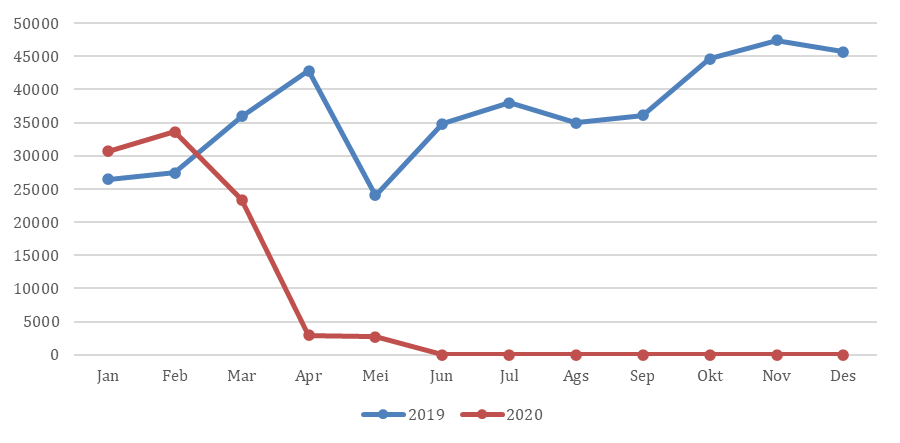
In Figure 2 the number of tourist visits in 2019 in Bangka Belitung Province from January to April had increased and in May it had decreased but the following month it continued to increase again. At the beginning of 2020 January to February there was an increase compared to the previous year. In 2019 the number of tourists in January was 26,446 and in February it was 27,474.
Figure 1: Tourism Contribution to GDP (%)
Source: Lokadata [1]
Figure 2: Number of Tourists at the Province of Bangka Belitung Islands from 2019-2020
Source: Central Bureau of Statistics 2021
During 2020 there was an increase in the number of tourist visits in January by 30,712 and February by 33,638 but from March to December it continued to decrease. This was due to the covid-19 pandemic. 19. The condition of the Covid-19 pandemic had an impact on the tourism sector in the province of Bangka Belitung Islands even throughout Indonesia. Governor of Bangka Belitung Islands Dr. H. Erzaldi Rosman said that the tourism sector in Bangka Belitung during the Covid-19 pandemic era decreased by around 40 to 45 percent [2].
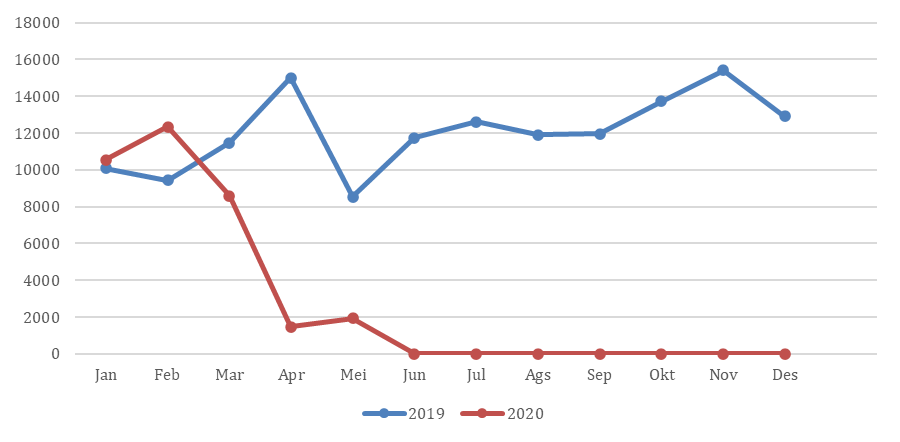
Figure 3 shows the number of tourists in Pangkalpinang city. In 2019 the number of tourists in January was 10,085 and in February it was 9,462 and increased in April and May by 11,468 and 14,993. Compared to 2019, in 2020 the number of tourists increased in January by 10,560 and in February by 12,332. Beginning in March 2020 to December the number of tourists in Pangkalpinang city continued to decline due to the covid-19 pandemic.
Due to the Covid-19 pandemic, a strategy was needed to improve the tourism sector in order to recover its condition. The tourism marketing strategy is a strategy used to increase the number of visits to a tourist destination area. In carrying out the tourism marketing strategy there is a marketing mix. According to Morrison the marketing mix includes 8P namely Product, Price, Place, Promotion, People, Partnership, Packaging, and Programming [3].
The previous research in the area of study includes Nova Indah Sari Pasaribu, James D.D Massie, Jane G. Poluan [3], the Effect of Tourism Marketing Strategy on the Decision to Visit the Mahawu Tomohon Prayer Hill.
Figure 3: Number of Tourists in Pangkalpinang City 2019-2020
Source: Central Bureau of Statistics 2021
The results showed that simultaneously the tourism marketing strategy, involving product, price, promotion, place, packaging, programs, human resources, and partnerships had a significant effect on the decision to visit tourists at Bukit Doa Mahawi Tomohon. The results showed that partially products with a t-count (1.617), prices with a t-count (-0.918), promotions with a t-count (1.737), HR with a probability value greater than 0.05 and t-count (1.109) , and partnerships with a probability value greater than 0.05 and t-count (-0.387) had no significant effect on the decision to visit the Mahawi Prayer Hill Tomohon. The results of the study showed that partially the place, packaging, and program had a positive and significant effect on the decision to visit Mahawu Tomohon Prayer Hill.
Rudi Santoso, Rahayu Shinta, Achmad Yanu Alif Fianto [4], the Effect of Service Marketing Mix on Decisions to Visit Marine Tourism in East Java. The results of the study showed that the variables of product, price, promotion, location, people, process, and physical evidence had a partial effect on the decision to visit. The results also revealed the four variables, including product, place, promotion, and physical evidence had a large impact on the decision to visit. The promotion variable based on the t-test results has the t-value and the largest beta coefficient had a strong influence in relation to other variables.
Olivia Christy Paramulia et al. [5], entitled ‘The Influence of the Marketing Mix on the Decision to Visit the Manado Nature House Tourism Object.’ The results of the study showed that simultaneously the marketing mix influences the decision to visit. The results also showed that product, place, and promotion had a significant positive effect on visiting decisions, while price and people had no significant effect on visiting decisions. The results of the study also showed that the process has a negative effect on the decision to visit.
Based on this description, the researcher intends to see and research "The Influence of Tourism Marketing Strategy on Decisions to Visit the Tourist Areas in Pangkalpinang during the Covid-19 Pandemic Era". The purpose of this study is to find out whether Product, Price, Place, Promotion, People, Partnership partially and simultaneously influence the decision to visit tourist destination areas in Pangkalpinang City during the Covid-19 pandemic era.
MATERIALS AND METHODS
This study uses quantitative research using primary data in the form of questionnaires and secondary data in the form of data from BPS log books, websites, or data from related agencies to strengthen and support this research data. The independent variables in this study are Product (X1), Price (X2), Place (X3), Promotion (X4), People (X5) and Partnership (X6), while the dependent variable in this study is the decision to visit (Y).
The population in this study is tourists, who visit tourist destination areas in Pangkalpinang, because the population size is unknown, the technique used is non-probability sampling technique. The sample used in this study was accidental sampling, which of sampling by chance used 100 samples.
The data analysis technique used in this study applies multiple linear regression methods. Data analysis techniques used in this study include descriptive analysis, validity test, reliability test, classical assumption test, and hypothesis test. In this study, data were processed using the Statistical Package for Social Science (SPSS).
Findings and Discussions
Based on the results of the T test, it can be seen that the significance value (sig) of the product variable (X1) is 0.042 <0.05, so it can be concluded that there is an influence between the product variable (X1) on the decision to visit partially. The significance value of the price variable (X2) is 0.044 <0.05, so it can be concluded that there is an influence between the price variable (X2) on the decision to visit partially The significance value of the price variable (X2) is 0.044 <0.05, so it can be concluded that there is an influence between the place variable (X3) on the decision to visit partially.
Table 1: Partial Test Results (T Test)
Coefficientsa
Model
Unstandardized Coefficients
Standardized Coefficients
T
Sig.
Collinearity Statistics
B
Std. Error
Beta
Tolerance
VIF
1
(Constant)
1.013
1.115
.908
.366
Totalx1
.090
.044
.137
2.064
.042
.774
1.292
Totalx2
.196
.096
.157
2.036
.044
.576
1.737
Totalx3
.221
.076
.254
2.922
.004
.450
2.221
Totalx4
.207
.092
.175
2.257
.026
.566
1.767
Totalx5
.203
.100
.156
2.027
.045
.574
1.741
Totalx6
.256
.104
.214
2.457
.016
.448
2.230
a. Dependent Variable: TOTALLY
Source: Data processed by researchers, 2022
Table 2: Simultaneous Test (Test F)
ANOVAa
Model
Sum of Squares
Df
Mean Square
F
Sig.
1
Regression
812.709
6
135.452
32.831
.000b
Residual
396.068
96
4.126
Total
1208.777
102
a. Dependent Variable: Totally
b. Predictors: (Constant), Totalx6, Totalx1, Totalx4, Totalx2, Totalx5, Totalx3
Source: Data processed by researchers, 2022
The significance value of the promotion variable (X4) is 0.026 <0.05, so it can be inferred that there is an influence between the promotion variable (X4) on the decision to visit partially. The significance value of the person variable (X5) is 0.045 <0.05, so we come to conclusion that there is an influence between the person variable (X5) on the decision to visit partially. The significance value of the partnership variable (X6) is 0.016 <0.05, hence this concluded that there is an influence between the partnership variable (X6) on the decision to visit partially.
Based on the F-test results table above, the significance value obtained is 0.000 <0.05, it can be concluded that there is a simultaneous effect between product (X1), price (X2), place (X3), promotion (X4), people (X5) , and partnerships (X6) on visiting decisions (Y).
CONCLUSION
From the results of this study conclusion could be described as follows:
Product (Product) has a significant effect on the decision to visit. This is based on the results of the product T-test whose significance value is below 5%, which is 0.042
Price has a significant effect on visiting decisions. This is based on the results of the T-test of price whose significance value is below 5%, which is equal to 0.044
Place has a significant effect on visiting decisions. This is based on the results of the T-test where the significance value is below 5%, which is 0.004
Promotion has a significant effect on visiting decisions. This is based on the results of the promotional T-test where the significance value is below 5%, which is 0.026
People (visitors) have a significant effect on the decision to visit. This is based on the results of the T-test for visitors whose significance value is below 5%, which is 0.045
Partnership has a significant effect on visiting decisions. This is based on the results of the partnership T-test where the significance value is below 5%, which is 0.016
Simultaneously the marketing strategy consisting of product, price, place, promotion, people, and partnerships on the decision to visit has a significant effect on the decision to visit the Pangkalpinang tourist area. This is based on the results of the F-test above where the significance value is less than 5%, which is equal to 0.000
Acknowledgment
We thank the research institutions and community service of University of Bangka Belitung for providing a platform for researchers to carry out the research as part of academic activities in our institution.
REFERENCE
Lokadata. "Kontribusi pariwisata terhadap PDB 2010–2019." Available at: https://lokadata.beritagar.id /chart /preview/kontribusi-pariwisata-terhadap-pdb-2010-2019-1582001327.
Ikatan Sarjana Ekonomi Indonesia (ISEI) Kepulauan Bangka Belitung. 2020. Book chapter kebangkitan ekonomi Bangka Belitung era Covid-19 tahun 2020. Serang, Banten: CV.AA.Rizky.
Pasaribu, N.I., Massie, J.D., and Poluan, J.G. 2019. "Pengaruh strategi pemasaran pariwisata terhadap keputusan berkunjung di Bukit Doa Mahawu Tomohon." Jurnal EMBA: Jurnal Riset Ekonomi, Manajemen, Bisnis dan Akuntansi, vol. 7, no. 4.
Santoso, R., Shinta, R., and Fianto, A.Y.A. 2019. "Pengaruh bauran pemasaran jasa terhadap keputusan berkunjung ke wisata bahari Jawa Timur." Jurnal MEBIS (Manajemen dan Bisnis), vol. 4, no. 2, 73–86.
Paramulia, O.C., Mandey, S.L., and Roring, F. 2019. "Pengaruh bauran pemasaran jasa terhadap keputusan berkunjung pada obyek wisata Rumah Alam Manado." Jurnal EMBA: Jurnal Riset Ekonomi, Manajemen, Bisnis dan Akuntansi, vol. 7, no. 3.
Anggarini, D.T. 2021. "Upaya pemulihan industri pariwisata dalam situasi pandemi Covid-19." Jurnal Pariwisata, vol. 8, no. 1, 22–31.
Utami, B.A., and Kafabih, A. 2021. "Sektor pariwisata Indonesia di tengah pandemi Covid-19." Jurnal Dinamika Ekonomi Pembangunan, vol. 4, no. 1, 383–389.
Basyir, M., and Sari, M. 2019. "Pengaruh bauran pemasaran terhadap keputusan wisatawan berlibur di Kabupaten Gayo Lues." Jurnal Ilmiah Mahasiswa Ekonomi Manajemen, vol. 4, no. 2, 199–213.
Yulita, H. 2017. "Pengaruh bauran pemasaran pariwisata terhadap keputusan untuk berkunjung." Jurnal Hospitality dan Pariwisata, vol. 2, no. 2.
Cahyani, F.G., and Sitohang, S. 2016. "Pengaruh kualitas produk, kualitas pelayanan dan harga terhadap kepuasan konsumen." Jurnal Ilmu dan Riset Manajemen (JIRM), vol. 5, no. 3.
Manafe, J.D., Setyorini, T., and Alang, Y.A. 2016. "Pemasaran pariwisata melalui strategi promosi objek wisata alam, seni dan budaya (Studi kasus di Pulau Rote NTT)." BISNIS: Jurnal Bisnis dan Manajemen Islam, vol. 4, no. 1, 101–123.
Wibowo, D.H., and Arifin, Z. 2015. "Analisis strategi pemasaran untuk meningkatkan daya saing UMKM (Studi pada Batik Diajeng Solo)." Jurnal Administrasi Bisnis, vol. 29, no. 1, 59–66.
Putra, Z.F.S., Sholeh, M., and Widyastuti, N. 2014. "Analisis kualitas layanan website BTKP-DIY menggunakan metode webqual 4.0." Jurnal Jarkom, vol. 1, no. 2.
License
Creative Commons Attribution-NonCommercial-NoDerivatives 4.0 International License
All papers should be submitted electronically. All submitted manuscripts must be original work that is not under submission at another journal or under consideration for publication in another form, such as a monograph or chapter of a book. Authors of submitted papers are obligated not to submit their paper for publication elsewhere until an editorial decision is rendered on their submission. Further, authors of accepted papers are prohibited from publishing the results in other publications that appear before the paper is published in the Journal unless they receive approval for doing so from the Editor-In-Chief.
Himalayan Journal of Economics and Business Management open access articles are licensed under a Creative Commons Attribution-Share A like 4.0 International License. This license lets the audience to give appropriate credit, provide a link to the license, and indicate if changes were made and if they remix, transform, or build upon the material, they must distribute contributions under the same license as the original.
Recommended Articles
Research Article
Resonant leadership and its role in achieving organizational success: An Exploratory study of the opinions of a sample of employees of the Baghdad Municipality-Baghdad Water Department-Southern Reservoir
Muthana M. Saeed
Download PDF
Cite
x
APA
Saeed, M. M. (2026). Resonant leadership and its role in achieving organizational success: An Exploratory study of the opinions of a sample of employees of the Baghdad Municipality-Baghdad Water Department-Southern Reservoir. Himalayan Journal of Economics and Business Management, 7(2), 1-14.
MLA
Saeed, Muthana M.. "Resonant leadership and its role in achieving organizational success: An Exploratory study of the opinions of a sample of employees of the Baghdad Municipality-Baghdad Water Department-Southern Reservoir." Himalayan Journal of Economics and Business Management 7.2 (2026): 1-14.
Chicago
Saeed, Muthana M.. "Resonant leadership and its role in achieving organizational success: An Exploratory study of the opinions of a sample of employees of the Baghdad Municipality-Baghdad Water Department-Southern Reservoir." Himalayan Journal of Economics and Business Management 7, no. 2 (2026): 1-14.
Harvard
Saeed, M. M. (2026) 'Resonant leadership and its role in achieving organizational success: An Exploratory study of the opinions of a sample of employees of the Baghdad Municipality-Baghdad Water Department-Southern Reservoir' Himalayan Journal of Economics and Business Management 7(2), pp. 1-14.
Vancouver
Saeed MM. Resonant leadership and its role in achieving organizational success: An Exploratory study of the opinions of a sample of employees of the Baghdad Municipality-Baghdad Water Department-Southern Reservoir. Himalayan Journal of Economics and Business Management. 2026 Jul;7(2):1-14.
Download PDF
Research Article
Modelling Structure Job Quality, Job Design and Job Satisfaction
Moch Nurhadi,
...
Avi Sunani
Published: 30/08/2022
Download PDF
Cite
x
APA
Nurhadi, M., Bisyri Effendi, M., Saiful Ulum, A. & Sunani, A. (2022). Modelling Structure Job Quality, Job Design and Job Satisfaction. Himalayan Journal of Economics and Business Management, 3(2), 1-4.
MLA
Nurhadi, Moch, et al. "Modelling Structure Job Quality, Job Design and Job Satisfaction." Himalayan Journal of Economics and Business Management 3.2 (2022): 1-4.
Chicago
Nurhadi, Moch, Moch Bisyri Effendi, Achmad Saiful Ulum and Avi Sunani. "Modelling Structure Job Quality, Job Design and Job Satisfaction." Himalayan Journal of Economics and Business Management 3, no. 2 (2022): 1-4.
Harvard
Nurhadi, M., Bisyri Effendi, M., Saiful Ulum, A. and Sunani, A. (2022) 'Modelling Structure Job Quality, Job Design and Job Satisfaction' Himalayan Journal of Economics and Business Management 3(2), pp. 1-4.
Vancouver
Nurhadi M, Bisyri Effendi M, Saiful Ulum A, Sunani A. Modelling Structure Job Quality, Job Design and Job Satisfaction. Himalayan Journal of Economics and Business Management. 2022 Jul;3(2):1-4.
Download PDF
Research Article
Influence of Leadership on Poverty Reduction in the Devolved Government in Trans-Nzoia County, Kenya
Kinisu Sifuna,
...
Peter Simotwo
Published: 30/06/2021
Download PDF
Cite
x
APA
Sifuna, K., Lwangale, D. W., Simotwo, P., Sifuna, K., Lwangale, D. W. & Simotwo, P. (2021). Influence of Leadership on Poverty Reduction in the Devolved Government in Trans-Nzoia County, Kenya. Himalayan Journal of Economics and Business Management, 2(1), None-None.
MLA
Sifuna, Kinisu, et al. "Influence of Leadership on Poverty Reduction in the Devolved Government in Trans-Nzoia County, Kenya." Himalayan Journal of Economics and Business Management 2.1 (2021): None-None.
Chicago
Sifuna, Kinisu, David W. Lwangale, Peter Simotwo, Kinisu Sifuna, David W. Lwangale and Peter Simotwo. "Influence of Leadership on Poverty Reduction in the Devolved Government in Trans-Nzoia County, Kenya." Himalayan Journal of Economics and Business Management 2, no. 1 (2021): None-None.
Harvard
Sifuna, K., Lwangale, D. W., Simotwo, P., Sifuna, K., Lwangale, D. W. and Simotwo, P. (2021) 'Influence of Leadership on Poverty Reduction in the Devolved Government in Trans-Nzoia County, Kenya' Himalayan Journal of Economics and Business Management 2(1), pp. None-None.
Vancouver
Sifuna K, Lwangale DW, Simotwo P, Sifuna K, Lwangale DW, Simotwo P. Influence of Leadership on Poverty Reduction in the Devolved Government in Trans-Nzoia County, Kenya. Himalayan Journal of Economics and Business Management. 2021 Jan;2(1):None-None.
Download PDF
Research Article
Financial Feasibility Study of Raised Floor Manufacturing Steel Panels in Indonesia
Daniel Tjeong,
...
Yunieta Anny Nainggolan
Published: 12/03/2024
Download PDF
Cite
x
APA
Tjeong, D., Sumirat, E. & Anny Nainggolan, Y. (2024). Financial Feasibility Study of Raised Floor Manufacturing Steel Panels in Indonesia. Himalayan Journal of Economics and Business Management, 5(1), 1-6.
MLA
Tjeong, Daniel, Erman Sumirat and Yunieta Anny Nainggolan. "Financial Feasibility Study of Raised Floor Manufacturing Steel Panels in Indonesia." Himalayan Journal of Economics and Business Management 5.1 (2024): 1-6.
Chicago
Tjeong, Daniel, Erman Sumirat and Yunieta Anny Nainggolan. "Financial Feasibility Study of Raised Floor Manufacturing Steel Panels in Indonesia." Himalayan Journal of Economics and Business Management 5, no. 1 (2024): 1-6.
Harvard
Tjeong, D., Sumirat, E. and Anny Nainggolan, Y. (2024) 'Financial Feasibility Study of Raised Floor Manufacturing Steel Panels in Indonesia' Himalayan Journal of Economics and Business Management 5(1), pp. 1-6.
Vancouver
Tjeong D, Sumirat E, Anny Nainggolan Y. Financial Feasibility Study of Raised Floor Manufacturing Steel Panels in Indonesia. Himalayan Journal of Economics and Business Management. 2024 Jan;5(1):1-6.
Veru Purbolakseto, H. & Wahyudin, N. (2023). The Effect of Tourism Marketing Strategy on Visiting Decision in Pangkalpinang City Tourism Area during the Covid-19 Pandemic Era. Himalayan Journal of Economics and Business Management, 4(2), 1-6.
MLA
Veru Purbolakseto, Hengky and Nanang Wahyudin. "The Effect of Tourism Marketing Strategy on Visiting Decision in Pangkalpinang City Tourism Area during the Covid-19 Pandemic Era." Himalayan Journal of Economics and Business Management 4.2 (2023): 1-6.
Chicago
Veru Purbolakseto, Hengky and Nanang Wahyudin. "The Effect of Tourism Marketing Strategy on Visiting Decision in Pangkalpinang City Tourism Area during the Covid-19 Pandemic Era." Himalayan Journal of Economics and Business Management 4, no. 2 (2023): 1-6.
Harvard
Veru Purbolakseto, H. and Wahyudin, N. (2023) 'The Effect of Tourism Marketing Strategy on Visiting Decision in Pangkalpinang City Tourism Area during the Covid-19 Pandemic Era' Himalayan Journal of Economics and Business Management 4(2), pp. 1-6.
Vancouver
Veru Purbolakseto H, Wahyudin N. The Effect of Tourism Marketing Strategy on Visiting Decision in Pangkalpinang City Tourism Area during the Covid-19 Pandemic Era. Himalayan Journal of Economics and Business Management. 2023 Jul;4(2):1-6.


 Download PDF
 Download XML