In order to better understand and raise awareness of the significance of digital transformation for people working in government banks, this study aims to determine the extent to which personal traits have an impact on accepting the digital transformation of banks. These key variables served as the foundation for the conceptual framework of the current investigation. The government banking industry in Iraq used the findings of this study. Using a set of statistical tools included in the programs, the questionnaire was employed as a method for data collection in eight government banks for a sample (301) of people working in government banks who were selected at random (SPSS.V.22 – AMOS.V.22). The study's findings include the following statements: There is a direct negative impact of negative personality traits on the digital transformation of banks.
Keywords
Personality Traits
Government Banks
Digital Transformation of Banks
INTRODUCTION
The digital transformation of banks is one of the important topics that have been increasingly studied by researchers and academics. One of the most important basic pillars of any economy is the banking system that works to encourage and facilitate the flow of capital in a way that provides sufficient financing for the majority of investments in order to advance important projects and achieve economic development and accelerate the pace capital flow. its growth rate. The banking system has recently gone through a kind of complexity and dynamism. The blame lies on the waves of globalization and the acceleration of technologies [1], which put the banking industry in many countries in the face of a number of challenges and required them to keep pace with these changes in order to maintain their market share in financial institutions and expand into new markets. . In order to analyze big data and turn it into a dynamic, accurate and smooth process, as well as to reduce operational costs and financial risks, the banking system seeks to adopt the trends of modern globalization and the trend towards simulating human intelligence, which is considered one of the most prominent products of modern technology in the world [2]. In addition, personal characteristics share with the behavior of working individuals, which negatively affects their willingness to accept digital transformation within the banking business through socially undesirable behavior and psychological characteristics. Due to the nature of these psychological characteristics and negative traits, researchers have described these traits as negative personality. As previous studies have shown that individuals who score high on negative traits such as narcissism, Machiavellianism and psychopathy tend to use negative and aggressive influence and score a clear decrease in compatibility, which gives an indication of the degree of weak correlation and the negative relationship between acceptance of the digital transformation of banks and traits. Negative personality [3]. Given the prevalence of negative refusal behavior of individuals working in the government health sector to digital transformation in banks, this formed the starting point for this study. As this study will attempt to identify the reasons behind these behaviors in that vital sector and explain their exact condition by focusing on the personal characteristics of individuals working in the government health sector.
Hence the following main question can be asked:
"What is the role of personality traits in accepting digital transformation in the Iraqi banking system"
As this study was applied to the Iraqi governmental banks in Iraq, Al-Rafidain and Al-Rasheed Banks in Dhi Qar Governorate as a model.
Accordingly, the following sub-questions can be raised:
What is meant by negative personality traits
What is the role of personal characteristics in accepting digital transformation in the banking system in Iraq
What are the opportunities and challenges facing the implementation of digital transformation in the banking sector
Study Objectives
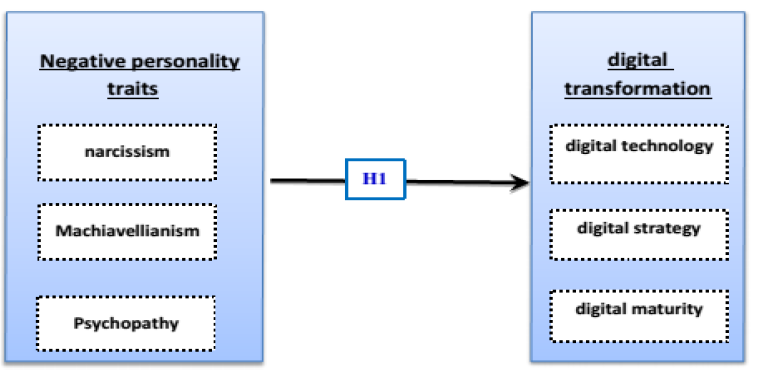
Constructing a conceptual model for the study variables represented by the independent variable (negative personality traits: narcissism, Machiavellianism and psychopathy) and the dependent variable (digital transformation of banks) and testing the relationships between them
Diagnosing the extent of the direct impact relationship between the independent variable (negative personality traits) and the dependent variable (digital transformation of banks)
Significance of the Study
The study is concerned with the applied level to determine whether it is possible to use the banks included in the study for digital transformation and to determine the extent of the psychological impact of negative personal characteristics in accepting digital transformation in the workplace. Then it provides the people working in these banks with data and information that shows the importance of the role that digital transformation plays in improving performance in general, which includes determining the importance of the role that digital transformation plays in accepting change in the workplace. Since there are no studies that dealt directly or indirectly with the relationship between the independent variable and the dependent variable on the basis of the current research, researchers have been limited examination of previous studies relevant to the study variables.
Conceptual Framework for Study
The conceptual framework of the main variables was based on a set of basic assumptions, namely:
The characteristics of personal characteristics reduce the likelihood of accepting the digital transformation of banks among working individuals
Figure 1: Scheme of the Hypothetical Study
Theoretical Framework
Negative personality Traits: Personality is an important factor in knowing why working individuals act as they do in organizations and why they have favorable or unfavorable attitudes towards their jobs and organizations and therefore knowing personality represents an important step in knowing the behavior of working individuals [4]. As each individual in the organization has his own style and way of behaving, therefore, effective work with others requires understanding and appreciation of how people differ from each other and managers need to understand individual differences so that they have the ability to influence the feelings, ideas and behaviors of each member of the organization [5]. Accordingly, personal identity represents the ultimate goal of the individual and subjective personal values become essential to organizing and directing behavior [6].
There have been many questions about why some characters are quiet and passive, while others are loud and aggressive. Are there certain types of personalities that are better adapted than others for certain jobs. In the context of answering these questions, the researchers sought to present multiple models for understanding personality and the most widely used and well-known model is the Big Five personality model, which describes an individual's full personality by exploring aspects of personality. The other model is the dark triad, whose components form part of personality, albeit to varying degrees. Individuals manifest their behavior not in the way their external environment actually is, but rather in the way they see or believe it [7].
Personality traits in general have been associated with negative personal and social outcomes. For example, there is sufficient reason to suggest that narcissism can be associated with increased aggressive behavior, especially in response to insults or other negative evaluations [8]. The decrease in the quality of job performance is consistently associated with increases in Machiavellianism and psychopathy and the digital transformation of banking was associated with increases in all three trait components of personality traits, but they were managed by contextual factors such as power and culture and that personality traits explain moderate amounts of Variation in opposite behaviors and that the three personality traits are positively related to each other but distinct enough to justify theoretical and empirical division [9]. When examining aspects of incompatibility, for example, the personality traits of personalities may provide more insight into the personality dynamics underlying vindictiveness [10]. Personality traits can be a particularly predictive predictor of malicious behavior such as vindictiveness [10].
Dimensions of Personality Traits
Narcissism: Narcissism has become an important matter in the field of organizational behavior because of its impact on organizations. Narcissism appears to consist of a "selfish perspective" represented by feelings of superiority, a drive for personal power and pride. Therefore, individuals with this characteristic may show their opinions exaggeratedly, because they have Imagine that they control everything and that there is a wild desire to attract the admiration of others. On this basis, it is not surprising that these narcissistic traits can promote the digital transformation of banking [11-12].
Psychopathy
Previous research on the nature of psychopathy has provided strong conceptual and empirical evidence that overt antisocial behavior is a component of psychopathy construction, rather it is an essential component of psychopathy construction [13]. Psychopathy is characterized by a lack of concern for others, impulsive behavior and a lack of remorse or guilt when one's actions harm others. Thus, the presence of this type of person is dangerous at work.
Machiavellianism
It seems that the Machiavellian personality, with its characteristics that make controlling or limiting it, is not an easy matter [14], as experimental reviews indicate that working individuals who are characterized by the Machiavellian trait suffer from a significant disorder in the effective performance of organizations [15] and it is more associated with opportunism in terms of economic issues and less cooperation [16], that the concept of Machiavellianism as a person who manipulates with others for personal gain is part of his culture that he used on it [17].
digital Transformation
Today, digital transformation has become the language of the world in dealing with reality and it is the only way to ensure the quality and sustainability of the banking sector. It represents a distinct and distinct stage in the global economy and a major pillar for building a distinctly developed and competitive economy [2]. There are many concepts of digital transformation, the most important of which are:
It is the transmission of modern technology and its application in reality in order to develop and enhance financial performance as well as enhance competitiveness and ease of access to basic services
It is a continuous process carried out by institutions to keep pace with the development taking place in the world to adapt to the requirements of individuals and markets through digital technology capabilities to improve operational and organizational efficiency
It is the use of technology to radically improve financial and organizational performance.
It is the integration of digital technology with business requirements to respond to environmental changes.
Accordingly, a comprehensive definition can be reached, which is to transform the banking business model into a more advanced model through the use of digital technologies that allow institutions to work with high efficiency [18].
As for its importance, the application of digital transformation in the banking sector leads to [19].
Raising efficiency in the banking sector and improving business operations, as well as achieving cost savings.
Reducing costs and efforts on a large scale, as well as increasing the opportunity for profit.
Achieving the competitive advantage of enterprises.
Digital transformation creates opportunities to provide innovative, modern and non-traditional services that contribute to simulating the human element and thus providing the best ways to improve banking financial services.
Digital transformation achieves easy access to the geographical location of banks, as well as the possibility of targeting markets and benefiting from them through electronic services.
There are also many motives for implementing digital transformation in the banking sector, such as the emergence of many institutions that use financial technology and are equipped with technological solutions and provide innovative and creative value-added services to banks at low prices, which distinguishes them with a spirit of competition. Digital transformation technology, which allows them ease of use to deal in financial and banking operations in innovative, modern and high-precision ways, increasing the intensity of competition, as the competition between banks to provide digital services and invest in digital technology to modernize their services and products and maintain and increase their market value in the future, is the global digital technological development Moving away from traditional matters attracts the use of digital transformation of banks as a result of the new fluctuations, as well as the different changes in financial and banking transactions [20].
Dimensions of digital transformation and its objectives
There are three main dimensions [18,21]:
Digital Technology: It is modern and advanced technologies that are a cornerstone and an important factor in enabling digital transformation, such as cloud computing technology, big data, display and analysis, tablet technology, mobile phones and social media
Digital Strategy: It is a strategy developed by the bank with the aim of making it a digitally transformed bank to keep pace with digital technology in the world
Digital Maturity: It is the highest level reached by digital transformation in the banking sector, which consists of three levels: early, advanced and mature. To reach these levels, digital transformation techniques must be fully adopted
The digital transformation process has many objectives, which center on financial institutions and others generating value through the digital approach and modern innovations and benefiting from them to increase the speed of growth of the banking sector and keep abreast of the latest developments and among the most important objectives are
Adopting an approach based on setting clear strategic plans to keep abreast of the latest developments in order to achieve comprehensive development of the banking sector and improve organizational financial efficiency
High transparency in banking operations and minimizing errors
Reducing high costs and reducing human effort
Maximizing efficiency in the banking sector, which supports the reduction of corruption operations
Work on continuous development to build knowledge and develop expertise
Challenges and obstacles facing digital transformation in the banking sector
Despite the advantages achieved by digital transformation in the economic system as a whole, especially in the banking sector, there are many obstacles facing the banking sector [22], the most important of which are:
Scarcity of a Digitally Qualified Workforce: The acute shortage is one of the most important challenges facing the digital transformation process and this is due to the educational system, which lacks specialization and training in digital technologies
Giving Confidence in the Digital Transformation Process: There is a lack of financial awareness levels, which creates a gap among customers who are reluctant to deal with digital services in the banking sector due to piracy and electronic fraud [23]
The Ability to Finance: Funding is the main obstacle to digital transformation, as it requires a large budget to finance and invest in the digital transformation initiative
A Culture of Counting Change: The digital transformation process requires a high-level cultural transformation, so decision makers must build a digital culture that contributes to the disappearance of fear and is able to absorb the importance of digital transformation
Internet services and Infrastructure: Internet services and infrastructure are the complementary means to the digital transformation process and are a basic requirement of the digital transformation process [24]
The benefits of using digital transformation and the factors affecting the success of its implementation
The role that digital transformation techniques play in technological progress has revolutionized the banking sector through its advanced systems. The benefits of digital transformation in the banking sector are as follows [25-26]:
Work to identify the pioneering and distinguished trends in providing digital services and communication with the outside world in order to reach the latest technologies related to the provision of digital products and services in banks
Work to identify the digital divide for the banking institution, which consists of three units: the input gap, the operations gap and the output gap
Work to achieve technical and security requirements for providing digital services and products to banks, as well as continuous evaluation and feedback process
Working on integrated risk management in banks capable of taking decisions effectively and efficiently through advanced systems that ensure data integration in a way that improves their level of performance
The use of digital transformation provides a distinct competitive environment, which enhances its growth and increases its position, thus keeping pace with global developments
The use of digital transformation helps in improving financial and banking services and ensuring easy access to these services for all
The digital transformation of banks helps in continuous growth and thus increases in maintaining credibility through its activities via the Internet and the adoption of this technology helps the emergence of modern innovations that allow them to adapt to new technological and digital trends. There are many factors that are directly related to the success of digital transformation, namely [27]:
The First Factor: The Organizational Aspect
Experimental projects: It aims to adopt the use of digital transformation gradually and not use it completely at once, as well as preparing for the future and preparing a map that includes strategic and operational objectives.
Studying society and the ability to understand and meet their needs, as well as qualifying workers through continuous training with high efficiency
Linking the use of technology with the tasks assigned to workers, as well as administrative support by providing institutions with resources and knowledge
Provide a comprehensive multidisciplinary work environment
The Second Factor: The Environmental Aspect
Providing confidence in communication and easy exchange of data between networks, which work to achieve a high degree of transparency and work on the need for cooperation inside and outside the organization, due to the complexity because issues can be resolved individually and adhere to the instructions and standards set by the senior management of the organization.
The Third Factor: The Technological Aspect
Working on creating the useful infrastructure for technological work, providing the appropriate atmosphere and working on reliability and appropriateness, which is providing correct data for the user, whether customers or the organization [28]. Working on a flexible system that has the ability to adapt to information needs, as well as maintaining information security, which is the basis for exchange [29]. And work to provide sufficient information covering all the different aspects, so that the data used is timely. As the success of the digital transformation in the banking sector varies according to the bank's ability to provide these factors and the integration between them in order to be able to achieve the greatest results and achieve the speed of the required response to the changing needs [30].
Study Design
To better comprehend the nature of the study's present challenge, which had only been superficially explored in earlier research. To address the issue with the study and comprehend the phenomena better, the exploratory design will be used [31-32]. Additionally, the researcher must be able to examine the causal relationships between the primary and dependent variables in order to demonstrate how the independent variable affects the dependent variable [33]. When the best approach is utilized to get the necessary data and when the data is used and evaluated to address the research questions in order to address this issue, It served as the impetus for starting the research endeavor [34].
Data Collection Methods
The final questionnaire consisted of 60 paragraphs, which in turn covered the main study variables, including 6 Sub-dimensions. A five-point Likert scale was also used and the following responses were included. The study was based on data collection on structured personal interviews of a number of the study sample, as well as the use of the questionnaire tool for the purpose of accurately knowing the problem, how the study variables are measured and what is required (very little, little, average, much, very much).
Sample Study
A number of managers (individuals working in banks) were selected in a number of 8 government banks in Dhi Qar Governorate and their opinions were surveyed. The study sample consisted of 301 working individuals from a community of 521 based on [31]. In a table to the appropriate sample size for each population.
Skewness and Kurtosis
The "Skewness and Kurtosis" test, which is distinguished by high accuracy and gives a clear picture of the nature of the data whether it is distributed normally or not when the collected data is for one sample, is one method for testing the normal distribution of data [35]. To do this, subtract the Skewness and Kurtosis values from the standard deviation of each of the variables and their dimensions. This yields the Z value [36]. If the estimated Z value of "Skewness and Kurtosis" falls within the range of 1.96 at a significant level of 0.05, the data are considered to be normally distributed [37]. The results are shown in Table 1.
Table 1: Normal Distribution Test
Cronbach's
Cronbach's
Cronbach's
Cronbach's
Cronbach's
Z Skewness
Statistic
Std. Error
Z Kurtosis
Cronbach's
Cronbach's
Cronbach's
-1.302
-0.12
0.337
-0.346
Cronbach's
Cronbach's
Cronbach's
-1.022
-0.373
0.337
-1.116
Cronbach's
Cronbach's
Cronbach's
-0.986
-0.33
0.346
-0.781
Cronbach's
Cronbach's
Cronbach's
-1.876
0.284
0.337
0.852
Cronbach's
Cronbach's
Cronbach's
-1.581
-0.374
0.337
-1.087
Cronbach's
Cronbach's
Cronbach's
-1.948
-0.479
0.337
-1.431
Cronbach's
Cronbach's
Cronbach's
-1.837
0.215
0.337
0.622
Cronbach's
Cronbach's
Cronbach's
0.146
-0.652
0.337
-1.874
The Gold Standard of Internal Integrity
Utilizing Cronbach's Alpha to assess internal consistency, the final study measures' stability and consistency are verified [38]. The degree to which the scale items are accurately represented for each scale utilized in the study is referred to as internal consistency [37]. Cronbach's Alpha coefficient values are statistically acceptable in the field of administrative and behavioral research if their value is more than (0.70) [38].
Correlation Coefficients and Descriptive Statistics
The goal of Pearson correlation is to determine the strength and direction of the relationship between the variables. In terms of trend, a positive correlation between the two variables denotes a direct relationship, where a negative correlation denotes an offset between an increase in one variable and a decrease in the other. The association is inverse for the other variable [38]. In terms of strength, the correlation is entirely positive or negative when its value falls between 1.0 and 0.7, strong positive or negative when it falls between 0.3 and 1.0 and weak positive or negative when it falls between 0.3 and 0 [39] Table 2.
Table 2: Cronbach's Alpha
Variables And The Dimensions
Before Deletion Cronbach's Alpha
After Deletion Cronbach's Alpha
Machiavellianism
0.776
0.887
narcissism
0.770
0.889
Psychopathy
0.787
0.897
digital technology
0.776
0.878
digital strategy
0.897
0.866
digital maturity
0.854
0.888
The presentation of Table 3 makes it obvious that there is a linear association between the study's variables. Based on that correlation, we can deduce that banks' personal traits did not correlate well with the digital transformation of banks, which caused them to reject the change in order to lessen their emotional anguish. This is what allows the banking sector organizations to grow. Her research on the issue of personality traits and bank digital transformation is extensive.
Table 3: Descriptive Statistics and Correlation between Personal Traits and Digital Transformation of Banks
Variables
Mean
Std. Deviation
Personal traits
Digital Transformation of Banks
Personal traits
3.506
0.580
1
Digital transformation of banks
3.540
0.726
0.399**
1
testing hypotheses
The AMOS program's pathway analysis was used by the researchers. V. 23 in order to match this analysis with models of studies that incorporate intermediate variables and evaluate the primary and supporting hypotheses Model for a mediator Assuming that the causal relationship of the intermediate factors is added to the relationship of the influence of the independent variables on the dependent variable, the path analysis is based on chains of multiple regression analysis. The effect linkages between the study's variables are displayed in Table 4.
Table 4 makes it evident that the hypotheses were accepted since the results demonstrated the direct negative impact of the link between personal qualities and the digital transformation of banks, with the effect calculated at 0.572.
Table 4: Testing the Main Hypotheses
Path
Estimate
S.E.
C.R.
p
Label
H1
Personal traits
<---
Digital transformation of banks
0.562
0.075
9.872
***
Accept
Direct Examination of the Sub-hypothesis
The route analysis test was carried out to test the sub-hypotheses by confirming the direct relationship between the dimensions of the study's primary variables Table 5.
It is clear from the above table that all the direct sub-hypotheses were accepted between the variables, except for the absence of a direct, negative, significant and statistically significant effect of narcissism in the digital strategy and the presence of a direct negative, significant and statistically significant effect of the negative Machiavellian personality traits and psychopathy in not accepting the digital transformation of banks.
Table 5: Direct Sub-Hypothesis Testing in
The course of direct sub-hypotheses
Estimate
S.E.
C.R.
p
Label
H1a
Machiavellianism
<---
digital technology
0.262
0.068
3.688
***
Accept
H1b
narcissism
<---
digital strategy
0.027
0.064
0.368
0.713
Refuse
H1c
Psychopathy
<---
digital maturity
0.190
0.069
2.816
0.005
Accept
CONCLUSION
The conclusions drawn by the two researchers identify points of similarity and difference with previous studies and analyze these results through the use of the questionnaire as a study tool as well as structured interviews with a sample of hospital managers conducted by the two researchers according to the main objectives of this study.
The results showed that there is a direct, negative and statistically significant effect relationship between personal characteristics and acceptance of the digital transformation of banks, as it seems that the negative aura surrounding the personalities of the personal characteristics (for individuals working in the banking sector) and the reactions they face with it from others makes them personalities associated with emotions Negativity is more than others, which justifies the nature of the predominance of the negative tendency of the personality traits, as the presence of low levels of empathy and the limited ability to show and communicate feelings to others may facilitate the hostile social strategy embodied in its characteristics and its rejection of any possible change. Its stability in these personalities may act as a stumbling block in front of individuals and their behavior, as embodied by the nature of those personalities. In general, these personalities share the presence of emotional deficits, in particular psychopathy.
Recommendations
According to the importance of the role of climate and positive energy and its impact on the personality of individuals working in Iraqi government banks, it is important to take into account the availability of a positive climate, especially those that promote emotions that directly affect the actions of working individuals and the resulting reactions of others, acceptance or rejection of new work methods and systems (such as digital transformation in the banking work environment) those with high empathy, for example, an increased ability to experience and understand other people's emotions will respond to alleviating negative feelings in others for altruistic reasons to comfort others. It should also be emphasized that the negative traits should atrophy as much as possible in the personality of the individual who is to be placed in the management of work within government banks and the sustainability of monitoring this matter, because these negative traits are seeds affected by the appropriate climate that stimulates their growth or vice versa. It should also be recalled that the primary goal on which work is based In state banking is very important. The presence of positive empathy facilitates prosaically behavior and prevents antisocial behavior. In contrast to traditional solutions that are used to addressing negative matters with insults, the study suggests that providing the appropriate environment within the framework of legitimate business for personalities of personal characteristics can significantly limit the rejection of the digital transformation of banks, as the aim of the actions of these personalities is to achieve their personal interests and not to reject the digital transformation By itself, for example, regulatory constraints (inadequate resources in Iraqi state banks) could actually facilitate ratings of performance among working individuals who are highly Machiavellian because they pursue high interests through social influence processes rather than performance. It is demanded of them and therefore the constraints that prevent the performance of legitimate tasks in reality create more opportunities for the highly Machiavellian individual to enter the arena of recalcitrant business than if the resources are plentiful and the legitimate performance is sufficient for the individual to achieve success and so it is for the rest of the traits.
REFERENCE
Huebner, J. et al. “Fintechs and the new wave of financial intermediaries.” 2019.
Loonam, J. et al. “Towards digital transformation: Lessons learned from traditional organizations.” Strategic Change, vol. 27, no. 2, 2018, pp. 101–109.
Palmer, J.C. et al. “Angel on one shoulder: Can perceived organizational support moderate the relationship between the dark triad traits and counterproductive work behavior?” Personality and Individual Differences, vol. 110, 2017, pp. 31–37.
van den Berg, P.T. and J.A. Feij. “Complex relationships among personality traits, job characteristics and work behaviors.” International Journal of Selection and Assessment, 2003, pp. 326–339.
George, J.M. and G.R. Jones. Understanding and Managing Organizational Behavior. 6th ed., Pearson Education, 2012.
Ewest, T. Prosocial Leadership: Understanding the Development of Prosocial Behavior within Leaders and Their Organizational Settings. 1st ed., Nature America, 2018.
Langton, N. et al.Organizational Behavior: Concepts, Controversies, Applications. 7th ed., Cenveo Publisher Services, 2016.
Bushman, B.J. and R.F. Baumeister. “Threatened egotism, narcissism, self-esteem and direct and displaced aggression.” Journal of Personality and Social Psychology, vol. 75, no. 1, 1998, pp. 219–229.
O’Boyle, E.H. et al. “A meta-analysis of the dark triad and work behavior.” Journal of Applied Psychology, vol. 97, no. 3, 2012, pp. 557–579.
Nathanson, C. Exploring the Dynamics of Revenge. PhD dissertation, University of British Columbia, 2008.
Kinicki, A. and M. Fugate. Organizational Behavior: A Practical, Problem-Solving Approach. 2nd ed., Aptara, 2018.
Arvan, M. “Bad news for conservatives? Moral judgments and the dark triad personality traits.” Springer Science + Business Media, 2011, pp. 1–12.
Neumann, C.S. et al. “Antisociality and the construct of psychopathy.” Journal of Personality, 2014.
Kuyumcu, D. and J.J. Dahling. “Constraints for some, opportunities for others?” Springer Science + Business Media, 2013.
Kish-Gephart, J.J. et al. “Bad apples, bad cases and bad barrels.” Journal of Applied Psychology, vol. 95, no. 1, 2010, pp. 1–31.
Sakalaki, M. et al. “Machiavellianism and economic opportunism.” Journal of Applied Social Psychology, vol. 37, no. 6, 2007, pp. 1181–1190.
Wastell, C. and A. Booth. “Machiavellianism: An alexithymic perspective.” Journal of Social and Clinical Psychology, vol. 22, no. 6, 2003, pp. 730–744.
Buch, C.M. and L.S. Goldberg. “Global banking: Toward an assessment of benefits and costs.” Annual Review of Financial Economics, vol. 12, 2020, pp. 141–175.
Nicoletti, B. “Financial services and fintech.” The Future of FinTech, Palgrave Macmillan, 2017, pp. 3–29.
Stief, S.E. et al. “Transform to succeed: An empirical analysis of digital transformation in firms.” International Journal of Economics and Management Engineering, vol. 10, no. 6, 2016, pp. 1833–1842.
Kane, G.C. et al. “Strategy, not technology, drives digital transformation.” MIT Sloan Management Review, 2015, pp. 1–25.
Bouarar, A.C. et al. “Digital transformation: Opportunities and challenges.” 2022, pp. 33–52.
Nambisan, S. et al. “The digital transformation of innovation and entrepreneurship.” Research Policy, vol. 48, no. 8, 2019, article 103773.
Chanias, S. et al. “Digital transformation strategy making in pre-digital organizations.” Journal of Strategic Information Systems, vol. 28, no. 1, 2019.
Kraus, S. et al. “Digital transformation in business and management research.” International Journal of Information Management, vol. 63, 2022, article 102466.
Maroufkhani, P. et al. “Digital transformation in the resource and energy sectors.” Resources Policy, vol. 76, 2022, article 102622.
Vogelsang, K. et al. “Success factors for fostering a digital transformation in manufacturing companies.” Journal of Enterprise Transformation, vol. 8, nos. 1–2, 2018, pp. 121–142.
Holmström, J. “From AI to digital transformation.” Business Horizons, vol. 65, no. 3, 2022, pp. 329–339.
Van Veldhoven, Z. and J. Vanthienen. “Digital transformation as an interaction-driven perspective.” Electronic Markets, vol. 32, no. 2, 2022, pp. 629–644.
de Bem Machado, A. et al. “Knowledge management and digital transformation for industry 4.0.” Knowledge Management Research & Practice, vol. 20, no. 2, 2022, pp. 320–338.
Sekaran, U. Research Methods for Business. 4th ed., John Wiley & Sons, 2003.
Adams, J. et al.Research Methods for Graduate Business and Social Science Students. 1st ed., Compugraphics, 2007.
Saunders, M. et al.Research Methods for Business Students. 5th ed., Pearson Education, 2009.
Sekaran, U. and R. Bougie. Research Methods for Business: A Skill-Building Approach. 7th ed., John Wiley & Sons, 2016.
Hardy, M.A. and A. Bryman, editors. Handbook of Data Analysis. Sage, 2009.
Khine, M.S. Application of Structural Equation Modeling in Educational Research and Practice. Sense Publishers, 2013.
Hair, J.F. et al.Multivariate Data Analysis. 7th ed., Pearson Prentice Hall, 2010.
Pallant, J. SPSS Survival Manual. 4th ed., Open University Press, 2011.
Bryman, A. and D. Cramer. Quantitative Data Analysis with SPSS. Routledge, 2002.
License
Creative Commons Attribution-NonCommercial-NoDerivatives 4.0 International License
All papers should be submitted electronically. All submitted manuscripts must be original work that is not under submission at another journal or under consideration for publication in another form, such as a monograph or chapter of a book. Authors of submitted papers are obligated not to submit their paper for publication elsewhere until an editorial decision is rendered on their submission. Further, authors of accepted papers are prohibited from publishing the results in other publications that appear before the paper is published in the Journal unless they receive approval for doing so from the Editor-In-Chief.
Himalayan Journal of Economics and Business Management open access articles are licensed under a Creative Commons Attribution-Share A like 4.0 International License. This license lets the audience to give appropriate credit, provide a link to the license, and indicate if changes were made and if they remix, transform, or build upon the material, they must distribute contributions under the same license as the original.
Recommended Articles
Research Article
Influence of Leadership on Poverty Reduction in the Devolved Government in Trans-Nzoia County, Kenya
Kinisu Sifuna,
...
Peter Simotwo
Published: 30/06/2021
Download PDF
Cite
x
APA
Sifuna, K., Lwangale, D. W., Simotwo, P., Sifuna, K., Lwangale, D. W. & Simotwo, P. (2021). Influence of Leadership on Poverty Reduction in the Devolved Government in Trans-Nzoia County, Kenya. Himalayan Journal of Economics and Business Management, 2(1), None-None.
MLA
Sifuna, Kinisu, et al. "Influence of Leadership on Poverty Reduction in the Devolved Government in Trans-Nzoia County, Kenya." Himalayan Journal of Economics and Business Management 2.1 (2021): None-None.
Chicago
Sifuna, Kinisu, David W. Lwangale, Peter Simotwo, Kinisu Sifuna, David W. Lwangale and Peter Simotwo. "Influence of Leadership on Poverty Reduction in the Devolved Government in Trans-Nzoia County, Kenya." Himalayan Journal of Economics and Business Management 2, no. 1 (2021): None-None.
Harvard
Sifuna, K., Lwangale, D. W., Simotwo, P., Sifuna, K., Lwangale, D. W. and Simotwo, P. (2021) 'Influence of Leadership on Poverty Reduction in the Devolved Government in Trans-Nzoia County, Kenya' Himalayan Journal of Economics and Business Management 2(1), pp. None-None.
Vancouver
Sifuna K, Lwangale DW, Simotwo P, Sifuna K, Lwangale DW, Simotwo P. Influence of Leadership on Poverty Reduction in the Devolved Government in Trans-Nzoia County, Kenya. Himalayan Journal of Economics and Business Management. 2021 Jan;2(1):None-None.
Download PDF
Research Article
Modelling Structure Job Quality, Job Design and Job Satisfaction
Moch Nurhadi,
...
Avi Sunani
Published: 30/08/2022
Download PDF
Cite
x
APA
Nurhadi, M., Bisyri Effendi, M., Saiful Ulum, A. & Sunani, A. (2022). Modelling Structure Job Quality, Job Design and Job Satisfaction. Himalayan Journal of Economics and Business Management, 3(2), 1-4.
MLA
Nurhadi, Moch, et al. "Modelling Structure Job Quality, Job Design and Job Satisfaction." Himalayan Journal of Economics and Business Management 3.2 (2022): 1-4.
Chicago
Nurhadi, Moch, Moch Bisyri Effendi, Achmad Saiful Ulum and Avi Sunani. "Modelling Structure Job Quality, Job Design and Job Satisfaction." Himalayan Journal of Economics and Business Management 3, no. 2 (2022): 1-4.
Harvard
Nurhadi, M., Bisyri Effendi, M., Saiful Ulum, A. and Sunani, A. (2022) 'Modelling Structure Job Quality, Job Design and Job Satisfaction' Himalayan Journal of Economics and Business Management 3(2), pp. 1-4.
Vancouver
Nurhadi M, Bisyri Effendi M, Saiful Ulum A, Sunani A. Modelling Structure Job Quality, Job Design and Job Satisfaction. Himalayan Journal of Economics and Business Management. 2022 Jul;3(2):1-4.
Download PDF
Research Article
The Constitutional and Legislative Basis for Considering the Taxable Capacity of Taxpayers in Iraqi Tax Legislation
Hussein Kamel Wadaa
Published: 05/05/2025
Download PDF
Cite
x
APA
Wadaa, H. K. (2025). The Constitutional and Legislative Basis for Considering the Taxable Capacity of Taxpayers in Iraqi Tax Legislation. Himalayan Journal of Economics and Business Management, 6(1), 1-10.
MLA
Wadaa, Hussein Kamel. "The Constitutional and Legislative Basis for Considering the Taxable Capacity of Taxpayers in Iraqi Tax Legislation." Himalayan Journal of Economics and Business Management 6.1 (2025): 1-10.
Chicago
Wadaa, Hussein Kamel. "The Constitutional and Legislative Basis for Considering the Taxable Capacity of Taxpayers in Iraqi Tax Legislation." Himalayan Journal of Economics and Business Management 6, no. 1 (2025): 1-10.
Harvard
Wadaa, H. K. (2025) 'The Constitutional and Legislative Basis for Considering the Taxable Capacity of Taxpayers in Iraqi Tax Legislation' Himalayan Journal of Economics and Business Management 6(1), pp. 1-10.
Vancouver
Wadaa HK. The Constitutional and Legislative Basis for Considering the Taxable Capacity of Taxpayers in Iraqi Tax Legislation. Himalayan Journal of Economics and Business Management. 2025 Jan;6(1):1-10.
Download PDF
Research Article
Proposed Digital Marketing Strategy to Enhance Engineering Consultancy Company Revenue
Alfarisy, K. A.,
Wandebori, H.
Published: 30/04/2024
Download PDF
Cite
x
APA
K. A., A. & H., W. (2024). Proposed Digital Marketing Strategy to Enhance Engineering Consultancy Company Revenue. Himalayan Journal of Economics and Business Management, 5(1), 1-18.
MLA
K. A., Alfarisy, and Wandebori, H.. "Proposed Digital Marketing Strategy to Enhance Engineering Consultancy Company Revenue." Himalayan Journal of Economics and Business Management 5.1 (2024): 1-18.
Chicago
K. A., Alfarisy, and Wandebori, H.. "Proposed Digital Marketing Strategy to Enhance Engineering Consultancy Company Revenue." Himalayan Journal of Economics and Business Management 5, no. 1 (2024): 1-18.
Harvard
K. A., A. and H., W. (2024) 'Proposed Digital Marketing Strategy to Enhance Engineering Consultancy Company Revenue' Himalayan Journal of Economics and Business Management 5(1), pp. 1-18.
Vancouver
K. A. A, H. W. Proposed Digital Marketing Strategy to Enhance Engineering Consultancy Company Revenue. Himalayan Journal of Economics and Business Management. 2024 Jan;5(1):1-18.
Mayea, S. S., Hussein, R. Y., Mohammed, A. A., Hasan, A. S. & Madhi, M. S. (2023). The Effect of Personal Characteristics in Accepting the Digital Transformation of Individuals Working in Iraqi Banks. Himalayan Journal of Economics and Business Management, 4(1), 1-8.
MLA
Mayea, Shaalan S., et al. "The Effect of Personal Characteristics in Accepting the Digital Transformation of Individuals Working in Iraqi Banks." Himalayan Journal of Economics and Business Management 4.1 (2023): 1-8.
Chicago
Mayea, Shaalan S., Raheem Y. Hussein, Abbas A. Mohammed, Ali S. Hasan and Mohammed S. Madhi. "The Effect of Personal Characteristics in Accepting the Digital Transformation of Individuals Working in Iraqi Banks." Himalayan Journal of Economics and Business Management 4, no. 1 (2023): 1-8.
Harvard
Mayea, S. S., Hussein, R. Y., Mohammed, A. A., Hasan, A. S. and Madhi, M. S. (2023) 'The Effect of Personal Characteristics in Accepting the Digital Transformation of Individuals Working in Iraqi Banks' Himalayan Journal of Economics and Business Management 4(1), pp. 1-8.
Vancouver
Mayea SS, Hussein RY, Mohammed AA, Hasan AS, Madhi MS. The Effect of Personal Characteristics in Accepting the Digital Transformation of Individuals Working in Iraqi Banks. Himalayan Journal of Economics and Business Management. 2023 Jan;4(1):1-8.


 Download PDF
 Download XML