Contents
Download PDF
pdf Download XML
1893 Views
460 Downloads
Share this article
Research Article | Volume 4 Issue 1 (Jan-June, 2023) | Pages 1 - 4
Operation and Maintenance Strategy for Jakarta - Bandung High Speed Railway
 ,
1
Institute Teknologi Bandung, Indonesia
Under a Creative Commons license
Open Access
Received
March 6, 2023
Revised
April 22, 2023
Accepted
May 13, 2023
Published
June 15, 2023
Abstract

Given the development of the first high-speed railway (HSR) in Indonesia, Jakarta-Bandung High-Speed Railway (JBHSR), this study examines appropriate operation and maintenance (O&M) strategies based on the resource restrictions of the project owner, PT. Kereta Cepat Indonesia China (KCIC). The study is guided by the Resource-Based View (RBV), Transaction Cost Economics (TCE), Dynamic Capabilities Theory (DCT) and (Capability Maturity Model) CMM concepts. The research combines secondary data collecting with primary data gathered from in-depth interviews with KCIC stakeholders to comprehend the organization's current resources and needs. Comparing the O&M tactics of HSRs in Europe, Japan, and China reveals that independent O&M, open track access, and outsourcing are the most prevalent strategies in each region. Nevertheless, given KCIC's current capabilities, the report recommends an initial plan of integrated outsourcing and training, followed by a transition to partial independence supported by technical consultation and advanced training, and finally independent operations and maintenance. The research emphasizes the importance of strategic planning and phased development strategy in managing the O&M of JBHSR when resources are limited.

Keywords
INTRODUCTION

Operating at speeds in excess of 250 km/h, high-speed railways (HSRs) provide a greener, more efficient, and more comfortable method of transportation. Since the launch of the Shinkansen line in Japan in 1964, these systems have experienced rapid growth and been linked to several economic advantages, including job creation and reduced air pollution. Currently, China, Spain, and France also have extensive HSR networks. 


A high-speed rail (HSR) project between Jakarta and Bandung has been in the works for years in Indonesia. Initial feasibility studies indicated a semi-high-speed train, but economic and political reasons led to the choice for a full-fledged HSR project, with China emerging as the partner due to its attractive financing terms. The resultant Jakarta-Bandung High Speed Railway (JBHSR), which is being constructed by a joint venture called PT. Kereta Cepat Jakarta Bandung (KCIC), will transform transportation in the region by cutting travel time from 3.5 hours to just 40 minutes. 


However, as civil work nears completion, with approximately 90 percent of the project completed, operation and maintenance (O&M) difficulties are becoming apparent. Due to construction cost overruns and projected O&M investment requirements, the JBHSR is currently experiencing significant financial strain. Additional considerations include the need for human and technological resources to ensure efficient O&M. Despite these obstacles, KCIC is pursuing a workable and adaptable O&M plan to guarantee the success of this flagship project. 


This study will investigate the standard O&M tactics utilized in HSR projects around the world, with the intent of analyzing and recommending strategies for JBHSR. Our research will be influenced by global strategies and KCIC's internal resources and skills, but may be limited by scope, data accessibility, and cultural and institutional variations.

MATERIALS AND METHODS

Resource-based View (RBV)

RBV implies that a company's competitiveness is dependent on its resources and capabilities [1]. For young businesses, a lack of resources might be problematic. In such circumstances, outsourcing can boost competitiveness by facilitating access to external resources [2].


Transaction Cost Economics (TCE)

The TCE asserts that corporations want to minimize transaction costs, or the expenses encountered while exchanging goods, services, or information [3]. This can be accomplished by outsourcing certain tasks to external companies. This notion was backed by (Lacity and Hirschheim, 1993), who demonstrated that outsourcing can provide cost savings, flexibility, and access to specialized expertise.


Dynamic Capabilities Theory (DCT)

DCT says that a company's competitiveness also rests on its capacity to produce, utilise, and adapt resources in response to shifting surroundings [4]. By offering access to new technology, knowledge, and expertise, outsourcing can support this objective [5].


Capability Maturity Model (CMM)

The CMM is an instrument for evaluating and enhancing organizational processes [6]. It was originally created for software development, but has now been applied to various industries and describes five levels of process maturity: Initial, Repeatable, Defined, Managed, and Optimizing. This paradigm can aid businesses in gaining process control and proficiency.

RESULTS

Japan Railway O&M Model

The Japanese model, which began in 1964 with the Shinkansen HSR, utilizes vertical integration and horizontal separation. The model started with state-owned Japan National Railway (JNR), which later privatized into seven independent regional companies (JRs), each managing a specific area [7]. This enabled JRs to meet local needs more effectively. In the current model, JRs own and independently operate their railways, with mutual access for certain routes.


European Railway O&M Model

Europe adopted a HSR system shortly after Japan. State-owned firms initially monopolized the O&M, but the European Union later introduced competition to improve railway utilization. Current legislation requires the separation of infrastructure management and railway operation services [8]. Infrastructure owners open track access to railway operators. However, the independence of infrastructure and operation entities is questioned due to their shared ownership under a public holding.


China Railway O&M Model

China, with the world's largest HSR network, developed two different O&M models. Initially, China followed an independent O&M strategy for conventional railways. Post-2013, China adopted a centralized construction and O&M model managed by the China Railway Corporation (CRC). CRC includes 18 regional administrations that operate trains and maintain infrastructure [9]. Infrastructure owners have two revenue models: a ticket revenue model, where joint ventures (JVs) generate revenue directly from ticket sales, and an access charge model, where revenue is generated from the number of operated trains.


JBHSR O&M Model

Taking into account the design and exclusive use of the JBHSR, independent or outsourced O&M solutions are offered. This proposal takes into account the incompatibility of the railways with existing conventional railways and the relative shortness of the track. The choice for open track access will depend on JBHSR's future growth. 


It is suggested that KCIC implement an autonomous O&M strategy for its main business to increase its long-term competitiveness. As a pioneer of HSR in Indonesia, KCIC should strive to become a dominant participant on the worldwide HSR market. Implementing an independent OM strategy would permit KCIC to significantly contribute to the expansion of the Indonesian HSR industry. KCIC should also consider outsourcing non-essential activities such as catering, sanitation, and security, among others. This would allow KCIC to focus on its core business areas while taking advantage of outside experience in managing auxiliary services. 


A balanced approach, with independent O&M for core operations and outsourcing for non-core tasks, will enable KCIC to achieve operational excellence and resource efficiency, thereby establishing a significant competitive edge in the HSR industry in Indonesia and internationally. 


However, the success of this plan rests heavily on KCIC's internal resources that support independent O&M activities. Prior to commercial operations, the company's capabilities satisfy the requirements for infrastructure, rolling stock, maintenance facilities, and equipment, which is essential for an autonomous O&M mission. Nevertheless, KCIC faces obstacles in the areas of investment, human resource recruiting, and technology capabilities, without a defined timescale for their resolution. 


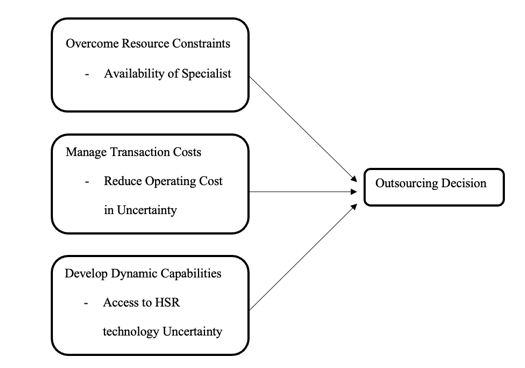
On the basis of the RBV, TCE, and DCT concepts, KCIC's possible O&M strategy for the JBHSR project at the startup phase that lacks sufficient resources should be studied. JBHSR is now constrained in terms of the necessary resources for O&M, such as financing, HSR expertise, and key technology. The RBV provides a strategic viewpoint on KCIC's possible outsourcing decision. Outsourcing could bridge these resource gaps and provide opportunities for competency growth, making it a feasible strategy for KCIC beyond its initial phase. In the JBHSR scenario, the high costs associated with asset specificity, daily O&M requirements, and technological and experience uncertainties may overcome the transaction costs of outsourcing these services if KCIC is not initially qualified to perform O&M chores. Linked to the concept of TCE, outsourcing to seasoned partners could lower the expenses associated with managing the intricacies of railway O&M. In addition, outsourcing contracts can be designed to limit potential risks by establishing service level agreements and performance criteria. With the rapid evolution of HSR technology, the DCT theory suggests that KCIC's ability to harness external resources through outsourcing and training can contribute to the development of dynamic capabilities. Through outsourcing, combining with training can enhance KCIC's internal capabilities, transforming it from an O&M service consumer into an O&M service provider.


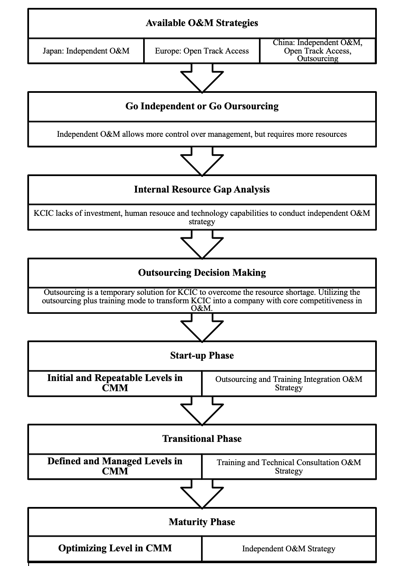
On the near run, outsourcing could alleviate the current skills and labor shortage. Combining training with outsourcing activities could boost learning and information transfer over the long run. CMM provides a roadmap for KCIC to migrate from the start-up phase to the transitional phase and, ultimately, to an independent O&M company in the maturity phase. In the initiation phase, KCIC employs an outsourcing and training integrated O&M strategy. As KCIC's internal skills increase, a training and technical consultation strategy can assist the organization gradually accept more responsibilities from its outsourcing partners. It also enables KCIC to respond rapidly to altering operational needs and technology improvements in the HSR industry, maintaining HSR business competitiveness during the transitional phase through a dynamic, learning-centered strategy. Eventually, KCIC would reach a maturity phase where it could manage all O&M activities alone and continuously optimize its operations.
 

A diagram of outsourcing

Description automatically generated with medium confidence


Figure 1: Outsourcing Decision Making Process
 

A picture containing text, receipt, screenshot, document

Description automatically generated


Figure 2: JBHSR O&M Strategy Development Process
CONCLUSION

The O&M approach for JBHR has been informed by the study's examination of leading HSR systems in Europe, Japan, and China. The distinct market conditions, regulations, and organizational capacities in different nations prevent KCIC from immediately replicating their techniques due to its resource constraints. 


In order to meet urgent demands while preparing for future self-sufficiency, the study has developed a phased O&M strategy with the assistance of MCC. Initially, KCIC implements an outsourcing and training plan. This method, consistent with the RBV and TCE theories, blends external knowledge for immediate O&M needs with an emphasis on building internal capabilities. 


KCIC would enter a phase of semi-independence as its capabilities improved. Throughout this stage, external vendors evolve from primary executors to technical consultants that provide advanced training and assistance. This phase permits KCIC to gradually assume additional O&M responsibilities while continuing to get technical assistance from other sources. 


Lastly, KCIC aspires to achieve complete independence in O&M, wherein it possesses the required abilities and resources to manage all O&M duties autonomously. In accordance with DCT, the emphasis will be placed on continual process development and improvement. 


In conclusion, a phased O&M strategy that mixes outsourcing, training, and gradually increasing independence enables KCIC to overcome its specific challenges and constraints. This strategy not only meets urgent operating requirements, but also builds long-term competences and capacities, preparing KCIC for long-term success in JBHSR O&M.

REFERENCE
  1. Barney, J.B. “Firm Resources and Sustained Competitive Advantage.” Journal of Management, vol. 17, no. 1, 1991, pp. 99–120.

  2. Goh, K.Y. and K.H. Lim. “The Application of Resource-Based Theory and the Measurement of Outsourcing Performance.” Journal of Business Research, vol. 69, no. 5, 2016, pp. 1660–1665.

  3. Williamson, O.E. “Transaction-Cost Economics: The Governance of Contractual Relations.” Journal of Law and Economics, vol. 22, no. 2, 1979, pp. 233–261.

  4. Teece, D.J. et al.“Dynamic Capabilities and Strategic Management.” Strategic Management Journal, vol. 18, no. 7, 1997, pp. 509–533.

  5. Narayanan, V.K., and D. Nath. “Leveraging Knowledge in Outsourcing: An Empirical Investigation.” Journal of Management, vol. 40, no. 6, 2014, pp. 1606–1636.

  6. Paulk, M.C. et al.Capability Maturity Model for Software, Version 1.1. Software Engineering Institute, 1993.

  7. Saito, T. “Japanese Private Railway Companies and Their Business Diversification.” Japan Railway & Transport Review, no. 10, 1997, pp. 2–9.

  8. European Commission. European Commission Mobility and Transport. August 2001, https://transport.ec.europa.eu/transport-modes/rail/railway-packages_en.

  9. Lawrence, M. et al. China’s High-Speed Rail Development. The World Bank, 2019.


License
CC BY-NC-ND
Creative Commons Attribution-NonCommercial-NoDerivatives 4.0 International License
Operation and Maintenance Strategy for Jakarta - Bandung High Speed Railway © 2026 by Zemei Su, Leo Aldianto licensed under CC BY-NC-ND 4.0
All papers should be submitted electronically. All submitted manuscripts must be original work that is not under submission at another journal or under consideration for publication in another form, such as a monograph or chapter of a book. Authors of submitted papers are obligated not to submit their paper for publication elsewhere until an editorial decision is rendered on their submission. Further, authors of accepted papers are prohibited from publishing the results in other publications that appear before the paper is published in the Journal unless they receive approval for doing so from the Editor-In-Chief.
Himalayan Journal of Economics and Business Management open access articles are licensed under a Creative Commons Attribution-Share A like 4.0 International License. This license lets the audience to give appropriate credit, provide a link to the license, and indicate if changes were made and if they remix, transform, or build upon the material, they must distribute contributions under the same license as the original.
Recommended Articles
Research Article
Influence of Leadership on Poverty Reduction in the Devolved Government in Trans-Nzoia County, Kenya
...
Published: 30/06/2021
Download PDF
Research Article
Modelling Structure Job Quality, Job Design and Job Satisfaction
...
Published: 30/08/2022
Download PDF
Research Article
The Constitutional and Legislative Basis for Considering the Taxable Capacity of Taxpayers in Iraqi Tax Legislation
Published: 05/05/2025
Download PDF
Research Article
Proposed Digital Marketing Strategy to Enhance Engineering Consultancy Company Revenue
Published: 30/04/2024
Download PDF
Flowbite Logo
Najmal Complex,
Opposite Farwaniya,
Kuwait.
Email: support@himjournals.com

Useful Links
Order Hard Copy
Privacy policy
Terms and Conditions
Refund Policy
Others
About Us
Team Members
Contact Us
Online Payments
Join as Editor
Join as Reviewer
Subscribe to our Newsletter
Follow us
MOST SEARCHED KEYWORDS
scientific journal
 | 
business journal
 | 
medical journals
 | 
Scientific Journals
 | 
Academic Publisher
 | 
Peer-reviewed Journals
 | 
Open Access Journals
 | 
Impact Factor
 | 
Indexing Services
 | 
Journal Citation Reports
 | 
Publication Process
 | 
Impact factor of journals
 | 
Finding reputable journals for publication
 | 
Submitting a manuscript for publication
 | 
Copyright and licensing of published papers
 | 
Writing an abstract for a research paper
 | 
Manuscript formatting guidelines
 | 
Promoting published research
 | 
Publication in high-impact journals
Copyright © Himalayan Journals . All Rights Reserved.