Online teaching and learning are one of the fastest growing trends in the educational uses of technology. The advent of the internet and the worldwide web has led educational institutions to change their learning techniques to meet the user demands in providing an ideal learning environment. In response to the, many countries around the world have closed schools, colleges and universities to stop the virus from spreading. The sudden closure of schools due to COVID-19 meant that education policymakers, school principals and teachers that is all the stakeholders are insisted to find alternatives to face-to-face traditional teaching in order to guarantee students’ right to education. In India online teaching and learning is quite a new reality for schools. The outbreak of Covid-19 and the country going under lockdown shifted the whole education system into online mode. In this situation teachers and students all are also significantly impacted, due to coronavirus. They had to quickly adapt to use advanced technology or become superfluous. So continuing the online teaching and learning their role is very much important. They had to quickly adapt the uses of the advanced technology or become redundant. In this regarding their perceptions on online teaching and learning which they have on the basis of their experiences is very important to make the process successful from the multiple ends and hence this study aims to study on this. In the present study the secondary level students and teachers of secondary level of Bolpur subdivision was considered as the population of the study. 40 secondary level students and 40 secondary level teachers were taken as samples and data were collected through questionnaire sent by Google form. The study analysed that moreover all the students and teachers don’t like the online reaching and learning and facing various types of difficulties. So to make the online teaching and learning more enjoyable and effective, continuous training with technological skills to both students and teachers and adopting new technology is very necessary.
Keywords
Online Teaching
COVID-19 Crisis
Bolpur
INTRODUCTION
The phrase ‘teaching and learning’ is inevitably associated with the term “school”. But due to the development in technology and the trend of using it in education for the present hour need, the online teaching and learning is growing rapidly worldwide. In response to the COVID-19 crisis, many countries around the world have educational institutions to stop the virus from spreading. According to UNESCO data, the peak of school closings was recorded in early April 2020 when around 1.6 billion students were affected in 194 countries, which is more than 90% of all enrolled students UNESCO, 2020. The sudden closure of schools due to COVID-19 meant that all the teachers and students of education are insisted to find alternatives to face-to-face traditional teaching in order to guarantee students’ right to education [1]. Many systems have adopted online teaching and learning many days ago for the sake of demand to an unprecedented level, often with widely used distance learning materials. School lessons are expected to continue to be interrupted. Even if the worst-case scenario of a second wave of the COVID outbreak has not materialized, school closings may still be required for temporary period to resist the transmission of COVID-19.
As in India online teaching and learning is quite a new reality for schools. The outbreak of Covid-19 and the country going under lockdown shifted the whole education system into online mode. The schools in India have been working for normalising the situation ad doing hard to create a comprehensive online infrastructure for the effective and qualitative distance learning for their students. In this situation teachers and students all are also significantly impacted, due to coronavirus. They had to quickly adapt to use advanced technology or become superfluous and in this situation both the teachers’ and students’ perceptions on online teaching and learning is very much necessary to understand to make the online teaching and learning more qualitative.
Emergence of the Problem
A study on Perception of teachers and students toward online classes in Dakshina Kannada and Udupi District by Abhinandan Dhoot [2] have discussed that though students are comfortable with online classes but they don’t think that traditional classroom can ever be replaced. The study also discussed that due to lack of techno pedagogical skills the teachers are facing a lot of problems and network issues become a vital barrier in making online classes effective, have also been emerged in this study with equal importance. The study on Teachers’ Challenges towards online learning in Pandemic Era by Elsa Rosalina and others described that internet connection, quota, the places of home living and the process of online learning like teachers’ lack of technological skills, less communicative, lack of interaction and fostering an effective online learning climate and for the strength it was found that teachers agreed that flexibility in time and place of online learning, which is also revealed by the present study in same manner, where the teachers of secondary level students have same perceptions regarding challenges and difficulty faced. In the study School Students’ perception and challenges towards online classes during COVID-19 Pandemic in India: An Econometric Analysis, Mohammad Arshad Khan and others revealed that by adopting the latest techniques of online classes and in that case government should take necessary measures.
By reviewing studies obtained in the form of thesis, dissertations and articles, it is observed that some studies have explored the strengths and weaknesses of online teaching and learning and some others on the impact of online teaching and learning on students’ health and also a few on online teaching learning quality and challenges. Compared to the studies undertaken in at international level the studies are few in India and it is further less in the state of West Bengal, lesser in Birbhum district and so in Bolpur subdivision. It is also found that compared to studies on online exercises during normal situations, studies on online teaching and learning during COVID-19 pandemic are more of the opinion oriented and less of research oriented. In addition with respect to the areas studies have been conducted on attitudes of students and teachers towards online education and also several studies on the perception of students and teachers towards e-learning. But no studies have been done students’ and teachers’ perception on online teaching and learning at secondary level in Bolpur subdivision during the pandemic. Thus there exist the research gap within the above researches. So the researcher decided to concentrate on the perception of secondary level students and the students’ teachers’ on online teaching and learning at secondary level in Bolpur Subdivision during COVID-19 pandemic to address the research gap in this area.
Rationale of the Study
Online teaching learning options to new levels as evidenced by increased popularity and involvement in online teaching and learning. Moreover, increase in the COVID pandemic worldwide has also added to the importance of online teaching and learning [3]. In India there are more than 370 m users are on the internet and helping online teaching learning to grow at a fast pace. Even though there is a rapid progress in online teaching and learning still it remains at an early stage of development. In this scenario, the role played by the teachers and students gains due importance as all the teachers and students actively participate in online teaching and learning to ensure quality learning outcome So it becomes relevant to know the opinion, views, feelings, understanding of the teachers and students like students, teachers perception on online teaching and learning on the basis of their experiences and to know what types of problem and difficulties they are facing during online teaching and learning. In case of India, especially in West Bengal the online teaching and learning at the secondary level of education is a very new concept, so in Bolpur subdivision under Birbhum district. It started during the pandemic lockdown period when all the schools are closed and the teaching and learning process made a switch to online mode. In that situation teachers and students are having prominent role in the online teaching learning process hence the study is an attempt to understand the teachers and students perception on online teaching and learning by keeping in mind their concerns [4,5]. The study has endeavoured to analyse the students and teachers perceptions on online teaching and learning at secondary level of education to improve the quality of online teaching and learning and make the process more successful for the benefits of the secondary level students.
Objectives of the Study
To study the perceptions on online teaching and learning of the Secondary level students during COVID-19 pandemic
To explore the perceptions on online teaching and learning of the teachers of the secondary level students during the pandemic
MATERIALS AND METHODS
Population and Sample of the Study
In the present study the secondary level students and teachers of secondary level of Bolpur subdivision was considered as the population of the study [6].
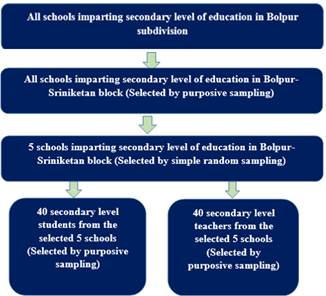
In the present study only Bolpur Sriniketan block from Bolpur subdivision was selected purposively and from that block 5 schools imparting secondary level of education were chosen randomly and from those 5 schools 40 secondary level teachers, 40 secondary level students studying at those 5 schools were selected purposively as the sample of the study [7]. The demographic profiles of the samples are shown below in the tabular form.
Demographic profiles of the student respondents (Table 1).
Demographic profiles of the teacher respondents (Table 2).
Sampling Technique
In the following chart selection of samples is shown (Figure 1):
Tools Used in the Study
The present study has been designed with the descriptive survey method, To conduct the study it is very important to design the methods and required tool which will be used for the study. From this perspective for which following tools were used.
Questionnaires for the students and teachers were made by the researcher and distributed to the participants by using Google form.
Figure 1: Sampling Technique
Table 1: Representing demographic profile of the student respondents
Particulars
Category
Frequency of Secondary level students
%
Gender
Female
24
60
Male
16
40
Locality of the residence
Urban
8
20
Semi Urban
22
55
Rural
10
25
Types of school
Govt./Govt. aided
26
65
Private
14
35
Studying in class
Class IX
12
30
Class X
8
20
Class XI
14
35
Class XII
6
15
Table 2: Representing demographic profile of the teacher respondents
Particulars
Category
Frequency
%
Gender
Male
22
55
Female
18
45
Locality of the
residence
Urban
15
37.5
Semi urban
9
22.5
Rural
16
40
Age group
Below 30
17
42.5
31-40
12
30
41-50
8
20
51-60
3
7.5
School type
Private
12
30
Government
28
70
Employment type
Full time
30
75
Part time
10
25
Primarily involved in the teaching
9th -10th standard
23
57.5
11th – 12th standard
17
42.5
Teaching experience
<5 years
25
62.5
5-10 years
3
7.5
10-15 years
4
10
>15 years
8
20
Teaching discipline
Mathematics
10
25
Language
7
17.5
Natural sciences
8
20
Social sciences
12
30
Fine and performing arts
3
7.5
Analysis And Interpretation of Data
This is the most important part of the study where researcher analysed the collected and systematized data to fulfil the objectives of the study and find the facts regarding the interpretation of the data. In the following section the collected data has been analysed according to the objectives of the present study [8-10].
RESULTS AND DISCUSSION
Analysis and Interpretation of Data Pertaining to ObjectivE-1
To study the perceptions on online teaching and learning of the Secondary level students during COVID-19 pandemic.
Dimension 1: Secondary level Students’ perceptions related to use and access of technological resources for online teaching and learning
Use and access of resources for online teaching and learning of the respondents
Interpretation and Discussion
From the above (Table 3) it can be said that almost all the students having no experience of online teaching and learning before and maximum students are quite new at using internet though they have quite a good access of resources mainly of smart phones and know the basic use of technological resources which are required for continuing online teaching and learning. All have cellular data connection for online teaching and learning purpose. Whatsapp is mostly used app for study purpose and online teaching and learning has a quite long span involvement in terms of screen time. In this lockdown situation online teaching and learning is the only mode of imparting education. So, the better facilities and good knowledge of uses of resources increases the pace of learning and have a direct effect on the better perception of online teaching and learning processes of secondary level students:
Dimension 2: Secondary level Students’ perceptions related to impact of online teaching and learning
Impact of online teaching and learning on the quality of learning of the respondents
Interpretation and Discussion of Table 4
From the above Table 4 it can be said that more than average students have positive impact on the basis of quality of online teaching and learning regarding various factors [11,12]. Maximum Students has positive impact on their increased technological literacy and below average number of students have positive impact on increased confidence involve in online teaching and learning.
Table 3: Table representing Use and access of resources for online teaching and learning of the student respondents
Particulars
Category
Frequency of
Secondary level students
%
Access and use of Device(s)
Desktop
15
37.5
Laptop
23
57.5
Smart phone
40
100
Tablet
4
10
Internet using for years
< 3 years
24
60
>/= 3 years
16
40
Type of Internet connectivity
Cellular data
40
100
Broadband/Wi-Fi
12
30
Use of application
software for online teaching learning purpose
Zoom
6
15
Google meet
10
25
Google classroom
8
20
Cisco WebEx
2
5
Whatsapp
40
100
Moodle
3
7.5
Microsoft teams
1
2.5
Hours spending daily
for online teaching and learning purpose
< 3 hours
12
30
3>/= hours
28
70
Experience of online
teaching and learning before pandemic
Yes
4
10
No
36
90
Table 4: Representing Impact of online teaching and learning on the quality of learning of the respondents
Particulars
Frequency of Secondary level students
%
Decreased Academic pressure
33
82.50
Increased confidence while involve in Online teaching and learning process
12
30
More effective study
24
60
Increased technological literacy
38
95
Helps to gain more knowledge
20
50
Easy to stick to a study schedule
13
32.5
More support and resources from teachers
21
52.5
More encouragement in discussion and participation
29
72.5
The impact of various factors on online teaching and learning help in building perceptions on online teaching and learning. On the basis of increased technological skills students are having quite a good perception on the impact of online teaching and learning at Secondary level.
Impact of online teaching and learning on the health of the Class wise respondents.
Interpretation and Discussion of Table 5
Increasing headaches with frequent eyesight problems are attributed to prolonged screen time. In addition, increasing fatigue due to home confinement are also on the rise. Students are suffering from anxiety, stress and depression with sleeping disorders (17.5%). They are not bound to have classroom professionalism in their home, hence their physical health is deteriorating too in many aspects. Due to lack of outdoor physical activities, eating junk food at home obesity is one rise. Unavailabity of good ergonomics one of the recent rise is spondylitis, back pain etc. So in this regard students have a pessimistic outlook towards online teaching and learning and hence a negative perception on online teaching and learning.
Dimension 3: Secondary level Students’ perceptions related to contact with students and supports from teachers on online teaching and learning.
Interpretation and Discussion of Table 6
From the above table it can be easily seen that all the items are reflecting some negative factors. It is easily verifiable that less than average number of students are telling that they have problem and lacking in class interaction and support from teachers. But students have also shared that they have less social interaction which often results into boredom.
Here the noticeable characteristics is that the private school students have better interaction and support than the govt schools students. In only one aspect “The single classmate dominating the class interaction process” the govt school students have shown their better perception (21%) than pvt. School students (25%). As may be the Govt School students do their class in whatsapp so there is less scope to dominate the interaction process by a single student.
Table 5: Table representing Impact of online teaching and learning on the health of the Class wise student respondents
Health Issue student
Class
Frequency
Headache
Eye problem
Fatigue
Boredom
Mood swings
Others
IX
12
8
7
6
4
5
1
X
8
7
5
5
6
4
1
XI
14
13
12
6
3
3
3
XII
6
6
5
4
1
2
2
TOTAL
40
34
29
21
14
14
7
(%)
100%
87.5%
72.5%
52.5%
35%
35%
17.5%
Table 6: Representing Contact with students and supports from teachers during online teaching and learning in Pvt. And Govt. schools
Particulars
Category
Frequency of Secondary level students
%
Private School
Low or no participation in class activities
5
31
Lack of time to participate
3
18.75
Off topic interaction occurs often
2
12.5
Single classmate dominating the class interaction process
4
25
Lack of feedback from teachers
2
12.5
Govt. School
Low or no participation in class activities
11
46
Lack of time to participate
6
25
Off topic interaction occurs often
3
12.5
Single classmate dominating the class interaction process
5
21
Lack of feedback from teachers
10
42
In average 38.5% students have higher complains in “low or no participation in class activities” than other aspects. May they the students don’t get classroom like environment in their home is one of the reason for that.
Another fact is that govt school students get less feedback (42%) from teachers than the private school students (12.5%). So in this case govt. school teachers should take more care for making the teaching environment active which has direct influence on the students’ perception on online teaching and learning.
Besides the above mentioned aspects some student also shared that among all the students only 50 to 60% students regularly join so they don’t come under regular class interaction process. So less class attendance is another problem in online teaching and learning.
Interaction among students and teachers is vital to develop students’ problem solving skills and critical thinking skills. It also supports productive and satisfying learning, which have impact on students’ achievement and satisfaction. Students also shared that in comparison with the period when lockdown began, this year they are getting more supports from the teachers. May be after 1 year’s teachers are being more tech savvy and using various approach to make the classroom interaction process fruitful. So in this case from the above discussion it can be seen that students have quite a average type of perception regarding their class interaction and support from teachers irrespective of from which type of school they belong to, private or government but for private its better:
Dimension 4: Secondary level Students’ perceptions related to comfortability of online teaching and learning
Comfortability of online teaching and learning
Interpretation and Discussion of Table 7
From the above Table 5.6 it can be said that students feel online teaching and learning more comfortable in terms of there is no impact to psychological stress (50%) and they can access information and learn from anywhere and at any moment (60%). In the other aspect very less people feel online teaching and learning comfortable.
So it can easily follow that students do not think that online teaching and learning can ever replace the traditional classroom teaching and they also feel that online teaching and learning can ever be as comfortable as the traditional classroom teaching. This is because online teaching and learning are in its infancy in a school. So in terms of comfortability maximum students have a pessimistic outlook and dissatisfaction hence a negative perception on online teaching and learning:
Dimension 5: Secondary level Students’ perceptions related to effectiveness of online teaching and learning
Effectiveness of online teaching and learning
Interpretation and Discussion of Table 8
From the Table 8 it can be said that only 25% students said that their online teaching and learning is going effectively where as 75% students said that according to them online teaching and learning is less effective.
Table 7: Representing Comfortability of the students of online teaching and learning
Particulars
Frequency of Secondary level students
%
enables us to access information and learn from anywhere and at any moment
24
60
makes us more productive at teaching using different methods
10
25
enhance exchange and communication among teachers and the students and between them
8
19
requires technological skills and ability
13
32
Not imparts to psychological stress
20
50
less time consuming
10
25
Feel online classes help me to gain more knowledge
16
40
Feel learning is same in class and at home on the internet
10
25
Find it hard to stick to a study schedule of the online class
4
10
Table 8: Representing effectiveness for the students of online teaching and learning
Particulars
Category
Frequency of secondary level students
%
Effectiveness of online teaching and learning
Yes
Offers an interactive mode of education
5
50
Ease to access of information related to the course
2
20
Can learn on your own pace
3
30
Ability to stay at home
3
30
Enables learning at anytime and anywhere
4
40
Comfortable surrounding
2
20
Helps in developing learners’ skills
3
30
Access to online materials
4
40
Classes are easy to navigate
1
10
May have the opportunity to mix what they learn with practical work
1
10
More achievement in the study
4
40
No
Need to feel connected to their school
3
30
Lack of interaction among classmates
3
30
Classroom environments helps you to learn more
7
70
Poor learning conditions at home
4
40
needs perfect computer and internet skills
3
30
social isolation
3
30
Among those 25% almost 50% students said they have better communication process. It can be seen that mainly more achievement in studies, online access of materials, learning from anywhere which is cost effective, are some factors on the basis of which students think that online teaching and learning is effective as each 40% students have said about these 3 factors.
Among the remaining 75% students, who have said that online teaching and learning is not that effective mainly they have the reasons that classroom environment them to learn more and 70% students respond that. Apart from this issue few people are also facing the poor learning condition at home.
From the above table it can be said that maximum students are saying that traditional teaching and learning is more effective rather than online teaching and learning. A few students also are being exceptional as they are preferring online teaching and learning in terms of its effectiveness. Here the teachers’ role play an important role for making the online teaching learning more effective [13]. With their skills they can make the process enjoyable and that has a direct effect on the effectiveness of the online teaching and learning. Here it is clearly visible that moreover students have quite a negative perceptions on online teaching and learning regarding its effectiveness and the main reason is that traditional face to face classroom environment help them to learn more and here among many one of the issue, the failure of teachers’ skills in taking online teaching and learning may be identified [14-18].
Dimension 6: Secondary level Students’ perceptions related to difficulty and challenges of online teaching and learning
Difficulty and challenges of online teaching and learning on the basis of subjects
Interpretation and Discussion of Table 9
From the above Table 9 it can be seen that students are facing highest difficulty in learning Mathematics during online teaching and learning. A lot of students (50%) face difficulties in learning mathematics. Here the abstractness become the barrier in learning and whenever it is through online then the abstractness get higher. If the students do not follow the instructions properly then they will have problems in solving math and this will result into lack of interest in that subject and will stand as a challenge to their learning.
Apart from Mathematics students also face difficulties in learning natural science (20%) and fine and performing arts (18%). In natural science they cannot do the practical application in the laboratory, though there are lots of digital lab but school students of Bolpur Sriniketan block are not that much aware regarding this which is occurring as challenges to them in connecting the theoretical knowledge and practical knowledge. And the learning remains incomplete. Also, computer science is among those subjects in which students are facing difficulties. Students are facing difficulty in fine and performing arts too. May be here the lack of skills of teachers and unavailability of proper environment are becoming the main hindrances. Students are facing difficulties in learning grammar during online teaching and learning process [19].
Students have shared that mainly the lack of board work, lack of attention and unavailability of practical experience they are facing difficulties in learning the subject, which will result into their negative perceptions on online teaching and learning.
Types of challenges faced by the students during online teaching learning process.
Table 9: Representing difficulty and challenges faced by the students during online teaching on the basis of subjects
Subject in which highest difficulty is faced during online teaching and learning
Frequency of secondary level students
%
Mathematics
20
50
Language
2
5
Natural sciences
8
20
Social science
3
7.5
Fine and performing arts
7
7.5
Total
40
100
Table 10: Types of challenges faced by the students during online teaching learning process
Particulars
Frequency of students
%
Distractions
28
70
Organization of learning processes and time management
13
32.5
Collaborative and cooperative learning
5
12.5
Lack of IT support
4
10
Continuous technological challenges
25
62.5
Unequal access for all students
20
50
Family issues (due to learning in home environment)
16
40
Social isolation
8
20
Lack of interaction
8
20
Internet security issues
6
15
Interpretation and Discussion of Table 10
From the above table it is clearly visible that 70% students are facing distractions during their online classes and 50% students are having unequal access during online teaching and learning. Just having hands on devices like phones, computers are not sufficient for the success of online teaching and learning, they are many more requirements for effective teaching like headphones, digital pen, speaker etc. 62.5% students said they face technological challenges, like accidental breakdown of the devices, network issues, lack of knowledge and skills of using technological resources from both the parties teachers and students. These types of challenges are faced by the maximum students during online teaching and learning. Lack of family environment is also another vital reason. Lack of infrastructure in home, maximum screen time results into head ache and eye irritation, others health impact are becoming barriers to their learning. Internet connectivity issue is one the major challenges faced by the students. So, these are some perceived challenges by the students on which their perceptions on online teaching and learning depends and it is found that students perceptions regarding this is not quite satisfactory.
Overall Perceptions of students on online teaching and learning.
Interpretation of Table 11
The researcher studied that, among 40 secondary level students 82% students said that they prefer traditional classroom teaching over online teaching and learning and from the remaining 18% students, 94% students said they prefer synchronous mode of communication. Among these 40 students, 70% students said that their needs are not fulfilled by online teaching and learning and 84% student said that they do not want to continue the online teaching and learning as the only mode of learning when the pandemic is over.
Table 11: Overall Perceptions of students on online teaching and learning
Particulars
Category
% of students
Meeting the requirements of learning through online teaching and learning
Yes
30
No
70
Preference as the mode of learning
Online
18
Offline
82
Desire of Continuation of online teaching and learning even after pandemic is over
Yes
16
No
84
Table 12: Representing Use and access of resources for online teaching and learning of the respondents
Particulars
Category
Frequency of Secondary level teachers
%
Access and use of own Device(s)
Desktop
5
12.5
Laptop
24
60
Smart phone
40
100
Tablet
4
10
Access and use of Device(s) at school
Desktop
12
30
Laptop
20
50
Smart phone
40
100
Tablet
4
10
Teaching experience
< 5 years
32
80
>/= 5 years
8
20
Internet skills
Moderate (know how to access emails and browse, use a few specific apps for online teaching and learning purpose)
1
2.5
Good (know how to access emails, browse and download materials online, use a few specific apps for online teaching and learning purpose)
7
17.5
Excellent (know how to access emails, browse, download materials, use social media for online teaching learning purposes and develop and share study material by my own)
32
80
Type of Internet connectivity
Cellular data
40
100
Broadband/Wi-Fi
12
30
Internet connectivity at school campus
Yes
33
82.5
No
7
17.5
Use of application software for online teaching learning purpose
Zoom
18
45
Google meet
33
82.5
Google classroom
45
35
Cisco WebEx
2
5
Whatsapp
40
100
Moodle
2
5
Microsoft teams
4
10
Hours spending daily for online teaching and learning purpose
< 3 hours
28
70
3>/= hours
12
30
Experience of online teaching and learning before pandemic
Yes
7
17.5
No
33
82.5
So from the above analysis it can be seen that though in some aspects some students prefer the online teaching and learning over the traditional classroom teaching and their responses were like to adapt and accept the new learning environment with an open mind still maximum number of students perceive that the online teaching and learning cannot take place of face to face traditional classroom which is the new normal have negative perceptions on the overall process of online teaching and learning.
Analysis and Interpretation of Data Pertaining to Objective 2
To explore the perceptions on online teaching and learning of the teachers of the secondary level students during the pandemic:
Dimension 1: Secondary level teachers’ perceptions related to use and access of resources for online teaching and learning
Use and access of resources for online teaching and learning of the respondents
Interpretation
With the above Table 12 it can be shown that-
Among the 40 respondents all the teachers have quite a good number of their own device.
About 100% teachers have smartphones this is the highest used device by the teachers. Besides that 60% of teachers use and access of laptops. Tablet is used by 10% of the teachers. So it can be said that as they all have devices, so they never face any problem regarding lack of devices during online teaching and learning.
From the Table 12 it can be seen that 100% teachers use smartphones at the school. About 50% teachers use laptops and 30% use school desktop at the school campus at the time of online teaching and learning during the pandemic. So On the whole they teachers don’t face lack of device at the school too [20].
It is visible that among the respondents 80% teachers are new at their profession they have less than 5 years of experience. Among the respondents 80% have excellent internet skills so they are not facing any problem regarding using internet for online teaching and learning. As maximum teachers are young so they are efficient in using technology and that is why internet skills among respondents are also excellent (80%).
All the teachers have cellular data and some have Broadband/WI-FI as well. So they don’t face any problem regarding the unavailability of network connection. Whenever there is a compulsion to take class from the school during the pandemic 82% got internet connectivity from the school though 18% of the respondents told that they don’t get internet connectivity from the school, they use their own internet connectivity [21,22].
So from the Table 12 it can be seen that 100% teachers use whatsapp for teaching and learning purpose. Apart from that Google meet is also a highly used app for teaching learning purpose in the online mode. Some more apps like zoom (45%), Google classroom (35%) and a few more are also use for online teaching and learning purpose.
From the Table 12 it can be seen that 70% teachers are involved in online teaching and learning purpose for less than 3 hours, which means they are not in that much stress and not going under a long screen time, 30% people among the teachers respondents shared they are involved for more than 3 hours in online teaching and learning purpose. Almost 83% teachers shared that teaching through online is quite a new experience under which they are going through during this pandemic, though 27% teachers shared that they have some kind of online teaching and learning experience in the past [23,24].
Discussion: From the above Table 12 it can be said that though maximum teachers did not have any experience of online teaching and learning before the pandemic though they have quite a good access of resources and know the basic use of technological resources which are required for making online teaching and learning more effective and which have direct effect on the perception on online teaching and learning of the secondary level teachers as online teaching and learning is honestly an evaluation of technological resources also. Whatsapp is the mostly used app for teaching purpose. In this lockdown situation online teaching and learning is the only mode of imparting education. So, the better facilities and good knowledge of uses of resources increases the easiness in teaching through online and making the process effective so it eventually has a direct effect on the better perception of online teaching and learning processes of secondary level teachers:
Dimension 2: Secondary level teachers’ perceptions related to impact of online teaching and learning
Impact of online teaching and learning on the teachers’ own self and teaching process
Interpretation and Discussion of Table 13
From the above table and figure it can be seen that 95% teachers said that technological skills have increased during online teaching and learning. About 70% teachers said they can provide more encouragement in students’ participation. According to 75% teachers they can provide more time to themselves. Half of the respondents said they can provide more support in resources to the students.
So according to this items the maximum teachers have positive impact of online teaching and learning, which is followed by their positive perception on online teaching and learning.
On the other hand maximum teachers have negative impact on their study schedule maintaining, effective teaching etc. They (70%) also feel lack of confidence in online teaching and learning. Almost 60% teachers said their academic pressure has increased. 55% teachers shared their facing management problem of academic administrative load online. So all these impacts influence the teachers’ perception in a negative way. They also shared that as the impact of online teaching and learning there is creating a barrier between the privileged and less privileged one. Where the privileged one won’t complain and the hegemony will continue to propagate capitalism by creating and maximizing the digital divide and the teachers and students are blind to practicality.
So in this case we can see the teachers have mixed perception regarding the impact of online teaching and learning.
Impact of online teaching and learning on the health of the secondary level teachers.
Table 13: Table representing Impact of online teaching and learning on the Secondary level teachers’ own self and teaching process
Particulars
Frequency of teachers of secondary level
%
Decreased Academic pressure
16
40
Easy to manage administrative and academic activity during online teaching as like the traditional set up.
18
45
Increased confidence while involve in Online teaching and learning process
12
30
More effective teaching
19
47.5
Increased technological literacy
38
95
More time for own self
30
75
Easy to stick to a study schedule
13
32.5
Can provide more support and resources
20
50
Can provide more encouragement in discussion and participation
28
70
Table 14: Representing Impact of online teaching and learning on the health of the Secondary level teachers
Particulars
Frequency of the teachers of secondary level
%
Headache
21
52.5
Eye problem
28
70
Fatigue
10
25
Boredom
16
40
Mood swings
18
45
Interpretation and Discussion of Table 14
From the Table 14 it can be said that a large number of people having health issues as the result of online teaching and learning. About 70% of teachers said they are suffering from eye problem due to at a stretch screen time. Though many are using ultraviolet glass for minimising the suffering. Online teaching presents a major risk on headache too. About 52% teachers are suffering from that too. On the basis of the survey it can be seen that it has accelerated the emotional health problem, psychological health problem like anxiety, stress, anger, loneliness, depression and, apart from boredom, fatigue etc. Due to work from home, the physical movement is restricted and as a result obesity, back pain, High BP, High sugar, heart problem have increased. So, it is clearly visible that teachers have quite a bad impact of online teaching and learning on their health and as a consequence a negative perception on online teaching and learning regarding its impact on health:
Dimension 3: Secondary level teachers’ perceptions related to contact with students and teachers during online teaching and learning.
Interpretation and discussion of Table 15
Here in the above table, it is seen that the data is categorised into two types of school, one is private school and another is government school. From the above figure 60.71%) and low participation of students (43.45%). In the government schools the 71% teachers said about low attendance of the students wherein the 50% private school teachers shared about the low and medium attendance of the students. The economical factor may be one of the reasons for the above aspects because generally the rich people study in the private schools they have available resources for class but many poor children from govt. /govt. aided schools are involving in other works and not attending classes, as other reasons the interest of the students also matter which up to some extent depends upon the teachers capability to make the class attractive so the students come and join the class in online mode.
Table 15: Representing Contact with students and teachers during online teaching and learning teaching and learning
Particulars
Category
Frequency of Secondary level teachers
%
Private School
low or no participation of students
4
33.33
lack of time to participate
3
25
off topic interaction occurs often
2
16.66
Single student dominating the class interaction process
3
25
lack of feedback of teaching from students
5
41.66
Low and medium Students attendance than the usual
6
50
Govt./ Govt. aided School
low or no participation of students
15
53.571
lack of time to participate
18
25.71
off topic interaction occurs often
4
14.28
Single student dominating the class interaction process
5
17.5
lack of feedback of teaching from students
19
67.85
Low and medium Students attendance than the usual
20
71.42
From the data it is visible that in the Gov. School students’ low participation is much higher (53.57%) and in private schools it is 33%. The govt. /govt. aided schools teachers are taking their class through WhatsApp and during the instruction teacher changes the setting and don’t allow the students to talk to, would may be a possible reason. Apart from this govt./govt. aided school teachers are using asynchronous platform more for the teaching purpose so it may hamper the contact and interaction environment. In this case Private school teachers are using zoom, Google meet to conduct classes. The synchronous platform may facilitate the contact and interaction among students and the teachers.
Apart from these three aspects a few teachers have complained about the other aspects of contact with students and teachers during online teaching and learning. Few teachers also said that online classes are encouraging participation from students who may not actively participate in traditional classroom settings. In this mode of teaching the teachers also have a wealth of technology at their fingertips to make classes more interesting and engaging. So moreover, it can be said that teachers have average contact with students and teachers during online teaching and learning, which result into moreover moderate to positive perceptions regarding this aspect [25].
It is well-known to all that the interaction part is one of the most vital part of the teaching learning process. The teacher student interaction in online leaching and learning must be a two -way street to be effective. That is through the teachers’ teaching styles and knowledge in online platform they will develop their social presence virtually and for the interactive atmosphere trusted presence for all parties. If the teacher contact information is readily available, regular and structured feedback via email, etc. occurs regularly then a student feels a greater connection to the environment and leads to better retention and engagement. Better engagement is no doubt important because it leads to clear expectations for both teachers and students, worthwhile discussion, needed support and encouragement and instructive feedback from both of the parties.
Online Teaching and Learning
Comfortability during online teaching and learning.
Interpretation and Discussion of Table 16
From the Table 16 it can be seen that 65% teachers find that online teaching and learning as a comfortable job because here the teachers enjoy the flexibility and convenience of the medium. They can teach from the comfort of their own homes and do not need to be at a specific time to teach or to interact with their students. Almost 40% teachers which is though less than the half of the sample, said that, this online teaching and learning provide them with greater flexibility to address varying learning styles and use different technologies. So here to make the teaching more comfortable technology skills are required and 50% teachers accepted this. So for few it would be like a challenge and result into discomfort. 50% teachers said that they are not trained with techno pedagogical skill during their B.Ed. course and not even during the pandemic for the sake of situation, so they are more comfortable in taking offline classes. Some teachers also said that when they are taking online classes from school they lack of techno friendly infrastructure and environment are making them more uncomfortable. Especially the govt. school teachers are facing this issue. Few teachers also have complained about the psychological stress (35%), more time consuming (37%) and communication problem (17.50%). So, the negative feedback on this aspect are from less than half of the sample. So here it can be said that while few Teachers are quite comfortable in taking online classes regarding these mentioned aspects and some are not. So moreover it can be said that teachers have mixed perceptions on the online teaching learning’s comfortability:
Dimension 5: Secondary level teachers’ perceptions related to effectiveness of online teaching and learning
Effectiveness of online teaching and learning
Interpretation and Discussion of Table 17
From the Table 17 it can be said that only 37% teachers said that their online teaching and learning is going effectively where as 63% teachers said that according to them online teaching and learning is less effective.
Among those 37% teachers 67% said about its affordability, 60% says about their improvement in skills, 53% told about their increasing focus in lectures. Almost 46% teachers among these 37% found it effective in terms of anytime, anywhere learning and comfortable surroundings. Also a few more teachers on the basis of interaction, ease of access of information, quality of learning found online teaching and learning effective.
On the other hand among the remaining 63% teachers 70% said that classroom environment is more effective as it helps the students to learn more.
Table 16: Teachers’ Comfortability during online teaching and learning
Particulars
Frequency of the teachers at secondary level
%
enables to access information and teach and learn from anywhere and at any moment
26
65
makes more productive at teaching using different methods
15
37.5
enhance exchange and communication among teachers and the students and between them
7
17.5
requires technological skills and ability
20
50
imparts to psychological stress
14
35
more time consuming than traditional way of teaching and learning
15
37
Table 17: Representing effectiveness of online teaching and learning according to teachers
Particulars
Category
Frequency of secondary level teachers
%
Effectiveness of online teaching and learning
Yes
Offers an interactive mode of education
4
26.6
Ease of access of information related to the class
6
40
Enables teaching at anytime and anywhere
7
46.6
Affordability
10
66.6
Focus in lectures, interactions and summative online assessment
8
53.3
Classes are easy to navigate
3
20
Flexibility, availability of content for revision and fewer distractions
6
40
More quality in teaching
5
31.25
Comfortable surrounding
7
46.66
Helps in developing teaching skills, specially technical skills
9
60
No
Students need to feel connected to their school
13
52
Lack of interaction among colleagues
6
24
Reduction of interaction with the students
12
48
Classroom environments helps students to learn more
19
76
Needs perfect technology and internet skills
13
52
More expensive than traditional education
9
36
Band width and internet speed could represent some problem
11
44
Lack of self-discipline
7
28
Social isolation
10
40
Management of screen time
8
32
About 52% said in online mode communication barrier occurs and technical skills create challenges. Also the availability of resources create digital divide which hinders in making the teaching and learning process effective.
About 44% said they face network issues. Social isolation make the teachers depressed and results into psychological stress which prevents to make the online teaching and learning process effective. Few more teachers also said about facing problems in managing screen time, expensive as because of owning technological devices and other resources. Lack of self-discipline is also another issue shared by some teachers which make the teaching process ineffective. Few teachers also said that online teaching and learning may be effective for students from higher education level but it creates blunder for school going children. They may be become mobile addicted and this adolescent period is very crucial time and continuous involvement in gadgets may be risky for their safety and security purpose.
Table 18: Representing Difficulty and challenges faced by teachers of online teaching and learning on the basis of the standard
Standard at which highest difficulty is faced during online teaching and learning
Frequency of secondary level teachers
%
IX
13
32.5
X
8
20
XI
4
10
XII
3
7.5
Could not select any particular class
12
30
So moreover it can be said that though some degree of agreement in effectiveness of online teaching and learning regarding focus in lectures, interactions and summative online assessments was found among teachers. Internet and technical issues, less supportive environment etc. were revealed to be the main constraints of this format whereas flexibility, availability of content for revision and fewer distractions were the positive features which make the. But it is found that the majority of the teachers felt that online teaching and learning could not replace traditional face-to-face teaching in terms of its effectiveness. Hence it can be said that majority of the teachers have negative perceptions on online teaching and learning when question comes about its effectiveness.
Dimension 6: Secondary level teachers’ perceptions related to difficulties and challenges of online teaching and learning
Difficulty and challenges of online teaching and learning on the basis of the standard
Interpretation and Discussion of Table 18
From the above table it can be seen that the maximum teachers are facing problem in taking online classes of junior children. The junior children have less maturity and they are also difficult to control. So taking their class through online is challenging. In this case some teachers also shared that the challenging situation occurs on the basis of subject not on the basis of classes. Like few mathematics, art craft teachers and the teachers of practical oriented subject shared they are facing problem in taking classes through online as they are not skilled enough or not that trained to take classes online effectively.
Types of challenges faced by the teachers during online teaching learning process.
Interpretation and Discussion of Table 19
From the above table it is clearly visible that 70% teachers have faced continuous technological challenges, 60% of teachers are depressed due to social isolation, Safety security issue, lack of home environment for taking online classes, issues during taking specific subject classes are some other challenges through which the more than half of the teachers are undergoing. Apart from these, distractions, unequal attention to students, LMS imperfection, lack of IT support, problems in instructional strategy are few other challenges which the teachers have to cope up to make the online teaching and learning successful. Majority of teachers encounter challenges that can cause hindrance in their effective teaching and the quality of successfully reaching out the teaching to the students are getting suppressed by the challenges during their teaching process and resulting into negative perceptions on online teaching and learning of the maximum teachers.
Table 19: Types of challenges faced by the teachers during online teaching learning process
Challenges
Frequency of students
%
distractions
18
45
organization of work processes and time management
13
32.5
instructional strategy
3
7.5
lack of it support
14
35
continuous technological challenges
28
70
unequal attention to all students
18
45
family issues (due to working from home)
20
50
adjusting of online teaching and learning process to deaf or hard of hearing students
15
17.87
lack of interaction
14
35
LMS (learning management system) imperfection
17
42.5
Issues during collaborative and cooperative and experiential teaching
21
52.5
safety and security issues
23
57.5
Social isolation
24
60
Table 20: Overall Perceptions of teachers on online teaching and learning
Particulars
Category
% of students
Reaching out the success of teaching through online mode teaching and learning
Yes
31
No
69
Preference as the mode of teaching
Online
19
Offline
81
Continuation of online teaching and learning even after pandemic is over
Yes
29
No
71
Overall Perceptions of teachers on online teaching and learning.
Interpretation and Discussion of Table 20
The researcher studied that, among 40 secondary level teachers 81% teachers said that they prefer traditional classroom teaching over online teaching and learning and from the remaining 19% teachers, 90% teachers said they prefer synchronous mode of communication. Among these 40 teachers, 69% teachers said that success of teaching through online mode teaching and learning is not getting and 71% teachers said that they do not want to continue the online teaching and learning as the only mode of teaching after the pandemic, may be the remaining 29% would prefer the blended form of teaching and learning.
When the teachers were surveyed many of them shared their own experiences. Like one teacher said, “After teaching a topic getting no question and query from the side of the students and during the time of teaching most of them are turning their mic and videos off and doing something else.”, another teacher had similar experience, he said, “The lazy students just join the class and do other childish work, being addicted with playing games and I have no control over it.”. One math teacher said that many students having basic weakness about mathematics which could be solved in offline classes more easily. One among the 40 teachers shared an important fact that during online teaching and learning, being at home the students are surrounded by their parents and that causes pressure on themselves, like this soften leads moment where they cannot freely express themselves. The teachers also shared that due to network fluctuations student cannot hear properly and become inattentive. Less attendance of students is also shared by many teachers. One teacher shared a vital point, she said, “We, the teacher are failed to organise proper evaluation process. Each and every students are getting too much marks, that’s the worst part in online teaching and learning”.
A few teachers shared that though online teaching and learning would make the students and teachers competent for the changing environment, where everyone should have the knowledge about technological resources and should be tech pro in order to pace up with the world full of technology, still they do not want the online teaching and learning (as the only mode of education) to be continued at least for the school going children even after pandemic because this have a lot of drawbacks and no doubt the classroom is fun and they are missing that enjoyment which make the teaching and learning process successful.
So from the above analysis it can be seen that though in some aspects some teachers prefer the online teaching and learning over the traditional classroom teaching still maximum number of teachers are not liking online teaching and learning and having negative perceptions on the overall process of online teaching and learning.
CONCLUSION
The purpose of the study was to gain knowledge of the teachers’ and students’ perceptions on online teaching and learning at secondary level in Bolpur subdivision during COVID-19. Descriptive survey method used in this study were well suited to achieve this goal [26].
While involving in online teaching and learning the teachers and students gained both positive and negative experiences, although their experiences tended to be more negative. As due to the pandemic all the schools are closed and the online teaching and learning is going on so to make the process successful it is evident to know the teachers’ and students’ perceptions. This study only tried to provide an overview of their experiences of online teaching and learning which contribute to their perceptions on that so that it can pave the path for the teachers and students to rethink about process they are going through during online teaching and learning.
The present study has found that moreover all the students and teachers don’t like the online reaching and learning and facing various types of difficulties. So to make the online teaching and learning more enjoyable and effective, continuous training with technological skills to both students and teachers and adopting new technology is very necessary [27].
In sum, this piece of research could have a positive impact on the field of educational research in India and subsequently may contribute to the literature of online teaching and learning and enable the teachers and students who are involved in online teaching and learning to evaluate their practices based on the findings and recommendations of the study. The result of the study may be considered by the school and the government to take necessary steps to make the online teaching and learning more successful during the pandemic.
REFERENCES
Blackmon S.J. and Major C. "Student experiences in online courses: a qualitative research synthesis." The Quarterly Review of Distance Education, vol. 13, no. 2, 2012, pp. 77–85. https://eric.ed.gov/?id=EJ1005840
Dhoot P. "A study on perception of students’ toward e-learning during COVID-19 lockdown phase in India." Dogo Rangsang Research Journal, vol. 10, no. 7, 2020. http://drsrjournal.com/no_1_july_20/34.pdf
Dhawan, S. "Online learning: a panacea in the time of COVID-19 crisis." Journal of Educational Technology Systems, vol. 49, no. 1, 2020, pp. 5–22. https://doi.org/10.1177/0047239520934018
Dambhare A. and Khan S.K. "An analysis of teachers perceptions towards online learning in India during covid pandemic." 2020. https://www.researchgate.net/publication/347947125
Deshwal P. et al. "Online learning experience scale validation and its impact on learners’ satisfaction." Procedia Computer Science, vol. 112, 2017, pp. 2455-2462. https://doi.org/10.1016/j.procs.2017.08.178
Fish W.W. and Gill P.B. "Perceptions of online instruction." Turkish Online Journal of Educational Technology, vol. 8, 2009, pp. 53-64. https://www.researchgate.net/publication/288064792
Gomez-Rey, P. et al. "Students’ perceptions about online teaching effectiveness: a bottom-up approach for identifying online instructors’ roles." Australasian Journal of Educational Technology, vol. 34, no. 1, 2018. https://ajet.org.au/index.php/AJET/article/view/3437/1521
Gómez-Rey P. et al. "Measuring teachers and learners’ perceptions of the quality of their online learning experience." Distance Education, vol. 37, no. 2, 2016, pp. 146-163. https://eric.ed.gov/?id=EJ1106996
Gilbert, B. "Online learning revealing the benefits and challenges." Education Masters, Paper 303, 2015. https://fisherpub.sjfc.edu/cgi/viewcontent.cgi?article=1304&context=education_ETD_masers
Grebennikova V.M. et al. "Students’ perception of e-learning based on media resources and readiness during covid-19." Media Watch, vol. 12, no. 2, 2021. https://doi.org/10.15655/mw/2021/v12i2/160151
Halupa C. "Risks: the impact of online learning and technology on student physical, mental, emotional and social health." ICERI2016 Proceedings, 2016, pp. 6305-6314. https://www.researchgate.net/publication/311362980
Joshi A. et al. "Impact of coronavirus pandemic on the Indian education sector: perspectives of teachers on online teaching and assessments." Interactive Technology and Smart Education, 2020. https://www.researchgate.net/publication/343961926
Kar S. "Teachers’ attitudes towards online teaching (e-learning) during covid-19 lockdown." Journal of Information and Computational Science, vol. 10, no. 8, 2020. http://www.joics.org/gallery/ics-3979.pdf
Kulal A & Nayak A. "A study on perception of teachers and students toward online classes in Dakshina Kannada and Udupi District." Asian Association of Open Universities Journal, 2020. https://www.researchgate.net/publication/345047667
Kour, S. "Exploring adolescent students' attitude towards the effectiveness of e-learning in their academic life." Indian Journal of Applied Research, vol. 7, no. 7, 2017. https://www.worldwidejournals.com/indian-journal-of-applied-research-(IJAR)/fileview/July_2017_1498904165176.pdf
Mamattah, R.S. "Students’ perceptions of e-learning." Dissertation, 2016. http://www.diva-portal.org/smash/get/diva2:925978/FULLTEXT01.pdf
Nagar, S. "Students’ perception towards e-learning and effectiveness of online sessions amid covid-19 lockdown phase in India: an analysis." 2020. https://www.fergusson.edu/upload/document/86850Dr.ShrutiNagar(IMDR).pdf
Nambiar, D. "The impact of online learning during COVID-19: students’ and teachers’ perspective." International Journal of Indian Psychology, vol. 8, no. 2, 2020, pp. 783-793. https://ijip.in/articles/the-impact-of-online-learning-during-covid-19-students-and-teachers-perspective/
Nivetha, G. et al. "Awareness of e-learning education among parents of school-going children." Drug Invention Today, vol. 12, no. 9, 2019, pp. 1962-1964. https://jprsolutions.info/files/final-file-5d91924ead5fe3.69473450.pdf
Palmieri, A. "Online learning's impact on mental health." English Department: Research for Change - Wicked Problems in Our World, Paper 32, Kutztown University, 2020. https://research.library.kutztown.edu/wickedproblems/32/
Paris, P.G. "E-learning: a study on secondary students' attitudes towards online web assisted learning." International Education Journal, vol. 5, 2004. https://www.researchgate.net/publication/255645355
Rapanta, C. et al. "Online university teaching during and after the covid-19 crisis: refocusing teacher presence and learning activity." 2020. https://www.researchgate.net/publication/342716579
Ray, P. "Web based e-learning in India: the cumulative views of different aspects." Indian Journal of Computer Science and Engineering, vol. 1, 2010. https://www.researchgate.net/publication/49616230
Van Wart, M. et al. "Integrating students’ perspectives about online learning: a hierarchy of factors." International Journal of Educational Technology in Higher Education, vol. 17, article 53, 2020. https://educationaltechnologyjournal.springeropen.com/articles/10.1186/s41239-020-00229-8
Verma, P. and Trivedi A. "Online education & school students: a reality check." International Journal of Recent Technology and Engineering (IJRTE), vol. 8, no. 4, 2019. https://www.ijrte.org/wp-content/uploads/papers/v8i4/D6765118419.pdf
Yadav, A.K. "Impact of online teaching on students’ education and health in India during the pandemic of COVID-19." Coronaviruses, vol. 1, 2020. https://doi.org/10.2174/2666796701999201005212801
Yang, Y. and Cornelius L.F. "Students' perceptions towards the quality of online education: a qualitative approach." Annual Proceedings-Chicago, vol. 1, 2004, pp. 861-877. https://eric.ed.gov/?id=ED485012
License
Creative Commons Attribution-NonCommercial-NoDerivatives 4.0 International License
All papers should be submitted electronically. All submitted manuscripts must be original work that is not under submission at another journal or under consideration for publication in another form, such as a monograph or chapter of a book. Authors of submitted papers are obligated not to submit their paper for publication elsewhere until an editorial decision is rendered on their submission. Further, authors of accepted papers are prohibited from publishing the results in other publications that appear before the paper is published in the Journal unless they receive approval for doing so from the Editor-In-Chief.
Himalayan Journal of Education and Literature open access articles are licensed under a Creative Commons Attribution-Share A like 4.0 International License. This license lets the audience to give appropriate credit, provide a link to the license, and indicate if changes were made and if they remix, transform, or build upon the material, they must distribute contributions under the same license as the original.
Recommended Articles
Research Article
Perceptions of Adolescent Pregnancy and Early Motherhood
Lucy Fonjong Udikoh,
Tamfuchia Ferdinard Baba
Published: 30/12/2020
Download PDF
Cite
x
APA
Fonjong Udikoh, L. & Ferdinard Baba, T. (2020). Perceptions of Adolescent Pregnancy and Early Motherhood. Himalayan Journal of Education and Literature, 1(1), 1-7.
MLA
Fonjong Udikoh, Lucy and Tamfuchia Ferdinard Baba. "Perceptions of Adolescent Pregnancy and Early Motherhood." Himalayan Journal of Education and Literature 1.1 (2020): 1-7.
Chicago
Fonjong Udikoh, Lucy and Tamfuchia Ferdinard Baba. "Perceptions of Adolescent Pregnancy and Early Motherhood." Himalayan Journal of Education and Literature 1, no. 1 (2020): 1-7.
Harvard
Fonjong Udikoh, L. and Ferdinard Baba, T. (2020) 'Perceptions of Adolescent Pregnancy and Early Motherhood' Himalayan Journal of Education and Literature 1(1), pp. 1-7.
Vancouver
Fonjong Udikoh L, Ferdinard Baba T. Perceptions of Adolescent Pregnancy and Early Motherhood. Himalayan Journal of Education and Literature. 2020 Jul;1(1):1-7.
Download PDF
Research Article
Interaction of Modern Literature-Paintings and Poetry, Storytelling, Literature
Jackline Njeri Murimi
Published: 27/01/2021
Download PDF
Cite
x
APA
Njeri Murimi, J. (2021). Interaction of Modern Literature-Paintings and Poetry, Storytelling, Literature. Himalayan Journal of Education and Literature, 2(1), 1-5.
MLA
Njeri Murimi, Jackline. "Interaction of Modern Literature-Paintings and Poetry, Storytelling, Literature." Himalayan Journal of Education and Literature 2.1 (2021): 1-5.
Chicago
Njeri Murimi, Jackline. "Interaction of Modern Literature-Paintings and Poetry, Storytelling, Literature." Himalayan Journal of Education and Literature 2, no. 1 (2021): 1-5.
Harvard
Njeri Murimi, J. (2021) 'Interaction of Modern Literature-Paintings and Poetry, Storytelling, Literature' Himalayan Journal of Education and Literature 2(1), pp. 1-5.
Vancouver
Njeri Murimi J. Interaction of Modern Literature-Paintings and Poetry, Storytelling, Literature. Himalayan Journal of Education and Literature. 2021 Jan;2(1):1-5.
Download PDF
Research Article
The Effect of Web Quest on the Achievement of Fifth Grade Literary Students in Philosophy and Psychology
Muntasser Mohammed Nada
Published: 30/05/2024
Download PDF
Cite
x
APA
Nada, M. M. (2024). The Effect of Web Quest on the Achievement of Fifth Grade Literary Students in Philosophy and Psychology. Himalayan Journal of Education and Literature, 5(1), 1-39.
MLA
Nada, Muntasser M.. "The Effect of Web Quest on the Achievement of Fifth Grade Literary Students in Philosophy and Psychology." Himalayan Journal of Education and Literature 5.1 (2024): 1-39.
Chicago
Nada, Muntasser M.. "The Effect of Web Quest on the Achievement of Fifth Grade Literary Students in Philosophy and Psychology." Himalayan Journal of Education and Literature 5, no. 1 (2024): 1-39.
Harvard
Nada, M. M. (2024) 'The Effect of Web Quest on the Achievement of Fifth Grade Literary Students in Philosophy and Psychology' Himalayan Journal of Education and Literature 5(1), pp. 1-39.
Vancouver
Nada MM. The Effect of Web Quest on the Achievement of Fifth Grade Literary Students in Philosophy and Psychology. Himalayan Journal of Education and Literature. 2024 Jan;5(1):1-39.
Download PDF
Research Article
The Effect of Practicing Critical Thinking Skills on Undergraduates English Learners: Teachers’ Perspective
Azza Elmadani,
...
Shiraz Al-Ali
Published: 15/03/2026
Download PDF
Cite
x
APA
Elmadani, A., Hussein, J. A. T. & Al-Ali, S. (2026). The Effect of Practicing Critical Thinking Skills on Undergraduates English Learners: Teachers’ Perspective. Himalayan Journal of Education and Literature, 7(1), 1-5.
MLA
Elmadani, Azza, Jehan Adli Tawfig Hussein and Shiraz Al-Ali. "The Effect of Practicing Critical Thinking Skills on Undergraduates English Learners: Teachers’ Perspective." Himalayan Journal of Education and Literature 7.1 (2026): 1-5.
Chicago
Elmadani, Azza, Jehan Adli Tawfig Hussein and Shiraz Al-Ali. "The Effect of Practicing Critical Thinking Skills on Undergraduates English Learners: Teachers’ Perspective." Himalayan Journal of Education and Literature 7, no. 1 (2026): 1-5.
Harvard
Elmadani, A., Hussein, J. A. T. and Al-Ali, S. (2026) 'The Effect of Practicing Critical Thinking Skills on Undergraduates English Learners: Teachers’ Perspective' Himalayan Journal of Education and Literature 7(1), pp. 1-5.
Vancouver
Elmadani A, Hussein JAT, Al-Ali S. The Effect of Practicing Critical Thinking Skills on Undergraduates English Learners: Teachers’ Perspective. Himalayan Journal of Education and Literature. 2026 Jan;7(1):1-5.
Ghosh, D. & Bairagya, S. (2022). Students’ and Teachers’ Perceptions on Online Teaching and Learning at Secondary Level in Bolpur Subdivision During COVID-19 Pandemic. Himalayan Journal of Education and Literature, 3(1), 1-12.
MLA
Ghosh, Debanjali and Shyamsundar Bairagya. "Students’ and Teachers’ Perceptions on Online Teaching and Learning at Secondary Level in Bolpur Subdivision During COVID-19 Pandemic." Himalayan Journal of Education and Literature 3.1 (2022): 1-12.
Chicago
Ghosh, Debanjali and Shyamsundar Bairagya. "Students’ and Teachers’ Perceptions on Online Teaching and Learning at Secondary Level in Bolpur Subdivision During COVID-19 Pandemic." Himalayan Journal of Education and Literature 3, no. 1 (2022): 1-12.
Harvard
Ghosh, D. and Bairagya, S. (2022) 'Students’ and Teachers’ Perceptions on Online Teaching and Learning at Secondary Level in Bolpur Subdivision During COVID-19 Pandemic' Himalayan Journal of Education and Literature 3(1), pp. 1-12.
Vancouver
Ghosh D, Bairagya S. Students’ and Teachers’ Perceptions on Online Teaching and Learning at Secondary Level in Bolpur Subdivision During COVID-19 Pandemic. Himalayan Journal of Education and Literature. 2022 Jan;3(1):1-12.



 Download PDF
 Download XML