Work engagement is a new concept in the Human Resource Management (HRM). The relationship between HRM practices and work engagement is still in its infancy. To understand the status quo of this relationship, this study aims to conduct a systematic literature review. The databases were searched for reliable articles. Three screenings were conducted to refine the articles. This has resulted in reviewing 25 articles. The findings showed that most of articles were conducted in Asian countries in banking and educational institutions. Most of the articles are empirical with sample size above 30 and mean of sample 348. The first generation of data analysis is still widely used in the literature. The relationship between HRM practices with work engagement is positive. In term of the components of HRM practices, their relationship with work engagement is mixed. This study conducted on 25 articles. More studies are recommended to examine the effect of HRM practices with work engagement in developing countries. Studies also recommended to use the second generation of data analysis and to conduct more studies in blue collar industries.
Working or employees’ engagement is a new concept in the HRM. Researchers believe that the studies of engagement are still in its infancy and for this reasons, researchers and practitioners are attracted to this topic [1–3]. This is because the more engaged employees are key success factors for organizations and can sharpen the competitive advantages of these organizations [4–6]. Engaged employees are less likely to leave the job and help the organizations to attract more customers and enhance the reputation of organizations. Employee engagement was originally derived from concept such as Organizational Citizenship Behavior (OCB) and organizational commitment [7]. Nevertheless, the employee engagement differs from the two concepts by having a two-way nature that occurs between employees and their employer [7].
Among the pioneer of employee engagement is [8] who defined it as “the simultaneous employment and expression of a person’s ‘preferred self’ in task behaviors that promote connections to work and to others, personal presence (physical, cognitive and emotional) and active, full role performance” [8]. One of the recent and widely used definition of work engagement is derived by [9] who defined it as a positive, affective-motivational state of high energy combined with high levels of dedication and a strong focus on work.
Human resource management practices (HRMP) are critical for the organizational and individual outcome. It has a critical role in improving the satisfaction and the employee performance. The literature has derived to a great extent evidence to support the positive relationship between HRMP and employee performance and satisfaction [10-21]. However, when it comes to the interrelationship between HRMP and employee engagement, the literature is still lacking [1–3].
Accordingly, this study is conducted to understand the relationship between HRM practices and employee engagement. For this reason, the literature is reviewed systematically. Articles that are pertaining to the topic is gauged and reviewed. The study also aims to provide the readers with the status of the art and the direction for future research. The coming sections discusses the literature, research methodology and findings as well as the limitation, future work and conclusion.
Literature Review
In this section, a summary of the articles that have been reviewed is discussed. The studies can be divided into two main themes. The first is the relationship between HRM practices and work engagement. The second is the role of work engagement in individual and organizational outcomes.
HRM Practices and Work Engagement
Several studies examined the link between HRM practices and work engagement. For example, in the study of [22], the effect of HRM practices on work engagement of employees in Malaysian hotels was examined and the findings showed that service training and performance appraisal are critical components of HRM practices that affected the work engagement. Reward and information sharing have insignificant effect. In Turkey and among HR managers, the HRM practices such as skill enhancement and motivation enhancement have a significant effect on the work engagement of employees [23]. In a conceptual study conducted by [24]. A conceptual study conducted by [25] also proposed that HRM practices will have a significant effect on job performance and work engagement and exhaustion. In UK healthcare, the effect of HRM practices on quality of care and safety through work engagement was examined. The findings showed that the training, participation in decision making and communication are critical for the safety and quality of care via work engagement.
Supervisors’ perception of Guanxi HRM practices affect subordinate work engagement in the study of [26]. Employee perception of high commitment HRM affected the work engagement. In addition, increasing job resource mediated effect of HRM on work engagement [27]. In a review study conducted by [28], the author found that HRM management affected the work engagement. In oil and gas industry, the study of [29] found that the effect of HRM practices such as training and employees’ performance appraisal satisfaction affect work engagement. Work engagement in turn affected negatively the turnover intention and mediated the effect of HRM practices on turnover intention. In Palestine, the study of [30] found that green HRM affected the green work engagement which in turn mediated the effect between the two variables.
In the study of [31], psychological contract affected the work engagement. For the study of [32], perceived empowerment HR practices affected the work engagement. Authority work value mediated the effect and identification motivation mediated the effect. There is a moderation mediation effect.
HRM Practices and Organizational Commitment
Work engagement is derived from OCB and organizational commitment. Several studies examined the effect of HRM practices on organizational commitment. For instance, [21] examined the HRM practices and its effect on organizational commitment and job satisfaction. The findings showed that HRM practices has a positive correlation with job satisfaction and organizational commitment. Job satisfaction has also a positive correlation with organizational commitment. In the study of [20], HRM practices affected OCB, psychological contract, job satisfaction and performance. Psychological contract mediated the effect of HRM practices on job satisfaction, OCB and job performance.
The study of [19] examined the effect of HRM practices and job performance. Selection, participation and employee empowerment, have a significant and positive effect on employee job performance. Training moderated the effect of HRM practices on job performance. In the study of [18], the author found that the relationship between HRM practices and Job performance is significant. Studies such as [17] and [16] examined the HRM practices and job satisfaction. More studies examined the effect of HRM practices on job satisfaction [10-15] (Table 1).
Research Methodology
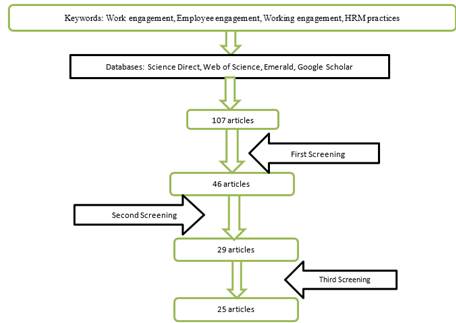
The study is a quantitative in nature. This study has conducted a systematic literature review. It has collected the articles from reliable databases using keywords such as work engagement, working engagement, employee engagement, HRM practices and a combination of these words. As a result, a total of 107 articles were extracted from the literature. Three screenings were conducted to refine the articles and select the most related articles to the topic of this study. the first screening included the outdated articles, non-English and duplicated articles. This has resulted in removing 61 articles. the remining 46 articles were further screened by reading the title and the abstract. this also resulted in removing 17 articles. The third screening were included full reading of the articles. This has resulted in reviewing 25 articles. Figure 1 shows the process of selecting the articles.
Findings
The study reviewed 25 articles. The descriptive information of the studies are presented based on the location of the study, industry, approach, sample size, method, data analysis approach and important factors that affect the work engagement.
Location of the Studies
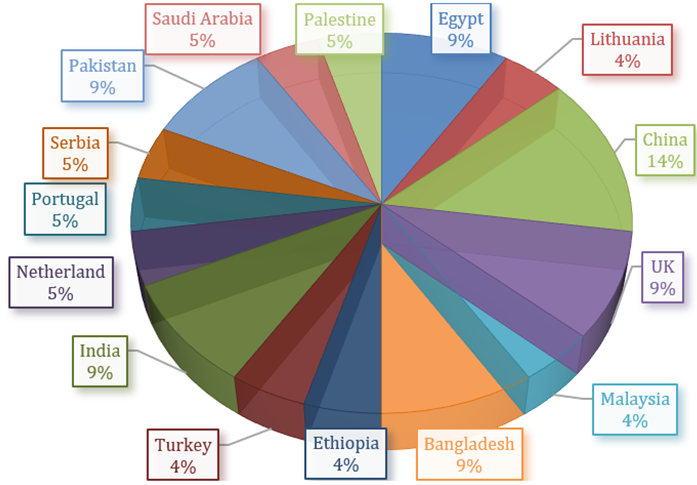
The reviewed studies mostly conducted in developing countries. Highest percentage were conducted in China (14%) followed by Egypt (9%), Pakistan (9%) and Bangladesh (9%). Figure 2 shows the location of the studies.
Table 1: Summary of the Studies
Author/year | Country/industry | I.V. | D.V. | Method | Findings |
[10-21] | The effect of HRM practices on organizational commitment and job satisfaction as well as job performance. | HRM practices
|
| Quantitative | There are mixed findings regarding the effect of HRM on organizational commitment, job satisfaction and performance. |
[22-33] | The effect of HRM practices on work engagement | HRM Practices |
| Quantitative | There are mixed findings regarding the components of HRM practices on work engagement. |

Figure 1: The process of selecting the articles

Figure 2: Location of the Studies
Industries
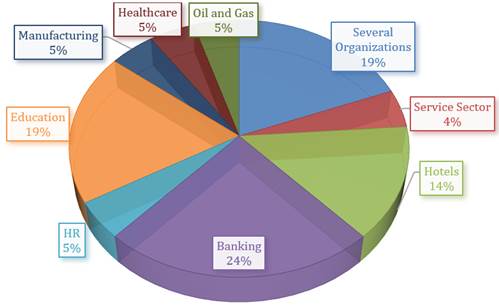
The reviewed studies were conducted in several industries. Highest number of studies were conducted in banking sector (24%) followed by education (19%). Some studies were conducted on several sectors and organizations and they account for 19% of the reviewed studies. Hotels received 14% of the reviewed studies. Figure 3 shows the industries of the reviewed studies.
Approach of the Review Studies
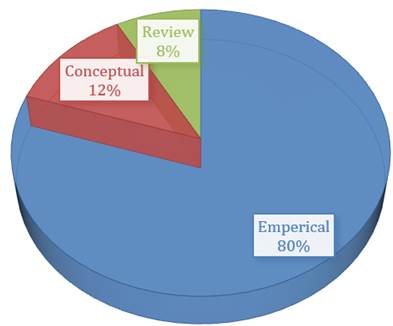
Among the 25 reviewed articles, there are 20 empirical studies accounted to 80% of the articles. A total of 12% are conceptual studies attempted to develop a conceptual framework while 8% of the studies are reviewed studies Figure 4 shows the approach of the studies.
Sample Size and Analytical Tools
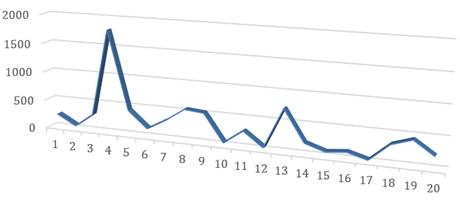
Among the 20 empirical studies, the sample size of the reviewed studies ranged between 1796 and 36 respondents with mean of 348 respondents for all the studies. This reflected the use of different analytical methods in the data analysis. Figure 5 shows the sample size of the reviewed studies.
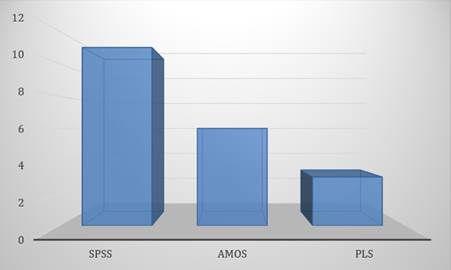
Majority (55%) of the 20 articles were analysed using Statistical package for Social Science (SPSS). AMOS or analysis of the moment structure was deployed in 30% of the articles. The use of Partial Least Square (PLS) was in 15% of the reviewed articles. Figure 6 shows the analytical tools of the reviewed studies.

Figure 3: Industries of the Studies

Figure 4: Approach of the Studies

Figure 5: Sample Size

Figure 6: Analytical Tools
Relationship between HRM Practices and Work Engagement
The relationship between HRM practices and Work engagement based on the reviewed studies is confirmed to be positive between the main construct HRM practices and work engagement [13] [23]. However, when it comes to the components of HRM practices, the relationship is mixed. For instance, the service training and performance appraisal were significant predictor or work engagement but service reward and information sharing were not [22]. Other studies found that the certain practices of HRM has significant effect on work engagement while other has insignificant effect [29].
Limitation and Future Work
This study was conducted by reviewing 25 articles. The articles was extracted from reliable databases. The study set a timeframe between 2010 to 2020. As a way for future work, more studies are recommended to be conducted to examine the effect of HRM practices on work engagement in different countries. The findings showed that china has the highest number of articles. More studies in south Asian countries and Middle Eastern countries are needed. The findings showed that the studies focused on banking and education sector. More studies are needed in other industries such as the manufacturing industry and healthcare industries. The need for work engagement is high during the COVID19. It is important for current studies to examine the link between HRM practices and work engagement in the healthcare sector.
The studies were mainly empirical using quantitative approach. More studies using mixed method or qualitative studies are needed. This can be conducted using interview or focus group where experts can be interviewed and conclusion can be made. Most of the previous studies deployed SPSS which is the first generation of data analysis. Recent and advanced second generation data analysis tools such as AMOS and PLS are less used in the literature. Thus, it is recommended for future studies to deploy the AMOS or PLS and include intervening variables. Important intervening variable such as trust and nepotism can be a direction for future work.
This study was conducted to examine the state of the art in the relationship between HRM practices and work engagement. The study reviewed the related articles using systematic literature review. The findings showed that there is variation in the number of studies among countries with banking and education sector received more studies compared with other sectors. Empirical studies are more than other conceptual and review studies and more review studies are needed. The use of first generation data analysis is prevalent and more complex analytical tools are recommended by including intervening variables.
Benlahcene, A., et al. "Personal Best Goals: Do They Mediate the Relationship between Teacher Autonomy Support and Student Engagement?" Malaysian Journal of Learning and Instruction, vol. 17, no. 1, 2020, pp. 25–49.
Li, S., et al. "Automated Detection of Cognitive Engagement to Inform the Art of Staying Engaged in Problem-Solving." Computers and Education, vol. 163, 2021, p. 104114.
Zhou, X., et al. "Visitor Engagement, Relationship Quality and Environmentally Responsible Behavior." International Journal of Environmental Research and Public Health, vol. 17, no. 4, 2020, p. 1151.
Samsudin, N., et al. "The Relationship Between Leadership Styles and Academician Job Satisfaction at a Public University in Malaysia." National Academy of Management Staff Culture ARTS Heritage, no. 1, 2018, pp. 1117–1120.
Alias, E.S., et al. "The Moderating Effect of Supervisor Support on Flexible Working Arrangement and Work-Family Conflict Relationship: A Conceptual Paper." International Business Education Journal, vol. 13, 2020, pp. 51–63.
Abd Razak, A.Z.A., et al. "Social Support Moderating Effect between Work-Family Conflict and Health and Stress of Working Students in UPSI." International Business Education Journal, vol. 12, 2019, pp. 25–38.
Robinson, D., et al. “The Drivers of Employee Engagement. Institute for Employment Studies, 2004.
Kahn, W.A. "Psychological Conditions of Personal Engagement and Disengagement at Work." Academy of Management Journal, vol. 33, no. 4, 1990, pp. 692–724.
Schaufeli, W.B. and A.B. Bakker. "Defining and Measuring Work Engagement: Bringing Clarity to the Concept." Work Engagement: A Handbook of Essential Theory and Research, vol. 12, 2010, pp. 10–24.
Savaneviciene, A. and Z. Stankeviciute. "Human Resource Management Practices Linkage With." Economics and Management, vol. 16, 2011, pp. 921–928.
Duque-Escobar, P.G. "Conceptual Framework on the Relationship Between Human Resource Management Practices, Job Satisfaction and Turnover." Journal of Economics and Behavioral Studies, vol. 2, no. 2, 2011, pp. 41–49.
Li, X., et al. "How Leader-Member Exchange, Work Engagement and HRM Consistency Explain Chinese Luxury Hotel Employees’ Job Performance." International Journal of Hospitality Management, vol. 31, no. 4, 2012, pp. 1059–1066.
Alfes, K., et al. "The Relationship Between Line Manager Behavior, Perceived HRM Practices and Individual Performance: Examining the Mediating Role of Engagement." Human Resource Management, vol. 52, no. 6, 2013, pp. 839–859.
Kreitner, R. and A. Kinicki. "Measurement of Employee Job Satisfaction." Proceedings of 11th Asian Business Research Conference 26-27 December 2014, BIAM Foundation, 2014.
Ijigu, A.W. "The Effect of Selected Human Resource Management Practices on Employees’ Job Satisfaction in Ethiopian Public Banks." Emerging Markets Journal, vol. 5, no. 1, 2015, pp. 1–16.
Qazi, S. and V. Jeet. "Impact of Prevailing HRM Practices on Job Satisfaction: A Comparative Study of Public and Private Higher Educational Institutions in India." International Journal of Business and Management, vol. 12, no. 1, 2016, p. 178.
Khanna, P. and M.M. Sehgal. "A Study of HRM Practices and Its Effect on Employees’ Job Satisfaction in Private Sector Banks with Special Reference to ICICI Banks in Ludhiana." International Journal of Management, vol. 4, no. 7, 2016, pp. 36–43.
Božović, J., et al. "Impact of HRM Practices on Job Satisfaction of Employees in Serbian Banking Sector." Management Sustainable Business Management Solutions in Emerging Economies, vol. 24, no. 1, 2019, p. 63.
Manzoor, F., et al. "An Examination of Sustainable HRM Practices on Job Performance: An Application of Training as a Moderator." Sustainability, vol. 11, no. 8, 2019, pp. 1–19.
Sobaih, A.E.E., et al. "Unlocking the Black Box: Psychological Contract Fulfillment as a Mediator Between HRM Practices and Job Performance." Tourism Management Perspectives, vol. 30, 2019, pp. 171–181.
Cherif, F. "The Role of Human Resource Management Practices and Employee Job Satisfaction in Predicting Organizational Commitment in Saudi Arabian Banking Sector." International Journal of Sociology and Social Policy, 2020.
Suan, C.L. and A.M. Nasurdin. "An Empirical Investigation into the Influence of Human Resource Management Practices on Work Engagement: The Case of Customer-Contact Employees in Malaysia." International Journal of Culture, Tourism and Hospitality Research, vol. 8, no. 3, 2014, pp. 345–360.
Aybas, M. and A.C. Acar. "The Effect of HRM Practices on Employees’ Work Engagement and the Mediating and Moderating Role of Positive Psychological Capital." BAM2015 Conference Proceedings, vol. 7, 2015, pp. 363–372.
Ahmaed, S., et al. "HRM Practices-Engagement-Performance Relationships: A Conceptual Framework for RMG Sector in Developing Economy." Mediterranean Journal of Social Sciences, vol. 7, no. 4, 2016, pp. 2039–9340.
Bakker, A.B. "Strategic and Proactive Approaches to Work Engagement." Organizational Dynamics, vol. 46, no. 2, 2017, pp. 67–75.
Yang, F., et al. "Bridging the Gap: How Supervisors’ Perceptions of Guanxi HRM Practices Influence Subordinates’ Work Engagement." Applied Psychology, vol. 67, no. 4, 2018, pp. 589–616.
Meijerink, J., et al. "How Employees’ Proactivity Translates High-Commitment HRM Systems into Work Engagement: The Mediating Role of Job Crafting." International Journal of Human Resource Management, vol. 31, no. 22, 2018, pp. 2893–2918.
Mozael, B.M. and D.N. Samsudin. "Review of the Role of the Transparency Commitment of Human Resource Practices in Employee Satisfaction in the Banking Sector." International Journal of English Literature and Social Sciences, vol. 4, no. 5, 2019, pp. 1307–1314.
Memon, M.A., et al. "Satisfaction Matters: The Relationships Between HRM Practices, Work Engagement and Turnover Intention." International Journal of Manpower, 2020.
Aboramadan, M. "The Effect of Green HRM on Employee Green Behaviors in Higher Education: The Mediating Mechanism of Green Work Engagement." International Journal of Organizational Analysis, 2020.
Soares, M.E. and P. Mosquera. "Fostering Work Engagement: The Role of the Psychological Contract." Journal of Business Research, vol. 101, 2019, pp. 469–476.
Zhang, L., et al. "How Perceived Empowerment HR Practices Influence Work Engagement in Social Enterprises: A Moderated Mediation Model." International Journal of Human Resource Management, vol. 29, no. 20, 2018, pp. 2971–2999.