The study explores the perceptions of Indonesian teachers in the EFL classroom using Zone of Proximal Developmentin Englishteaching. This study employs a descriptive study using the purposive sampling technique. The participants are teachers of an Islamic UniversityinMakassar metropolitan area- Indonesia. The questionnaire and interview were used to collect data on perceptions of EFL teachers in using Zone of Proximal Developmentin teaching English poetry to their universities students. The observation was applied to gain the data on the EFL teacher’s teaching practices in implementing the Zone of Proximal Developmentin teaching English poetry. The results of the study demonstrate that there were marked differences in the way the teachers perceive Zone of Proximal Developmentin teaching Englishpoetry. The differences fall into 3 categories: (1) Zone of Proximal Development Meta Perception (2) Zone of Proximal Development Macro Perception and (3) Zone of Proximal Development Micro Perception. This study expects to be a beneficial reference for English poetry teachers, the government, and other literature practitioners.
Keywords
Zone of Proximal Development
Poetry
Teachers’ perceptions
INTRODUCTION
Teaching literature in non-native countries or a place where this language is considered a foreign language is a complex problem. It has a range of variations in terms of its cultures. The aforementioned problems contribute to the complicated learning process due to its different cultural views. The problem will remain to grow up while it is found that the students do not have proper English competencies. One reason behind this is that because mostly they learn English intensively while they come and choose the English department in the university. Perhaps, some students have good ability in English but mostly they do not have it. Thus, the students will struggle hard to master their basic skills in English at the beginning of the learning process at university. Based on Indonesia's higher education curriculum, it needs two or three semesters to sharpen students ' English basic skills. Then, starting in the 4th semester they will begin to learn or to introduce the reading about the literature, including English poetry.
The challenges encountered by poetry lectures today are instead of only focusing on preparing students to pass the exams, the goal of learning poetry should be returned to its original essence namely the achievement of literary competence in the form of accessing the cultural background of the poem, encouraging language acquisition, expanding opportunities for independent learning, developing students ' interpretative abilities and imaginative capabilities.
The primary goal of teaching literature at UINAM (Universitas Islam Negeri Alauddin Makassar-Indoensia), faculty of Adab and Humaniora, English literature study program is to familiarize students with a variety of literary genres and, in turn, introduce them to the social, cultural, literary and intellectual backgrounds of other countries especially English speaking countries. Although lecturers' approaches to literature differ somewhat from one another, a common theme may be found. The majority of the class's valuable time is often spent on the "extrinsic" qualities of literary works, which transfer biographical, historical, aesthetic and philosophical knowledge to the pupils. This is known as the "conventional method" to teaching poetry. This present study explored more about how lecturers’ of poetry in this particular setting approach English poetry subject by adapting the notion of Zone of Proximal Development.
Theoretical Concepts
The Zone of Proximal Development (ZPD), according to Vygotsky, is the gap between a child's "actual developmental level as determined by independent problem solving" and a higher level of "potential development as determined by problem solving" with the help of more competent peers or with adult supervision. Vygotsky's viewpoint on the function of instruction and assessment in general is reflected in this statement. The topic of his investigation was how learners develop. The "dynamic assessment" skill set has been instilled with the emphasis on process as well as product in evaluation. Vygotsky's conceptual map that comes after and is associated to it are primarily founded on the fundamental genetic rule of cultural evolution. The ZPD creates a setting in which the social and the individual can interact. The so-called "psychological instruments" (especially speech) and signs play a mediational function in the ZPD [1].
Au [2] have emphasized, Vygotsky claimed that learning is formed through the ZPD, which creates a dialectic unity of learning-and-development, rather than students’ stages of development setting a precondition (i.e., of ‘readiness’) for their learning (as in Piaget’s theories). In Vygotsky’s theory, language acquisition provides the paradigm case of learning leading development, because in this activity the aspirant speaker must “borrow” the knowledge and consciousness of the tutor to enter a language through the fundamentally human process of meaning-making in collaborative activity with other members of the culture.
Though Vygotsky did not mention the existence of a ZPD for innovation, recent empirical findings on the amplification and decrease of encouraging creativity based on the social capacities of creative endeavors suggest that such an event is at play. An empirical illustration of a ZPD-like pattern in students' original thought, together with a more comprehensive theoretical reinterpretation of creativity as being highly adjustable. This work may help educational psychology grasp this important construct more fully in the present and in the future. Researchers specifically use a Vygotskian philosophical viewpoint and a personal data analysis method in the current study to find that pupils substantially differ from one another in terms of the width of their ZPD creativity-relevant because these trends in ZPD could be used to acknowledge conscious and unconscious profile information of creative students [2].
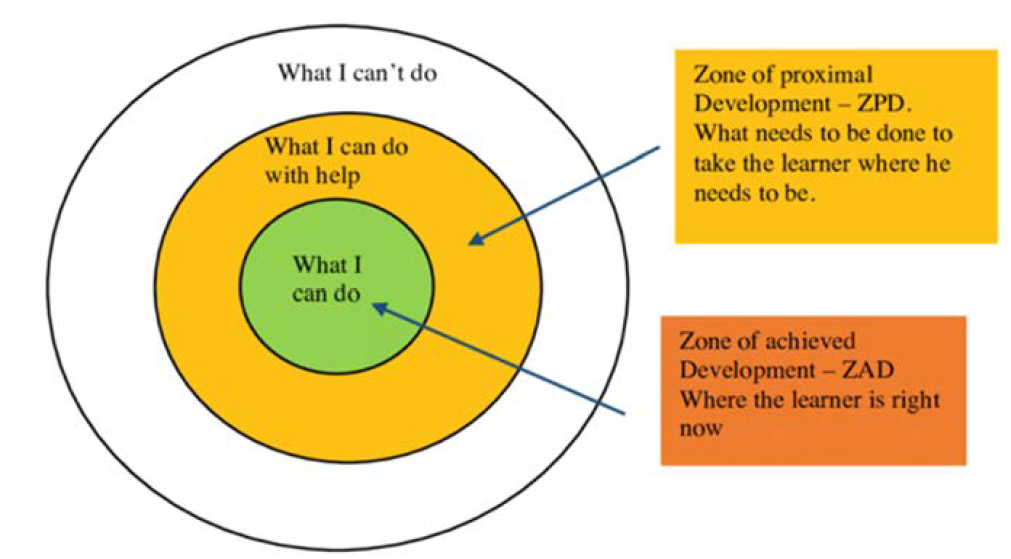
Figure 1 shows that each student has two ability zones. Zone of Proximal Development (ZPD) where students can do anything with help and Zone of Achieved Development (ZAD) where students can do anything without any help. The problem-solving zone independently will be owned by students when the help zone is passed well. When interacting with the social environment, other learning actors including lecturers and their friends, students get the help that directs them to achieve independence, then these students will reach the zone of achievement. This achievement zone is a zone where students have been able to solve problems or construct knowledge without any help from the lecturer or their friends.
ZPD heavily relies on social contact between students and adults. According to Pransky and Bailey [4] as providing the following justification for this interaction: initially in the company of others, but later he can do it alone. The internalization process happens in stages: initially, the adult plans and supervises the kids' activities, but with time, the adult and the students start to collaborate on problem-solving, with the children taking the lead while the adult supervises and checks at the same time. They are not smooth pupils. In the end, the adult relinquishes control of the arrangements to the pupils and his role is now essentially that of a sympathetic and encouraging listener. Scaffolding refers to the arrangements and direction given by adults or more experienced peers.
A concept associated with the ZPD is “scaffolding,” which was first used by Vygotsky and Luria in reference to how adults introduce children to cultural means [5] and was later popularized by Bruner as a metaphor for a mother’s verbal efforts to maintain conversation with a child and, indirectly, to promote language acquisition. According to Smagorinsky [6], the mother’s scaffolding behavior is characterized by five important features: (a) reducing the complexity of the task, (b) getting the child’s attention and keeping it focused, (c) offering models, (d) extending the scope of the immediate situation and (e) providing support so that the child moves forward and does not slip back.
And then, based on the research of Chang-Kredl and Kingsley [8] and Murray et al. [9], they found that teachers who want to adapt the notion of ZPD in their classroom should refer to the following concepts:
Activities in the classroom consist of 80% of free activity and 20% of teacher-led activities
Doing various tasks that encourage thinking about social relationships
Offering opportunities for social relationships through free interaction
The arguments are found by learners, not presented by the teacher
The pronunciation rules are obtained through pattern recognition, not by memorizing every aspect of the curriculum involving thought
Figure 1: Process of Zone of Proximal Development [7]
METHODOLOGHY
The research pedagogy used in this study is a qualitative approach. Creswell said that the qualitative approach aims to explore and understand the issues of individuals or groups such as behavior, motivation and action [10]. This study used an online class observations aimed at teachers’ perceptions towards the application of ZPD in teaching English poetry. The survey was conducted on 5 English poetry teachers at English poetry class in English literature study program of UINAM-Indonesia. In collecting data, the researcher used an online questionnaire by using Google form, online class observation, online in-depth interviews and documentation. The questionnaire was used to obtain teachers' understanding of ZPD and then observation and video recordings are used in the learning process. In-depth interviews were used to obtain more information about the teachers' perceptions toward the ZPD in teaching English poetry.
RESULT AND DISCUSSION
The response of the 20 statements was categorized into two categories of perceptions on ZPD in poetry teaching. The categories are (A) dependence; (B) opportunities for social relationship.
Dependence
By applying ZPD in teaching, teachers looked like an independent adult or independent teachers who knows the class well. They knew the potential of their students through good introduction and approach. Take a look at the collections of conversation quotes (Table 1).
Table 1: Teachers interview report
No.
Categories
Statements
1
Dependence
Sebagai guru, saya bertindak sebagai pengelola yang mengatur tata tertib pembelajaran puisi tanpa mengganggu proses diskusi siswa.
2
Saya berperan sebagai pemimpin di kelas dan siswa bertindak sebagai pemilik kelas.
Untuk mendekatkan siswa dengan puisi, kegiatan di kelas puisi diisi dengan kegiatan yang membebaskan siswa untuk melakukan kegiatan yang mendukung pengenalan sensorik
Yang saya pahami tentang ZPD adalah guru tidak bisa hanya datang untuk mengajar dan pulang, tetapi guru harus memiliki kedekatan yang baik dan profesional dengan siswanya. Ingat, secara profesional dan terukur.
Guru adalah sosok yang mandiri dan mandiri, ia bebas menentukan metode yang digunakannya dalam mengajar, meski kembali digarisbawahi harus terukur dan profesional.”
3
Opportunities for Social Relationship
Saya memberi siswa waktu 30-45 menit untuk membaca puisi yang diberikan secara mandiri
4
Setelah 30 menit, saya membimbing siswa untuk membaca puisi dan menanyakan pendapat atau kesulitan mereka dalam memahami kata-kata.
5
Siswa dapat berdiskusi dengan teman sekelas atau teman yang mereka pilih tentang puisi
6
Siswa menemukan bahwa beberapa temannya memiliki pendapat yang berbeda tentang puisi tersebut
7
Dalam proses diskusi, siswa saling menghargai tentang perbedaan pendapat yang muncul terkait puisi yang diberikan
8
Sebagai guru, saya memberikan banyak kesempatan kepada siswa untuk mengungkapkan pendapatnya tentang puisi yang sedang dibahas
One feature of learning with adaptation of ZPD is the portion of activity within the classroom should be divided into 80% of free activity and 20% of teacher-led activity. It means that students must be given more freedom in expressing their ideas and opinion about the lesson or the topic given by the teacher. The teacher must limit his/her portion during the learning process and can be acted as the manager or the leader of the class. There are three (3) statements (no. 2-4) related to this and approved or fully agreed by 3 teachers (60%), answered doubtfully by 1 teacher (20%) and is not approved by 1 teacher (20%).
During the class observation session, the researchers observed how the teacher implemented this ZPD notion feature in teaching. The teacher who agreed with this statement seemed to be more prepared and performed guidance and material introduction about the poem at the beginning of the session in about 20 minutes. The poems chosen are animal-themed poems with serious but fun experiences. The theme of poems given to students must be that pleasing them, close to their lives and they can do what they find in poetry. One type of poem suitable for students is limerick [11]. Limerick is suitable for sudents in any age because of its unique composition, it only has 5 lines and has a unique rhyme or sound equation so it is easy to create and interesting to read. Consider the example of the old limerick poem (Figure 2).
Figure 2: The Old Limerick
This limerick describes the tale of a rat who enjoys playing around a wall clock that a cat is watching over. Due to its intriguing rhymes and relevance to our daily lives, this particular style of limerick is also frequently employed in teaching pupils fundamental mathematics [11]. The teacher read the poem Hickory Dickory dock in front of the students asking them to create any ways to perform the lyric dramatically by combining gestures, mimics, voice changes and intonation to attract students ' attention. The planned 30 minutes for the introduction of English poetry is still unfinished, but the students have participated in poetry readings either in the form of following their friends mimic and laughing together, following the movement of the teacher, or by pretending to be a children and some version of the mouse.
One teacher (20%) did not approve and one teacher (20%) was hesitant to carry out activities that had a higher proportion of free activities and a lower proportion of instructor-led activities. The two teachers used various activities while adopting ZPD characteristics in the classroom when the researchers watched their classes. The instructor who objected to the 80:20 ratio of the class activity taught poetry using reading pedagogy, gave out papers with a brief essay on the subject and asked the students to debate it in pairs. On the other hand, the instructor who was hesitant to carry out this 80:20 section of the class exercise performed similarly to the three instructors who agreed with this assertion, yet according to the researchers' observations,she was not so enthusiastic about attracting students' attention to find out the poetry and did not present the story behind the poem to her students that will be very useful in guiding and attracting students' interest.
Opportunities for Social Relationship
Students need to move and teachers need to give them the opportunity to explore their environment to build social relationships. This is important particularly for students in big city who are traditionally viewed as highly active and this fact is in line with studies conducted in the United States and the United Kingdom that found that students engage in relatively little moderate to vigorous intensity physical activity [12].
One of the key point for the establishment of a ZPD over the semester was the constant attention to offer or facilitate emotional attachment to give teachers and students the opportunity to build social relations. Building a social relationship with students is important to prepare them to face real life with different types of human characters and social classes. The more frequently the students interact with other people the more socially competent they will be. A study has shown that socially competent students will be more academically successful while poor social skills are a strong predictor of academic failure [13,14].
Questions or statements related to this were number 5 to number 10. When the questions or statements that lead to the role of the ZPD in giving the students opportunity to socialize through teaching poetry were given to teachers, 4 of the teachers (80%) agreed to the statement but there was 1 teacher (20%) who doubts about this. This pedagogy does not restrict children from socializing and interacting freely with other students. This was seen in the observation session when the teacher demonstrated how to perform and discuss about a poem entitled a sick rose by William Blake (Figure 3-4).
Mr. Xa :“baik,silahkan kelompok William blake, waktu anda 10 menit untuk membagi pengetahuan anda.”
Samira :“baik, sir. Teman-teman, kami menemukan bahwa William blake sering menggunakan figurative language jenis symbol, metaphor serta menggunakan diksi yang sederhana agar pembacanya langsung memahami apa yang ingin ia sampaikan.”
Ali :“saya tambahkan, William blake menggunakan Bahasa sederhana bukan karena diksi yang ia ketahui sedikit namun cara ia mendekati pembaca secara sederhana menunjukkan kelas dirinya yang elegan meski berbalut kesederhanaan. “
Mr.Xa : untuk kelompok yang lain. Apakaha ada pendapat tentang topik ini ?
Asma : saya pak,
Mr. Xa : silahkan
Asma : about disloyalty, apakah puisi ini sejalan dengan kutipan Khalil Gibran tentang merelakan ? ( sambil membagikan layar)
Mr. Xa : “wow.. Asma ?sangat menarik . ayooo teman-teman bagaimana tanggapan anda tentang ini.”
Samira : “menurut saya secara literal ini tidak berhubungan namun bagi yang pernah merasakan kehilangan karena ada yang tidak setia ( kalimat ini disambut meriah oleh teman-teman kelasnya ) .. ini sangat relevan . “
Crystal :” he he he.. iyaaa relevan sekali. Kita jadi merelakan akibat dari ketidak setiaan. Dan kita tidak akan hidup dalam dampak dari ketidaksetiaan. Dia akan kembali jika dia ditakdirkan untukmu, dia setia dan mau merelakan. “
Bur :” wahhhhh, saya sukaaaaa
These conversations quote illustrated how in a group there was collaboration and social relationship. The teacher opened opportunities for students to open up to differences so that there is indirect interaction and introduction between students. members helped each other and supported what their group mates. Everyone listens to each other and appreciates contributions.
The first feature of ZPD observed in this research is class activity. This pedagogy believes that giving activities to students during the learning process in class will result in an improvement to students. The learning process should be based more on student-centered activities rather than teacher-centered activities. The teacher acts as the leader of the class while the students become the owner of the class. The teacher must ensure that activities in the poetry class are filled with activities that make students feel free to do activities supporting their sensory recognition [15].
From the teachers' response to the questionnaire, most teachers (60%) believe that this notion (ZPD) is suitable to be implemented in class. They agreed that students must be given more portions in class and the teacher should manage or regulate the class to ensure that all students will be active and will express their ideas and opinion accordingly. Based on the teachers' positive respond the researchers did interviews and class observations to confirm their responses. They were very enthusiastic in answering the researchers' questions and in explaining their understanding of the Zone of Proximal Development. They were also very well prepared when practicing this notion in class and their classes were very well managed and running well. The students were also very active during the lesson and enjoyed the class without any psychological pressure.
The teachers who responded “I doubt it” and “I disagree” to the statements seemed difficult to find a specific reason, but tried to explain their choice during the interview and observation sessions. They thought that it was not a good idea to give students more portion of free activities in class because it would make the class very crowded and be very difficult to be controlled. Although they understand that psychologically, students should be encouraged and motivated by giving more activities they love in class, but they thought that the traditional way of teaching (teacher-centered activities) is still better to apply to university students. The researchers continued to observe the class and found that the teachers who doubted and disagreed with the Zone of Proximal
Development teaching concept were not well prepared before coming to the class and they just distributed the poem to the students, asked them to read and memorized some words from the poems.
In terms of building a social relationship, most teachers (80%) agreed to Zone of Proximal Development concept of learning that provided intense interaction between students in class. Only 1 teacher (20%) did not agree, but also did not disagree with the statements. She only doubted the statement to be applied in class. This was proved when the researchers did an interview and continued observing the class. All teachers seemed very well adapted to this notion and they could also manage the students well to build more interaction between students during the poetry lesson. The students were very enthusiastic about following their teacher's instructions. They raced each other to come in front of the class when the teacher asked them to. They also tried to find a partner and share their opinion about the poem with their partner. They learned much about understanding and appreciating friends' opinions. This fact is in line with the goal of what Vygotsky mean by saying independent problem solving and social competence that will be possessed by students when practicing the building of social relationships [12,13,16].
Based on the response of the teachers about their views on ZPD, the researchers divided them into three (3) categories, they are: (1) Zone of Proximal Development Meta Perception, this category is coined to refer to respondents who answered agree with a question or statement submitted. This agreement is also related to ways of teachers facilitated learning process independently and do not merely concentrate on the transmission of knowledge; (2) Zone of Proximal Development Macro Perception, this category is coined to refer to respondents who answerany doubt about the questions or statements submitted. This choice of doubt to accommodate the teachers’ response in the teaching of poetry remains the notion of ZPD without having more knowledge or special training in the teaching of poetry. The third category is (3) Zone of Proximal Development Micro Perception this category is coined to refer to respondents who answered disagree with the proposed questions or statements. This disapproving answer describes the teacher's response whose teaching in English poetry still often uses traditional and teacher-centered pedagogy rather than the notion of ZPD in teaching students. They in this category basically know about the ZPD concept but do not fully understand this concept, so they assume that giving students free activities in class will limit the teachers' control and give super power to students.
CONCLUSION
The current study concludes that 3 showed a positive perception towards the application of ZPD in teaching English poetry to university students. There is still one teacher who has doubts about the positive effects of this pedagogy, but still use this pedagogy in the classroom and there is also one teacher who disagree with the application of this pedagogy and choose to use other pedagogy because they do not see the role of teachers in the notion of ZPD. Therefore, this study concludes that the better the teacher's perception of ZPD, the more things that can be taught through the ZPD concept and the more opportunities for students to socialize with literary works in groups, their understanding will develop.
Further research on the use of ZPD as a teaching concept in English poetry class and other literary works for university students is still necessary. The teacher's impression in applying this pedagogy should be further investigated. It is recommended for teachers as suggested by Robertsonet al. [17] that teachers should have early knowledge of the norm of student behavior and historical background before teaching English, the ZPD needs to pay attention to this. There are learning devices in this notion that serve to resolve conflicts in the classroom that often occur because of the lack of cultural and historical understanding that teachers have. The students’ social experience of receiving this notion also needs to be researched. How far this notion gives students social experience in English language learning and how far an English teaching strategy can guide students to be good people as affirmed by Chung and Wei [18] about ELT ought to consolidate moral and ethical values in arranging strategies to move forward learners’ involvement and give the wealthier learning environment.
Acknowledgment
We thank English literature study program of UINAM Makassar-Indonesia for the support of our research at their institution. We also really appreciate the support of our friends for the 2019 batch of the English education doctoral program at Universitas Negeri Makassar (UNM)-Indonesia.
REFERENCE
Vygotsky, L.S. et al.The Cambridge Companion to Vygotsky. Choice Reviews Online, vol. 45, no. 4, 2007. https://doi.org/ 10.5860/choice.45-2312.
Au, K.H. “Social constructivism and the school literacy learning of students of diverse backgrounds.” Journal of Literacy Research, vol. 30, no. 2, 1998, pp. 297-319. https://doi.org/10.1080/10862969809548000.
Bakri, F. et al. “Zone of proximal development in teaching English poetry: An overview in Indonesian higher education.” NSPBI, vol. 1, 2022, pp. 296-302.
Pransky, K. and F. Bailey. “To meet your students where they are, first you have to find them: Working with culturally and linguistically diverse at-risk students.” The Reading Teacher, vol. 56, no. 4, 2002, pp. 370-383. https://doi.org/10.1598/rt.56.4.3.
Daniels, H. An Introduction to Vygotsky. Edited by H. Daniels, Taylor & Francis, 2002. https://doi.org/10.4324/9780203 434185.
Smagorinsky, P. “Is instructional scaffolding actually Vygotskian, and why should it matter to literacy teachers?” Journal of Adolescent and Adult Literacy, vol. 62, no. 3, 2018, pp. 253-257. https://doi.org/10.1002/jaal.756.
Gallimore, R., and R. Tharp. “Teaching mind in society: Teaching, schooling, and literate discourse.” Vygotsky and Education, Aug. 1990, pp. 175-205. https://doi.org/10. 1017/cbo9781139173674.009.
Chang-Kredl, S. and S. Kingsley. “Identity expectations in early childhood teacher education: Pre-service teachers’ memories of prior experiences and reasons for entry into the profession.” Teaching and Teacher Education, vol. 43, 2014, pp. 27-36. https://doi.org/10.1016/j.tate.2014. 05.005.
Murray, A. et al.Journal of Montessori Research. American Montessori Society, vol. 5, no. 1, 2019, pp. 1-8. https://doi. org/10.1109/elektro.2018.8398244.
Ishtiaq, M. “Book review: Creswell, J.W. (2014). Research design: Qualitative, quantitative and mixed methods approaches (4th ed.).” English Language Teaching, vol. 12, no. 5, 2019, p. 40. https://doi.org/10.5539/elt.v12n5p40.
Tarnogórska, M. “‘Funny’ and ‘curious’ verse: The limerick in Polish children’s literature.” Bookbird: A Journal of International Children’s Literature, vol. 53, no. 3, 2015, pp. 37-45. https://doi.org/10.1353/bkb.2015.0062.
Trost, S.G. et al. “Feasibility and efficacy of a ‘move and learn’ physical activity curriculum in preschool children.” 2008, pp. 88-103.
Webster-Stratton, C. and M.J. Reid. “Strengthening social and emotional competence in infants and young children.” Infants and Young Children, vol. 17, no. 2, 2004, pp. 96-113.
Rezaei, S. and M.A. Meshkatian. “Iranian teachers’ attitude towards using social media and technology to increase interaction amongst students inside or outside the classroom.” Theory and Practice in Language Studies, 2017. https://doi.org/10.17507/tpls.0706.02.
Zoglowek, H. “Motor learning in the zone of proximal development.” Contributions to the Development of the Contemporary Paradigm of the Institutional Childhood, May 2017.
Azi, Y. “Scaffolding and the teaching of writing within ZPD: Doing scaffolded writing (a short case study).” International Journal of Linguistics, vol. 12, no. 3, 2020, p. 105. https://doi. org/10.5296/ijl.v12i3.14044.
Robertson, P. et al. The Asian EFL Journal Professional Teaching Articles. 2016, http://www.elejournals.com.
Chung, J.H.J. and X. Wei. “Teach effectively or guide wisely? Discussing the application of wisdom approach to language teaching in Thai higher education.” International Journal of Language Education, vol. 4, no. 3, 2020, pp. 322-333. https://doi.org/10.26858/ijole.v4i3.15097.
License
Creative Commons Attribution-NonCommercial-NoDerivatives 4.0 International License
All papers should be submitted electronically. All submitted manuscripts must be original work that is not under submission at another journal or under consideration for publication in another form, such as a monograph or chapter of a book. Authors of submitted papers are obligated not to submit their paper for publication elsewhere until an editorial decision is rendered on their submission. Further, authors of accepted papers are prohibited from publishing the results in other publications that appear before the paper is published in the Journal unless they receive approval for doing so from the Editor-In-Chief.
Himalayan Journal of Education and Literature open access articles are licensed under a Creative Commons Attribution-Share A like 4.0 International License. This license lets the audience to give appropriate credit, provide a link to the license, and indicate if changes were made and if they remix, transform, or build upon the material, they must distribute contributions under the same license as the original.
Recommended Articles
Research Article
Perceptions of Adolescent Pregnancy and Early Motherhood
Lucy Fonjong Udikoh,
Tamfuchia Ferdinard Baba
Published: 30/12/2020
Download PDF
Cite
x
APA
Fonjong Udikoh, L. & Ferdinard Baba, T. (2020). Perceptions of Adolescent Pregnancy and Early Motherhood. Himalayan Journal of Education and Literature, 1(1), 1-7.
MLA
Fonjong Udikoh, Lucy and Tamfuchia Ferdinard Baba. "Perceptions of Adolescent Pregnancy and Early Motherhood." Himalayan Journal of Education and Literature 1.1 (2020): 1-7.
Chicago
Fonjong Udikoh, Lucy and Tamfuchia Ferdinard Baba. "Perceptions of Adolescent Pregnancy and Early Motherhood." Himalayan Journal of Education and Literature 1, no. 1 (2020): 1-7.
Harvard
Fonjong Udikoh, L. and Ferdinard Baba, T. (2020) 'Perceptions of Adolescent Pregnancy and Early Motherhood' Himalayan Journal of Education and Literature 1(1), pp. 1-7.
Vancouver
Fonjong Udikoh L, Ferdinard Baba T. Perceptions of Adolescent Pregnancy and Early Motherhood. Himalayan Journal of Education and Literature. 2020 Jul;1(1):1-7.
Download PDF
Research Article
Interaction of Modern Literature-Paintings and Poetry, Storytelling, Literature
Jackline Njeri Murimi
Published: 27/01/2021
Download PDF
Cite
x
APA
Njeri Murimi, J. (2021). Interaction of Modern Literature-Paintings and Poetry, Storytelling, Literature. Himalayan Journal of Education and Literature, 2(1), 1-5.
MLA
Njeri Murimi, Jackline. "Interaction of Modern Literature-Paintings and Poetry, Storytelling, Literature." Himalayan Journal of Education and Literature 2.1 (2021): 1-5.
Chicago
Njeri Murimi, Jackline. "Interaction of Modern Literature-Paintings and Poetry, Storytelling, Literature." Himalayan Journal of Education and Literature 2, no. 1 (2021): 1-5.
Harvard
Njeri Murimi, J. (2021) 'Interaction of Modern Literature-Paintings and Poetry, Storytelling, Literature' Himalayan Journal of Education and Literature 2(1), pp. 1-5.
Vancouver
Njeri Murimi J. Interaction of Modern Literature-Paintings and Poetry, Storytelling, Literature. Himalayan Journal of Education and Literature. 2021 Jan;2(1):1-5.
Download PDF
Research Article
The Effect of Web Quest on the Achievement of Fifth Grade Literary Students in Philosophy and Psychology
Muntasser Mohammed Nada
Published: 30/05/2024
Download PDF
Cite
x
APA
Nada, M. M. (2024). The Effect of Web Quest on the Achievement of Fifth Grade Literary Students in Philosophy and Psychology. Himalayan Journal of Education and Literature, 5(1), 1-39.
MLA
Nada, Muntasser M.. "The Effect of Web Quest on the Achievement of Fifth Grade Literary Students in Philosophy and Psychology." Himalayan Journal of Education and Literature 5.1 (2024): 1-39.
Chicago
Nada, Muntasser M.. "The Effect of Web Quest on the Achievement of Fifth Grade Literary Students in Philosophy and Psychology." Himalayan Journal of Education and Literature 5, no. 1 (2024): 1-39.
Harvard
Nada, M. M. (2024) 'The Effect of Web Quest on the Achievement of Fifth Grade Literary Students in Philosophy and Psychology' Himalayan Journal of Education and Literature 5(1), pp. 1-39.
Vancouver
Nada MM. The Effect of Web Quest on the Achievement of Fifth Grade Literary Students in Philosophy and Psychology. Himalayan Journal of Education and Literature. 2024 Jan;5(1):1-39.
Download PDF
Research Article
The Effect of Practicing Critical Thinking Skills on Undergraduates English Learners: Teachers’ Perspective
Azza Elmadani,
...
Shiraz Al-Ali
Published: 15/03/2026
Download PDF
Cite
x
APA
Elmadani, A., Hussein, J. A. T. & Al-Ali, S. (2026). The Effect of Practicing Critical Thinking Skills on Undergraduates English Learners: Teachers’ Perspective. Himalayan Journal of Education and Literature, 7(1), 1-5.
MLA
Elmadani, Azza, Jehan Adli Tawfig Hussein and Shiraz Al-Ali. "The Effect of Practicing Critical Thinking Skills on Undergraduates English Learners: Teachers’ Perspective." Himalayan Journal of Education and Literature 7.1 (2026): 1-5.
Chicago
Elmadani, Azza, Jehan Adli Tawfig Hussein and Shiraz Al-Ali. "The Effect of Practicing Critical Thinking Skills on Undergraduates English Learners: Teachers’ Perspective." Himalayan Journal of Education and Literature 7, no. 1 (2026): 1-5.
Harvard
Elmadani, A., Hussein, J. A. T. and Al-Ali, S. (2026) 'The Effect of Practicing Critical Thinking Skills on Undergraduates English Learners: Teachers’ Perspective' Himalayan Journal of Education and Literature 7(1), pp. 1-5.
Vancouver
Elmadani A, Hussein JAT, Al-Ali S. The Effect of Practicing Critical Thinking Skills on Undergraduates English Learners: Teachers’ Perspective. Himalayan Journal of Education and Literature. 2026 Jan;7(1):1-5.
Bakri, F., Wello, M. B. & Dollah, S. (2023). Zone of Proximal Development in the Teaching of English Poetry to Indonesian EFL Learners: Teachers' Perceptions. Himalayan Journal of Education and Literature, 4(1), 1-7.
MLA
Bakri, Fitriyani, M. B. Wello and Syarifuddin Dollah. "Zone of Proximal Development in the Teaching of English Poetry to Indonesian EFL Learners: Teachers' Perceptions." Himalayan Journal of Education and Literature 4.1 (2023): 1-7.
Chicago
Bakri, Fitriyani, M. B. Wello and Syarifuddin Dollah. "Zone of Proximal Development in the Teaching of English Poetry to Indonesian EFL Learners: Teachers' Perceptions." Himalayan Journal of Education and Literature 4, no. 1 (2023): 1-7.
Harvard
Bakri, F., Wello, M. B. and Dollah, S. (2023) 'Zone of Proximal Development in the Teaching of English Poetry to Indonesian EFL Learners: Teachers' Perceptions' Himalayan Journal of Education and Literature 4(1), pp. 1-7.
Vancouver
Bakri F, Wello MB, Dollah S. Zone of Proximal Development in the Teaching of English Poetry to Indonesian EFL Learners: Teachers' Perceptions. Himalayan Journal of Education and Literature. 2023 Jan;4(1):1-7.



 Download PDF
 Download XML