Language Politeness in the Online Learning Process of Language Education Study Program Students and Indonesian Literature Muhammadiyah University of Makassar
Wahyu Ningsih
1
,
Johar Amir
1
,
Akmal Hamsa
1
1
Universitas Negeri Makassar Jalan Andi Pangerang Pettarani, South Sulawesi, Indonesia
The purpose of this study is to examine the form, function and strategy of language politeness of students of the Indonesian Language and Literature Education Study Program, University of Muhammadiyah Makassar. This research is a qualitative research. The data in this study are speeches that contain language politeness regarding the form, function and strategy carried out by students towards fellow students and students towards lecturers. The data analysis technique in this study is descriptive using the help of Nvivo 12 Plus for windows. Analysis of the form of language politeness refers to the concept of Leech, the function of language politeness refers to the concept of Searle and the strategy of language politeness refers to the concept of Brown and Levinson. The results showed that the form of adherence to the principle of language politeness consists of: (a) a maxim of wisdom in the form of impositive / directive, commissive speech; (b) acceptance/manufacturing maxims in the form of impositive/directive speech, commissive: (c) maxims of humility forms of assertive and expressive speech; (d) the maxim of generosity in the form of assertive and expressive speech; (e) the maxim of the suitability of assertive and expressive forms of speech; and (f) the maxim of sympathy with expressive and assertive forms of speech. The function of language politeness consists of: (a) the function of stating; (b) the function of asking; (c) commanding functions; (d) exclamative functions; and (e) empathic functions. The language politeness strategy consists of: (1) Positive politeness strategy; and (2) Negative civility strategies.
Keywords
Extant of Politeness
Function of Politeness
Strategy of Politeness
INTRODUCTION
The purpose of national education has two main elements, namely intelligence, which is interpreted as academic intelligence, namely skills and knowledge, as well as people who have faith, piety and have noble character. The reality of education today, the second element, namely faith and piety and morals are the main concerns and issues that always adorn educational discussions. Through education, it is hoped that humans will have good morals and behavior. Morals and good behavior are reflected in the language used when interacting, especially in the study room. Philosophically, research on language politeness in the teaching and learning process is based on three main things, namely ontological, axiological and epistemological.
Ontologically, humans as social beings daily interact with their fellows. One way to interact with others is to communicate using language so that they can understand each other. Communicating is not just to understand each other, but to say good words as a form of polite language behavior favored by those who hear them. In the Qur'an there is a command to speak good words, as in the verse piece,"... and speak good words." (33:32).
Axiologically, human beings as social beings do want to respect and respect each other, to respect and respect each other. This is a universal aspect, because basically human beings desire to live in comfortable conditions and are less likely to experience conflict when communicating with others. The conflict should indeed be avoided because languages have their own systems, each has a principle of manners that can differ from one language to another. Epistemologically, the study of communication that considers the way speakers organize what they want to say that is tailored to the partner they are talking to is a pragmatic study. Pragmatics is very attached to the context so it will be interesting if language politeness in the teaching and learning process involving students and lecturers is studied by looking at the form of adherence to the principles of politeness, the function of language politeness and the strategies used so that politeness is maintained during the teaching and learning process.
Language politeness should be considered because communicating is not only exchanging messages but also for establishing social relationships. The dimension of language politeness considers various aspects, one of which aims to maintain harmony between speakers and speakers, when using Ningsih and Razak [1]. Students who uphold the value of politeness will make language politeness an important part of the educational process, especially the campus world in which there are various characters owned by students. Students who are in the adolescent age category with egos that are possessed in the process of finding their identity need to be really able to control themselves, especially when speaking.
Observing the dynamics that occur in the world of education, the author feels the need to conduct research on language politeness, especially language politeness in the teaching and learning process of students of the Indonesian Language and Literature Education Study Program at the University of Muhammadiyah Makassar.
LITERATURE REVIEW
The Theory of Language Politeness as a Pragmatic Phenomenon
Language politeness is one of the studies of pragmatic language science known as the Politeness Principle. If one is talking about language politeness, it is also talking about pragmatics. Talking about the concept of politeness in common can be divided into two, namely politeness whose basis is the concept of face and politeness whose basis is implicature. The first concept was initiated by Erving Goffman which was later developed into the 'Goffmanian View of Politeness'. The second concept was initiated by Grice with its implication concept, which later gave birth to the 'Gricen View of Politenes [2]. Language activities in a society, especially in the scope of education, will be able to run well if the utterances present in the language activity are conveyed properly by people who do not ignore the context. The linguistic and non-linguistic rules that govern in a community, control various linguistic phenomena that arise. Or in other words, the linguistic phenomena that exist in society are regulated and constrained by linguistic and non-linguistic principles that are deliberately created by man as the speaker.
The pragmatic science of language theory has been put forward by a number of experts. Among them are Goeefrey N. Leech on the principle of civility [3], the function of language politeness according to Searle [4], Brown and Levinson on the strategy of politeness [5].
Brown and Levinson's Language Politeness Strategy
The Language Politeness Strategy According to Brown and Levinson [5] can be summarized into two strategies, namely performing speech acts by using positive politeness to show closeness, intimacy and good relations between speakers and speakers. This strategy is carried out by speakers through fifteen ways as follows: (1) Pay attention to the interests, desires, needs, or everything that belongs to the speaker, (2) Exaggerate interest, support and sympathy for the speaker, (3) Take the speaker seriously, (4) Use forms of group identity, (5) Seek agreement, (6) Avoid disagreement, (7) Imply, accentuate, express togetherness, (8) Joke, (9) Express or imply knowledge and attention to the desire of the speaker, (10) Offer or promising something, (11) Being optimistic, (12) Engaging the speaker in an activity, (13) Giving or asking for reasons, (14) Implying or stating reciprocal things and (15) Giving something (gift, sympathy, understanding and cooperation) to the speaker.
The second strategy is to perform speech acts by using negative politeness to indicate social distancing between speakers and speakers. This strategy is carried out by speakers through ten ways as follows: (1) using indirect speech acts, (2) using questions, or hedges, (3) being pessimistic, (4) doing minimal imposition, (5) using a form of respect, (6) apologizing and (7) expressing as if they are indebted or something that makes the speech happy.
Leech's Principle of Language Politeness
The principle of civility presented by Leech contains six maxims that speakers and speech partners must pay attention to make the ongoing conversation truly polite. The following is an explanation and elaboration of each maxim in the principle of civility. Maxim of Wisdom (Tact Maxim), in this Maxim of Wisdom it is explained that in polite speech every speech participant must always try to minimize losses to others and maximize profits to others as well.
Thus, the dimension to be shown in the maxim of wisdom or 'tact maxim' is the dimension of others or 'others', not the dimension of oneself or 'self' [6]. The maxim of Generosity Maxim is outlined that in order for one's speech to be polite and polite, it must be made as simple and simple as possible. People who say it must also be humble, not the other way around, to be arrogant and bragging. Approbation Maxim explained by Rahardi et al. [6], the main thing desired by the maxim of acceptance or 'approbation maxim' is that in speech activities, one must always try to maximize losses for oneself and minimize profits for oneself. Thus it can be said, that one must always try to accept oneself as one is. Leech [3] asserts, that in order to achieve the maxim of humility, one must be willing to minimize the praises of oneself and maximize the slurs aka vilification of oneself. Agreement Maxim Leech [3] asserts that in order to achieve the maxim of compatibility, a person must be willing to minimize disagreements between himself and others, himself and his speech partner. On the contrary, a person must also be willing to maximize the compatibility between himself and the other party.
In other words, really among speakers and speech partners there must be a common effort to maximize compatibility and minimize mismatches. Sympathy Maxim The practice of speech must also be an effort to maximize mutual sympathy and minimize mutual antipathy between the speaker and the speech partner, between one party and the other.
Searle Language Politeness Function
Searle [4] states that speech acts are divided into five categories which become a function of politeness in language on the basis of the speaker's intention when speaking, namely, the function of stating (Declarative) which is a sentence that conveys news or the situation around the speaker. With the utterances in these declarative sentences, the speaker does not expect any comment from the speech opponent; There is also no obligation of the speech opponent to comment on it.
However, that doesn't mean speech opponents shouldn't comment on it. The function of asking (interrogative) speech with the function of asking is carried out in the form of interrogative sentences. An interrogative sentence is a sentence that contains the intention of asking something to the speech partner. In other words, if a speaker intends to know the answer to a thing or a situation, the speaker will speak using interrogative sentences to the speech partner. The Function of Commanding (Imperative) speech with the function of commanding is performed in imperative mode sentences. Imperative sentences contain the intention of commanding or requesting that speech partners do something as the speaker wants.
Imperative sentences in Indonesian can range from very harsh or rude to very harsh or rude pleadings to very subtle or polite pleas. Exclamative Function is a sentence intended to express awe. Because the exclamative sentence describes a state of affairs that invites admiration. This sentence is composed of declarative sentences with adjectives. The Empathic Function is a sentence in which is contained the intention of giving special emphasis.
Language Politeness in the Online Learning Process
One part of the purpose of education is to cultivate humans to be able to think and communicate in accordance with moral and religious values. The ability to think and communicate essentially departs from human nature and is developed through the educational process in this case the teaching and learning process. Polite language is one part of the teaching and learning process which plays a very important role as a forum for building a person's character. Currently, the digital-based learning model has been massively maximized almost throughout Indonesia. Challenges for lecturers and students related to the use of learning technology must continue to be improved.
Moreover, the content of online learning still needs to be continuously refined to be more interactive so that it allows students to be more involved in the learning process while still prioritizing the values of politeness even though the interaction is carried out virtually. Indicators of politeness in the teaching and learning process are classified into four categories, namely very polite, polite, disrespectful and very disrespectful [7]. In the activity of asking or confirming something, speakers are categorized as polite if they use the word "apologies" and are not prejudiced against the opponent. It is said to be disrespectful if the speaker in speaking accuses let alone commits slander to the opponent of the speech. When someone refuses to something, it is better to convey the speech sincerely and honestly so that the speaker's speech can be categorized as a very polite speech. Meanwhile, if the speaker refuses with lies and harsh tones, the speech is said to be very disrespectful. In commenting on opinions or criticizing the other party's work, it should be done very politely by using the word "sorry", not thinking badly and offending the other party and giving input with a good choice of words. The attitude and politeness of all elements (lecturers, students and other supporting elements) are very important and supportive in learning.
The lecturer's harsh, rude, or spoken speech is considered polite, but the way it is told is not polite, it will scare, trauma and increasingly dislike the teaching and learning process. Even the fatal ones can result in a reluctance to follow or be present in the next teaching and learning process. For this reason, an educator must be psychologically able to understand and know the character of his students.
MATERIAL AND METHODS
This type of research is qualitative research with descriptive methods. Qualitative research is a research procedure that produces descriptive data in the form of written or spoken words of the observed object. Qualitative research was chosen by considering the type of data needed to describe language politeness in the online teaching and learning process [8]. Based on the problems studied, the focus of this research is a form of adherence to the principles of language politeness, the function of language politeness and language politeness strategies for students of the Indonesian Language and Literature Education Study Program, University of Muhammadiyah Makassar in the learning process carried out online.
Operational definitions of terms are necessary to understand and provide limits to research. The term referred to is as language politeness is a way of communicating through verbal signs or a way of speaking that is subject to cultural norms, not just conveying ideas that are thought of, but language procedures must be in accordance with cultural elements that exist in the society in which a language lives and is used in communicating; The form of adherence to the principle of language politeness is the use of maxims in the principles of politeness; the function of language politeness is the positive response of each utterance to achieve the goal; Language politeness strategy is a condition that speakers show by speaking politely to respect speech partners; and the learning process is the interaction of learners with fellow learners as well as with educators who are oriented towards the needs and abilities of students. The first step taken is to determine or formulate research problems, conduct research using pragmatic theory, especially regarding language politeness which aims to examine the form of adherence to the principles of language politeness, functions and strategies of language politeness. The data in this study are speeches that contain language politeness regarding the form, function and strategy carried out by students towards fellow students and students towards lecturers. The source of data in this study is students of the Indonesian Language and Literature Education Study Program, University of Muhammadiyah Makassar in the learning process.
This research instrument is that the researcher acts as a single instrument or key instrument. Researchers use tools such as cell phones to record and data cards to record all research data and speech contexts. The data collection technique in this study used audio-visual recording and recording techniques. Examination of the validity of data in research conducted using data triangulation. Data analysis techniques in this study using the help of Nvivo 12 Plus for windows.
RESULT AND DISCUSSION
A Form of Compliance with the Principle of Civility
Students become objects in this language politeness research because students are learners who have more schemata compared to students. The level of thinking of students has also reached the stage of creating, not just being critical, knowing, let alone remembering. Based on the results of data analysis, research findings were obtained in the form of language politeness of students of the Indonesian Language and Literature Education Study Program in the learning process which was carried out online in the form of a form of adherence to the principle of language impression which is divided into six maxims with various forms and modes of speech such as wisdom maxims with the form of impositive speech/directives with the mode of asking and suggesting and forms of commissive speech with the mode of offering speech. The maxim of acceptance is spoken in the form of impositive speech/directive with the mode of begging and asking for clarity and commissive with the mode of swearing, promising and offering prayers.
The maxim of humility is also spoken with the form of assertive speech with the mode of acknowledging and showing as well as the form of expressive speech with the mode of feeling, expressing the overflow of the heart and giving praise. The maxim of compatibility and the maxim of sympathy in the form of language politeness that students speak using expressive and assertive forms of speech with various modes such as congratulations, pity, reporting, testifying and thanksgiving.
Students of the Indonesian Language and Literature Education Study Program, University of Muhammadiyah Makassar, use politeness signs such as 'please, apologize, tabe/tabik' to communicate, so as to give the impression that students of the Indonesian Language and Literature Education Study Program, University of Muhammadiyah Makassar apply the maxim of wisdom in adhering to the principle of language politeness in the learning process even though it is carried out virtually or online.
The maxim of policy in the form of language politeness is not limited to spoken language only but also written language, in this case online, chat/chat online, or when collecting assignments. Online learning is one of the practical and fast means of communication, so that everyone uses online and social media in communicating. There are times when technology is utilized appropriately but it is not uncommon for deviations in the use of technology. Several messages from students sent to lecturers show that students are able to take advantage of online services and social media appropriately.
When using technology online, students can use polite language without reducing the content of the intended message. Some of the messages sent by students also show that there is conformity to the form of politeness, sent according to the principle of propriety and filled with respect for the person they send messages to, both between fellow students, especially to lecturers.
In this study, students of the Language and Literature Education Study Program used acceptance maxims in the form of impositive/directive speech with a pleading mode and commissive speech with the mode of swearing, promising and praying. For example, in online learning, students are heartened to accept the lecture rules and will earnestly carry out these rules, students will willingly accept the lecturer's reprimand for the mistakes made, as well as when discussing, students will receive the opinions expressed by their friends if the answers or responses given are in accordance with the questions asked. Again and not reluctant to say thank you as a form of appreciation even though the interaction occurs between students. The Bugis philosophy of "sipakalebbi" or mutual respect is reflected in the various utterances spoken not only to lecturers but also to fellow students.
The maxim of generosity or 'generosity maxim' is outlined that in order for one's speech to be polite and polite, it must be made as simple and simple as possible. In this study, students had a humble narrative, not the other way around, they were arrogant and bragging. By placing the figure of himself in a position that is below or in a low position it means that the person is being kind, being generous and behaving as a benefactor towards other parties, this is stated in the results of research in the case that students have an attitude of generosity of language by saying "apologize", "ask for permission" before asking questions. The maxim of generosity is usually spoken through expressive speech and assertive speech with various modes such as giving compliments, saying thank you and mentioning something.
Student politeness is not only shown by the choice of words used, but also through symbols contained in the device which can be a substitute for nonverbal movements that cannot be shown in online communication, for example symbols clasping the palms of both hands, symbols, thumbs and various other symbols. Students often utter exclamation words as a form of praise for the work made by their friends. For example, when there are students who make a complete and clear slide, then other students do not feel rivaled but make this a motivation, students do not hesitate to give praise or say thank you.
The maxim of humility is also shown by students by always being good listeners rather than dominating the conversation, in addition, when expressing opinions or presenting material, they do not exaggerate, are open to the opinions of others, for example when presenting a slide but what is presented is incomplete then there is input from other discussion participants humbly students open and admit the mistakes made. They did not seek justification, but immediately apologized. The politeness of language that students manifest in the maxim of humility minimizes the possibility of being involved in disputes or disagreements involving the ego because of their ability to show humility and choose the right diction so as not to cause conflict.
The maxim of the suitability of students of the Indonesian Language and Literature Education Study Program is realized by the form of expressive speech with the mode of congratulations and compassion and the form of assertive speech with the mode of reporting. The process of speech both between students and to lecturers shows that students are trying to find a manufacture or match with speech partners, for example when the level leader asks to send assignments according to the lecturer's orders, but because there are some friends who are still working, with compassion, the level chairman gives additional time in the hope that the tasks that are temporarily done are not in vain just because the tasks are not sent collectively.
The maxim of sympathy is an attempt to maximize mutual sympathy and minimize mutual antipathy between the speaker and the speech partner, between one party and the other. If a person puts forward a sense of antipathy towards others, what happens is a very disharmonious state between one party and the other. The other party cannot appreciate the other party because it equally promotes a sense of antipathy to him.
From the results of data processing using N-Vivo, the results of the form of language politeness in students of the Indonesian Language and Literature Study Program, University of Muhammadiyah Makassar are as in Figure 1.
Judging from the results of N-Vivo for the variable form of language impressions, there are six maxims owned by students of the Indonesian Language and Literature Education Study Program, University of Muhammadiyah Makassar, namely the Maxim of Wisdom, the Maxim of Acceptance, the Maxim of Generosity, the Maxim of Sympathy, the Maxim of Fit and the Maxim of Humility.
Language Politeness Function
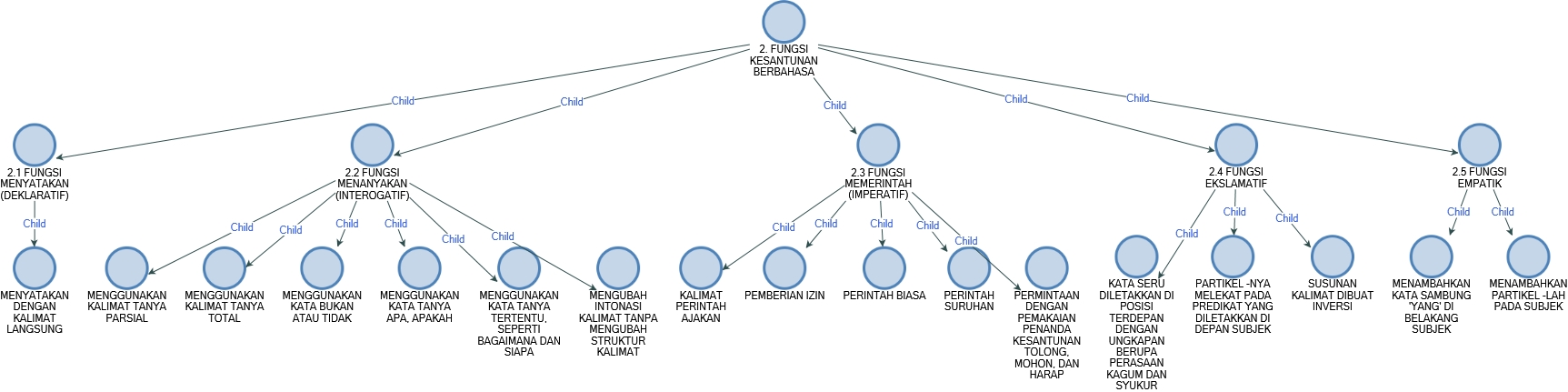
The function of language politeness in the speech of students of the Indonesian Language and Literature Education Study Program in the online learning process is in the form of a declarative or declarative function. Regarding the function of stating, student speech is expressed with direct sentences. This politeness function is reflected in the way the level leader conveys to his friend who has not deposited the assignment and the student conveys to the lecturer who teaches the course that he is in charge of presenting the discussion. Students respond well and also give appreciation to friends for being reminded as well as the lecturer's response to students because students convey their intentions politely, thus reflecting the politeness of the language of the function of stating.
The function of asking or in the form of interrogative mode sentences based on the data that researchers found, the form of student speech by using the politeness function with question sentences in the form of the use of what/if words, using non/no words, changing sentence intonation, using certain question words, total interrogative and partial interrogative.
The commanding function is performed in imperative sentences. Imperative sentences contain the intention of commanding or requesting that speech partners do something as the speaker wants. The imperative functions of student speech range from ordinary commands, requests, solicitations, granting permissions and orders. Although using command sentences, in practice the speech partner does not feel intimidated by these commands because the sentences used are expressed subtly and politely so that the speech partner is happy to respond to these utterances. An exclamative function is a function in a sentence intended to express awe. Based on the findings of research data, the pattern of exclusive sentences in student speech includes: inversion sentence structure, particles are attached to the predicate that has been attached to the subject, interjections are placed in the leading position. This exlamative function can be a statement of awe, gratitude, wonder, fear, anxiety and disappointment.
An empathic function is a sentence in which is contained the intention of giving special emphasis. In Indonesian, that particular emphasis is usually placed on the subject part of the sentence. That particular emphasis can be done by adding more information about that subject. The empathic function is the function of language which is one of the tools of social interaction used by a group of people in the process of communicating and understanding what the speaker feels. Empathic functions can be performed between two speakers as well as on a large scale. The empathic function in communicating aims to establish social relationships between one speaker and another through messages so that they can be understood by each other.
The results of data processing using N-Vivo for the function of language politeness in students of the Indonesian Language and Literature Education Study Program, University of Muhammadiyah Makassar are as in Figure 2.
Judging from the results of N-Vivo on the variables of the language impression function, there are five functions of language politeness owned by students of the Indonesian Language and Literature Education Study Program, University of Muhammadiyah Makasar, namely the function of declaring (declarative), the function of asking (interrogative), the function of commanding (imperative), the function of exlamative and the function of empathy. The function of stating or declarative is spoken by students using direct sentences.
Language Politeness Strategy
Students of the Indonesian Language and Literature Education Study Program have the concept of positive politeness and negative politeness strategies. Positive politeness is the highest result because this online learning has changed the pattern of communication between lecturers and students. The diction and sentences and discourses used to express ideas are certainly no longer the same as the face-to-face learning process. Communication has changed, previously conducted face-to-face but now done through technological intermediaries. This makes students' strategies in communicating must be balanced with distance and time in delivering messages. Especially when the teaching and learning process takes place, it all depends on the speed of the internet signal and the technology used during learning.
Figure 1: The form of language politeness in students of the Indonesian Language and Literature Study Program
Figure 2: N-Vivo Results of Language Politeness Function
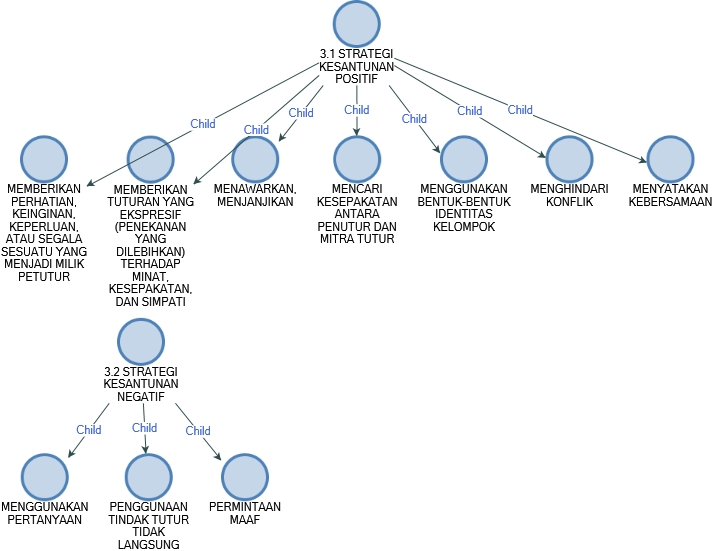
Figure 3: Language Politeness Strategies for Students of the Indonesian Language and Literature Education Study Program
Changes in tools in learning communication and pauses in the form of distance and time are the causes of language politeness strategies to change. The implementation of language politeness in student lectures during the pandemic is the focus of this research. This is done because based on observations made by researchers during online learning, students tend to continue to use polite language.
Positive politeness strategies based on research findings in the form of (1) Giving attention, desires, needs, or everything that belongs to the speaker, (2) An exaggerated emphasis on interest, agreement and sympathy for the speech partner, (3) Markers of group familiarity, (4) Seeking agreement, (5) Avoiding conflict, (6) Offering/promising something and (7) Express togetherness. The positive politeness strategy of students of the Indonesian Language and Literature Education Study Program, University of Muhammadiyah Makassar is used to maintain the positive face of speech partners (both students and lecturers). This is done to maintain close relationships and familiarity between speakers and speech partners so that communication can run smoothly.
The results of data processing using N-Vivo for language politeness strategies for students of the Indonesian Language and Literature Education Study Program, University of Muhammadiyah Makassar are as in Figure 3.
Judging from the results of N-Vivo on the variable language impression strategy, there are two language politeness strategies owned by students of the Indonesian
Language and Literature Education Study Program, Muhammadiyah Makasar University, namely a positive politeness strategy by providing attention, desires, needs, or everything that belongs to the speaker; providing expressive speech (exaggerated emphasis) of interest, agreement and sympathy to speech partners; using markers of group familiarity, especially between students when speaking; seeking agreement between speakers and speech partners; demonstrate an effort to avoid conflict; offering/promising something; and expressed togetherness.
CONCLUSION
Based on the problems, objectives and results of research and discussion, it is broadly concluded that the form of compliance with the principle of language politeness in the learning process of students of the Indonesian Language and Literature Education Study Program, University of Muhammadiyah Makassar is: (a) The maxim of wisdom, (b) Acceptance maxims, (c) Maxims of humility, (d) The maxim of generosity, (e) Match maxim; and (f) The maxim of sympathy. The functions of language politeness in the learning process of students of the Indonesian Language and Literature Education Study Program, University of Muhammadiyah Makassar are: (a) The function states, (b) The function of asking, (c) Commanding functions, (d) Exclamative functions and (e) Empathic functions. Language politeness strategies in the learning process of students of the Indonesian Language and Literature Education Study Program, University of Muhammadiyah Makassar are: (1) Positive politeness strategies and (2) Negative civility strategies.
Suggestion
Based on the results of data analysis and conclusions that the author has stated above, in this section the author puts forward several suggestions as follows:
This research was conducted during the Covid-19 pandemic, however, the politeness of students' language was still considered. Researchers hope that the realization of language politeness will receive attention, both among students and lecturers so that the politeness of the communication process is maintained in various situations not only in the teaching and learning process, but also in other communication directly/face-to-face and online/virtual face-to-face
The author hopes that there will be more specific follow-up research on the realization of language politeness in the campus environment, with interesting studies, larger samples and more in-depth analytical techniques to obtain perfect study results. Hope that if there is further research, subsequent researchers will be more courageous to reveal the facts that actually happened in the field, not fixated on what is seen and heard alone
REFERENCE
Ningsih, W. and N.K. Razak. “The effectiveness of cooperative integrated reading and composition model in the teaching and learning narrative essay writing.” Journal of Indonesian Language Education and Literary, vol. 2, no. 2, 2017, pp. 134–137. http://usnsj.com/index.php/JILEL/ article/view/2.1.134-137.
Rahardi, R.K. Pragmatik: Kesantunan imperatif bahasa Indonesia. Erlangga, 2005.
Leech, G.N. Prinsip-prinsip pragmatik. Universitas Indonesia, 1983.
Searle, J.R. “A taxonomy of illocutionary acts.” L.A.U.T., 1976.
Brown, P. and S.C. Levinson. Politeness: Some universals in language usage. Cambridge University Press, 1987.
Rahardi, K., et al. Pragmatik fenomena ketidaksantunan berbahasa. Erlangga, 2016.
Chaer, A. Kesantunan berbahasa. Rineka Cipta, 2010.
Bogdan, R. and S.J. Taylor. Introduction to qualitative research methods: A phenomenological approach to the social sciences. Wiley, 1975.
License
Creative Commons Attribution-NonCommercial-NoDerivatives 4.0 International License
All papers should be submitted electronically. All submitted manuscripts must be original work that is not under submission at another journal or under consideration for publication in another form, such as a monograph or chapter of a book. Authors of submitted papers are obligated not to submit their paper for publication elsewhere until an editorial decision is rendered on their submission. Further, authors of accepted papers are prohibited from publishing the results in other publications that appear before the paper is published in the Journal unless they receive approval for doing so from the Editor-In-Chief.
Himalayan Journal of Education and Literature open access articles are licensed under a Creative Commons Attribution-Share A like 4.0 International License. This license lets the audience to give appropriate credit, provide a link to the license, and indicate if changes were made and if they remix, transform, or build upon the material, they must distribute contributions under the same license as the original.
Recommended Articles
Research Article
Perceptions of Adolescent Pregnancy and Early Motherhood
Lucy Fonjong Udikoh,
Tamfuchia Ferdinard Baba
Published: 30/12/2020
Download PDF
Cite
x
APA
Fonjong Udikoh, L. & Ferdinard Baba, T. (2020). Perceptions of Adolescent Pregnancy and Early Motherhood. Himalayan Journal of Education and Literature, 1(1), 1-7.
MLA
Fonjong Udikoh, Lucy and Tamfuchia Ferdinard Baba. "Perceptions of Adolescent Pregnancy and Early Motherhood." Himalayan Journal of Education and Literature 1.1 (2020): 1-7.
Chicago
Fonjong Udikoh, Lucy and Tamfuchia Ferdinard Baba. "Perceptions of Adolescent Pregnancy and Early Motherhood." Himalayan Journal of Education and Literature 1, no. 1 (2020): 1-7.
Harvard
Fonjong Udikoh, L. and Ferdinard Baba, T. (2020) 'Perceptions of Adolescent Pregnancy and Early Motherhood' Himalayan Journal of Education and Literature 1(1), pp. 1-7.
Vancouver
Fonjong Udikoh L, Ferdinard Baba T. Perceptions of Adolescent Pregnancy and Early Motherhood. Himalayan Journal of Education and Literature. 2020 Jul;1(1):1-7.
Download PDF
Research Article
Interaction of Modern Literature-Paintings and Poetry, Storytelling, Literature
Jackline Njeri Murimi
Published: 27/01/2021
Download PDF
Cite
x
APA
Njeri Murimi, J. (2021). Interaction of Modern Literature-Paintings and Poetry, Storytelling, Literature. Himalayan Journal of Education and Literature, 2(1), 1-5.
MLA
Njeri Murimi, Jackline. "Interaction of Modern Literature-Paintings and Poetry, Storytelling, Literature." Himalayan Journal of Education and Literature 2.1 (2021): 1-5.
Chicago
Njeri Murimi, Jackline. "Interaction of Modern Literature-Paintings and Poetry, Storytelling, Literature." Himalayan Journal of Education and Literature 2, no. 1 (2021): 1-5.
Harvard
Njeri Murimi, J. (2021) 'Interaction of Modern Literature-Paintings and Poetry, Storytelling, Literature' Himalayan Journal of Education and Literature 2(1), pp. 1-5.
Vancouver
Njeri Murimi J. Interaction of Modern Literature-Paintings and Poetry, Storytelling, Literature. Himalayan Journal of Education and Literature. 2021 Jan;2(1):1-5.
Download PDF
Research Article
The Effect of Web Quest on the Achievement of Fifth Grade Literary Students in Philosophy and Psychology
Muntasser Mohammed Nada
Published: 30/05/2024
Download PDF
Cite
x
APA
Nada, M. M. (2024). The Effect of Web Quest on the Achievement of Fifth Grade Literary Students in Philosophy and Psychology. Himalayan Journal of Education and Literature, 5(1), 1-39.
MLA
Nada, Muntasser M.. "The Effect of Web Quest on the Achievement of Fifth Grade Literary Students in Philosophy and Psychology." Himalayan Journal of Education and Literature 5.1 (2024): 1-39.
Chicago
Nada, Muntasser M.. "The Effect of Web Quest on the Achievement of Fifth Grade Literary Students in Philosophy and Psychology." Himalayan Journal of Education and Literature 5, no. 1 (2024): 1-39.
Harvard
Nada, M. M. (2024) 'The Effect of Web Quest on the Achievement of Fifth Grade Literary Students in Philosophy and Psychology' Himalayan Journal of Education and Literature 5(1), pp. 1-39.
Vancouver
Nada MM. The Effect of Web Quest on the Achievement of Fifth Grade Literary Students in Philosophy and Psychology. Himalayan Journal of Education and Literature. 2024 Jan;5(1):1-39.
Download PDF
Research Article
The Effect of Practicing Critical Thinking Skills on Undergraduates English Learners: Teachers’ Perspective
Azza Elmadani,
...
Shiraz Al-Ali
Published: 15/03/2026
Download PDF
Cite
x
APA
Elmadani, A., Hussein, J. A. T. & Al-Ali, S. (2026). The Effect of Practicing Critical Thinking Skills on Undergraduates English Learners: Teachers’ Perspective. Himalayan Journal of Education and Literature, 7(1), 1-5.
MLA
Elmadani, Azza, Jehan Adli Tawfig Hussein and Shiraz Al-Ali. "The Effect of Practicing Critical Thinking Skills on Undergraduates English Learners: Teachers’ Perspective." Himalayan Journal of Education and Literature 7.1 (2026): 1-5.
Chicago
Elmadani, Azza, Jehan Adli Tawfig Hussein and Shiraz Al-Ali. "The Effect of Practicing Critical Thinking Skills on Undergraduates English Learners: Teachers’ Perspective." Himalayan Journal of Education and Literature 7, no. 1 (2026): 1-5.
Harvard
Elmadani, A., Hussein, J. A. T. and Al-Ali, S. (2026) 'The Effect of Practicing Critical Thinking Skills on Undergraduates English Learners: Teachers’ Perspective' Himalayan Journal of Education and Literature 7(1), pp. 1-5.
Vancouver
Elmadani A, Hussein JAT, Al-Ali S. The Effect of Practicing Critical Thinking Skills on Undergraduates English Learners: Teachers’ Perspective. Himalayan Journal of Education and Literature. 2026 Jan;7(1):1-5.
Ningsih, W., Amir, J. & Hamsa, A. (2023). Language Politeness in the Online Learning Process of Language Education Study Program Students and Indonesian Literature Muhammadiyah University of Makassar. Himalayan Journal of Education and Literature, 4(1), 1-7.
MLA
Ningsih, Wahyu, Johar Amir and Akmal Hamsa. "Language Politeness in the Online Learning Process of Language Education Study Program Students and Indonesian Literature Muhammadiyah University of Makassar." Himalayan Journal of Education and Literature 4.1 (2023): 1-7.
Chicago
Ningsih, Wahyu, Johar Amir and Akmal Hamsa. "Language Politeness in the Online Learning Process of Language Education Study Program Students and Indonesian Literature Muhammadiyah University of Makassar." Himalayan Journal of Education and Literature 4, no. 1 (2023): 1-7.
Harvard
Ningsih, W., Amir, J. and Hamsa, A. (2023) 'Language Politeness in the Online Learning Process of Language Education Study Program Students and Indonesian Literature Muhammadiyah University of Makassar' Himalayan Journal of Education and Literature 4(1), pp. 1-7.
Vancouver
Ningsih W, Amir J, Hamsa A. Language Politeness in the Online Learning Process of Language Education Study Program Students and Indonesian Literature Muhammadiyah University of Makassar. Himalayan Journal of Education and Literature. 2023 Jan;4(1):1-7.


 Download PDF
 Download XML