Objective: Pancreatic tumors are the most common tumors of the periampullary region and have a poor prognosis. Whipple's operation is the only curative treatment option for these tumors. It is a complex surgery and the complication and mortality rates are still high. The aim of this retrospective study is to evaluate patients who underwent Whipple's operation for pancreatic tumors. Material and Methods: Twenty patients who underwent Whipple's operation for pancreatic tumor at Istanbul Medipol University Medical Faculty Hospital Hepatopancreatobiliary Surgery Department between March 2015 and March 2018 were retrospectively analyzed. Demographic characteristics, clinical characteristics, surgical results and factors that may affect the mortality of these patients were evaluated. Results: The mean age of the patients was 61.6±12.5 years. Twelve (60%) of these patients were male and 8 (40%) were female. Twelve (60%) of the patients were early stage (Stage1-2), 8 (40%) were advanced (Stage 3-4). Standard Whipple's operation was performed for all patients. Postoperative complications (pancreatic fistula, bleeding, gastrojejunostomy leak) were detected in 5 (25%) patients. The mean follow-up time was 10.8±10.3 (1-36) months. During the follow-up period, the overall mortality rate was 40%. Mortality was seen mostly in advanced-stage patients. Conclusion: We think that attention should be paid to advanced-stage patients with high mortality risk after the Whipple's operation.
Keywords
Pancreatic Tumor
Whipple's Operation
Analysis
INTRODUCTION
Pancreatic tumors are the most common periampullary tumors. In advanced-stage patients with extremely poor prognosis and inoperable patients, the mean survival is between 6 and 12 months [1]. In patients with resection, the 5-year average survival rate is reported to be 10-30% [2].
The only curative treatment of pancreatic tumors was the Whipple's operation and was first described in 1935 [3]. Whipple's operation is a very complex operation, with a mortality rate of 1-5%, regardless of the disease [4].
The aim of this retrospective study is to evaluate patients who underwent a standard Whipple's operation for a pancreatic tumor.
MATERIALS AND METHODS
Patients
In this study, twenty patients who underwent a Whipple's operation for a pancreatic tumor in the Hepatopancreatobiliary Surgery Department of Istanbul Medipol University Medical Faculty Hospital between March 2015 and March 2018 were retrospectively analyzed. The demographic characteristics, clinical characteristics, surgical results and disease stages of these patients were evaluated using age, gender, liver function tests (alanine aminotransferase, aspartate aminotransferase, bilirubin and gamma-glutamyl transferase) among the factors that may affect mortality.
The technical content of the research protocol was reviewed and approved by the ethical committee of the Istanbul Medipol University (Ethical Committee Approved Number: 10840098-772.02) and the protocols were performed in accordance with the Declaration of Helsinki.
Statistical Analysis
SPSS 22.0 (SPSS for Windows, 2007, Chicago) was used for statistical analysis. Normally distributed continuous variables were given as mean ± Standard deviation. Statistical analysis for parametric variables was performed by Student's T-test. Qualitative variables were given as percentages and the correlation between categorical variables was investigated using the chi-square test and Fisher's exact test. Statistical significance level was defined as p 0.05.
RESULTS
The mean age of the patients was 61.6±12.5 years. Twelve (60%) of these patients were male and 8 (40%) were female. Twelve (60%) of the patients were early stage (Stage1-2), 8 (40%) were advanced (Stage 3-4). Standard Whipple's operation was performed for all patients. Postoperatively, 2 (10%) patients had spontaneous regression of pancreatic fistula, 1 (5%) patient had bleeding from jejunogenostomy anastomosis controlled with relaparotomy + anastomosis revision, 1 (5%) patient had bleeding from the gastroduodenal artery controlled by relaparotomy + hemostasis and 1 (5%). 5%), leakage was detected from the gastrojejunostomy anastomosis controlled by relaparotomy + anastomosis revision.
Table 1 shows the demographic-clinical characteristics and surgical results of patients who underwent Whipple's operation for pancreatic tumors.
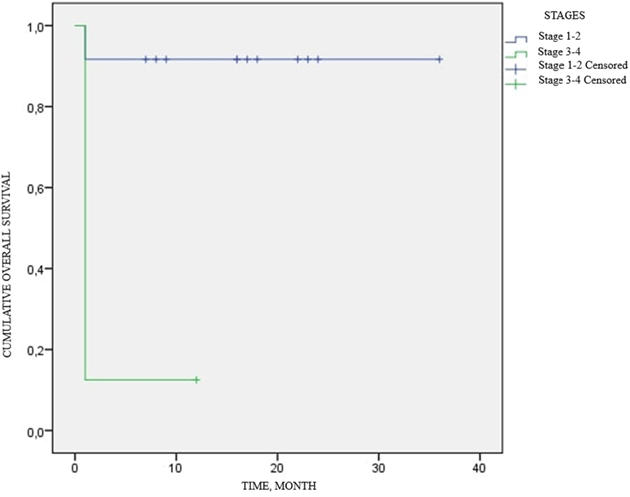
The mean follow-up time was 10.8±10.3 (1-36) months. During the follow-up period, the overall mortality rate was 40%. Age, gender and liver function tests (alanine aminotransferase, aspartate aminotransferase, bilirubin and gamma-glutamyl transferase) were not found to be associated with mortality, among the factors that may increase the risk for mortality. It was found that only the disease stage was associated with mortality and mortality was more common in advanced-stage patients.
Table 2 shows the risk factors for postoperative mortality are compared.
Figure 1 shows the effect of stage on cumulative overall survival.
DISCUSSION
Pancreatic tumors are the most common of all periampullary tumors and have the worst prognosis [5]. The most common pathological type is pancreatic ductal adenocarcinoma [6]. Predisposing factors for the development of pancreatic cancer include advanced age, obesity, smoking, alcohol use, diabetes mellitus and previous chronic pancreatitis [7].
Table 1: Demographic and Clinical Characteristics of the Patients
Age (years)
61.6±12.5
Male/Female (n/%)
12 (% 60)/8 (%40)
Stage (n/%)
Early Stage (1-2)
12 (%60)
Late Stage (3-4)
8 (%40)
Complications After Whipple’s Operation (n/%)
Pancreatic Fistula
2 (%10)
Bleeding from Jejunojejunostomy
1 (%5)
Bleeding from Gastroduodenal Artery
1 (%5)
Leakage from Gastrojejunostomy
1 (%5)
Mortality (n/%)
8 (%40)
Table 2: Comparison of Risk Factors for Post-Surgical Mortality
Figure 1: Effect of Stage on Cumulative Overall Survival
The only curative treatment option in its treatment is Whipple's operation and it is combined with neoadjuvant and adjuvant chemo-radiotherapy [8].
Whipple's operation was first described in 1935 and its modified form of pylorus-sparing Whipple's operation was described in 1944 [3,9]. Whipple's operation, which has been performed as open surgery for many years, can now be performed by laparoscopic technique [10,11]. In our study, standard Whipple's operation with the open surgical technique was performed for a pancreatic tumor in 20 patients.
Whipple's operation is an extremely complex surgery. Complications and mortality due to surgery are common. The most common complication after Whipple's operation is a pancreatic fistula, with a reported incidence of 2–30% [12]. Other common complications are leaks from other anastomoses, bleeding and infection [13,14].
In our study, the postoperative complication rate was 25%. Spontaneously regressing pancreatic fistula in 2 (10%) patients, bleeding from jejunogenostomy anastomosis controlled with relaparotomy + anastomosis revision in 1 (5%) patient, bleeding from the gastroduodenal artery controlled by relaparotomy + hemostasis in 1 (5%) patient and 1 (5%)), leakage was detected from the gastrojejunostomy anastomosis controlled by relaparotomy + anastomosis revision.
Despite all technical improvements, the operative mortality rate is between 1 and 5% on average [4]. In our study, no perioperative mortality due to Whipple's operation was observed.
Predisposing factors that increase postoperative mortality of patients include advanced age (over 65 years of age), male gender, advanced stage of the tumor and the presence of additional diseases (liver, kidney, heart) [15,16]. In our study, age, gender and liver function tests (alanine aminotransferase, aspartate aminotransferase, bilirubin and gamma-glutamyl transferase) were not found to be associated with mortality. It was found that only the disease stage was associated with mortality and the mortality rate was higher in patients with advanced-stage tumors. The 5-year average survival rate in patients with resection is reported to be between 10 and 30% [2].
The mean follow-up time in our study was 10.8±10.3 (1-36) months. During the follow-up period, the overall mortality rate was 40% (8 patients).
There are some limitations in our study. These are retrospective studies and a small number of cases.
CONCLUSION
In conclusion, mortality was more common among patients who underwent Whipple's operation for pancreatic tumors, especially those with advanced-stage tumors. Despite the limitations stated in the discussion section, we think that attention should be paid especially in terms of mortality in this patient group.
Informed Consent
Written informed consent was obtained from the patients who participated in this study.
Conflict of Interest
The authors have no conflict of interest to declare.
Funding
The authors declared that this study has received no financial support.
Author Contributions
Gokhan Ertugrul and Mahmut Zenciroglu: Concept; Gokhan Ertugrul and Mahmut Zenciroglu: Design; Gokhan Ertugrul and Mahmut Zenciroglu: Supervision; Gokhan Ertugrul, Mahmut Zenciroglu and Atıf Tekin: Resource; Gokhan Ertugrul, Mahmut Zenciroglu and Atıf Tekin: Materials; Gokhan Ertugrul, Mahmut Zenciroglu and Atıf Tekin: Data Collection and/or Processing; Gokhan Ertugrul, Mahmut Zenciroglu and Hande Gungor: Analysis and/or Interpretation; Literature Search; Gokhan Ertugrul: Writing; Gokhan Ertugrul, Mahmut Zenciroglu, Atıf Tekin and Hande Gungor : Critical Reviews.
Ethical Approval
Ethics committee approval was received for this study from the Istanbul Medipol University Hospital (Decision date: 27.01.2021).
REFERENCES
Riall, T.S. et al. "Resected Periampullary denocarcinoma: 5-Year Survivors and Their 6- to 10-Year Follow-up." Surgery, vol. 140, 2006, pp. 764–772.
Richter, A. et al. "Long-Term Results of Partial Pancreaticoduodenectomy for Ductal Adenocarcinoma of the Pancreatic Head: 25-Year Experience." World Journal of Surgery, vol. 27, 2003, pp. 324–329.
Whipple, A.O., et al. "Treatment of Carcinoma of the Ampulla of Vater." Annals of Surgery, vol. 102, 1935, pp. 763–779.
Traverso, L.W. et al. "Useful Benchmarks to Evaluate Outcomes After Esophagectomy and Pancreaticoduodenectomy." American Journal of Surgery, vol. 187, 2004, pp. 604–608.
Siegel, R.L. et al. "Cancer Statistics, 2019." CA: A Cancer Journal for Clinicians, vol. 69, 2019, pp. 7–34.
Adamska, A. et al. "Pancreatic Ductal Adenocarcinoma: Current and Evolving Therapies." International Journal of Molecular Sciences, vol. 18, 2017, pp. 1338–1381.
Rebours, V. et al. "Obesity and Fatty Pancreatic Infiltration Are Risk Factors for Pancreatic Precancerous Lesions (PanIN)." Clinical Cancer Research, vol. 21, 2015, pp. 3522–3528.
Seaton, M. et al. "Adjuvant Therapy for Pancreatic Body or Tail Adenocarcinoma: A Study of the National Cancer Database." Therapeutic Advances in Medical Oncology, vol. 11, 2019, p. 1758835919842438.
Watson, K. "Carcinoma of the Ampulla of Vater: Successful Radical Resection." British Journal of Surgery, vol. 31, 1944, pp. 368–373.
Gagner, M. and Pomp, A. "Laparoscopic Pylorus-Preserving Pancreatoduodenectomy." Surgical Endoscopy, vol. 8, 1994, pp. 408–410.
Adam, M.A. et al. "Minimally Invasive Versus Open Pancreaticoduodenectomy for Cancer: Practice Patterns and Short-Term Outcomes Among 7061 Patients." Annals of Surgery, vol. 262, 2015, pp. 372–377.
Allen, P.J., et al. "Pasireotide for Postoperative Pancreatic Fistula." New England Journal of Medicine, vol. 370, 2014, pp. 2014–2022.
Bhosale, P. et al. "Complications of Whipple Surgery: Imaging Analysis." Abdominal Imaging, vol. 38, 2013, pp. 273–284.
Malleo, G. and Vollmer, C.M. Jr. "Postpancreatectomy Complications and Management." Surgical Clinics of North America, vol. 96, 2016, pp. 1313–1336.
Tamirisa, N.P. et al. "Relative Contributions of Complications and Failure to Rescue on Mortality in Older Patients Undergoing Pancreatectomy." Annals of Surgery, vol. 263, 2016, pp. 385–391.
None
None
License
Creative Commons Attribution-NonCommercial-NoDerivatives 4.0 International License
All papers should be submitted electronically. All submitted manuscripts must be original work that is not under submission at another journal or under consideration for publication in another form, such as a monograph or chapter of a book. Authors of submitted papers are obligated not to submit their paper for publication elsewhere until an editorial decision is rendered on their submission. Further, authors of accepted papers are prohibited from publishing the results in other publications that appear before the paper is published in the Journal unless they receive approval for doing so from the Editor-In-Chief.
Himalayan Journal of Medicine and Surgery open access articles are licensed under a Creative Commons Attribution-Share A like 4.0 International License. This license lets the audience to give appropriate credit, provide a link to the license, and indicate if changes were made and if they remix, transform, or build upon the material, they must distribute contributions under the same license as the original.
Recommended Articles
Research Article
Primordial Prevention of Coronary Artery Diseases
Ahmed Adil Ali,
...
Hassan Ali Noori
Published: 26/07/2026
Download PDF
Cite
x
APA
Ali, A. A., Hussien, H. A., Kareem, H. B., Sarhan, S. R. & Noori, H. A. (2026). Primordial Prevention of Coronary Artery Diseases. Himalayan Journal of Medicine and Surgery, 7(2), 1-6.
MLA
Ali, Ahmed Adil, et al. "Primordial Prevention of Coronary Artery Diseases." Himalayan Journal of Medicine and Surgery 7.2 (2026): 1-6.
Chicago
Ali, Ahmed Adil, Hamza Ali Hussien, Hassan Baqer Kareem, Sarhan Raad Sarhan and Hassan Ali Noori. "Primordial Prevention of Coronary Artery Diseases." Himalayan Journal of Medicine and Surgery 7, no. 2 (2026): 1-6.
Harvard
Ali, A. A., Hussien, H. A., Kareem, H. B., Sarhan, S. R. and Noori, H. A. (2026) 'Primordial Prevention of Coronary Artery Diseases' Himalayan Journal of Medicine and Surgery 7(2), pp. 1-6.
Vancouver
Ali AA, Hussien HA, Kareem HB, Sarhan SR, Noori HA. Primordial Prevention of Coronary Artery Diseases. Himalayan Journal of Medicine and Surgery. 2026 Jul;7(2):1-6.
Download PDF
Research Article
Impact of Gut-Liver Axis: Hepatic Biochemical and Metabolic Changes Associated with Chronic Gastritis in Iraqi Patients with Helicobacter Pylori
Noor Zuhair Bakheet N. Z.
Published: 20/02/2026
Download PDF
Cite
x
APA
N. Z., N. Z. B. (2026). Impact of Gut-Liver Axis: Hepatic Biochemical and Metabolic Changes Associated with Chronic Gastritis in Iraqi Patients with Helicobacter Pylori. Himalayan Journal of Medicine and Surgery, 7(1), 1-4.
MLA
N. Z., Noor Z. B.. "Impact of Gut-Liver Axis: Hepatic Biochemical and Metabolic Changes Associated with Chronic Gastritis in Iraqi Patients with Helicobacter Pylori." Himalayan Journal of Medicine and Surgery 7.1 (2026): 1-4.
Chicago
N. Z., Noor Z. B.. "Impact of Gut-Liver Axis: Hepatic Biochemical and Metabolic Changes Associated with Chronic Gastritis in Iraqi Patients with Helicobacter Pylori." Himalayan Journal of Medicine and Surgery 7, no. 1 (2026): 1-4.
Harvard
N. Z., N. Z. B. (2026) 'Impact of Gut-Liver Axis: Hepatic Biochemical and Metabolic Changes Associated with Chronic Gastritis in Iraqi Patients with Helicobacter Pylori' Himalayan Journal of Medicine and Surgery 7(1), pp. 1-4.
Vancouver
N. Z. NZB. Impact of Gut-Liver Axis: Hepatic Biochemical and Metabolic Changes Associated with Chronic Gastritis in Iraqi Patients with Helicobacter Pylori. Himalayan Journal of Medicine and Surgery. 2026 Jan;7(1):1-4.
Download PDF
Research Article
Effect of Land Degradation on Livelihood
Kemalo Abdulmalik,
Isreal Zewide
Published: 04/01/2024
Download PDF
Cite
x
APA
Abdulmalik, K. & Zewide, I. (2024). Effect of Land Degradation on Livelihood. Himalayan Journal of Medicine and Surgery, 5(1), 1-4.
MLA
Abdulmalik, Kemalo and Isreal Zewide. "Effect of Land Degradation on Livelihood." Himalayan Journal of Medicine and Surgery 5.1 (2024): 1-4.
Chicago
Abdulmalik, Kemalo and Isreal Zewide. "Effect of Land Degradation on Livelihood." Himalayan Journal of Medicine and Surgery 5, no. 1 (2024): 1-4.
Harvard
Abdulmalik, K. and Zewide, I. (2024) 'Effect of Land Degradation on Livelihood' Himalayan Journal of Medicine and Surgery 5(1), pp. 1-4.
Vancouver
Abdulmalik K, Zewide I. Effect of Land Degradation on Livelihood. Himalayan Journal of Medicine and Surgery. 2024 Jan;5(1):1-4.
Download PDF
Research Article
Awareness and Practices among Professional Healthcare Workers towards COVID-19 in Iraq
Yasir H Motlaq,
...
Zainab T. N M. Almuhannah
Published: 30/03/2024
Download PDF
Cite
x
APA
H Motlaq, Y., A Aqebian, E. & N M. Almuhannah, Z. T. (2024). Awareness and Practices among Professional Healthcare Workers towards COVID-19 in Iraq. Himalayan Journal of Medicine and Surgery, 5(1), 1-9.
MLA
H Motlaq, Yasir, Esraa A Aqebian and Zainab T. N M. Almuhannah. "Awareness and Practices among Professional Healthcare Workers towards COVID-19 in Iraq." Himalayan Journal of Medicine and Surgery 5.1 (2024): 1-9.
Chicago
H Motlaq, Yasir, Esraa A Aqebian and Zainab T. N M. Almuhannah. "Awareness and Practices among Professional Healthcare Workers towards COVID-19 in Iraq." Himalayan Journal of Medicine and Surgery 5, no. 1 (2024): 1-9.
Harvard
H Motlaq, Y., A Aqebian, E. and N M. Almuhannah, Z. T. (2024) 'Awareness and Practices among Professional Healthcare Workers towards COVID-19 in Iraq' Himalayan Journal of Medicine and Surgery 5(1), pp. 1-9.
Vancouver
H Motlaq Y, A Aqebian E, N M. Almuhannah ZT. Awareness and Practices among Professional Healthcare Workers towards COVID-19 in Iraq. Himalayan Journal of Medicine and Surgery. 2024 Jan;5(1):1-9.
Ertugrul, G., Zenciroglu, M., Tekin, A. & Gungor, H. (2021). Standard Whipple’s Operation for Pancreatic Tumors: A Single Center Experience. Himalayan Journal of Medicine and Surgery, 2(1), 1-4.
MLA
Ertugrul, Gokhan, et al. "Standard Whipple’s Operation for Pancreatic Tumors: A Single Center Experience." Himalayan Journal of Medicine and Surgery 2.1 (2021): 1-4.
Chicago
Ertugrul, Gokhan, Mahmut- Zenciroglu, Atıf Tekin and Hande Gungor. "Standard Whipple’s Operation for Pancreatic Tumors: A Single Center Experience." Himalayan Journal of Medicine and Surgery 2, no. 1 (2021): 1-4.
Harvard
Ertugrul, G., Zenciroglu, M., Tekin, A. and Gungor, H. (2021) 'Standard Whipple’s Operation for Pancreatic Tumors: A Single Center Experience' Himalayan Journal of Medicine and Surgery 2(1), pp. 1-4.
Vancouver
Ertugrul G, Zenciroglu M, Tekin A, Gungor H. Standard Whipple’s Operation for Pancreatic Tumors: A Single Center Experience. Himalayan Journal of Medicine and Surgery. 2021 Jan;2(1):1-4.


 Download PDF
 Download XML