Background: This study was done to determine the Management and Outcome of Blunt Trauma Abdomen patients in a tertiary care Hospital. Material and Methods: This Observational prospective study was conducted from July 2018 to December 2019 and included all Blunt Trauma Abdomen (BTA) patients admitted in study period at advanced trauma center, PGIMER Chandigarh. Pattern, prevalence, non-operative versus operative management and outcome in term of mortality and morbidity were monitored. Results: Seventy-five patients admitted to ATC during study period were selected for the study. The most common age group affected was 16-30 years which constitute 42(56%) of total affected. Ninety two percent (n=69) of affected population were males whereas 8% (n=6) were females. In the present study, there were 20 patients (26.67%) who were surgically managed and 55(73.33%) were managed conservatively (NOM). Among the total 75 patients, 5 (6.66%) were died during treatment while 70(93.33%) were discharged after recovery. There was no mortality in NOM group. While 5 patients were expired who were surgically managed. Pneumonia was the most common complication that occurred in 45% (n=9) of patients followed by sepsis in 30% (n=6) of cases. No statistically significant difference was found for solid organ injury with mortality. However, injury to ileum, jejunum, colon and mesentery were found to be statistically significant predictors of mortality. Conclusion: Most of the blunt trauma patients were managed conservatively. All patients Involving hollow visceral organ injury required surgical intervention while it was required in only one patient involving solid organ injury Pneumonia followed by sepsis was the most common complication following surgery. There was no mortality in NOM group.
Treatment of patients with blunt abdominal injury requires the routine ABCs (Airway, Breathing and Circulation). Airway and cervical spine are protected first. After the primary survey is complete, patients who are hypotensive require aggressive fluid resuscitation and blood transfusion. All patients with blunt abdominal trauma who have signs of peritonitis, frank bleeding, or worsening of clinical signs require an immediate laparotomy. Depending on clinical features, hemodynamic stability and CT results and conservative management is given [1].
The vital nature of organs contained within the abdomen makes evaluation and management a priority. The predominant source of morbidity and mortality are bleeding and visceral perforation associated with sepsis. In setting of blunt trauma solid organs often sustain contusion or laceration, causing bleeding that may require surgical management. About 25% of patients requiring surgical management for bowel trauma have more than one bowel injury and likely more than one mechanism [2].
The shift from routine operative to selective non-operative management (NOM) of blunt injuries to solid organs of abdomen is one of the most notable trends in the care of trauma patients during past two decades [3]. American Association for the Surgery of Trauma (AAST) grading may be used to classify hollow visceral injury severity, but it has not been a proven predictor of mortality [4].
Most authors consider grade III injuries (50% to 75% circumferential laceration) or greater to be severe, although there remains no clear consensus on the best operative treatment of these injuries. There is some consensus on fact that surgery should be performed within 8 hours of injury in patients with hollow visceral injuries to avoid the increase in morbidity [5].
Mortality rates quoted from blunt intestinal trauma range from 10-30%. Reports have shown that mortality increases with the number of associated injuries [6].
No study has been there from our institute regarding the management, outcome and complication after blunt trauma abdomen injury. So, we conduct this study to highlight the Management and Outcome of Blunt Trauma Abdomen patients in a tertiary care Hospital.
Aims and Objective
To determine the Management and Outcome of Blunt Trauma Abdomen patients in a tertiary care Hospital.
Study Design
Observational prospective study.
Study Period
July 2018 to December2019.
Study Population
FAST positive patients admitted in study period at ATC PGIMER Chandigarh, India were included in the study as per the inclusion and exclusion criteria. Informed understood written consent was taken from all the patients and approval from the institute’s ethical committee was obtained.
Sample Size
Seventy-five consecutive patients were recruited based on satisfying the inclusion and exclusion criteria. All the recruited patient's injuries were classified according to existing classification of organ injury. Pattern, prevalence, non-operative versus operative management and outcome in term of mortality and morbidity were monitored.
Eligibility
All consecutive patients with blunt trauma abdomen admitted during the time Frame of the study.
Inclusion Criteria
All patients with blunt trauma abdomen having FAST POSITIVE or evidence of solid
Viscous injury clinically or radiologically
Both Sex
Age >14 years and <80 years
Patients giving a valid informed consent
Exclusion Criteria
Age <14 years as they are managed by department of pediatric surgery at PGIMER Chandigarh
Patients who refuse to give consent.
Patients having GCS score less than or equal to 4 on arrival
Material and Methods
Advance Trauma Center PGIMER Chandigarh is the major trauma center of India and it caters major population of Punjab, Haryana, Chandigarh, Himachal, Uttar Pradesh, Bihar, JandK, Rajasthan and act as referral center for the urban and rural hospitals within the region. It has a computerized registry into which trained data collectors have prospectively entered data on all injury admissions. Patients admitted for Blunt Trauma Abdomen were taken into study and categorized into:
Patients with hollow viscous perforation
Patients with solid organ injury
Patients with solid and hollow viscous organ injury along with other coexisting injuries
Patients were managed as per existing protocol of trauma guidelines of the institute and ATLS guidelines and outcome in term of morbidity mortality and length of hospital stay was monitored. Operative, non-operative management and its indications and outcomes were evaluated.
Clinical Course
Patients with blunt trauma abdomen were taken and their history was taken. Name, age, sex, residence, mode of injury, time of injury, time of arrival at ATC, brief history about antecedent incident was taken. Primary survey was done and GCS of patient and vitals such as pulse, blood pressure, respiration was noted. Airway, breathing, circulation was secured as per ATLS guidelines. Secondary survey was done and detailed injuries were noted from head to toe.
After initial resuscitation patient underwent routine blood investigations such ABG, haemogram, blood biochemistry including electrolytes, renal function test and liver function test. Medico legal x-rays of skull with cervical spine, bilateral hip with pelvis, chest and abdominal X-ray was performed in addition injury specific x rays. FAST was done preliminary for BTA. In FAST positive patients CECT abdomen was performed and details of organ injured was noted. All the injuries noted clinically and by radiology were given an AIS and ISS score. Specific organ injuries were graded according to AAST grading of organ injuries.
Conservative or surgical management was done as per existing guidelines of institute. Conservative management includes BTA charting (hourly monitoring of pulse, blood pressure, respiration rate, urine output, abdominal girth, febrile status, 6hourly hemogram) transfusion of blood products, radiological interventions like percutaneous drainage or angioembolization, as guided by the clinical status of the patient, biochemical and radiological findings.
Surgical management for hollow visceral perforation and hemodynamicaly unstable solid organ injury includes exploratory laprotomy. Postoperatively, patient was monitored and managed according to clinical features, hemodynamic status with the help of biochemical and radiological investigations as indicated. Mortality and morbidity were noted.
Statistical Analysis
Data were summarized and expressed as frequency and percentages. All calculations were conducted with standard statistical programs (SPSS 8.01, SPSS, Inc, Chicago IL).
Seventy-five patients admitted to Trauma center during study period were selected for the study based on inclusion and exclusion criteria. Following observations were made based on their admission and their stay and management.
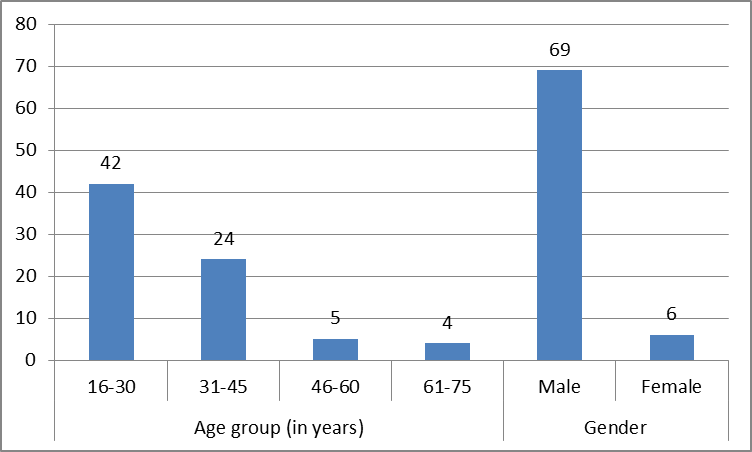
There were 75 patients who were included in this study belonged to the age group 16-75 years. The most common age group affected was 16-30 years which constitute 56% of total affected population. 61-75 years group constituted least affected group (Table 1 and Figure 1).
In the present study, Solid Organ injured in 54(72%) of cases, followed by hollow viscous injury 19(25.33%) (Table 2).
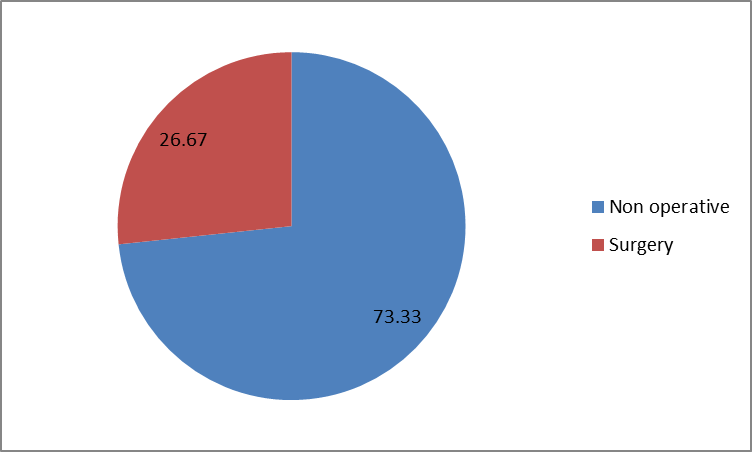
Surgical and non-operative management (NOM) was used based on type of organ involved and hemodynamic stability after injury. There were 20 patients (26.67%) who were surgically managed and 55(73.33%) were managed conservatively (NOM) (Table 3 and Figure 2).
Table 1: Age and Gender Distribution in Blunt Trauma Abdomen Patients
Variables | Frequency | Percentage |
Age group (in years) |
|
|
16-30 | 42 | 56.00 |
31-45 | 24 | 32.00 |
46-60 | 5 | 6.67 |
61-75 | 4 | 5.33 |
Gender | ||
Male | 69 | 92.00 |
Female | 6 | 8.00 |
Total | 75 | 100.00 |
Table 2: Comparison of Organs Involved in Blunt Trauma Injury
Type of organ | Frequency | Percentage |
Solid organs | 54 | 72.00 |
Hollow viscous | 19 | 25.33 |
Only free Fluid | 2 | 2.76 |
Table 3: Type of Management in Blunt Trauma Injuries
Type of management | Frequency | Percentage |
Non operative | 55 | 73.33 |
Surgery | 20 | 26.67 |
Total | 75 | 100.00 |
Table 4: Relation between Outcome and Mode of Management
Outcome | Mode of management | Frequency | Percentage |
Death | Operative(n=20) | 5 | 6.66 |
Non- operative(n=55) | 0 | ||
Discharge | Operative(n=20) | 15 | 93.33 |
Non- operative(n=55) | 55 |
Table 5: Univariate Analysis for Mortality with Solid Organ and Hollow Viscus Injury
Type of organ injured | Sig (p value) |
Solid organ | |
Liver | 0.426 |
Spleen | 0.636 |
Kidney | 0.360 |
Retroperitoneal hematoma | 0.114 |
Urinary Bladder | 0.611 |
Pancreas | 0.540 |
Hollow viscus | |
Duodenum | 0.591 |
Jejunum | <0.005 |
Ileum | 0.001 |
Colon | <0.005 |
Mesentery | 0.012 |
Among the total 75 patients, 5 (6.66%) were died during treatment while 70(93.33%) were discharged after recovery. There was no mortality in NOM group. While 5 patients were expired who were surgically managed (Table 4).
Pneumonia was the most common complication that occurred in 45% (n=9) of patients followed by sepsis in 30% (n=6) of cases. Acute kidney injury developed in 25% (n=5) of patients. There was no anastomotic leak in surgical operated patients.
No statistically significant difference was found for solid organ injury with mortality. (Table 5) However injury to ileum, jejunum, colon and mesentery were found to be statistically significant predictors of mortality (Table 5).
Surgical and non-operative management (NOM) was used based on type of organ involved and hemodynamic stability after injury.
In the present study, there were 20 patients (26.67%) who were surgically managed and 55(73.33%) were managed conservatively (NOM). Similarly, in the study done by M J George et al. 172% of cases were managed by conservative approach. 12% of cases were managed by operative procedures.
Primary repair was done in 6 patients (10.66%) involving single and small perforations and resection anastomosis was done in 12 patients (16%) involving perforation associated with mesentery, loss of perforated segment or grade III/IV perforations, which were similar to methods adopted in other studies by Jha et al.,6 and Mukhopadhyay et al. [7].

Figure 1: Age and Gender Distribution in Blunt Trauma Abdomen Patients

Figure 2: Type of Management in Blunt Trauma Injuries
Out of 20 patients who were surgically managed only 1 had grade IV splenic injury and rest of them were hollow visceral injuries. Multiple perforation and Grade IV bowel injuries underwent resection and end to end anastomosis. 4 patients (5.3%) underwent stoma formation. Twelve patients (60%) among those who were operated required ionotropic support post operatively.
All 19 patients (100%) Involving hollow viscus organ injury required surgical intervention while only 1 patient (1.81%) involving solid organ injury (grade IV Splenic injury) required surgical intervention
Pneumonia (45%) followed by sepsis (30%) was the most common complication following surgery. Similarly, in the study done by M J George et al. [1], out of total 11o patients 7 patients developed septicemia and 3 patients developed acute renal failure.
Among the total 75 patients, 5 (6.66%) were died during treatment while 70(93.33%) were discharged after recovery. There was no mortality in NOM group. While 5 patients were expired who were surgically managed. Similarly, in the study done by M J George et al.,1, out of total 110 patients 10 patients died contributing 9.09% mortality. Mortality was zero in patients who were treated by conservative method.
12 patients (60%) out of 20 who underwent surgical management required inotropic support and 5 patients didn’t get extubated in post op period. Mortality was 100% for patients who didn’t get intubated in post-operative period.
No statistically significant difference was found for solid organ injury with mortality. However, injury to ileum, jejunum, colon and mesentery were found to be statistically significant predictors of mortality.
Most of the blunt trauma patients were managed conservatively. All patients Involving hollow visceral organ injury required surgical intervention while it was required in only one patient involving solid organ injury Pneumonia followed by sepsis was the most common complication following surgery. There was no mortality in NOM group. While five patients were expired who were surgically managed.
George M.J. et al. "Evaluation of criteria and outcome of conservative approach in management of blunt trauma abdomen." Med pulse International Journal of Surgery, vol. 9, no. 2, 2019, pp. 1–2.
Watts D.D. et al. "Incidence of hollow viscus injury in blunt trauma: an analysis from 275,557 trauma admissions from the east multi-institutional trial." Journal of Trauma, vol. 54, no. 2, 2003, pp. 289–294.
Richardson J.D. et al. "Evolution in the management of hepatic trauma: a 25-year perspective." Annals of Surgery, vol. 232, no. 3, 2000, pp. 324.
Moore E.E. et al. "Organ injury scaling, II: pancreas, duodenum, small bowel, colon and rectum." The Journal of Trauma, vol. 30, no. 11, 1990, pp. 1427–1429.
Fakhry S.M. et al. "Relatively short diagnostic delays (< 8 hours) produce morbidity and mortality in blunt small bowel injury: an analysis of time to operative intervention in 198 patients from a multicenter experience." Journal of Trauma and Acute Care Surgery, vol. 48, no. 3, 2000, pp. 408–415.
Jha N.K. et al. "Characteristics of hollow viscus injury following blunt abdominal trauma: a single centre experience from Eastern India." Bulletin of Emergency and Trauma, vol. 2, no. 4, 2014, pp. 156.
Mukhopadhyay M. "Intestinal injury from blunt abdominal trauma: a study of 47 cases." Oman Medical Journal, vol. 24, no. 4, 2009, pp. 256.