Background: Coronavirus Disease (COVID-19) now considered as the most infectious disease occurring once in a century, spreading all over the world in past 2 years in different waves. India accounting for the second largest number of COVID-19 positive patients worldwide and is causing the burden on health facilities and economy. Aim: Assessing the specific epidemiological factors and clinical outcomes in hospitalized patients with mild to moderate severity of COVID -19 in a tribal district of Northern India. Methods: Authors retrospectively investigated epidemiological, demographic, laboratory and clinical data of 420 laboratory confirmed COVID-19 positive patients admitted in Dedicated COVID Care Center from 3rd June 2020 to 24th November 2021. Results: Study period from 16th May 2020 to 22nd Dec 2021 in tribal district of Himachal Pradesh reveals that the positivity rate was 4.28%, admission rate of 11.9% and death rate of 1.1%. Male predominance of admitted patients was there in Dedicated COVID Health Centre at Reckong Peo, Kinnaur. Mean age during admission ranges from 45-46 years in females and male. Patients with moderate to severe patients were referred to higher Dedicated COVID Hospitals within 2 days of their admission. Conclusion: Study suggested that age group of 18-59 years were more hospitalized due to symptoms ranging from mild to severe in Dedicated COVID facilities and required medical attention. Challenge for a Tribal District with highly rugged terrain, limited human resources, health institutions and facilities in hospitals, practicing appropriate COVID-19 behavior is necessary in containment of COVID-19 waves in future.
Keywords
Tribal
COVID-19
DCCC
DCHC
WGS
INTRODUCTION
In December 2019, a cluster of severe pneumonia cases of unknown cause was reported in Wuhan, Hubei province, China. The initial cluster was epidemiologically linked to a seafood wholesale market in Wuhan, although many of the initial 41 cases were later reported to have no known exposure to the market [1]. The 2019 novel coronavirus (SARS‑cov2) or COVID‑19 as it is now called is rapidly spreading worldwide from its place of origin in Wuhan City of Hubei Province of China.
As of 22 Dec 2021, the disease has spread to over 222 countries and territories with 276,593,547 confirmed cases and 5,414,808 deaths globally. In India total 34,786,481 people have been infected till date with total 4,79,685 deaths reported [2]. In Himachal total number of persons infected with COVID 19 are 2,28,370 with 3853 deaths [3]. India reported its first COVID -19 positive case on 30th January 2020 in a 20 years old female who returned from Wuhan city on 23rd January, 2020. It took more than a year to complete the first wave of infection. During the prolonged first wave, India registered a low number of daily confirmed cases/million inhabitants in comparison to many other countries; however, the scenario started changing from March 2021, with the rapid rise of COVID-19-positive cases throughout the country [4] accounting for the second wave of COVID-19 in country.
Mortality from COVID-19 shows a strong relationship with age and pre-existing medical conditions, with increasing age as the major risk factor for all-cause mortality. A Better understanding of its epidemiology can help in developing informed strategies to identify and protect those most at risk of poor outcomes during the pandemic [5]. Among the factors that increase the chance of severe outcomes, age seemed to be the most influential; adults older than 60 years may have at least five times the magnitude of association with hospitalization and mortality from COVID-19 compared with those aged less than 45 years. This association with increased hospitalization and mortality appears to magnify at least to some degree even for those older than 60 years, with those aged over 80 years possibly having double the magnitude of association for mortality of those aged 65-69 years [6].
Objective of this study in a Tribal District is to analyze epidemiological characteristics among tribal people affected by the pandemic and to provide useful indications for further policy making in further containment of pandemic during upcoming COVID-19 waves.
MATERIALS AND METHODS
Current study is a hospital based retrospective study. District Ayurvedic Hospital, Reckong Peo, Kinnaur was notified as Dedicated COVID Health Centre and Sarai Bhawan, Reckong Peo as Dedicated COVID Care Centre for isolation and management of confirmed cases of COVID-19. Retrospective analysis of all the admitted laboratory confirmed COVID 19 positive cases either in RT-PCR, True Nat, RAT test were included in this study. After clinical assessment patients with comorbidities, dyspnea, Respiratory Rate (RR) >24, Oxygen Saturation (SpO2) <94% on room air, were either admitted in DCCC or DCHC. Patient socio demographic data, duration of stay, outcome etc. were recorded in hospital case sheets from there the descriptive data was collected and analyzed. Data was then cleaned, sorted and entered in Microsoft Excel which was further analyzed. Descriptive epidemiological analysis was carried out and results were generated.
RESULTS
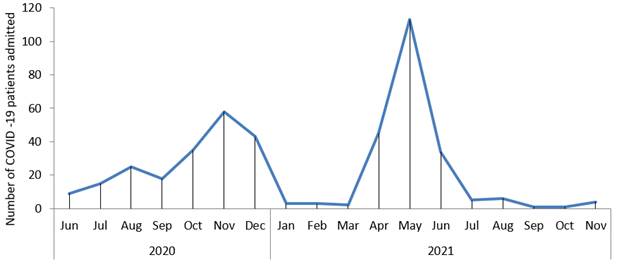
District Kinnaur, a Tribal District in Himachal Pradesh had its first laboratory confirmed COVID-19 positive case on 2nd June 2020 and its first hospitalization on 3rd June 2020. Total 82326 persons were screened either via RT- PCR, RAT, TrueNat method for COVID 19 during the study period from 16th May 2020–22nd Dec 2021, out of which 3531 persons were laboratory confirmed COVID 19 cases. 420 cases were admitted from June 2020-Nov 2021 (Figure 1) either in designated Dedicated COVID Care Facility, Dedicated COVID Health Centre in District Kinnaur or referred to higher Health Facilities in District Shimla. The mean age was 46.11 years with age groups ranging from 11 to 95 years; male 46.1 years female 45.7 years. Maximum proportion of admitted patients belonged to the age group of 40-59 years (35%), followed by those aged 20-39 years (34.5%) and lowest among elderly above 80 years (Table 1).
The higher proportion of admitted COVID-19 patients presented moderate to severe symptoms (57.1%) and were admitted to Dedicated COVID Health Centre (DCHC) in District Ayurvedic Hospital, at Reckong Peo Kinnaur and patients with mild signs and symptoms (42.9%) were admitted in Dedicated COVID Care Facility (DCCC), Sarai Bhawan at Reckong Peo, Kinnaur (Table 2). Maximum duration of stay at Dedicated COVID Care Centers was ranging from 8-13 days (58.9%) with mean days of 7.19 and male predominance of 59.1% whereas maximum duration in Dedicated COVID Health Centers was less than 2 days (46.7%) with mean days of 6.85 and female predominance of 48.5% (Table 3).
Patients admitted in Dedicated COVID Health Centre were either referred (55.8%), recovered (40.8%), discharged against medical advice (2.1%) or succumbed to COVID-19 (1.3%) (Table 4). Maximum COVID-19 patients were referred within 1 day of being admitted in Dedicated Health Centres (56%), with female patients (63.2%) mostly referred to higher COVID-19 Dedicated Hospitals (Table 5). Out of 240 admitted COVID-19 admitted patients in DCHC, 3 male patients (1.25%) succumbed to COVID-19 during their stay at DCHC at Reckong Peo (Table 6).
Table 1: Age and Sex Distribution of COVID-19 admitted patients from June 2020-Nov 2021, District Kinnaur, Himachal Pradesh
Age Group (Years)
Total Cases
%
Male
%
Female
%
<18
12
2.9
4
1.52
8
5.1
18-39
159
37.9
124
47
35
22.4
40-59
147
35.0
84
31.8
63
40.4
60-79
84
20.0
41
15.5
43
27.6
>80
18
4.3
11
4.17
7
4.5
Total
420
100
264
100
156
100
Table 2: Distribution of COVID-19 admitted patients in different Dedicated COVID-19 Health Facilities, District Kinnaur, Himachal Pradesh
Type of Facility
Frequency
%
Dedicated COVID Care Centre
180
42.9
Dedicated COVID Health Centre
240
57.1
Total
420
100
Figure 1: Distribution of COVID-19 Cases Admitted from June 2020-Nov 2021, District Kinnaur, Himachal Pradesh
Table 3: Duration of Stay of COVID-19 Admitted Patients in Different Dedicated COVID-19 Health Facilities, District Kinnaur, Himachal Pradesh
Duration of Stay
Total
Percent
Male
Percent
Female
Percent
Dedicated COVID Care Hospital
< 2 days
4
2.2
2
1.6
2
3.7
2-7 days
30
16.7
20
15.7
10
18.9
8 -13 days
106
58.9
75
59.1
31
58.5
>14 days
40
22.2
30
23.6
10
18.9
Total
180
100
127
100
53
100
Dedicated COVID Health Centers
< 2 days
112
46.7
62
45.3
50
48.5
2-7 days
64
26.6
34
24.8
30
29.1
8-13 days
52
21.7
34
24.8
18
17.5
>14 days
12
5
7
5.1
5
4.9
Total
240
100
137
100
103
100
Table 4: Outcome of COVID-19 Patients Admitted in Dedicated COVID-19 Health Centre, District Ayurvedic Hospital, Reckong Peo, Kinnaur, Himachal Pradesh
Outcome
Frequency
%
Recovered
98
40.8
Referred
134
55.8
Discharged Against Medical Advice
5
2.1
Death
3
1.3
Total
240
100
Table 5: Number of Referral Days w.r.t Sex Wise Distribution of COVID-19 Admitted Patients in Dedicated COVID Health Center, District Ayurvedic Hospital, Reckong Peo, Kinnaur, Himachal Pradesh
Referral day
Total
%
Male
%
Female
%
<1 day
75
56
39
50.6
36
63.2
1-2 days
41
30.5
24
31.2
17
29.8
3-5 days
10
7.5
8
10.4
2
3.5
>6 days
8
6
6
7.8
2
3.5
Total
134
100
77
100
57
100
Table 6: Age Wise Distribution WRT Number of Duration of Stay of Admitted COVID-19 Patients in District Ayurvedic Hospital, Reckong Peo, Kinnaur, Himachal Pradesh
Age Group
1-2 days
>2 days
Total Deaths
< 30 years
1
0
1
>60 years
1
1
2
Total
2
1
3
DISCUSSION
COVID -19 has taken down the health of people globally and tribal areas like District Kinnaur with limited human and health resources are mostly affected if timely precautions and guidelines are not followed. Its population dynamics mirror the typical waves of infection displayed in earlier pandemics of other respiratory pathogens, including the influenza pandemics in 1918 and in 2009 [7].In particular, India's first wave of SARS-CoV-2 infection began in late January 2020 and lasted for about nine months. This was relatively mild compared to the second wave that followed, from mid-February 2021 onwards and exhibiting a more explosive spread across the country [8].
The main finding of this study states that District Kinnaur experiences its first wave in November 2020 and its second wave after 6 months in May 2021 increasing the COVID-19 admitted as well positive patients up to two- fold. Due to lack of data in Whole Genome Sequencing in COVID-19 positive patients during second wave, we were not able to find out the dominant because no facility of WGS was there in District Kinnaur and samples have to be sent to District Shimla on weekly basis.
It provides the information for further management and which age group should be targeted in coming waves for making treatment strategies while designing future protocols in tribal districts.
Most affected age group in District Kinnaur was ranging from 18-59 years accounting from almost 37% of total admitted patients with predominance of male accounting 47%, this may be due to the working class comprises of more male in the society 240 patients out of 420 in District Kinnaur exhibiting moderate to severe COVID-19 symptoms were admitted in DCHC for clinical management and 112 patients were referred within 2 days of admission to higher Dedicated medical hospitals for management due to lack of appropriate medical facilities in District Kinnaur.
Although no relation were found between the geriatric age group and admission in DCCC, DCHC Overall 240(6.8%) of 3531patients were admitted to DCHC which included 112(3.2%) severe patients also. Severe patients after stabilization were referred as per protocol to dedicated covid hospital DDU/IGMC Shimla.
Total 39 deaths were reported in District Kinnaur during the study period, out of which 3 were reported in DCHC District Kinnaur, 4 were brought dead, 7 died in home isolation and 25 died in higher facilities outside District Kinnaur. Of 3 deaths at DCHC 2(66.6%) died within 1day, both patients were of severe category with ARDS showing severe disease with delayed initial admission was directly related to mortality in both patients.
CONCLUSION
COVID-19 is rapidly mutating itself among human beings, making it more difficult to manage at peripheral or tribal areas due to lack of data in numbers, clinical signs and symptoms, management and outcome.
Limitation
The study was done on demographic variables whereas clinical aspect and health status before infecting from COVID-19 could not be drawn due to lack of data.
Acknowledgment
We would like to thank all the hospital staff of Dedicated COVID Health facilities of District Kinnaur for providing us the base line data and all the co-authors for providing their valuable suggestions.
REFERENCES
Huang, C. et al. "Clinical Features of Patients Infected with 2019 Novel Coronavirus in Wuhan, China." The Lancet, vol. 395, 2020, pp. 497–506. DOI: 10.1016/S0140-6736(20)30183-5.
Sarkar, A.et al. "Covid-19 Infection in India: A Comparative Analysis of the Second Wave with the First Wave." Pathogens, vol. 10, no. 9, 2021, p. 1222. DOI: 10.3390/pathogens10091222.
Bhaskaran, K. et al. "Factors Associated with Deaths Due to COVID-19 versus Other Causes: Population-Based Cohort Analysis of UK Primary Care Data and Linked National Death Registrations within the OpenSAFELY Platform." Lancet Regional Health–Europe, vol. 6, 2021, p. 100109. DOI: 10.1016/j.lanepe.2021.100109.
Wingert, A. et al. "Risk Factors for Severity of COVID-19: A Rapid Review to Inform Vaccine Prioritisation in Canada." BMJ Open, vol. 11, no. 5, 2021, e044684. DOI: 10.1136/bmjopen-2020-044684.
Tan, Y. et al. "Durability of Neutralizing Antibodies and T-Cell Response Post SARS-CoV-2 Infection." Frontiers in Medicine, vol. 14, 2020, pp. 746–751.
Mandal, Sandip, et al. "Plausibility of a Third Wave of COVID-19 in India." Indian Journal of Medical Research, vol. 153, no. 5–6, 2021, pp. 522–532. DOI: 10.4103/ijmr.ijmr_1627_21.
License
Creative Commons Attribution-NonCommercial-NoDerivatives 4.0 International License
All papers should be submitted electronically. All submitted manuscripts must be original work that is not under submission at another journal or under consideration for publication in another form, such as a monograph or chapter of a book. Authors of submitted papers are obligated not to submit their paper for publication elsewhere until an editorial decision is rendered on their submission. Further, authors of accepted papers are prohibited from publishing the results in other publications that appear before the paper is published in the Journal unless they receive approval for doing so from the Editor-In-Chief.
Himalayan Journal of Medicine and Surgery open access articles are licensed under a Creative Commons Attribution-Share A like 4.0 International License. This license lets the audience to give appropriate credit, provide a link to the license, and indicate if changes were made and if they remix, transform, or build upon the material, they must distribute contributions under the same license as the original.
Recommended Articles
Research Article
Primordial Prevention of Coronary Artery Diseases
Ahmed Adil Ali,
...
Hassan Ali Noori
Published: 26/07/2026
Download PDF
Cite
x
APA
Ali, A. A., Hussien, H. A., Kareem, H. B., Sarhan, S. R. & Noori, H. A. (2026). Primordial Prevention of Coronary Artery Diseases. Himalayan Journal of Medicine and Surgery, 7(2), 1-6.
MLA
Ali, Ahmed Adil, et al. "Primordial Prevention of Coronary Artery Diseases." Himalayan Journal of Medicine and Surgery 7.2 (2026): 1-6.
Chicago
Ali, Ahmed Adil, Hamza Ali Hussien, Hassan Baqer Kareem, Sarhan Raad Sarhan and Hassan Ali Noori. "Primordial Prevention of Coronary Artery Diseases." Himalayan Journal of Medicine and Surgery 7, no. 2 (2026): 1-6.
Harvard
Ali, A. A., Hussien, H. A., Kareem, H. B., Sarhan, S. R. and Noori, H. A. (2026) 'Primordial Prevention of Coronary Artery Diseases' Himalayan Journal of Medicine and Surgery 7(2), pp. 1-6.
Vancouver
Ali AA, Hussien HA, Kareem HB, Sarhan SR, Noori HA. Primordial Prevention of Coronary Artery Diseases. Himalayan Journal of Medicine and Surgery. 2026 Jul;7(2):1-6.
Download PDF
Research Article
Impact of Gut-Liver Axis: Hepatic Biochemical and Metabolic Changes Associated with Chronic Gastritis in Iraqi Patients with Helicobacter Pylori
Noor Zuhair Bakheet N. Z.
Published: 20/02/2026
Download PDF
Cite
x
APA
N. Z., N. Z. B. (2026). Impact of Gut-Liver Axis: Hepatic Biochemical and Metabolic Changes Associated with Chronic Gastritis in Iraqi Patients with Helicobacter Pylori. Himalayan Journal of Medicine and Surgery, 7(1), 1-4.
MLA
N. Z., Noor Z. B.. "Impact of Gut-Liver Axis: Hepatic Biochemical and Metabolic Changes Associated with Chronic Gastritis in Iraqi Patients with Helicobacter Pylori." Himalayan Journal of Medicine and Surgery 7.1 (2026): 1-4.
Chicago
N. Z., Noor Z. B.. "Impact of Gut-Liver Axis: Hepatic Biochemical and Metabolic Changes Associated with Chronic Gastritis in Iraqi Patients with Helicobacter Pylori." Himalayan Journal of Medicine and Surgery 7, no. 1 (2026): 1-4.
Harvard
N. Z., N. Z. B. (2026) 'Impact of Gut-Liver Axis: Hepatic Biochemical and Metabolic Changes Associated with Chronic Gastritis in Iraqi Patients with Helicobacter Pylori' Himalayan Journal of Medicine and Surgery 7(1), pp. 1-4.
Vancouver
N. Z. NZB. Impact of Gut-Liver Axis: Hepatic Biochemical and Metabolic Changes Associated with Chronic Gastritis in Iraqi Patients with Helicobacter Pylori. Himalayan Journal of Medicine and Surgery. 2026 Jan;7(1):1-4.
Download PDF
Research Article
Effect of Land Degradation on Livelihood
Kemalo Abdulmalik,
Isreal Zewide
Published: 04/01/2024
Download PDF
Cite
x
APA
Abdulmalik, K. & Zewide, I. (2024). Effect of Land Degradation on Livelihood. Himalayan Journal of Medicine and Surgery, 5(1), 1-4.
MLA
Abdulmalik, Kemalo and Isreal Zewide. "Effect of Land Degradation on Livelihood." Himalayan Journal of Medicine and Surgery 5.1 (2024): 1-4.
Chicago
Abdulmalik, Kemalo and Isreal Zewide. "Effect of Land Degradation on Livelihood." Himalayan Journal of Medicine and Surgery 5, no. 1 (2024): 1-4.
Harvard
Abdulmalik, K. and Zewide, I. (2024) 'Effect of Land Degradation on Livelihood' Himalayan Journal of Medicine and Surgery 5(1), pp. 1-4.
Vancouver
Abdulmalik K, Zewide I. Effect of Land Degradation on Livelihood. Himalayan Journal of Medicine and Surgery. 2024 Jan;5(1):1-4.
Download PDF
Research Article
Awareness and Practices among Professional Healthcare Workers towards COVID-19 in Iraq
Yasir H Motlaq,
...
Zainab T. N M. Almuhannah
Published: 30/03/2024
Download PDF
Cite
x
APA
H Motlaq, Y., A Aqebian, E. & N M. Almuhannah, Z. T. (2024). Awareness and Practices among Professional Healthcare Workers towards COVID-19 in Iraq. Himalayan Journal of Medicine and Surgery, 5(1), 1-9.
MLA
H Motlaq, Yasir, Esraa A Aqebian and Zainab T. N M. Almuhannah. "Awareness and Practices among Professional Healthcare Workers towards COVID-19 in Iraq." Himalayan Journal of Medicine and Surgery 5.1 (2024): 1-9.
Chicago
H Motlaq, Yasir, Esraa A Aqebian and Zainab T. N M. Almuhannah. "Awareness and Practices among Professional Healthcare Workers towards COVID-19 in Iraq." Himalayan Journal of Medicine and Surgery 5, no. 1 (2024): 1-9.
Harvard
H Motlaq, Y., A Aqebian, E. and N M. Almuhannah, Z. T. (2024) 'Awareness and Practices among Professional Healthcare Workers towards COVID-19 in Iraq' Himalayan Journal of Medicine and Surgery 5(1), pp. 1-9.
Vancouver
H Motlaq Y, A Aqebian E, N M. Almuhannah ZT. Awareness and Practices among Professional Healthcare Workers towards COVID-19 in Iraq. Himalayan Journal of Medicine and Surgery. 2024 Jan;5(1):1-9.
Negi, S., Negi, R. K., Negi, S. G., Negi, K. R. & Mushtaq, T. (2021). Clinico-Epidemiological Profile of COVID-19 Patients Admitted in COVID Dedicated Hospital in Tribal District of Himachal Pradesh. Himalayan Journal of Medicine and Surgery, 2(2), 1-4.
MLA
Negi, Swati, et al. "Clinico-Epidemiological Profile of COVID-19 Patients Admitted in COVID Dedicated Hospital in Tribal District of Himachal Pradesh." Himalayan Journal of Medicine and Surgery 2.2 (2021): 1-4.
Chicago
Negi, Swati, Raj K. Negi, Sonam G. Negi, Kavi R. Negi and Tahsin Mushtaq. "Clinico-Epidemiological Profile of COVID-19 Patients Admitted in COVID Dedicated Hospital in Tribal District of Himachal Pradesh." Himalayan Journal of Medicine and Surgery 2, no. 2 (2021): 1-4.
Harvard
Negi, S., Negi, R. K., Negi, S. G., Negi, K. R. and Mushtaq, T. (2021) 'Clinico-Epidemiological Profile of COVID-19 Patients Admitted in COVID Dedicated Hospital in Tribal District of Himachal Pradesh' Himalayan Journal of Medicine and Surgery 2(2), pp. 1-4.
Vancouver
Negi S, Negi RK, Negi SG, Negi KR, Mushtaq T. Clinico-Epidemiological Profile of COVID-19 Patients Admitted in COVID Dedicated Hospital in Tribal District of Himachal Pradesh. Himalayan Journal of Medicine and Surgery. 2021 Jul;2(2):1-4.


 Download PDF
 Download XML