Introduction: Currently, head and neck reconstruction is mainly performed with techniques based on free flaps. Advances in microsurgery have left pedicled flaps behind; however, the pedicled pectoralis major flap is an option for the reconstruction of these defects when there is no access to free flaps. The disadvantages such as its volume or its functional and aesthetic sequelae, have been some of the reasons why it is used less and less. Clinical Case: We present the case of a patient with oncologic resection of the neck due to recurrence of papillary thyroid cancer where neck reconstruction was performed with a pectoralis major flap with partial thickness skin graft. Conclusion: The use of the pectoralis major hanging to cover neck defects continues to be an option in the reconstruction of neck defects since it provides good coverage, it is an easy technique, it is performed in the same operative field and presents excellent functional and esthetic results.
Keywords
Pectoralis Major Myocutaneous Flap
Head and Neck Reconstruction
Free Flaps
Papillary Thyroid Carcinoma and Skin Metastasis
INTRODUCTION
For many years the pedicle pectoralis major flap (PMPF) was used for head and neck reconstructions in many institutions in Mexico. Advances in microsurgery have left pediculate flaps behind, but they are still used frequently in head and neck surgery [1]. Historically, Pickrell used the pectoralis major only as a local flap to cover chest wall defects. Conley in 1953 described a flap based on the deltopectoral region of the thorax for the reconstruction of head and neck defects [2]. In 1965, Bakamjian described the deltopectoral flap medially based on the perforations of the internal breast, which has the advantage of not being deferred, but does not reach the upper areas of the head, unless its distal end is deferred [2]. The first reports of pectoralis major myocutaneous flap (PMMF) appeared in the literature in 1968 by Dr Hueston, a surgeon from Melbourne Australia, where he described incorporating the pectoralis muscle with the overlying skin to reconstruct chest wall defects [3]. In 1979, descriptions of the PMMF for head and neck reconstruction were described separately by Ariyan and Baek and at least partially derived from the previous of work of Conley who introduced the laterally based deltopectoral flap for reconstruction of head and neck defects [4].
Indications for the use of this flap are primary or secondary reconstruction of surgical defects of the head and neck región:
Repair of defects following partial or total glossectomy
Repair of defect following orbital exenteration
Repair of defect following radical maxillectomy
Repair of defect following temporal bone resection
Repair of pharyngeal defects after total laryngectomy
Repair of soft tissue defects of the neck following radical neck dissection [5]
According to the classification of Mathes e Nahai [6], in terms of muscle vascularization, the pectoralis major muscle flap, as with the wide dorsal muscle flap, belongs to group V. This is because it is irrigated by a dominant artery. (Thoracoacromial artery) and several other pedicles (perforating the internal breast), thus being able to lift two different flaps based on two different pedicles.
Currently, PMPF is used for reconstruction of anterior pharyngeal defects after laryngectomy to cover vital structures (e.g. the carotid artery), for reinforcement during salvage surgery and when reconstruction with a free flap is not possible (e.g. because of severe comorbidity, or failures). Moreover, PMPF is fairly easy to harvest, is very close to the neck and has a reliable vascular anatomy, which makes it a very versatile flap [7].
CLINICAL CASE
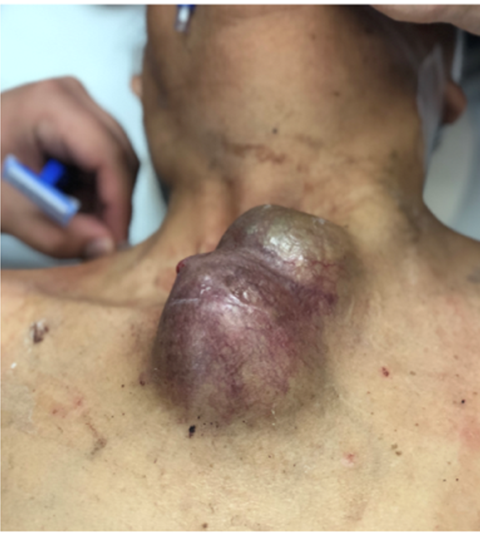
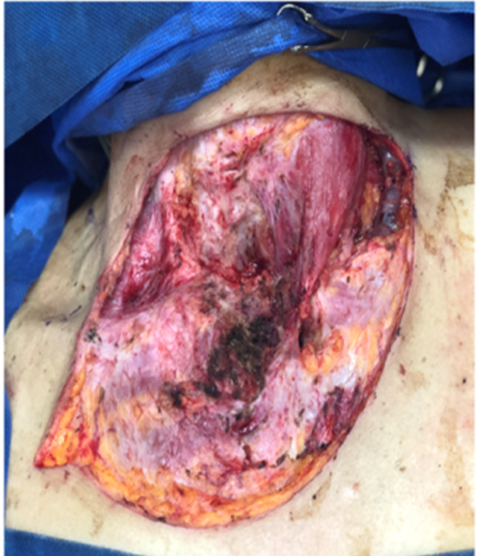
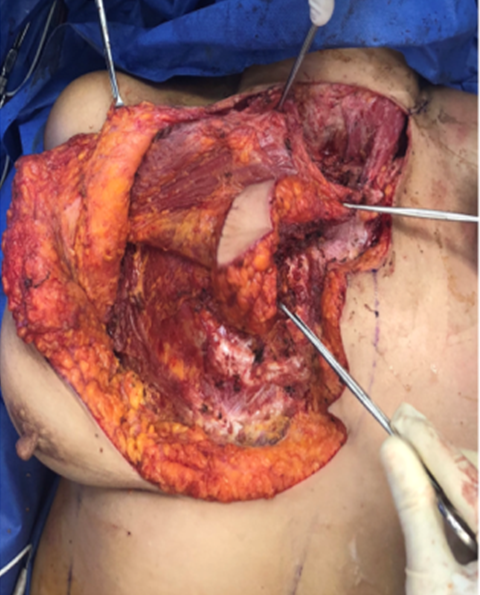
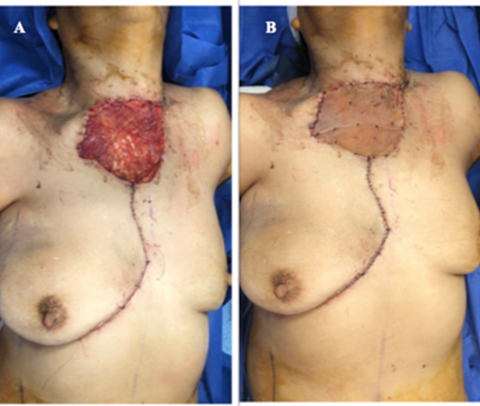
In April 2021 he presented a non-mobile stony tumor of about 10 cm in diameter, purplish in color (Figure 1). Ultrasound was requested, reporting a large subcutaneous tumor, which did not infiltrate deep planes. In an extension study there was tumor progression with paratracheal nodules. Palliative surgery was performed; with excision of the cutaneous lesion for aesthetic reasons. (Figure 2). The plastic surgery service decides to reconstruct the resection defect with a pedicle pectoralis major flap (Figure 3) with partial thickness skin graft (Figure 4) because compared to other regional flaps used more recently, such as the supraclavicular, the pectoralis major has the advantage of having a robust pedicle and a direct and constant vascularization. The pathological anatomy reports metastasis of papillary thyroid carcinoma. Currently the patient presents good aesthetic results and is undergoing ablative treatment with radioactive iodine.
Figure 1: Metastasis of papillary thyroid carcinoma
DISCUSSION
In recent years, the development of microsurgical reconstruction techniques has revolutionized the reconstruction of head and neck defects; this type of surgery has taken the place of PMMF and currently both reconstructive options coexist and are the object of multiple comparisons.
Figure 2: Total tumor resection defect
Figure 3: Myocutaneous flap of the pectoralis major rotation
Figure 4: A Total defect coverage with Myocutaneous flap. B. Partial thickness grafting
One aspect to take into consideration is that the performance of micro-anastomosed flaps involves a complex technique, with the participation of teams with specific training and rigorous post-surgical monitoring. In contrast, the technique for PMMF is relatively simple, does not require specific training and has a very high reliability. This means that centers without the possibility of performing microsurgery restrict their reconstructive procedures to pedicled flaps, which is why in this case it was decided to opt for PMMF reconstruction at that time.
Disadvantages of the PMPF are its bulkiness, which can influence speech and swallowing, the need to rotate the vascular pedicle of the flap 180 when using the skin paddle to resurface the neck and complications like a higher rate of fistulas (as compared to fasciocutaneous free flaps) and hematomas [8,9]. Recently, Liu et al reviewed their outcomes using the PMMF in the era of free tissue transfer and utilized pedicled flaps in 20% of their cases [10]. The PMMF was selected as a primary reconstruction option in 74% of patients primarily due to poor vascular status and history of previous radiation > 60 Gy [10]. Donor site morbidity is often cited as one of drawbacks following PMMF harvest; however, no patients reported severe shoulder pain or dysfunction and cosmetic outcomes were deemed excellent in follow up questionnaires [10]. As with any surgical option, patient selection is paramount to achieve excellent results with minimal morbidity, of which 40 years since its initial description the PMMF remains a workhorse flap in modern day head and neck reconstruction.
As for papillary thyroid carcinoma, cutaneous metastases are rare, they should be taken into account when a patient with this history presents a suspicious cutaneous lesion. In our case the patient presented two recurrences of the disease, the first in the left sternocleidomastoid muscle and the second in the subcutaneous tissue. The mechanisms to explain cutaneous metastasis in this type of tumor are not clear, although some authors propose contamination of the skin by thyroid cancer cells during surgery. Although our patient presented tumor progression and palliative surgery was decided for aesthetic reasons, according to some authors, the appearance of single metastases in rare sites such as the skin does not necessarily represent a poor prognosis of the disease and can be treated by complete surgical excision.
CONCLUSION
The use of the pectoralis major hanging to cover neck defects continues to be an option in the reconstruction of neck defects since it provides good coverage, it is an easy technique, it is performed in the same operative field and presents excellent functional and esthetic results.
Acknowledgment
We appreciate the valuable collaboration of Dr. Jaime Aron Garcia Espinoza.
REFERENCES
De Bree, R. Forn et al. “Modern reconstruction techniques for oral and pharyngeal defects after tumor resection.” European Archives of Otorhinolaryngology, vol. 265, 2008, pp. 1–9.
Ariyan, Stephan. Cancer of the Head and Neck. C.V. Mosby Company, 1997.
Hwang, K. “The Origins of deltopectoral flaps and the pectoralis major myocutaneous flap.” Journal of Craniofacial Surgery, vol. 27, 2016, pp. 1845–1848.
Watts, Tammara Lynn. “The pectoralis major myocutaneous flap.” Operative Techniques in Otolaryngology, vol. 30, 2019, pp. 134–137.
Ariyan, Stephan. “Pectoralis major flap for head and neck reconstruction.” Operative Dictations in Plastic and Reconstructive Surgery, chap. 87, pp. 365–368.
Losee, J.E. Forn et al. “Plastic and reconstructive surgery.” Schwartz’s Principles of Surgery, 9th ed., edited by F.C. Brunicardi et al., McGraw-Hill, 2010, chap. 45.
Refos. Forn et al. “Shoulder morbidity after pectoralis major flap reconstruction.” Head and Neck, 2016, doi:10.1002/hed.
Kruse, A.L. Forn et al. “Evaluation of the pectoralis major flap for reconstructive head and neck surgery.” Head and Neck Oncology, vol. 3, 2011, p. 12.
McLean, J.N. et al. “The pectoralis major myocutaneous flap revisited: a reliable technique for head and neck reconstruction.” Annals of Plastic Surgery, vol. 64, 2010, pp. 570–.
Liu, M. Forn et al. “Pectoralis major myocutaneous flap for head and neck defects in the era of free flaps: harvesting technique and indications.” Scientific Reports, vol. 7, 2017, article 46256.
License
Creative Commons Attribution-NonCommercial-NoDerivatives 4.0 International License
All papers should be submitted electronically. All submitted manuscripts must be original work that is not under submission at another journal or under consideration for publication in another form, such as a monograph or chapter of a book. Authors of submitted papers are obligated not to submit their paper for publication elsewhere until an editorial decision is rendered on their submission. Further, authors of accepted papers are prohibited from publishing the results in other publications that appear before the paper is published in the Journal unless they receive approval for doing so from the Editor-In-Chief.
Himalayan Journal of Medicine and Surgery open access articles are licensed under a Creative Commons Attribution-Share A like 4.0 International License. This license lets the audience to give appropriate credit, provide a link to the license, and indicate if changes were made and if they remix, transform, or build upon the material, they must distribute contributions under the same license as the original.
Recommended Articles
Research Article
Primordial Prevention of Coronary Artery Diseases
Ahmed Adil Ali,
...
Hassan Ali Noori
Published: 26/07/2026
Download PDF
Cite
x
APA
Ali, A. A., Hussien, H. A., Kareem, H. B., Sarhan, S. R. & Noori, H. A. (2026). Primordial Prevention of Coronary Artery Diseases. Himalayan Journal of Medicine and Surgery, 7(2), 1-6.
MLA
Ali, Ahmed Adil, et al. "Primordial Prevention of Coronary Artery Diseases." Himalayan Journal of Medicine and Surgery 7.2 (2026): 1-6.
Chicago
Ali, Ahmed Adil, Hamza Ali Hussien, Hassan Baqer Kareem, Sarhan Raad Sarhan and Hassan Ali Noori. "Primordial Prevention of Coronary Artery Diseases." Himalayan Journal of Medicine and Surgery 7, no. 2 (2026): 1-6.
Harvard
Ali, A. A., Hussien, H. A., Kareem, H. B., Sarhan, S. R. and Noori, H. A. (2026) 'Primordial Prevention of Coronary Artery Diseases' Himalayan Journal of Medicine and Surgery 7(2), pp. 1-6.
Vancouver
Ali AA, Hussien HA, Kareem HB, Sarhan SR, Noori HA. Primordial Prevention of Coronary Artery Diseases. Himalayan Journal of Medicine and Surgery. 2026 Jul;7(2):1-6.
Download PDF
Research Article
Impact of Gut-Liver Axis: Hepatic Biochemical and Metabolic Changes Associated with Chronic Gastritis in Iraqi Patients with Helicobacter Pylori
Noor Zuhair Bakheet N. Z.
Published: 20/02/2026
Download PDF
Cite
x
APA
N. Z., N. Z. B. (2026). Impact of Gut-Liver Axis: Hepatic Biochemical and Metabolic Changes Associated with Chronic Gastritis in Iraqi Patients with Helicobacter Pylori. Himalayan Journal of Medicine and Surgery, 7(1), 1-4.
MLA
N. Z., Noor Z. B.. "Impact of Gut-Liver Axis: Hepatic Biochemical and Metabolic Changes Associated with Chronic Gastritis in Iraqi Patients with Helicobacter Pylori." Himalayan Journal of Medicine and Surgery 7.1 (2026): 1-4.
Chicago
N. Z., Noor Z. B.. "Impact of Gut-Liver Axis: Hepatic Biochemical and Metabolic Changes Associated with Chronic Gastritis in Iraqi Patients with Helicobacter Pylori." Himalayan Journal of Medicine and Surgery 7, no. 1 (2026): 1-4.
Harvard
N. Z., N. Z. B. (2026) 'Impact of Gut-Liver Axis: Hepatic Biochemical and Metabolic Changes Associated with Chronic Gastritis in Iraqi Patients with Helicobacter Pylori' Himalayan Journal of Medicine and Surgery 7(1), pp. 1-4.
Vancouver
N. Z. NZB. Impact of Gut-Liver Axis: Hepatic Biochemical and Metabolic Changes Associated with Chronic Gastritis in Iraqi Patients with Helicobacter Pylori. Himalayan Journal of Medicine and Surgery. 2026 Jan;7(1):1-4.
Download PDF
Research Article
Effect of Land Degradation on Livelihood
Kemalo Abdulmalik,
Isreal Zewide
Published: 04/01/2024
Download PDF
Cite
x
APA
Abdulmalik, K. & Zewide, I. (2024). Effect of Land Degradation on Livelihood. Himalayan Journal of Medicine and Surgery, 5(1), 1-4.
MLA
Abdulmalik, Kemalo and Isreal Zewide. "Effect of Land Degradation on Livelihood." Himalayan Journal of Medicine and Surgery 5.1 (2024): 1-4.
Chicago
Abdulmalik, Kemalo and Isreal Zewide. "Effect of Land Degradation on Livelihood." Himalayan Journal of Medicine and Surgery 5, no. 1 (2024): 1-4.
Harvard
Abdulmalik, K. and Zewide, I. (2024) 'Effect of Land Degradation on Livelihood' Himalayan Journal of Medicine and Surgery 5(1), pp. 1-4.
Vancouver
Abdulmalik K, Zewide I. Effect of Land Degradation on Livelihood. Himalayan Journal of Medicine and Surgery. 2024 Jan;5(1):1-4.
Download PDF
Research Article
Awareness and Practices among Professional Healthcare Workers towards COVID-19 in Iraq
Yasir H Motlaq,
...
Zainab T. N M. Almuhannah
Published: 30/03/2024
Download PDF
Cite
x
APA
H Motlaq, Y., A Aqebian, E. & N M. Almuhannah, Z. T. (2024). Awareness and Practices among Professional Healthcare Workers towards COVID-19 in Iraq. Himalayan Journal of Medicine and Surgery, 5(1), 1-9.
MLA
H Motlaq, Yasir, Esraa A Aqebian and Zainab T. N M. Almuhannah. "Awareness and Practices among Professional Healthcare Workers towards COVID-19 in Iraq." Himalayan Journal of Medicine and Surgery 5.1 (2024): 1-9.
Chicago
H Motlaq, Yasir, Esraa A Aqebian and Zainab T. N M. Almuhannah. "Awareness and Practices among Professional Healthcare Workers towards COVID-19 in Iraq." Himalayan Journal of Medicine and Surgery 5, no. 1 (2024): 1-9.
Harvard
H Motlaq, Y., A Aqebian, E. and N M. Almuhannah, Z. T. (2024) 'Awareness and Practices among Professional Healthcare Workers towards COVID-19 in Iraq' Himalayan Journal of Medicine and Surgery 5(1), pp. 1-9.
Vancouver
H Motlaq Y, A Aqebian E, N M. Almuhannah ZT. Awareness and Practices among Professional Healthcare Workers towards COVID-19 in Iraq. Himalayan Journal of Medicine and Surgery. 2024 Jan;5(1):1-9.
Barker Antonio, A., Rosas Daniel Antonio, B., Ruiz Ediel Osvaldo, D., Manzano Roberto Armando, G. & Aragon Veronica Belem, A. (2021). Myocutaneous Flap of the Pectoralis Major in Neck Reconstruction a Still Viable Option. Himalayan Journal of Medicine and Surgery, 2(2), 1-3.
MLA
Barker Antonio, Alan, et al. "Myocutaneous Flap of the Pectoralis Major in Neck Reconstruction a Still Viable Option." Himalayan Journal of Medicine and Surgery 2.2 (2021): 1-3.
Chicago
Barker Antonio, Alan, Bracamontes Rosas Daniel Antonio, Dávila Ruiz Ediel Osvaldo, García Manzano Roberto Armando and Aguilar Aragon Veronica Belem. "Myocutaneous Flap of the Pectoralis Major in Neck Reconstruction a Still Viable Option." Himalayan Journal of Medicine and Surgery 2, no. 2 (2021): 1-3.
Harvard
Barker Antonio, A., Rosas Daniel Antonio, B., Ruiz Ediel Osvaldo, D., Manzano Roberto Armando, G. and Aragon Veronica Belem, A. (2021) 'Myocutaneous Flap of the Pectoralis Major in Neck Reconstruction a Still Viable Option' Himalayan Journal of Medicine and Surgery 2(2), pp. 1-3.
Vancouver
Barker Antonio A, Rosas Daniel Antonio B, Ruiz Ediel Osvaldo D, Manzano Roberto Armando G, Aragon Veronica Belem A. Myocutaneous Flap of the Pectoralis Major in Neck Reconstruction a Still Viable Option. Himalayan Journal of Medicine and Surgery. 2021 Jul;2(2):1-3.



 Download PDF
 Download XML