Contents
Download PDF
pdf Download XML
1377 Views
430 Downloads
Share this article
Research Article | Volume 2 Issue 2 (July-Dec, 2021) | Pages 1 - 4
Complications and Duration of Hospital in Patients with Cholelithiasis and Choledocholithiasis: A Longitudinal Descriptive Study
 ,
 ,
 ,
 ,
1
Department of Surgery, IGMC Shimla, India
2
Professor, Department of Surgery, IGMC Shimla, India
3
Assistant Professor, Department of Surgery, IGMC Shimla, India
4
Department of Physiology, IGMC Shimla, India
Under a Creative Commons license
Open Access
Received
May 12, 2021
Revised
June 3, 2021
Accepted
July 24, 2021
Published
Aug. 31, 2021
Abstract

Introduction: Generally, in well-equipped centres of the world, ERCP followed by laparoscopic cholecystectomy is recommended as a safe and cost-effective procedure. However, various centres advocate laparoscopic cholecystectomy with common bile duct (CBD) exploration or a Rendezvous technique where endoscopy and laparoscopy are performed simultaneously. They both have a similar efficacy profile with the added benefit of saving time. Material and Methods: This longitudinal descriptive study was carried out from 1-August-2018 to 31-July-2019. Detailed history was taken, thorough clinical examination was done and required investigations were done. Therapeutic decision making was based on expertise availability, number and size of CBD stones, impacted stones and presence of stricture at the lower end of CBD. Laparoscopic cholecystectomy with laparoscopic exploration of CBD was done in some cases depending on availability of expertise. In all cases, operative findings were noted, post-operative morbidity and mortality were noted. Results: Out of 108 patients nine patients had intra operative bleeding (8 during laparoscopic cholecystectomy and 1 during ERCP), three patients had post ERCP pancreatitis. One patient had dense adhesion (frozen calot) and one patient had intra operative bile spillage. Conclusion: Laparoscopic cholecystectomy with laparoscopic CBD stone extraction is a single-step approach and efficacious procedure though surgical expertise is a limiting factor. All modalities have comparable rate of complications and convenience. The modality chosen depends on patients’ choice and availability of facility and expertise.

Keywords
INTRODUCTION

The vast majority of common bile duct stones is formed within the gall bladder and migrates down the cystic duct into the common bile duct as secondary stones. Once in the CBD, stones may reach the duodenum along with the bile flow. Common bile duct stones may be primary or secondary. Primary bile duct stones are formed within the bile ducts and are usually of brown pigment variety. These tend to have less than 20% cholesterol and high bilirubin content. Secondary bile duct stones are cholesterol stones in 75% and black pigment stones in 25% of patients. The clinical presentation of choledocholithiasis may vary widely, as CBD stones may be asymptomatic in 5-10% of cases [1]. Because of the smaller diameter of the distal CBD at the Vater papilla, they may remain in the choledochus. Common bile duct produces colicky pain, jaundice or potentially life-threatening complications, such as ascending cholangitis or acute pancreatitis.


The management of concomitant gall bladder and CBD stones has evolved significantly over the past 20-30 years. In the era of open surgery, open CBD exploration (choledocholithotomy) used to be performed if any common bile duct stones were identified at cholangiography. Following the introduction of ERCP, open CBD exploration was reserved for patients with failed ERCP. There remains a conflict of opinion in approach to treatment of cholelithiaisis with choledocholithiasis. Available options range from open surgery, endoscopic and laparoscopic exploration. With the advent of various modern technologies, open surgical procedures, such as CBD exploration or biliary-enteric bypasses, are now usually considered where ERCP fails to retrieve stones or where facilities of advanced laparoscopic surgery are not available. A relative indication for open exploration is large or multiple stones or the need to perform a transduodenal sphincteroplasty.


Laparoscopic common bile duct exploration: Because over 80% of cholecystectomies are done laparoscopically, simultaneous laparoscopic common bile duct exploration can be done. The advantage is that the gallbladder and CBD stones are taken care of simultaneously in a minimally invasive manner. Successful laparoscopic management of CBD stones depends on several factors including surgical expertise, adequate equipment, the biliary anatomy and the number and size of CBD stones. The most direct method of dealing with choledocholithiasis preoperatively is by endoscopic retrograde cholangiopancreatography (ERCP). It was introduced in 1968 by Drs. McCune, Shorb and Moscovitz [2]. Decompression of the ductal system can be achieved by means of endoscopic removal of stones with or without sphincterotomy. This procedure has a reported success rate of 70% to 90%. Because the published morbidity rates for ERCP and laparoscopic common bile duct exploration are roughly equivalent, ERCP plus or minus sphincterotomy followed by laparoscopic cholecystectomy is a good technique. Generally, in well-equipped centres of the world, ERCP followed by laparoscopic cholecystectomy is recommended as a safe and cost-effective procedure. However, various centres advocate laparoscopic cholecystectomy with common bile duct (CBD) exploration or a Rendezvous technique where endoscopy and laparoscopy are performed simultaneously. They both have a similar efficacy profile with the added benefit of saving time [3]. The objective of this study is to explore and assess complications and duration of hospital stay in cases of cholelithiasis with choledocholithiasis.

MATERIALS AND METHODS

This longitudinal descriptive study was carried out in the department of General surgery in concordance with Department of Gastroenterology Indira Gandhi Medical College Shimla (H.P.) on patients admitted with diagnosis of Cholelithiasis with choledocholithiasis from 1-August-2018 to 31-July-2019. Detailed history was taken, thorough clinical examination was done and required investigations were done.


Therapeutic decision making was based on expertise availability, number and size of CBD stones, impacted stones and presence of stricture at the lower end of CBD. Laparoscopic cholecystectomy with laparoscopic exploration of CBD was done in some cases depending on availability of expertise. In all cases, operative findings were noted; post-operative morbidity and mortality were noted.


Statistical Analysis: Data was entered in Microsoft excel spreadsheet, cleaned for errors and was analyzed using Epi Info software version 7.2.2.2. Descriptive statistics were used to summarize the demographic data. Frequencies and their percentages were used to describe categorical variables whereas means and standard deviation is used to describe quantitative variables.

RESULTS

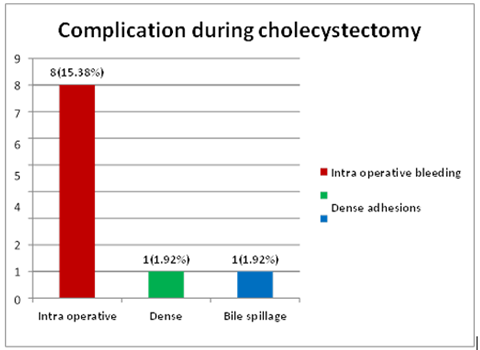
Out of 108 patients nine patients had intra operative bleeding (8 during laparoscopic cholecystectomy and 1 during ERCP), three patients had post ERCP pancreatitis. One patient had dense adhesion (frozen calot) and one patient had intra operative bile spillage. (Table 1, Figure 1).


Post-Operative Complications/Morbidity

Out of one hundred eight patients total six patients had post-operative complications in form of wound sepsis (n=1), prolonged bile leakage in patients with T- tube drainage (n=1). And in patients who underwent ERCP, post ERCP pancreatitis (n=3) was present in three patients. Post-operative bile leakage (n=1) in patient with choledochoduodonostomy (Table 2).


Hospital Stay

Total hospital stays in early cholecystectomy group ranged from 2 to 7 days with a mean of 3.62 ± 1.465days. In late cholecystectomy group it ranges from 3 to 12 days with mean of 5.83 ± 2.55days. Hospital stay in patients with open cholecystectomy with choledocholithotomy with primary repair of CBD was 5-7 days with mean of 5.5 days, in patients with repair over T-tube was 12-14 days with a mean of 12.67days (Table 3). 


Table 1: Complications Following ERCP

ERCP Complication

Number

(%)

Pancreatitis

3

4.2

Bleeding

1

1.4


Table 2: Post-Operative Complications (excluding ERCP f/b LC)

Post-operative complication

Number

 (%)

Bile leak

1

3.2

Wound sepsis

1

3.2

Bile leak from drain after LCBDE

1

12.5

Post ERCP Pancreatitis

3

4.2


Table 3: Mean Duration of Hospital Stay (Days)

OperationMean Hospital Stay (Days)
ERCP F/B Early LC3.62
ERCP F/B Late LC5.83
O.C. With CDL With CDD12.27
O.C. With CDL With Primary Closure5.5
O.C. With CDL With T- Tube Closure12.67
LC With LCBDE With Primary Closure6.6
LC With LCBDE With T- Tube Drainage13


Figure 1: Complication during Laparoscopic Cholecystectomy


In patients with open cholecystectomy with choledocholithotomy with choledochoduodonostomy was about 12-14 days with a mean of 12.27days. Mean duration of hospital stay in patients in which LC with LCBDE with primary closure was done was 6.6 days and in patients in whom LC with LCBDE with T-tube closure was done was 13 days.

DISCUSSION

In patients with ERCP followed by LC, total number of patients who had complications were 14 (19.44%). Four patients had ERCP related complication. Three patients had post ERCP pancreatitis (4.2%).


One patient had bleeding post sphincterotomy (1.4%). This in comparison to a study done by Merete Christensen et al. [4], in which pancretitis and bleeding occur in 3.8% and 0.9% respectively. Ten patients had complication related to Laparoscopic cholecystectomy post ERCP. There was intraoperative bleeding in 8 patients in both early and late cholecystectomy group and 1 had dense adhesion and 1 patient had intraoperative bile spillage in late group. Seven out of 8 cholecystectomies in which there was intra operative bleeding were completed by converting into open procedure (87.5%). This was similar to the study by Suraj R. Nair. [5], in which intra operative bleeding was responsible for conversion of 13 out of 14 patients (92.8%).


Bile spillage was statistically insignificant in our study however it was seen more in delayed LC group due to difficulty handling gallbladder and dense adhesions leading to gall bladder perforation. Similar findings were seen in study by Dr. Ranjith Rao M in which 64.3% patients had difficult gall bladder dissection [6]. None of the patient in our study who underwent Open cholecystectomy and choledocholithotomy with primary closure, T- tube drainage or choledochoduodonostomy had post operative bile leak. This in comparison to a study done by Md. Saiful Hoque et al. [7], in which there was bile leak in one patient and one patient had wound sepsis who had primary repair of CBD out of 37 patients (2.7%). In patients with closure over T-tube wound sepsis was present in two out of 34 patients (2.9%).


In study done by M. Ambreen out of sixteen patients fifteen patients in the primary closure group did not suffer any complication. One patient had a bile leakage that subsided on the third postoperative day. The total complication rate in this group was 6.3%. In the T-tube drain patients, biliary complication occurred in three patients, accounting for 15.7%. There was one case each of post-operative bile leak and one of wound sepsis in our study in which choledochoduodonostomy was performed (3.2%). In a study done by Okamoto there was one case of post-operative bile leakage out of 45 patients (2.2%) in which choledochoduodonostomy was performed. Incidence of post-operative bile leak was 2.6% in study done by Bulent Aydinli et al., The incidence of wound sepsis was 4.7% in a study done by Lygidakis in which choledochoduodonostomy was performed.


Although it is considered to be a sterile procedure, there is certainly chance of infection. In the present series none of the patients had wound (port/incision site) infection, abscess formation, prolonged ileus or deep venous thrombosis as reported in literature.


In our study one patient out of eight (12.5%) patients who underwent laparoscopic cholecystectomy with laparoscopic CBD exploration had post-operative bile leak through tube drain. Bile coming out of T-tube was due to stricture in lower common bile duct which was diagnosed on T-tube cholangiogram done on 7th post operative day, for which ERCP with CBD stenting was done. Although number of patients in our study was small, the results were comparable to a study done by Chung-Ngai et al. [8], in which bile leak was present in 14.8% of patients.


Hospital Stay

Hospital stay was calculated from the time of initial admission to discharge after definitive surgery for early cholecystectomy group. In late cholecystectomy group it was summation of hospital stay in first admission for ERCP plus duration of stay in the second admission for LC. Total hospital stays in early cholecystectomy group ranged from 2 to 7 days (3.62±1.465 days). And in late cholecystectomy group it ranges from 3 to 12 days (5.83±2.55). This was statistically significant and comparable to study by Diwakar Sahu et al.,6 in which mean hospital stay was 2.1 ± 1.3 days for early cholecystectomy group patients and 5.4 ± 2.1 days for delayed LC patients.


Hospital stay in patients with open cholecystectomy with choledocholithotomy with primary repair was 5 – 6 days with a mean of 5.5 days and in patients with choledochoduodonostomy was about 10 – 14 days with a mean 12.27 days with standard deviation of ±2.85. All four patients of repair over T-tube were discharged after 10th postoperative day after cholangiogram and the hospital stay was 12-14 days with a mean of 12.67 days with standard deviation of ±1.15. In a study done by M. Ambreen the mean postoperative hospital stay in the primary closure group was 5.1±1.1 days (median, 5.0 days; range, 4–7 days), compared to the T-tube drainage group which was 13.6±2.3 (median, 15.0 days; range, 7-18 days). It was comparable to our study group [9]. In patients with LC with LCBDE the mean hospital stay was 7.15 days, ranging from 4 to 15 days in all patients. Eryk Naumowicz et al. [10], reported mean hospital stay of 7.1 days (range 4-16days) which correlates with results of present study. Mean duration of hospital stay in patients in which primary closure was done was 6.6 days with standard deviation of ±0.55 and in patients in which T-tube closure was done the mean duration of hospital stay was 13 days. Yi et al. [11], reported hospital stay significantly shorter in primary closure group than in T-tube group (8.59 ± 6.0d for primary closure vs. 14.96 ± 5.4d for T-tube closure group) where as in present study mean duration of postoperative hospital stay in primary group was less than T- tube group. Ha et al. [12], reported post operative stay (5 vs. 8.5 days, p=0.003) were shorter in the primary closure group when compared with the T-tube group, which is in agreement with the results of present study.

CONCLUSION

Post ERCP pancreatitis occurs in 3 patients, post sphincterotomy bleeding was present in 1 patient. There was intraoperative bleeding in 8 patients in both early and late cholecystectomy group and 1 had dense adhesion and 1 patient had intraoperative bile spillage in late group. 7 out of 8 cholecystectomies in which there was intra operative bleeding was completed by converting into open procedure. Mean hospital stay in early cholecystectomy group was 3.62±1.465 days. And in late cholecystectomy group it ranges from 5.83±2.55 days. Mean hospital stay in patients with open cholecystectomy with choledocholithotomy with primary repair was 5.5days and in patients with open cholecystectomy with choledocholithotomy with choledochoduodonostomy was about 12.27±2.85 days. All four patients of repair over T-tube had mean hospital stay of 12.67±1.15 days. Mean duration of hospital stay in patients in which LCBDE with primary closure was done was 6.6±0.5 days and in patients in whom T-tube closure was done the mean duration of hospital stay was 13 days.

REFERENCES
  1. Sarli, L. et al. "Asymptomatic bile duct stones: selection criteria for intravenous cholangiography and/or endoscopic retrograde cholangiography prior to laparoscopic cholecystectomy." European Journal of Gastroenterology and Hepatology, vol. 12, no. 11, 2000, pp. 1175–1180.

  2. Wanis, K.N. et al. "Endoscopic retrograde cholangiopancreatography: a review of technique and clinical indications." Journal of Gastrointestinal and Digestive System, vol. 4, 2014, p. 208.

  3. Ghazanfor, R. et al. "Choledocholithiasis: Treatment options in a tertiary care setup in Pakistan." Cureus, vol. 9, no. 8, 2017.

  4. Christensen, M. et al. "Complications of ERCP: A prospective study." Gastrointestinal Endoscopy, vol. 60, no. 5, 2004, pp. 721–731. 

  5. Nair, S.R. and R. Kamble. "A Study to assess the outcome of patients undergoing laparoscopic cholecystectomy post ERCP." International Surgery Journal, vol. 3, no. 3, 2016, pp. 1318–1321.

  6. Rao, R. et al. "Pre-Operative ERCP Is a significant difficulty predictor for laparoscopic cholecystectomy an analysis."

  7. Hoque, M. S. et al. "Choledocholithotomy without T tube drainage: our initial experience." Chattagram Maa-O-Shishu Hospital Medical College Journal, vol. 12, no. 2, 2013, pp. 41–44.

  8. Tang, C.N. et al. "laparoscopic exploration of common bile duct: a solution to difficult choledocholithiasis." Annals of the College of Surgeons of Hong Kong, vol. 5, no. 3, 2001, pp. 104–109.

  9. Ambreen, M. et al. "Primary closure versus t-tube drainage after open choledochotomy." Asian Journal of Surgery, vol. 32, no. 1, 2009, pp. 21–25.

  10. Naumowicz, E. et al. "Results of treatment of patients with gallstone disease and ductal calculi by single-stage laparoscopic cholecystectomy and bile duct exploration." Videosurgery and Other Miniinvasive Techniques, vol. 9, no. 2, 2014, pp. 179–184.

  11. Yi, H.J. et al. "Long-Term outcome of primary closure after laparoscopic common bile duct exploration combined with choledochoscopy." Surgical Laparoscopy, Endoscopy and Percutaneous Techniques, vol. 25, no. 3, 2015, pp. 250–253.

  12. Ha, J.P. et al. "Primary closure versus t-tube drainage after laparoscopic choledochotomy for common bile duct stones." Hepato-Gastroenterology, vol. 51, no. 60, 2004, pp. 1605–1608.

License
CC BY-NC-ND
Creative Commons Attribution-NonCommercial-NoDerivatives 4.0 International License
Complications and Duration of Hospital in Patients with Cholelithiasis and Choledocholithiasis: A Longitudinal Descriptive Study © 2026 by A. Dhiman, B. Ram, A.K. Gupta, J. Gupta, S. Kumari licensed under CC BY-NC-ND 4.0
All papers should be submitted electronically. All submitted manuscripts must be original work that is not under submission at another journal or under consideration for publication in another form, such as a monograph or chapter of a book. Authors of submitted papers are obligated not to submit their paper for publication elsewhere until an editorial decision is rendered on their submission. Further, authors of accepted papers are prohibited from publishing the results in other publications that appear before the paper is published in the Journal unless they receive approval for doing so from the Editor-In-Chief.
Himalayan Journal of Medicine and Surgery open access articles are licensed under a Creative Commons Attribution-Share A like 4.0 International License. This license lets the audience to give appropriate credit, provide a link to the license, and indicate if changes were made and if they remix, transform, or build upon the material, they must distribute contributions under the same license as the original.
Recommended Articles
Research Article
Phenotypic Characterization and Antimicrobial Resistance Patterns of Clinical Klebsiella pneumoniae Isolates from Al-Najaf Teaching Hospital
Published: 30/06/2026
Download PDF
Research Article
Impact of Gut-Liver Axis: Hepatic Biochemical and Metabolic Changes Associated with Chronic Gastritis in Iraqi Patients with Helicobacter Pylori
Published: 20/02/2026
Download PDF
Research Article
Effect of Land Degradation on Livelihood
Published: 04/01/2024
Download PDF
Research Article
Awareness and Practices among Professional Healthcare Workers towards COVID-19 in Iraq
...
Published: 30/03/2024
Download PDF
Flowbite Logo
Najmal Complex,
Opposite Farwaniya,
Kuwait.
Email: support@himjournals.com

Useful Links
Order Hard Copy
Privacy policy
Terms and Conditions
Refund Policy
Others
About Us
Team Members
Contact Us
Online Payments
Join as Editor
Join as Reviewer
Subscribe to our Newsletter
Follow us
MOST SEARCHED KEYWORDS
scientific journal
 | 
business journal
 | 
medical journals
 | 
Scientific Journals
 | 
Academic Publisher
 | 
Peer-reviewed Journals
 | 
Open Access Journals
 | 
Impact Factor
 | 
Indexing Services
 | 
Journal Citation Reports
 | 
Publication Process
 | 
Impact factor of journals
 | 
Finding reputable journals for publication
 | 
Submitting a manuscript for publication
 | 
Copyright and licensing of published papers
 | 
Writing an abstract for a research paper
 | 
Manuscript formatting guidelines
 | 
Promoting published research
 | 
Publication in high-impact journals
Copyright © Himalayan Journals . All Rights Reserved.