Contents
Download PDF
pdf Download XML
1976 Views
351 Downloads
Share this article
Review Article | Volume 2 Issue 2 (July-Dec, 2021) | Pages 1 - 4
Estimating the Effect of 0.25% Levobupivacaine and its Adjuvant Dexamethasone on Sensory and Motor Functions: A Cross-Sectional Study in a Medical College of Rural India
1
Department of Anaesthesia, DRPGMC Tanda, Himachal Pradesh, India
Under a Creative Commons license
Open Access
Received
July 7, 2021
Revised
Aug. 12, 2021
Accepted
Aug. 29, 2021
Published
Sept. 20, 2021
Abstract

Levobupivacaine is an amino-amide local anaesthetic drug belonging to the family of n-alkyl substitute pipecoloxylidide. Specifically, the drug binds to the intracellular portion of sodium channels and blocks sodium influx into nerve cells, which prevents depolarization. It blocks nerve conduction in sensory and motor nerves mainly by interacting with voltage sensitive sodium channels on the cell membrane. It also interferes with impulse transmission and conduction in other tissues. Dexamethasone, a high-potency long-acting glucocorticoid has been shown to prolong peripheral nerve blockade and duration of analgesia as perineural adjuvant to bupivacaine. This study was aimed to assess the effect of 0.25% Levobupivacaine and its adjuvant 4 mg Dexamethasone on the sensory and motor functions of the nervous system through a USG guided supraclavicular plexus block. It was a cross-sectional observational study that was conducted among the patients undergoing surgery at DRPGMC Kangra, Himachal Pradesh. The study was carried out over a period of 6 months. After excluding these patients, the total number of patients taken for the study were 30. Nearly 51% participants were females. The majority of the study participants belonged to ASA grade one (70%) while the rest belonged to ASA grade two. The onset of sensory block was nearly 8 minutes. The duration for which the sensory block was maintained was 210 minutes. The time taken to attain the motor block using 0.5% levobupivacaine was around 10 minutes. The duration for which the motor block could be sustained was 180 minutes. The onset of sensory and motor blockade is quick in the patients being administered with 0.25% levobupivacaine mixed with the adjuvant dexamethasone 4 mg. The duration for which the motor and sensory block was attained was short. The patients experienced painful interval between the onset through the offset of the anesthesia.

Keywords
INTRODUCTION

Local anaesthetic preferentially binds to the inactivated state of voltage gated sodium channels, but has also been found to bind potassium channels, G-protein coupled receptors, N-methyl-D-aspartate (NMDA) receptors and calcium channels in vitro [1].


It has been observed that it is not the concentration but volume that affects the effective dose of local anaesthetic [2]. Out of various agents which are used for brachial plexus block, levobupivacaine is the agent which not only prolongs motor and sensory blockade but is also less cardiotoxic and neurotoxic. 


Levobupivacaine is an amino-amide local anaesthetic drug belonging to the family of n-alkyl substitute pipecoloxylidide. Levobupicavaine is about 97% bound to plasma proteins. Half-life of levobupivacaine is 3.3 hours. Levobupivacaine is extensively metabolized with no unchanged levobupivacaine detected in urine or feces. The plasma concentration of levobupivacaine following therapeutic administration depends on dose and route of administration, because absorption from the site of administration is affected by the vascularity of the tissue. The volume of distribution is estimated at 66.91 ± 18.23 L (after intravenous administration of 40 mg in healthy volunteers) [3]. Clearance of levobupicaiaine is 39.06 ±13.29 L/h [after intravenous administration of 40 mg in healthy volunteers]. 


Levobupivacaine exerts its pharmacological action through reversible blockade of neuronal sodium channels. Myelinated nerves are blocked through exposure at the nodes of ranvier more readily than unmyelinated nerves; and small nerves are blocked more easily than larger ones [4].


In general, the progression of anaesthesia is related to the diameter, myelination and conduction velocity of the affected nerve fibers. Specifically, the drug binds to the intracellular portion of sodium channels and blocks sodium influx into nerve cells, which prevents depolarization. It blocks nerve conduction in sensory and motor nerves mainly by interacting with voltage sensitive sodium channels on the cell membrane. It also interferes with impulse transmission and conduction in other tissues [5].


Dexamethasone, a high-potency long-acting glucocorticoid has been shown to prolong peripheral nerve blockade and duration of analgesia as perineural adjuvant to bupivacaine [6]. he proposed mechanism of action may stem from decreased nociceptive C-fiber activity via a direct effect on glucocorticoid receptors and inhibitory potassium channels. Other suggested mechanisms include a local vasoconstrictive effect, resulting in reduced local anaesthetic absorption or a systemic anti-inflammatory effect following vascular uptake of the drug [7]. 


This study was aimed to assess the effect of 0.25% Levobupivacaine and its adjuvant 4 mg Dexamethasone on the sensory and motor functions of the nervous system through a USG guided supraclavicular plexus block.

MATERIALS AND METHODS

Study design 

Observational Cross-sectional study


Study Site 

Department of Anaesthesia, Dr RPGMC Kangra at Tanda 


Inclusion criteria 


  • Males and females between the age group 18-60 years

  • ASA physical class I-II

  • Body Mass Index 18.5-29.9 kg/m2 

  • Patients who underwent open reduction and internal fixation for fractures of lower end humerus and forearm bones 


Exclusion criteria


  • Patients on steroids

  • Body Mass Index>30 kg/m2

  • Local infections or anatomic deformities

  • Coagulation disorder and allergy to local anaesthetics


Randomization 

Randomization was done by computer generated randomized number table. Random numbers were enclosed in a sealed opaque envelope and opened by one of the investigators to know the study drug/combination to be administered, only after shifting of patient inside operation theatre. Observer anaesthesiologist who collected the postoperative data was blinded to the test.


Statistical Analysis

The data was collected and cleaned using MS Excel 2010 and statistical analysis was done using SPSS software 21. The One-Sample Kolmogorov-Smirnov Test was used for assessing the data distribution in the study. The quantitative data was expressed using mean and standard deviation. The qualitative data was expressed in frequencies and proportions.

RESULTS


The total number of patients enrolled were 36, but there were 6 participants who had attained only partial or failed blocks. After excluding these patients, the total number of patients taken for the study were 30. The mean age of the study participants was 41.63±11.64 years, ranging from 21 to 66 years. The majority of the study participants belonged to ASA grade one (70%) while the rest belonged to ASA grade two.

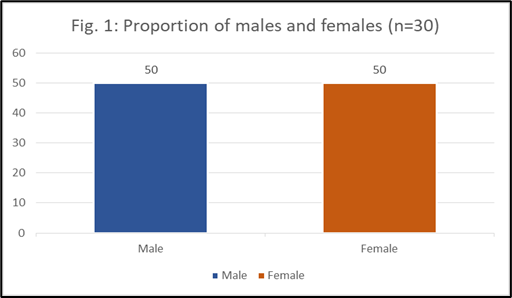
Our study found that the onset of sensory block was 8.32±2.96 minutes. The duration for which the sensory block was maintained was 210 minutes. The range of duration for which the sensory block was maintained varied from a minimum of 177.5 minutes to a maximum of 222.5 minutes. The time taken to attain the motor block using 0.25% levobupivacaine was 14.78±3.85 minutes. The duration for which the motor block could be sustained was 180 minutes. The range for maintenance of motor block varied from a minimum of 160 minutes to a maximum of 210 minutes (Table 1 & Figure 1).

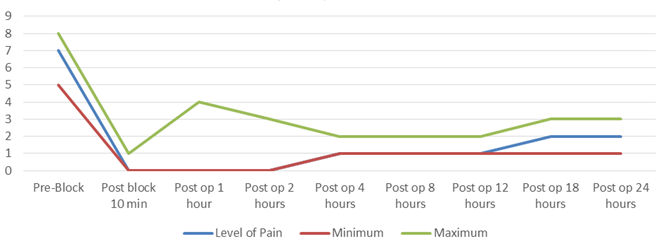
The patients were also assessed for pain on a scale of 0 to 10, with 0 being the painless after the block while 10 being most painful. There was no feeling of pain at 10 minutes, one hour and 2 hours post operatively and the maximum scale was recorded to be 7 when the anaesthetic was not administered before the procedure started. The pain on the scale of 1 was felt at 4 hours post operatively. The pain at 8 hours post operatively was also felt at a level of 1 and similarly, the level of pain was 1 after 12 hours of operation. The level of pain gradually increased to 2 after 18 hours as well as after 24 hours after the operation (Figure 2).


Table 1: Onset and Duration of Sensory and Motor Block among the Patients Receiving 0.25% Levobupivacaine (N=30)

Onset of sensory block (min) [mean±SD]

8.32±2.96 

Onset of motor block(min) [mean±SD] 

14.78±3.85 

Duration of sensory block(min) median[range]

210 [177.5- 222.5] 

Duration of motor block(min) Median[range] 

180 [160.0- 210.0] 


Figure 1: Proportion of males and females


Figure 2: level of pain after administration of 0.25% lignocaine

DISCUSSION

Regional anaesthesia allows a procedure to be done on a region of body without your being unconscious. Rapid onset of sensory block and prolonged postoperative analgesia with stable hemodynamic without side effects are important goals in regional anaesthesia. The supraclavicular level is an ideal site to achieve anaesthesia of the entire upper extremity just distal to the shoulder as the plexus remains relatively tightly packed at this level, resulting in a rapid and high-quality block [8]. Supraclavicular blocks have been administered at the level of nerve trunk of the brachial plexus.


Among the local anaesthetics used during supraclavicular block, levobupivacaine has better therapeutic profile and less cardio depressant effect and therefore preferred over commonly used bupivacaine [9]. The decreased toxicity of levobupivacaine is attributed to its S enantiomer and faster protein binding rate whereas ropivacaine a long-acting pure S enantiomer is considered to be less cardiotoxic than bupivacaine with similar pharmacodynamics properties. However, ropivacaine is less likely to penetrate large myelinated motor nerve fibres, resulting in a relatively reduced motor blockade. 


Abdel Hamid et al. [10] reported that onset of sensory block was significantly later in the patients who received 0.25% levobupivacaine. Whereas, Urbanek et al. [11] reported that sensory onset times and analgesic quality of blockade 30 min (23–36 min) and were not significantly different among levobupivacaine 0.5% and levobupivacaine 0.25%. 


Di Donato et al. [12] also assessed the effect of 0.25% levobupivacaine on the sensory and motor block onset as well as the duration for which the effect of the anaesthetic lasted. Their findings were in discordance with our study. In a study by Cox et al., [13] the onset time of levobupivacaine 0.25% ranged from a mean of 8±3 minutes in supraclavicular brachial plexus block with 0.4 ml/kg. They also suggested that the long duration of sensory block illustrates the benefit of 0.25% levobupivacaine in providing prolonged postoperative analgesia. The study also showed that the higher dermatomes were blocked more consistently than the lower ones, as expected with the supraclavicular approach [13].


In the study by Srinivasa et al. the efficacy of 4mg dexamethasone [4 mg vs. 8 mg] as an adjuvant to levobupivacaine (0.25%) in interscalene brachial plexus block using nerve stimulation technique was done. The duration of analgesia was prolonged. Similarly, the duration of motor block was longer. Postoperative analgesic consumption for the first 48 hours was lower. The authors concluded that the addition of dexamethasone to 0.25% levobupivacaine significantly prolonged the duration of the motor block and improved the quality of analgesia following interscalene block [14]. The meta-analysis by Kirkham et al. [15] suggested that 4 mg of perineural dexamethasone represents a ceiling dose and prolongs analgesia by a mean period of 6 and 8 hours, when combined with short-/intermediate- or long-acting local anaesthetics, respectively; higher doses failed to provide additional analgesic duration. Furthermore, it has been established in a meta-analysis that increasing perineural dexamethasone dose above 4 mg does not have any clinical impact [16]. 

CONCLUSION

The onset of sensory and motor blockade in the patients being administered with 0.25% levobupivacaine mixed with the adjuvant dexamethasone 4 mg is slow. The duration for which the motor and sensory block attained was shortened. The patients experienced some level of pain between the onset through the offset of the anesthesia. Further studies are needed to critically evaluate the effectiveness of 0.25% levobupivacaine in comparison to other frequently used doses of levobupivacaine.

REFERENCE
  1. Marban, E. et al. "Structure and function of voltage-gated sodium channels." Journal of Physiology, vol. 508, 1998, pp. 647–57.

  2. Gupta, P.K. and Hopkins P.M. "Effect of concentration of local anaesthetic solution on the ED₅₀ of bupivacaine for supraclavicular brachial plexus block." British Journal of Anaesthesia, vol. 111, 2013, pp. 293–96.

  3. Bajwa, S.S. and Kaur J. "Clinical profile of levobupivacaine in regional anaesthesia: A systematic review." Journal of Anaesthesiology Clinical Pharmacology, vol. 29, 2013, pp. 530–39.

  4. Leone, S. et al. "Pharmacology, toxicology and clinical use of new long acting local anaesthetics, ropivacaine and levobupivacaine." Acta Biomedica, vol. 79, 2008, pp. 92–105.

  5. Burlacu, C.L. and Buggy D.J. "Update on local anaesthetics: Focus on levobupivacaine." Therapeutics and Clinical Risk Management, vol. 4, 2008, pp. 381–92.

  6. Dhumane, P. and Shakir N. "Supraclavicular brachial plexus block with and without dexamethasone as an adjuvant to local anaesthetics: A comparative study." International Journal of Biomedical Advance Research, vol. 7, 2016, pp. 456–59.

  7. Albrecht, E. et al. "A systematic review and meta-analysis of perineural dexamethasone for peripheral nerve blocks." Anaesthesia, vol. 70, 2015, pp. 71–83.

  8. El-Soudy, E.M. et al. "The effect of ketamine as adjuvant in ultrasonic guided supraclavicular brachial plexus block." The Egyptian Journal of Hospital Medicine, vol. 76, 2019, pp. 4643–48.

  9. Ilham, C. et al. "Efficiency of levobupivacaine and bupivacaine for supraclavicular block: A randomized double-blind comparative study." Revista Brasileira de Anestesiologia, vol. 64, 2014, pp. 177–82.

  10. Abdelhamid, B.M. and Omar H. "Nalbuphine as an adjuvant to 0.25% levobupivacaine in ultrasound-guided supraclavicular block provided prolonged sensory block and similar motor block durations (RCT)." Journal of Anaesthesia, vol. 32, 2018, pp. 551–57.

  11. Urbanek, B. et al. "Onset time, quality of blockade and duration of three-in-one blocks with levobupivacaine and bupivacaine." Anaesthesia and Analgesia, vol. 97, 2003, pp. 888–92.

  12. Di Donato, A. et al. "Efficacy and comparison of 0.5% levobupivacaine with 0.75% ropivacaine for peribulbar anaesthesia in cataract surgery." European Journal of Anaesthesiology, vol. 23, no. 6, 2006, pp. 487–90.

  13. Cox, C.R. et al. "Comparison of S(–)-bupivacaine with racemic (RS)-bupivacaine in supraclavicular brachial plexus block." British Journal of Anaesthesia, vol. 80, 1998, pp. 594–98.

  14. Nallam, S.R. "Interscalene brachial plexus block: Comparison of efficacy of varying doses of dexamethasone combined with levobupivacaine: A double-blind randomized trial." Journal of Evolution of Medical and Dental Sciences, vol. 3, 2014, pp. 6900–08.

  15. Kirkham, K.R. et al. "Optimal dose of perineural dexamethasone to prolong analgesia after brachial plexus blockade: A systematic review and meta-analysis." Anaesthesia and Analgesia, vol. 126, 2018, pp. 270–79.

  16. Albrecht, E. et al. "A systematic review and meta-analysis of perineural dexamethasone for peripheral nerve blocks." Anaesthesia, vol. 70, 2015, pp. 71–83.

License
CC BY-NC-ND
Creative Commons Attribution-NonCommercial-NoDerivatives 4.0 International License
Estimating the Effect of 0.25% Levobupivacaine and its Adjuvant Dexamethasone on Sensory and Motor Functions: A Cross-Sectional Study in a Medical College of Rural India © 2026 by Ajay Kumar Verma licensed under CC BY-NC-ND 4.0
All papers should be submitted electronically. All submitted manuscripts must be original work that is not under submission at another journal or under consideration for publication in another form, such as a monograph or chapter of a book. Authors of submitted papers are obligated not to submit their paper for publication elsewhere until an editorial decision is rendered on their submission. Further, authors of accepted papers are prohibited from publishing the results in other publications that appear before the paper is published in the Journal unless they receive approval for doing so from the Editor-In-Chief.
Himalayan Journal of Medicine and Surgery open access articles are licensed under a Creative Commons Attribution-Share A like 4.0 International License. This license lets the audience to give appropriate credit, provide a link to the license, and indicate if changes were made and if they remix, transform, or build upon the material, they must distribute contributions under the same license as the original.
Recommended Articles
Research Article
Phenotypic Characterization and Antimicrobial Resistance Patterns of Clinical Klebsiella pneumoniae Isolates from Al-Najaf Teaching Hospital
Published: 30/06/2026
Download PDF
Research Article
Impact of Gut-Liver Axis: Hepatic Biochemical and Metabolic Changes Associated with Chronic Gastritis in Iraqi Patients with Helicobacter Pylori
Published: 20/02/2026
Download PDF
Research Article
Effect of Land Degradation on Livelihood
Published: 04/01/2024
Download PDF
Research Article
Awareness and Practices among Professional Healthcare Workers towards COVID-19 in Iraq
...
Published: 30/03/2024
Download PDF
Flowbite Logo
Najmal Complex,
Opposite Farwaniya,
Kuwait.
Email: support@himjournals.com

Useful Links
Order Hard Copy
Privacy policy
Terms and Conditions
Refund Policy
Others
About Us
Team Members
Contact Us
Online Payments
Join as Editor
Join as Reviewer
Subscribe to our Newsletter
Follow us
MOST SEARCHED KEYWORDS
scientific journal
 | 
business journal
 | 
medical journals
 | 
Scientific Journals
 | 
Academic Publisher
 | 
Peer-reviewed Journals
 | 
Open Access Journals
 | 
Impact Factor
 | 
Indexing Services
 | 
Journal Citation Reports
 | 
Publication Process
 | 
Impact factor of journals
 | 
Finding reputable journals for publication
 | 
Submitting a manuscript for publication
 | 
Copyright and licensing of published papers
 | 
Writing an abstract for a research paper
 | 
Manuscript formatting guidelines
 | 
Promoting published research
 | 
Publication in high-impact journals
Copyright © Himalayan Journals . All Rights Reserved.