Contents
Download PDF
pdf Download XML
2185 Views
379 Downloads
Share this article
Research Article | Volume 3 Issue 1 (Jan-June, 2022) | Pages 1 - 5
Composite Cephalometric Analysis for Orthognathic Surgery (CCAOS)
 ,
 ,
1
Department of Orthodontics, Vokkaligara Sangha Dental College and Hospital, India
Under a Creative Commons license
Open Access
Received
Dec. 23, 2021
Revised
Jan. 4, 2022
Accepted
Feb. 22, 2022
Published
March 20, 2022
Abstract

The Successful Treatment Depends on Careful Diagnosis. The Role of Orthodontist in Orthognathic Surgery Cases Is to Evaluate the Skeletal Problem, Identify and Quantify the Same. There Are Various Cephalometric Analysis to Evaluate the Orthognathic Surgery Cases Such as Cephalometric Analysis for Orthognathic Surgery (COGS), Quadrilateral Analysis, Arnett Analysis, Burstone and Legan Soft Tissue Cephalometric Analysis, etc. All These Analysis Were Based on Hard Tissue References with the Paradigm Shift to Soft Tissue. It Is Very Difficult to Do So Many Analyses for Each Case. There Are Many Common Overlapping Parameters in These Analysis. The Commonly Used Analysis Are Burstone's Cephalometric Analysis for Orthognathic Surgery (COGS), Dipaolo's Quadrilateral Analysis, Arnett's Soft Tissue Cephalometric Analysis (STCA). Hence, An Attempt Is to Combine the Overlapping Parameters of These Three Analysis and Composite Cephalometric Analysis for Orthognathic Surgery (CCAOS) Is Arrived and Is Presented.


Keywords
INTRODUCTION

The assessment of craniofacial dimension is not a new skill in orthodontics. Cephalometry is used to assess craniofacial growth and determine treatment responses. Cephalometric radiology was introduced in orthodontics during the 1930’s but the method really gained wider acceptance for practical application during the last 20 years [1]. Over the years, whole range of analysis has been developed by number of authors. The analysis will only supply answers to a particular set of questions and these answers will depend on correct application of the method and interpretation of results.


The successful treatment of orthodontics of orthognathic surgical treatment is dependent on careful diagnosis. It is important for the clinician to be able to predict the soft tissue changes resulting from alterations of the hard tissue. Many studies have attempted to evaluate the relationship between hard tissue surgery and the effects it has on the overlying soft tissue [2]. Though cephalometric analysis has its limitations, it is a tool which will guide us in planning orthodontic treatment.


The various cephalometric analysis given by many authors such as Cephalometric Analysis for Orthognathic Surgery (COGS) [3], Quadrilateral Analysis [4], Arnett Analysis [5], Burstone and Legan Soft Tissue Cephalometric Analysis [6], etc., were used for surgical patients for interpretation of results. All these analyses were based on hard tissue references with the paradigm shift to soft tissue. Arnett and Bergman [5], presented the facial keys to orthodontic diagnosis and treatment planning.


Widely used cephalometric analysis for surgical analysis of an orthognathic surgery case are


  • Burstone’s Cephalometric Analysis for Orthognathic Surgery (COGS)

  • DiPaolo’s Quadrilateral Analysis

  • Arnett’s Soft Tissue Cephalometric Analysis (STCA


Though each analysis has its own merits and demerits, there are many overlapping parameters studied by these three authors. Hence, the aim of the present study is to identify the significant parameters and overlapping parameters from the above analyses and to arrive at a CCAOS.


Obtaining The Lateral Cephalometric Radiograph            

Lundstrom and Lundstrom [7] findings indicate that a horizontal line, related to natural head position, adjusted to natural head orientation when indicated, presents the most reliable basis for cephalometric analysis. Some patients assume an “Unnatural head position”. Accordingly, these patients need adjustment to “natural head orientation” [5].


Anatomical Landmarks Used for the Analysis

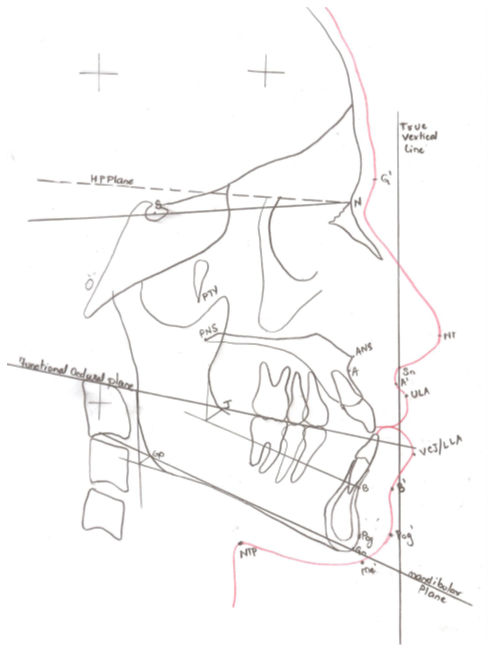
The landmarks used in the cephalometric analysis are the following (Figure 1).


Hard Tissues

Sella (S), Nasion (N), Pterygomaxillary fissure (PTM), Subspinale (A), Supramentale (B), Pogonion (Pog), Anterior nasal spine (ANS), Posterior Nasal Spine (PNS), Gnathion (Gn), Gonion (Go) [3], J point, Nasal floor [4].


Soft Tissues

Glabella (G’), Nasal Tip (NT), Subnasale (Sn), Subspinale (A’), Submentale (B’), Upper Lip Anterior (ULA), Lower Lip Anterior (LLA), Pogonion (Pog’) [5].


Reference Planes

COGS [3]- Hard tissue-horizontal plane (H-P) [Surrogate Frankfurt Horizontal plane].

STCA [5] - Soft tissue –True vertical line.


Other Planes

Palatal plane- ANS-PNS [4], Mandibular Plane (MP)- GoGn [3,4] and Functional Occlusal Plane [3].
MATERIALS AND METHODS

Cephalogram of an adult patient with skeletal malocclusion case is taken. Lateral Cephalogram is traced using 4H lead pencil on Acetate tracing paper.


Linear Measurements

Hard Tissue: In this most of the measurements are made either parallel or perpendicular to HP plane.


Figure 1: Anatomic Land Marks and Reference Planes

Chin Prominence

Perpendicular line from H-P plane is dropped from point N. Distance from Pog to this line indicates the prominence of chin. These measurement help determine if there is horizontal genial hyperplasia or hypoplasia.


Vertical Skeletal and Dental Discrepancy

Posterior Maxillary Height: Posterior maxillary height is the length of perpendicular line dropped from HP intersecting the PNS


Vertical Dental Dysplasia

It is divided into Anterior and Posterior Components:


Anterior Maxillary Dental Height and Mandibular 

Dental Height


  • Perpendicular from Upper incisor (U1) to nasal floor (ANS-PNS).

  • The tip of the Lower incisor (L1) to Mandibular plane (Go-Gn).


Posterior Dental Measurement


  • Perpendicular length of a line through the maxillary first molar mesiobuccal cusp tip to MP

  • It is a similar line through the mandibular first molar mesiobuccal tip of the cusp constructed to MP


Skeletal Assessment

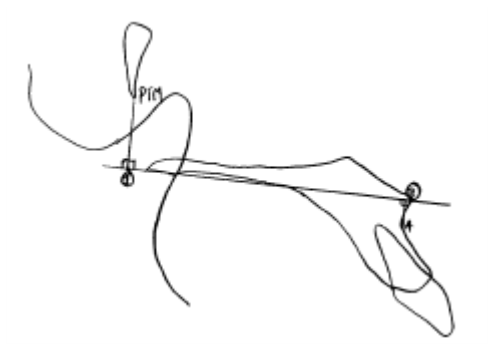
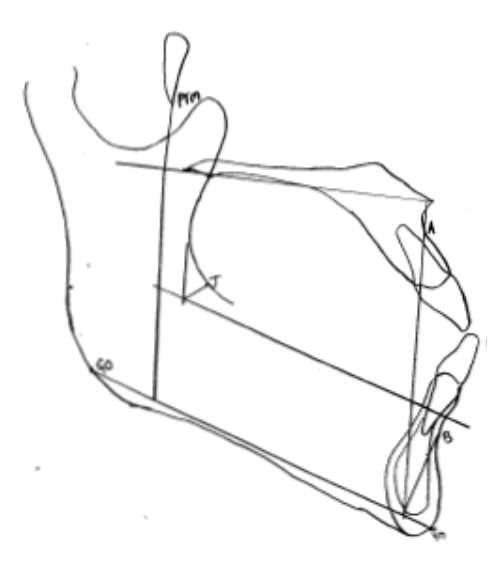
Maxillary Base Length: Horizontal linear measurement along the palatal plane between the two points. The anterior limit is determined by projecting a perpendicular from point A upward to palatal plane (ANS-PNS), while the posterior limit is determined by projecting a perpendicular from the most inferior portion of Pterygomaxillary Fissure (PTM) downward to palatal plane (Figure 2).


Mandibular Base Length

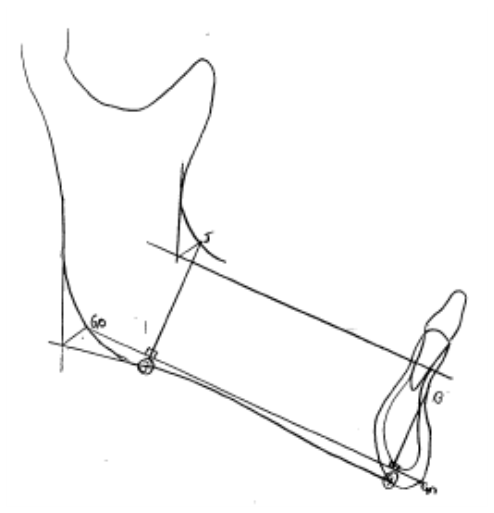
Mandibular Base Length is measured horizontally along the Go-Gn plane between the two points. 


Figure 2: Maxillary Base Length


Figure 3: Mandibular Base Length


Figure 4: Assessment of Proportionality


The anterior limit is determined by projecting a perpendicular from point B downward to the mandibular plane (Go Gn), while the posterior limit is determined by projecting a perpendicular from point J downward to the mandibular plane (Go Gn) (Figure 3).


Proportionality

The quadrilateral analysis indicates that in a balanced facial pattern a 1:1 ratio exists between the maxillary and mandibular bony base lengths.


Maxillary length = Mandibular length = ALFH+PLFH

Dental Assessment


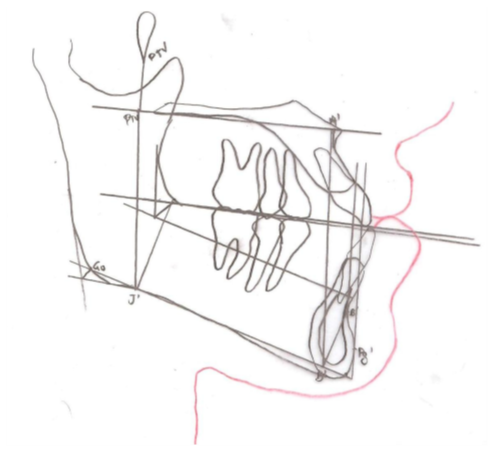
  • Maxillary Incisor Position: determined by drawing line through point A parallel to the anterior lower facial height (ALFH). A perpendicular from this line to the most anterior point on the maxillary incisor (Figure 5)

  • Mandibular Incisor Position: determined by drawing line through point A parallel to the anterior lower facial height (ALFH). A perpendicular from this line to the most anterior point on the mandibular incisor

  • Chin Position: determined by drawing line tangent to the Pog parallel to the anterior lower facial height (ALFS). A perpendicular from this line to most anterior point on the mandibular incisor. This measurement will indicate if the chin is excessive or deficient in size


Saggittal Ratio

Extend the Quadrilateral to meet at a point. It forms an isosceles triangle. It is divided into anterior and posterior legs. The anterior legs are formed by maxillary and mandibular base and posterior legs formed extending the anterior legs to meet at a common point. This helps in pinpointing the area of deformity whether or not surgical procedure is indicated.


  • Posterior Divergence of the Mandible: It is shown by MP angle. It is the angle formed between a line from Go-Gn (MP) and HP as it intersects at Gn. Posterior maxillary height and MP angle defines the vertical dysplasia of the posterior components

  • Angle Of Facial Convexity: is the angle formed between N, projection of point A onto the palatal plane and projection of point B onto mandibular plane (Go-Gn)


Soft Tissue

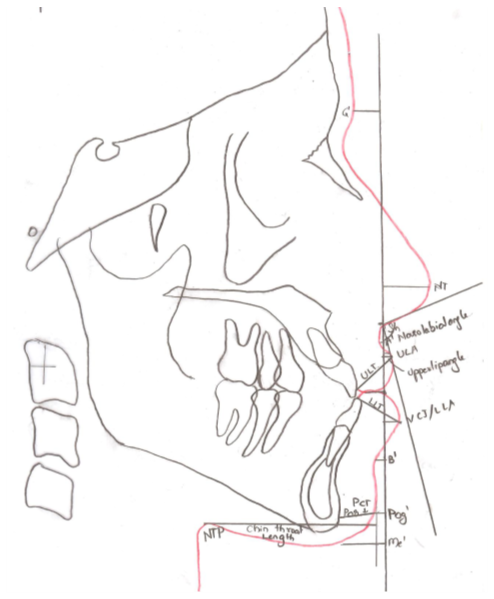
Most of the measurements were made either parallel or perpendicular TVL. The factors considered and measured in this analysis for SCCA are:


Dentofacial Factors


  • Overjet: parallel lines are drawn from incisal edge of upper and lower incisors to True vertical line (TVL) and distance between these 2 parallel lines are measured

  • Overbite: Perpendicular lines are drawn from incisal edge of upper and lower incisors to True Vertical Distance Line (TVL) and the distance between these two perpendicular lines are measured


Soft Tissue Thickness


  • Upper Lip (ULT): Measured from inside of upper lip to upper lip anterior

  • Lower Lip (LLT): Measured from inside of lower lip to lower lip anterior or vermilion-cutaneous junction

  • Pogonion–Chin (PCT): Measured from hard tissue pogonion (Pog) to soft tissue pogonion (Pog’)


Soft Tissue Lengths


  •  Upper Lip Length: Distance between the projection of subscale to TVL and projection of upper lip inferior to TVL


Figure 5: Dental Assessment


Figure 6: Soft Tissue Assessment


  • Lower Lip Length: distance between the projection of lower lip inferior to TVL and projection of soft tissue Menton (Me’) to TVL


True Vertical Line Projection

this gives thickness of overlying soft tissue in relation to TVL.


High Midface


  • Glabella(G’) to TVL


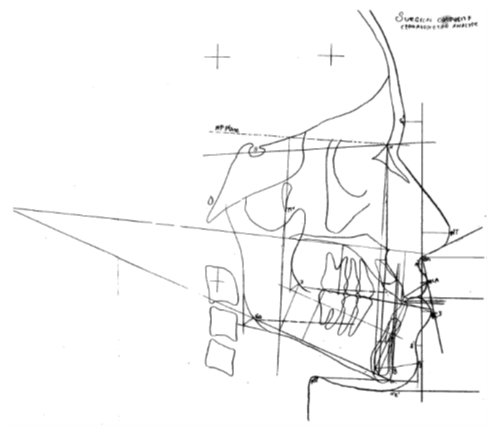
Figure 7: Composite Cephalometric Analysis for Orthognathic Surgery


Maxillary Projections


  • Nasal tip (NT)to TVL
  • Soft tissue points A (A’) to TVL


Mandibular Projections


  • Lower lip anterior (LLA) to TVL
  • Soft tissue points B (B’) to TVL  
  • Soft tissue pogonion (Pog’) to TVL
  • Throat length: neck throat point (NTP) to soft tissue pogonion (Pog’)


Upper Lip Angle

Angle formed between tangent to upper lip anterior to TVL.


Nasolabial Angle

Angle formed between tangent to upper lip anterior, sub nasale and columella.

DISCUSSION

COGS do not offer a complete diagnostic assessment of both anteroposterior and vertical skeletal dysplasia. Diagnostic methods that are currently used are unable to “pinpoint” where the skeletal discrepancy exists or the magnitude of that discrepancy. The quadrilateral analysis shows that this is a vertical problem only and not an anteroposterior disharmony in jaw size4. Arnett’s Soft tissue cephalometric analysis is a method for quantifying facial disharmony and identifying its underlying cause. This is important because, as a rule, improved facial aesthetics are achieved if the underlying problems are identified and treated5. Hence, an attempt is made to study the advantages and disadvantages of these three widely used analysis and present it in a compact manner for better diagnosis. The standardized values for the Composite Cephalometric Analysis for Orthognathic Surgery (CCAOS) are being listed in Table 1.

CONCLUSION

The orthognathic surgical cases require proper planning and implementation of the treatment strategies. One cephalometric analysis cannot yield the proper inference for planning the surgical procedures hence these three analysis tracings which are widely used were simplified henceforth, saving a lot of time for the clinician, patient as well as for the proper outcome of the treatment.


Table 1: The Standard Values for the Composite Cephalometric Analysis for Orthognathic Surgery

 NormsFemale±SDMale±SD
  1.  
Horizontal skeletal 

N-A 

-2 ±3.7mm0±3.7mm

N-B

-6.9±4.3mm-5.3±6.7mm

N-Pog  

-6.5 ±5.1mm-4.3±8.5mm
B.Vertical (skeletal, dental)
PNS-N50.6±2.2mm53.9±1.7mm
MP-HP Angle24.20±50230±5.90
Upper incisor to NF27.5±1.7mm30.5±2.1mm
Lower incisor to MP40.8±1.8mm45±2.1mm
Upper molar to NF32±1.9mm35.8±2.6mm
Lower molar to MP32±1.9mm35.8±2.6mm
C.Skeletal 
Maxillary bony base length50.9±2mm

Mandibular bony base length

50±2.5mm
DiscrepancyN/M
Posterior legs of maxillaN/M
Posterior legs of mandibleN/M
Lower anterior facial height60±3.5mm
Lower posterior facial height39.4±2.2mm
Upper anterior facial height49.2±2.3mm
Maxillary incisor position5±1mm
Mandibular incisor position2±1mm
Chin position0±2mm
Angle of convexity169.5±3.20
D.Dentoskeletal factors
Overjet3.2±0.4mm3.0±0.6mm
Overbite3.2±0.7mm3.2±0.7mm
E.Soft tissue thickness  
Upper lip12.6±1.8mm14.8±1.4mm
Lower lip13.6±1.4mm15.1±1.2mm
Pogonion-chin11.8±1.5mm13.5±2.3mm
F.Soft tissue lengths
Upper lip21±1.9mm24.4±2.5mm
Lower lip46.9±2.3mm54.3±2.4mm
G.True vertical line projection

Glabella

8.5±2.4mm-8±2.5mm

Nasal projection

16±1.4mm17.4±1.7mm

Soft tissue points A

0.1±1.0mm-0.3±1.0mm

Upper lip anterior

3.7±1.2mm3.3±1.7mm

Upper lip angle

12.1±5.108.3±5.40

Nasolabial angle

103.5±6.80106.4±7.70

Lower lip anterior

1.9±1.4mm1±2.2mm

Soft tissue B point

5.3±1.5mm7.1±1,6mm

Soft tissue pogonion

2.6±1.9mm-3.5±1.8mm

Chin throat length

58.2±5.8mm61.4±7.4mm


REFERENCES
  1. R, Thomas and T.M, Graber. "Colour atlas of dental medicine - orthodontic diagnosis." Thieme Publications, 1993.

  2. M.T, Chew. "Soft and hard tissue changes after bimaxillary surgery in Chinese class III patients." Angle Orthod, vol. 75, 2005, pp. 959–963.

  3. C.J, Burstone et al. "Cephalometrics for orthognathic surgery." J Oral Surg, vol. 36, no. 4, 1978, pp. 269–277.

  4. R.J, Di Paolo et al. "The quadrilateral analysis: an individualized skeletal assessment." Am J Orthod Dentofacial Orthop, vol. 83, no. 1, 1983, pp. 19–32.

  5. G.W, Arnett et al. "Soft tissue cephalometric analysis: diagnosis and treatment planning of dentofacial deformity." Am J Orthod Dentofacial Orthop, vol. 116, 1999, pp. 239–253.

  6. H.L, Legan and C.J, Burstone. "Soft tissue cephalometric analysis for orthognathic surgery." J Oral Surg, vol. 38, no. 10, 1980, pp. 744–751.

  7. A, Lundstrom and F, Lundstrom. "Frankfort horizontal basis for cephalometric analysis." Am J Orthod Dentofacial Orthop, vol. 107, 1995, pp. 537–540.

Advertisement
Recommended Articles
Case Report
Management of Urethral Prolapse in Girls at the Jeanne Ebori Foundation Mother-Child University Hospital: A Report of 7 Cases
...
Published: 25/10/2025
Download PDF
Research Article
Epidemiological And Therapeutic Aspects of Spermatic Cord Torsion in The Pediatric Surgery Department of the mother and Child University Hospital of Libreville from January 2019 to October 2022
...
Published: 02/11/2025
Download PDF
Research Article
Clinicopathological Profile and Disease Presentation Patterns in Colorectal Cancer: A Prospective Observational Study from a Tertiary Care Center in North India
...
Published: 05/04/2025
Download PDF
Review Article
Clinicopathological Profile of Colorectal Cancer Patients: A Contemporary Review
Published: 05/04/2025
Download PDF
Chat on WhatsApp
Flowbite Logo
Najmal Complex,
Opposite Farwaniya,
Kuwait.
Email: kuwait@iarcon.org

Editorial Office:
J.L Bhavan, Near Radison Blu Hotel,
Jalukbari, Guwahati-India
Useful Links
Order Hard Copy
Privacy policy
Terms and Conditions
Refund Policy
Others
About Us
Contact Us
Online Payments
Join as Editor
Join as Reviewer
Subscribe to our Newsletter
Follow us
MOST SEARCHED KEYWORDS
scientific journal
 | 
business journal
 | 
medical journals
 | 
Scientific Journals
 | 
Academic Publisher
 | 
Peer-reviewed Journals
 | 
Open Access Journals
 | 
Impact Factor
 | 
Indexing Services
 | 
Journal Citation Reports
 | 
Publication Process
 | 
Impact factor of journals
 | 
Finding reputable journals for publication
 | 
Submitting a manuscript for publication
 | 
Copyright and licensing of published papers
 | 
Writing an abstract for a research paper
 | 
Manuscript formatting guidelines
 | 
Promoting published research
 | 
Publication in high-impact journals
Copyright © iARCON Internaltional LLP . All Rights Reserved.