Objective: To evaluate the effect of electroacupuncture involving the lumbosacral region for patients with Neurogenic Bowel Dysfunction (NBD) secondary to Spinal Cord Injury (SCI). Materials and Methods: 10 cases received electroacupuncture therapy from February 2020 and February 2022. Patients were evaluated at baseline and week 4. The outcomes including Neurogenic Bowel Dysfunction score (NBD score), mean anal canal resting pressure, mean maximum systolic pressure, initial sensory threshold and maximal sensory threshold during anorectal manometry. Adverse events were recorded. Results: 12 SCI patients were recruited in this trial. Significant differences between baseline and week 4 after treatment with respect to mean NBD score (14.62 vs. 7.06, p <0.001), mean maximum anal canal resting pressure (32.11 cmH2O vs. 50.94 cmH2O, p <0.001) , mean maximum systolic pressure (56.02 cmH2O vs. 71.33 cmH2O, p <0.001) , mean initial sensory threshold (49.08 ml vs. 33.29 ml, p <0.001) and mean maximal sensory threshold (220.84 ml vs. 179.21 ml, p <0.001), respectedly. No patients reported adverse events. Conclusions: Electroacupuncture is effective and safe for SCI patients with NBD.
Spinal Cord Injury (SCI) is one of the leading causes of disability worldwide. Prevalence of traumatic SCI in developed countries ranges from 280 to 906/million [1]. Patients with SCI often have bowel symptoms significantly impacting quality of life [2].
In the past ten years, as one of the most important branches of traditional Chinese medicine, acupuncture combining active electrical stimulation have improved bowel function for patients suffering from non-neurogenic bowel dysfunction [3,4]. The objective of our retrospective study was to evaluate the effect of electroacupuncture on patients with bowel dysfunction secondary to SCI.
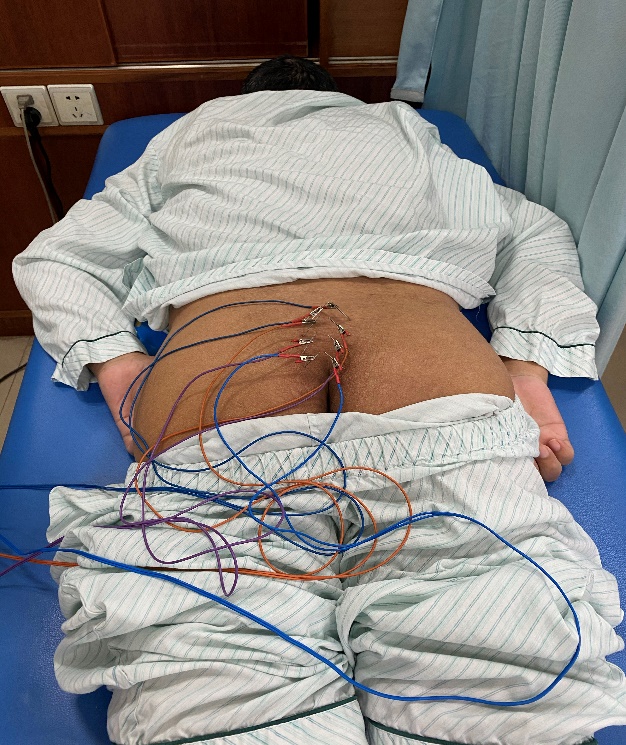
We reviewed the records of SCI patients who received electroacupuncture in our department from February 2020 and February 2022. Electro-acupuncture was performed on the acupoint of bilateral Shangliao (BL31), bilateral Ciliao (BL32), bilateral Zhongliao (BL33) and bilateral Xialiao (BL34) (Figure 1). 8 Paired electrodes from the electroacupuncture apparatus were attached transversely to the needle handles at bilateral BL31, BL32, BL33 and BL34. The electroacupuncture stimulation lasted for 30 minutes with a continuous wave of 50 Hz and a current intensity of 1 to 5 Ma. patients received 5 treatment sessions per week for 4 consecutive weeks. The outcomes including Neurogenic Bowel Dysfunction score (NBD score) [5], mean anal canal resting pressure, mean maximum systolic pressure, mean initial sensory threshold and mean maximal sensory threshold during anorectal manometry. Adverse events were also recorded. The study was approved by each hospital’s Ethics Committee. Student’s t-test was used for comparison of related variables and results are presented as means±standard deviation. The chi-square test was used for categorical data. A P value of 0.05 or less was considered statistically significant. Statistical analyses were performed with SPSS 13.0 software (SPSS, Inc., Chicago, IL).
The mean age of the 10 patients enrolled in the study was 32.4 years (range, 19-48 years) and the mean duration of SCI was 1.6 years (range, 0.5-3.02 years). There were 4 patients with thoracic level SCI and 6 patients with a lumbar level injury. Most patients had previously attempted therapy for neurogenic bowel dysfunction including oral tablets or drops against constipation
As listed in Table 1, significant differences between baseline and week 4 after treatment with respect to mean NBD score (14.62 vs. 7.06, p<0.001), mean maximum anal canal resting pressure (32.11 cmH2O vs. 50.94 cmH2O, p<0.001) , mean maximum systolic pressure (56.02 cmH2O vs. 71.33 cmH2O, p<0.001) , mean initial sensory threshold (49.08 ml vs. 33.29 ml, p<0.001) and mean maximal sensory threshold (220.84 ml vs. 179.21 ml, p<0.001), respectedly. No patients reported adverse events.
Acupuncture is a traditional Chinese medicine characterized by no or few side effects. It has been recommended widely for the treatment of bowel dysfunction 3. However, effects of electroacupuncture on Neurogenic Bowel Dysfunction (NBD) remain uncertain because of the high risks of bias in previous clinical trials. In our study, although the follow-up period was relatively short, electroacupuncture has been demonstrated to relieve NBD caused by SCI. Specifically, we found (1) according to our trial, patients showed significant improvement (58.64%) of the mean maximum anal canal resting pressure at week 4; and (2) most importantly, the patients mean maximum systolic pressure increased from 56.02 cmH2O to 71.33 cmH2O (p<0.0001).
Improvements in anorectal manometry outcomes also translated into better quality of life, which is another important treatment aim for SCI patients. The reasons may be related to the following changes:
The proportional improvement of mean initial sensory threshold and mean maximal sensory threshold was observed at week 12 Most importantly, 3 patients with NBD did not require digital stimulation or evacuation of the anorectum and NBD score from them was relatively high. Undoubtedly, these patients are less likely to worry about the disturbance from bowel dysfunction.
No patients developed systemic or significant adverse events of treatment in this trial. A limitation of this study is that the sample size was relatively small. Therefore, further studies are warranted.
Our results have demonstrated that electro-acupuncture is effective and safe for SCI patients with NBD.
Acknowledgment
This study was supported by Traditional Chinese Medicine of Guangdong Province, China (grant number 20211060, 20221064); Medical Scientific Research Foundation of Guangdong Province, China (grant number A2022190); and Science and Technology Program of Guangzhou, China (202102080006).
Table 1: Clinical outcomes at baseline and 4 weeks
| Outcome | Baseline | Week 4 | p-value |
| Number of patients | 10 | 10 | |
| Mean NBD score | 14.62±6.43 | 7.06±3.52 | <0.001 |
| Mean maximum anal canal resting pressure, cmH2O | 32.11±10.18 | 50.94±11.64 | <0.001 |
| Mean maximum systolic pressure, cmH2O | 56.02±19.83 | 71.33±22.47 | <0.001 |
| Mean initial sensory threshold, ml | 49.08±18.37 | 33.29±15.02 | <0.001 |
| Mean maximal sensory threshold, ml | 220.84±32.12 | 179.21±25.86 | <0.001 |

Figure 1: Location of Acupoints for the Electroacupuncture
Furlan, Julio C. et al. Krassioukov. "Global incidence and prevalence of traumatic spinal cord injury." Canadian Journal of Neurological Sciences, vol. 40, no. 4, 2013, pp. 456–464.
Krassioukov, Andrei et al. "Neurogenic Bowel Management after spinal cord injury: A Systematic Review of the Evidence." Spinal Cord, vol. 48, no. 10, 2010, pp. 718–733.
Song, Guangyu et al. "Acupuncture in Inflammatory Bowel Disease." Inflammatory Bowel Diseases, vol. 25, no. 7, 2019, pp. 1129–1139.
Simpson, L.A. et al. "The health and life priorities of individuals with spinal cord injury: a systematic review." Journal of Neurotrauma, vol. 29, no. 8, 2012, pp. 1548–1555.
Krogh, Klaus et al. "Neurogenic bowel dysfunction score." Spinal Cord, vol. 44, no. 10, 2006, pp. 625–631.