To implement integrated nurse’s service, there is a need for leaders to address healthcare developments. It is still unclear what kind of leadership is necessary, who professionals ought to fill this role and how these nursing leaders should be supported. The study literature continually emphasizes the significance of nursing leadership for building a high-standard healthcare system that consistently delivers safe and effective care, taking into consideration the terms of nursing leadership that have been published and synthesizing the literature to identify the characteristics, qualities or skills necessary to be a successful clinical leader and effective nursing leader in the hospital. Think about nursing leadership in primary care. The purpose of this study was to synthesize the evidence related to leadership and primary service performance in the hospital. A systematic literature review was performed using the PICO framework within Science Direct, PubMed CINAHL, Word Scientific and Doaj databases in the last 5 years, with keywords leadership, nursing or primary care. A systematic literature review was performed using the PICO framework within Science Direct, PubMed CINAHL, Taylor & Francis Online, Wiley Online Library, Word Scientific and DOAJ databases in the last 5 years, with keywords leadership, nursing or primary nursing services. Nurse practitioners were aware of the four components of transformative leadership: idealized influence, inspirational motivation, intellectual stimulation and individual consideration. Support from the leadership prepared for and aided with the implementation of integrated service performance. The majority of the studies recommended nurses' leadership skills required persistence, support and education for taking care of nurse’s service performance in hospitals.
Keywords
Leadership
Nursing
Nursing Service Performance
Hospital
INTRODUCTION
Globally, developed nations' health care systems continue to struggle with rising service and cost demands. Inefficient service design, such as outdated care models, contributes to budgetary needs that are unsustainable. Several different tasks have been connected to efficient clinical leadership. It is a prerequisite for hospital treatment and is a crucial part of the healthcare system. It affects system performance, the accomplishment of health reform objectives, timely care delivery, system integrity and system efficiency [1].
The nursing profession involves a lot of strain. Contrary to common assumptions, a nurse's responsibilities extend beyond simply monitoring patients' vital signs and giving medication. They have a variety of duties to take care of, including helping patients, supporting procedures, recording treatment and holding leadership positions in hospitals, health systems and other organizations. However, significant obstacles have arisen as a result of problems at the organizational, state and federal levels, making it challenging for nurses to perform their duties successfully. In order to effectively address every potential problem faced by nurses and discover the best ways to lessen those challenges, it is crucial to first recognize and understand those challenges [1].
One of the many problems that requires attention and the involvement of all parties involved in the health care industry is the nursing shortage. Nurses always work in a high-risk environment; they are prone to numerous occupational health hazards that have harmful effects both on their mental and physical health, as well as on their productivity and efficacy at work [1].
The near-impossible responsibilities of ensuring the quality of the care given in the unit, maintaining patient and family satisfaction with the care, achieving productivity objectives and attending to the needs of the personnel fall on nurse managers. Nurse managers must stay current with the most recent scientific advances in their profession due to the complex work environment. In order to get the best results, they must also be able to examine issues clearly and decide on the best course of action for each circumstance. Therefore, nurses in leadership roles must improve their problem-solving abilities. The most recent research advises that nurse manager candidates take additional training in a number of areas, such as problem-solving abilities. This training should be an essential part of orientation programs designed before promotion to managerial positions [2].
Within their respective healthcare organizations, nursing leaders are accountable for both the operational management of a ward or unit and the clinical leadership and care of patients. Engaging and collaborating with teams, helping them achieve clinical outcomes and high-quality patient care and changing healthcare practices are all part of the leadership responsibility. In terms of administration, nurse unit managers strive to keep their staff members happy and committed, to preserve their ward or unit budgets and to ensure that their setting adopts organizational imperatives and strategic goals. Primary care in hospitals is very important to taking care of patients [3].
MATERIALS AND METHODS
Briefly, to obtain the evidence regarding leadership in nursing and primary care, we first used a non-systematic search across numerous databases to find published, peer-reviewed research articles. To create the compendium of papers about nursing leadership and primary care in hospitals, we first identified and retrieved primary studies from these published research papers after processing eligible studies. To synthesize the quantitative and qualitative data, respectively, we created a narrative summary and a thematic synthesis. To combine the results of the first two syntheses, we performed a third synthesis. There was no set protocol for this non-systematic review. As there were no human subjects involved in this study, neither informed consent nor review by an ethical committee were necessary.
The PICO Literature Review was used to conduct the literature review (Table 1). framework within ScienceDirect, PubMed CINAHL, Word Scientific and DOAJ (Directory of Open Access Journals) databases in the last 5 years, with keywords leadership, nursing management AND hospital, primary care. Reviews of the gathered articles' references and abstracts were also done.
The following inclusion criteria were used to evaluate the titles and abstracts of manuscripts for their relevance to the subject:
Empirical quantitative, qualitative or mixed-methods studies
Published in peer-reviewed journals between 2017 and 2022
Written in English
Table 1. Description of the PICO Literature Review
P
Patient, Population, Problem
Nurse’s
I
Intervention
Leadership
C
Comparison Intervention (if appropriate)
NA
O
Outcome to Measure or Achieve
Service performance in hospitals
The complete article was reviewed to assess whether inclusion was appropriate if relevance could not be determined from the initial review. Following the first collection, the complete texts of the articles were evaluated to determine whether they would ultimately be included in the review. Eight articles met the requirements for inclusion. Data were extracted into a Journal Citation Report (JCR) to review study characteristics and rate levels of evidence for each article. We conducted an analysis of the research articles identified using the PICO (Population, Intervention, Comparison, Outcome) framework.
We gathered information regarding each full-text's publication year, database searches, research population and environmental changes. The authors separately reviewed the publications' full texts, summaries and titles. The complete texts of potential publications were retrieved by the authors and they ultimately decided which ones to include in the review based on the publications' relevance to the topic, the caliber of the studies, the weight of the evidence and the inclusion and exclusion criteria. Disagreements were settled by conversation or, if necessary, by contacting another author.
Each article that was kept was evaluated, with the main data being added to a table of evidence that summarized the research procedures and conclusions. The characteristics, methods, environmental modification assessment, outcome and advice are summarized in the supplementary table (Table 2).
Each study's potential for bias was not assessed. The general caliber of the evidence was not evaluated. The discussion helped to settle the findings regarding the possibility of bias and quality rating.
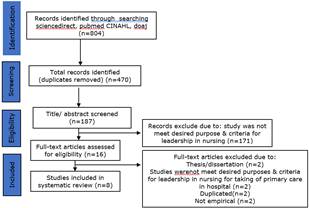
We focused on articles that considered nurses' leadership and nurses' service performance in hospitals. During the preliminary search, 802 citations and abstracts in total were evaluated. The abstract review rejected 171 entries and 16 were evaluated in full text. After full-text screening, eight papers were eliminated and eight studies were finally included in the analysis (Figure 1).
Figure 1: PRISMA Flow Diagram of Included Studies
Table 2: Mapping Table
No.
Author
Year
Sample
Location
Method
Result
1
Gunawan et al. [4]
2020
247 first-line nurse managers from 18 hospitals
Indonesia
A cross-sectional study
The five factors of managerial competence were identified: performance appraisal (ß = 0.476, p < 0.001), career advancement (ß = 0.425, p < 0.001), recruitment and selection (ß = 0.354, p < 0.001), larger hospitals (ß = 0.165, p = 0.001) and management training attendance (ß = 0.109, p = 0.029), which collectively explained 44.9% of the variance in managerial competence.
2
Poghosyan and Bernhardt [5]
2018
278 nurse practitioners
New York State
A cross-sectional survey design
The four factors of transformational leadership idealized influence, inspirational motivation, intellectual stimulation and individual consideration were recognized by nurse practitioners. Almost half of nurse practitioners reported that leadership did not share information equally between nurse practitioners and physicians (idealized influence) and 45.9% reported that nurse practitioners were not represented on important organizational committees (intellectual stimulation).
3
Al-Dossary [6]
2022
390 participants
Saudi Arabian
a cross-sectional design using an online survey instrument targeted at nurse managers and nurses working in Saudi Arabian hospitals.
Among the participants, 84.4% were nurses and 15.6% were nurse managers. significant difference (p <0.05) of opinions is observed among nurse managers in relation to transformational and transactional leadership styles and engagement. Transformational and transactional leadership are positively correlated with organizational commitment and nurses’ engagement.
4
Vahdat et al. [7]
2022
50 managers working in hospitals
Iran
The present study used an exploratory
Based on the interviews and extracted data, the findings were identified in five main themes: (1) strategic goals and needs assessment in line with the organization’s goals; (2) Strategic communication and organizational structure, (3) talent identification and empowerment, (4) development and excellence of qualified individuals and (5) monitoring of succession planning programs.
5
Lamb et al. [8]
2018
78 participants
Eastern Canada
Purposive sampling of advanced practice nurses working in tertiary acute care facilities in Eastern Canada were employed. Data sources included face-to-face interviews and document analysis.
Two main themes were identified: "patient-focused leadership” and "organization. And system- Focused leadership”. These two Themes are further Described through Leadership domains and Capabilities that Clearly articulate Advanced practice Nursing leadership and its contribution to improve the Care environment for patients and families, Nurses and other Healthcare providers, organizations and the healthcare system.
6
Stanley et al. [9]
2017
307 respondents
America
used a mixed-methods approach, although quantitative methodological principles dominated.
A total of 307 complete surveys were returned. Participants represented 6.1% of the total WA HP workforce and a wide range of HP disciplines. The majority of respondents were female (86.5%), the median age was 38.9 years and the majority of respondents worked in acute hospital environments (59.9%) and in a metropolitan location (73.7%). Most participants (79.2%) saw themselves or were reportedly seen by others (76.2%) as clinical leaders.
7
Kim and Thompson [10]
2022
2091 hospitals
America
The American Hospital Association (AHA) Annual Survey of Hospitals for 2018, the Area Health Resources Files and the Medicare Cost Reports A multiple logistic regression was used to test the associations between the independent variables. with the hospital leadership of ACOs.
We found that nearly one-third of the hospitals studied were leading an ACO. System-affiliated and not-for-profit hospitals were more likely to be the leaders. Hospitals that lead an ACO offer more clinical services and have better financial performance. Metropolitan core-based statistical areas and per capita income were significantly positively associated with leading an ACO. However, the proportion of the population aged 65 and over and the percentage of Medicare advantage penetration were significantly negatively associated with leading an ACO.
8
Vuong [11]
2023
361 respondents
Vietnam
This study utilized a self-administered questionnaire to collect data from the respondents. The questionnaire was posted on Google Docs and hard copies were used to collect the data.
The study found that public service motivation positively affected innovative work behavior and strengthened its association with servant leadership. The managerial implication is that public managers should promote civil servants’ public service motivation and adopt servant leadership. Suggestions for future research are also presented.
Characteristics of Included Studies
Four studies used quantitative study designs, including cross-sectional, survey and quasi-non-experimental study designs [1,5,12,13,]. Three studies used a qualitative explanatory design [14-16].
Nursing Leadership
Several different tasks have been connected to efficient clinical leadership. It is a prerequisite for hospital treatment and is a crucial part of the healthcare system. It affects system performance, the accomplishment of health reform objectives, timely care delivery, system integrity and system efficiency. Hospital primary care still receives the majority of the money and places a lot of emphasis on service quality and related issues. Government policy, population demographics and the politics and power of service providers are just a few of the factors that influence and drive the services that certain hospitals deliver.
Because of the complexity of today's healthcare delivery system, first-line nurse managers in hospitals now have exceedingly difficult roles to fulfill. Through the processes of succession planning, training, rewards and career development, top managers and human resource leaders have increased their efforts to improve the managerial competency of first-line nurse managers. The hospital's goal and mission were to be realized through high-quality care for the units, which is what motivated these efforts. The numerous and intricate tasks involved in ward administration, budgeting, staff management, professionalism and leadership are perhaps the reason why becoming a first-line nurse manager is still difficult. As an expression of knowledge, abilities and attitudes, it also calls for a high level of competence [4].
According to the International Council of Nurses, registered nurses who work in advanced practice nursing (APN) roles have received graduate-level education, possess expert-level knowledge, complex decision-making skills and clinical competencies for expanded practice specific to the context in which they are qualified to practice [8]. Extensive practice Although high-level leadership qualities are demanded of nurses in their employment, there are few thorough descriptions of what these competencies entail or how to operationalize them in healthcare settings [8,14].
Thus, clinical managers should be the first to be motivated and inspired by these goals. They ought to function as role models for pro-organizational conduct and social change to encourage their followers to adopt similar attitudes and deeds and to give back by going above and beyond the call of duty and supporting initiatives that advance medical and nursing procedures continuously [17].
The function, nature and goals of nursing and medical leadership, the traits of leaders and the importance of fostering nurse and medical leadership are all topics covered in a variety of literature. There is a ton of material on the developmental requirements of people who want to work in nursing or medicine, as well. Effective communication, clinical competency, approachability, role modeling and supportiveness were the primary characteristics related to clinical leadership. Nursing leadership was thought to affect the way clinical care is provided, staff support and facilitating change and service enhancement [9].
Four transformational leadership factors have been identified by Bass as promoting followers [16]. Initially, idealized influences Followers view their leader as trustworthy and polite and they attempt to emulate their transformational leader's behaviors. Because they feel their leader prioritizes their needs, followers are more likely to feel devoted to them. Because the leader has persuaded them that by working together, they can accomplish significant goals, followers are motivated to put forth the extra effort and do what is necessary to attain the desired results. Second, the leader inspires followers by making it abundantly evident that the group's goals outweigh those of the individual contributors. Clear communication regarding high expectations and accomplishing the organization's present and future goals serves as the operationalization of inspirational motivation. When they hear such feedback, followers drive themselves to accomplish their goals. Third, those who enjoy intellectual stimulation [5,18].
The characteristics of a leader are: (1) establishing relationships with subordinates; (2) empowering subordinates; (3) assisting subordinates in growing and succeeding; (4) acting morally; (5) possessing conceptual skills; (6) prioritizing the needs of subordinates; and (7) adding value for individuals outside the organization [11]. The results of this systematic study offer compelling evidence in favor of the use of relational leadership approaches in fostering favorable nurse workforce outcomes and associated organizational outcomes. The best results for the nursing profession cannot be achieved by leadership that is merely task-focused. To improve nursing job satisfaction, retention, work environment variables and individual productivity within healthcare settings, relationship-centered leadership approaches need to be promoted and supported by both individuals and organizations [19,20].
Understanding the relationship between factors such as nurses’ leadership styles, work engagement and organizational commitment is important because of the fast-changing regulations, procedures and quality of work life, which may significantly affect healthcare operations and service delivery. In addition, nurses exhibited lower work engagement and organizational commitment compared to nurse managers, who are planning to completely transform the healthcare infrastructure. As transformational and transactional leadership are positively correlated with organizational commitment and nurses’ engagement, there is a need to effectively adopt these leadership styles for a smooth transition of the existing healthcare system [6].
Nurse's Service Performance in Hospital
Hospitals operate in changing, complex situations. Hospitals face competition from a growing number of different healthcare groups, in addition to one another, for essential resources. Hospital environments have the power to either increase or decrease the availability of vital resources that these institutions require. Compared to more restrictive conditions, locations with favorable resources, such as high population income, offer hospitals significant resource opportunities [10].
Integrating primary care is thought to require leadership to provide direction and bring interprofessional teams together [2]. Primary nursing care is the routine medical attention provided by a healthcare professional. Typically, this healthcare provider serves as the patient's primary point of contact, main source of ongoing treatment and coordinator of any specialty care the patient may require.
There are two strategies to promote servant leadership in nursing. First, training in servant leadership and people planning should be provided to the current managers. Second, organizations need to teach servant leadership to aspiring managers [11].
Relationships were the foundation for clinical activities and assisted with the effectiveness of clinical care. Relationships also facilitated meaningful actions in the utility register, recognized as necessary by health professionals and accepted by patients. The practice manager’s comments included wanting to provide a good service for patients (utility) [21]. Health care professionals providing care to vulnerable populations are particularly prone to burnout as they cope with the consequences of an increasing workload. Conflicting values have been overcome with the help of values-based frameworks and practices that can help offer person-centered care.
The practices of valuing framework have provided a novel means by which to examine how values in care are enacted and manifested. Our understanding of how care actions are supported by values is furthered by making clear the hidden registers of valuing at work in caregiving and the conflicts between them [21].
The provision and coordination of care, the avoidance of unfavorable outcomes and the improvement of patient outcomes are all crucial tasks performed by nurses, who are vital players in the delivery of healthcare. Beyond providing safe care that is in line with the most recent research and clinical standards, nurses also have obligations to participate in larger organizational and systemic quality and safety structures [22].
The practice domains for professional nursing services shared similarities, according to an analysis of nurse standards, position statements and codes of practice.
Factors affecting leadership succession Hospital leadership's uses of nurse planning are: 1) assessment of strategic needs and goals in line with those of the organization; 2) organizational structure and strategic communication; 3) identification of talent and empowerment; 4) Individual growth of qualified individuals; 5) Management of succession planning [7].
RESULTS
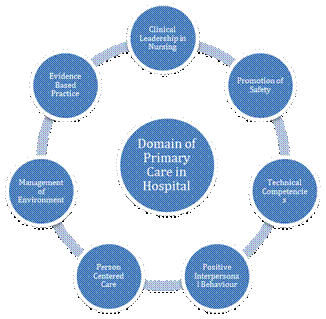
Nurses’ responsibilities in healthcare quality extend beyond the provision of safe care that is aligned with best evidence and clinical standards to participation in broader organizational and system quality and safety structures. Leadership in nursing entails measuring, monitoring and reporting on the appropriateness and efficacy of healthcare, which informs advancements in healthcare quality. y. Consumer-centered care, continuity of care, full disclosure, sensitivity to the cultural needs of patients and sensitivity to their level of health literacy are all responsibilities.
Figure 2: Professional practice framework: Domains of healthcare quality.
DISCUSSION
The framework, which was developed from the professional standards literature, defines a core group of seven dimensions of quality in primary care for registered nurses' roles, responsibilities and scope of practice. Nurses' roles in each quality domain are defined by the factors listed within each domain. The ability to explain, comprehend and evaluate nurses' perceptions of their roles in healthcare quality and to support them in carrying out these duties depends on health service and education providers' understanding of these domains and features in a range of circumstances. Nursing leadership that focuses on transformational change is beneficial. It has also been acknowledged as a successful method for maximizing the benefits of primary care for patients.
CONCLUSION
In light of the current study, it can be said that the leadership in nursing and primary care, this professional practice framework of nurses' responsibility for healthcare quality, has content validity and contributes to understanding quality in healthcare. The framework is based on the range of nursing practice. Instead of being restricted to quality outcomes, measures, traits or competences, it includes realistic, practice-based areas of quality that are discipline-specific and attainable, highlighting the comprehensive responsibilities that nurses have for healthcare quality.
Building relationships, enhancing collaborative arrangements and negotiating the role are crucial to the effectiveness of implementing the nurse role for providing primary care in hospitals, according to the study's nursing implications. Responses from nurse practitioners show that various facets of transformative leadership are prevalent in their work environments. There are some things, nevertheless, that need attention. The desire to follow the leader because they are reliable and well-respected is a sign of transformative leadership (intended impact).
REFERENCE
Gab Allah, A.R. et al. “Developing strategy: a guide for nurse managers to manage nursing staff’s work-related problems.” Asian Nursing Research, vol. 14, no. 3, 2020, pp. 178–187. https://doi.org/10.1016/j.anr.2020.07.004.
Nieuwboer, M.S. et al. “Clinical leadership and integrated primary care: a systematic literature review.” European Journal of General Practice, vol. 25, no. 1, 2019, pp. 7–18. https://doi.org/10.1080/13814788.2018.1515907.
El-Haddad, M. et al. “Nurse unit managers’ work and impacts on clinical leadership: a cross-sectional study.” Collegian, vol. 29, no. 5, 2022, pp. 635–644. https://doi. org/10.1016/j.colegn.2022.02.004.
Gunawan, J. et al. “Managerial competence of first-line nurse managers in public hospitals in Indonesia.” Journal of Multidisciplinary Healthcare, vol. 13, 2020, pp. 1017–1025. https://doi.org/10.2147/JMDH.S269150.
Poghosyan, L. and J. Bernhardt. “Transformational leadership to promote nurse practitioner practice in primary care.” Journal of Nursing Management, vol. 26, no. 8, 2018, pp. 1066–1073. https://doi.org/10.1111/jonm.12636.
Al-Dossary, R.N. “Leadership style, work engagement and organizational commitment among nurses in Saudi Arabian hospitals.” Journal of Healthcare Leadership, vol. 14, 2022, pp. 71–81. https://doi.org/10.2147/JHL.S365526.
Vahdat, S. et al. “Key factors affecting succession planning in the leadership of public hospitals in Iran: a qualitative study.” International Journal of Healthcare Management, 2022, pp. 1–9. https://doi.org/10.1080/20479700.2022.2153963.
Lamb, A. et al. “Describing the leadership capabilities of advanced practice nurses using a qualitative descriptive study.” Nursing Open, vol. 5, no. 3, 2018, pp. 400–413. https://doi.org/10.1002/nop2.150.
Stanley, D. et al. “Health professionals’ perceptions of clinical leadership: a pilot study.” Cogent Medicine, vol. 4, no. 1, 2017, p. 1321193. https://doi.org/10.1080/2331205x.2017.1321193.
Kim, T.H. and J. Thompson. “Market and organizational factors associated with hospital leadership in accountable care organizations.” Hospital Topics, vol. 101, no. 4, 2022, pp. 1–13. https://doi.org/10.1080/00185868.2022.2040403.
Vuong, B.N. “The influence of servant leadership on job performance through innovative work behavior: does public service motivation matter?” Asia Pacific Journal of Public Administration, vol. 45, no. 3, 2023, pp. 295–315. https://doi.org/10.1080/23276665.2022.2070517.
Dorji, K. et al. “Leadership and management competencies required for Bhutanese primary health care managers in reforming the district health system.” Journal of Healthcare Leadership, vol. 11, 2019, pp. 13–21. https://doi.org/10. 2147/JHL.S195751.
Ofei, A.M.A. et al. “Exploring the management competencies of nurse managers in the Greater Accra Region, Ghana.” International Journal of Africa Nursing Sciences, vol. 13, 2020, p. 100248. https://doi.org/10. 1016/j.ijans.2020.100248.
Boitshwarelo, T. et al. “Strengths employed by resilient nurse managers in dealing with workplace stressors in public hospitals.” International Journal of Africa Nursing Sciences, vol. 13, 2020, p. 100252. https://doi.org/10. 1016/j.ijans.2020.100252.
Sethibe, T.G. “Towards a comprehensive model of the relationship between leadership styles, organizational climate, innovation and organizational performance.” International Journal of Innovation Management, vol. 22, no. 2, 2018, pp. 1–19. https://doi.org/10.1142/S1363919618500214.
Wardani, E. and T. Ryan. “Barriers to nurse leadership in an Indonesian hospital setting.” Journal of Nursing Management, vol. 27, no. 3, 2019, pp. 671–678. https://doi. org/10.1111/jonm.12728.
Luu, T.T. et al. “Team creativity in public healthcare organizations: the roles of charismatic leadership, team job crafting and collective public service motivation.” Public Performance and Management Review, vol. 42, no. 6, 2019, pp. 1448–1480. https://doi.org/10.1080/15309576. 2019.1595067.
McMurray, A. “Leadership in primary health care: an international perspective.” Contemporary Nurse, vol. 26, no. 1, 2007, pp. 30–36. https://doi.org/10.5172/conu.2007.26.1.30.
Cummings, G.G. et al. “Leadership styles and outcome patterns for the nursing workforce and work environment: a systematic review.” International Journal of Nursing Studies, vol. 85, 2018, pp. 19–60. https://doi.org/10.1016/ j.ijnurstu.2018.04.016.
Kakemam, E. et al. “Leadership and management competencies for hospital managers: a systematic review and best-fit framework synthesis.” Journal of Healthcare Leadership, vol. 12, 2020, pp. 59–68. https://doi.org/10. 2147/JHL.S265825.
Young, J. et al. “The value of good care in neoliberal times: the importance of relationship activities.” New Zealand Sociology, vol. 32, no. 2, 2017, pp. 81–104.
Oldland, E. et al. “A framework of nurses’ responsibilities for quality healthcare: exploration of content validity.” Collegian, vol. 27, no. 2, 2020, pp. 150–163. https://doi. org/10.1016/j.colegn.2019.07.007.
License
Creative Commons Attribution-NonCommercial-NoDerivatives 4.0 International License
All papers should be submitted electronically. All submitted manuscripts must be original work that is not under submission at another journal or under consideration for publication in another form, such as a monograph or chapter of a book. Authors of submitted papers are obligated not to submit their paper for publication elsewhere until an editorial decision is rendered on their submission. Further, authors of accepted papers are prohibited from publishing the results in other publications that appear before the paper is published in the Journal unless they receive approval for doing so from the Editor-In-Chief.
Himalayan Journal of Nursing and Midwifery open access articles are licensed under a Creative Commons Attribution-Share A like 4.0 International License. This license lets the audience to give appropriate credit, provide a link to the license, and indicate if changes were made and if they remix, transform, or build upon the material, they must distribute contributions under the same license as the original.
Recommended Articles
Research Article
General public Knowledge, Attitude and Practices Regarding COVID-19: a Cross-Sectional study in Himachal Pradesh
Hanish Kumar Rana,
...
Badal Katoch
Published: 10/07/2022
Download PDF
Cite
x
APA
Rana, H. K., Katoch, R. & Katoch, B. (2022). General public Knowledge, Attitude and Practices Regarding COVID-19: a Cross-Sectional study in Himachal Pradesh. Himalayan Journal of Nursing and Midwifery, 1(2), 1-4.
MLA
Rana, Hanish K., Riya Katoch and Badal Katoch. "General public Knowledge, Attitude and Practices Regarding COVID-19: a Cross-Sectional study in Himachal Pradesh." Himalayan Journal of Nursing and Midwifery 1.2 (2022): 1-4.
Chicago
Rana, Hanish K., Riya Katoch and Badal Katoch. "General public Knowledge, Attitude and Practices Regarding COVID-19: a Cross-Sectional study in Himachal Pradesh." Himalayan Journal of Nursing and Midwifery 1, no. 2 (2022): 1-4.
Harvard
Rana, H. K., Katoch, R. and Katoch, B. (2022) 'General public Knowledge, Attitude and Practices Regarding COVID-19: a Cross-Sectional study in Himachal Pradesh' Himalayan Journal of Nursing and Midwifery 1(2), pp. 1-4.
Vancouver
Rana HK, Katoch R, Katoch B. General public Knowledge, Attitude and Practices Regarding COVID-19: a Cross-Sectional study in Himachal Pradesh. Himalayan Journal of Nursing and Midwifery. 2022 Jul;1(2):1-4.
Download PDF
Review Article
Prevention of Extravasation Non-Cytotoxic Agents (Review Study)
Batool Kadham Hussin
Published: 20/10/2022
Download PDF
Cite
x
APA
Hussin, B. K. (2022). Prevention of Extravasation Non-Cytotoxic Agents (Review Study). Himalayan Journal of Nursing and Midwifery, 1(2), None-None.
MLA
Hussin, Batool K.. "Prevention of Extravasation Non-Cytotoxic Agents (Review Study)." Himalayan Journal of Nursing and Midwifery 1.2 (2022): None-None.
Chicago
Hussin, Batool K.. "Prevention of Extravasation Non-Cytotoxic Agents (Review Study)." Himalayan Journal of Nursing and Midwifery 1, no. 2 (2022): None-None.
Harvard
Hussin, B. K. (2022) 'Prevention of Extravasation Non-Cytotoxic Agents (Review Study)' Himalayan Journal of Nursing and Midwifery 1(2), pp. None-None.
Vancouver
Hussin BK. Prevention of Extravasation Non-Cytotoxic Agents (Review Study). Himalayan Journal of Nursing and Midwifery. 2022 Jul;1(2):None-None.
Download PDF
Research Article
Self-Care Practices in Primary Dysmenorrhea among Nursing Students at AL- Diwaniyah Governorate
Fadia Hussein Ali,
Haider Abd AL Ameer Twair Hamad
Published: 30/03/2024
Download PDF
Cite
x
APA
Ali, F. H. & Hamad, H. A. A. A. T. (2024). Self-Care Practices in Primary Dysmenorrhea among Nursing Students at AL- Diwaniyah Governorate. Himalayan Journal of Nursing and Midwifery, 3(1), None-None.
MLA
Ali, Fadia H. and Haider Abd A. A. T. Hamad. "Self-Care Practices in Primary Dysmenorrhea among Nursing Students at AL- Diwaniyah Governorate." Himalayan Journal of Nursing and Midwifery 3.1 (2024): None-None.
Chicago
Ali, Fadia H. and Haider Abd A. A. T. Hamad. "Self-Care Practices in Primary Dysmenorrhea among Nursing Students at AL- Diwaniyah Governorate." Himalayan Journal of Nursing and Midwifery 3, no. 1 (2024): None-None.
Harvard
Ali, F. H. and Hamad, H. A. A. A. T. (2024) 'Self-Care Practices in Primary Dysmenorrhea among Nursing Students at AL- Diwaniyah Governorate' Himalayan Journal of Nursing and Midwifery 3(1), pp. None-None.
Vancouver
Ali FH, Hamad HAAAT. Self-Care Practices in Primary Dysmenorrhea among Nursing Students at AL- Diwaniyah Governorate. Himalayan Journal of Nursing and Midwifery. 2024 Jan;3(1):None-None.
Download PDF
Research Article
Knowledge Regarding Cardio Pulmonary Resuscitation in Pregnant Women among Registered Nurses Working in Selected Hospitals of Shimla
Sangeeta Devi,
Pooja Rani Sood
Published: 18/02/2022
Download PDF
Cite
x
APA
Devi, S. & Rani Sood, P. (2022). Knowledge Regarding Cardio Pulmonary Resuscitation in Pregnant Women among Registered Nurses Working in Selected Hospitals of Shimla. Himalayan Journal of Nursing and Midwifery, 1(1), 1-4.
MLA
Devi, Sangeeta and Pooja Rani Sood. "Knowledge Regarding Cardio Pulmonary Resuscitation in Pregnant Women among Registered Nurses Working in Selected Hospitals of Shimla." Himalayan Journal of Nursing and Midwifery 1.1 (2022): 1-4.
Chicago
Devi, Sangeeta and Pooja Rani Sood. "Knowledge Regarding Cardio Pulmonary Resuscitation in Pregnant Women among Registered Nurses Working in Selected Hospitals of Shimla." Himalayan Journal of Nursing and Midwifery 1, no. 1 (2022): 1-4.
Harvard
Devi, S. and Rani Sood, P. (2022) 'Knowledge Regarding Cardio Pulmonary Resuscitation in Pregnant Women among Registered Nurses Working in Selected Hospitals of Shimla' Himalayan Journal of Nursing and Midwifery 1(1), pp. 1-4.
Vancouver
Devi S, Rani Sood P. Knowledge Regarding Cardio Pulmonary Resuscitation in Pregnant Women among Registered Nurses Working in Selected Hospitals of Shimla. Himalayan Journal of Nursing and Midwifery. 2022 Jan;1(1):1-4.
Saragih, R. S., Kartasurya, M. I. & Surjoputro, A. (2023). Nursing Leadership on Effect Nurse's Service Performance in Hospital: A Systematic Review. Himalayan Journal of Nursing and Midwifery, 2(2), 1-6.
MLA
Saragih, Rita S., Martha I. Kartasurya and Antono Surjoputro. "Nursing Leadership on Effect Nurse's Service Performance in Hospital: A Systematic Review." Himalayan Journal of Nursing and Midwifery 2.2 (2023): 1-6.
Chicago
Saragih, Rita S., Martha I. Kartasurya and Antono Surjoputro. "Nursing Leadership on Effect Nurse's Service Performance in Hospital: A Systematic Review." Himalayan Journal of Nursing and Midwifery 2, no. 2 (2023): 1-6.
Harvard
Saragih, R. S., Kartasurya, M. I. and Surjoputro, A. (2023) 'Nursing Leadership on Effect Nurse's Service Performance in Hospital: A Systematic Review' Himalayan Journal of Nursing and Midwifery 2(2), pp. 1-6.
Vancouver
Saragih RS, Kartasurya MI, Surjoputro A. Nursing Leadership on Effect Nurse's Service Performance in Hospital: A Systematic Review. Himalayan Journal of Nursing and Midwifery. 2023 Jul;2(2):1-6.


 Download PDF
 Download XML