Contents
Download PDF
pdf Download XML
1081 Views
88 Downloads
Share this article
Research Article | Volume 2 Issue 1 (Jan-June, 2023) | Pages 1 - 4
Valuation of perceived stress, coping strategies and emotional intelligence among nursing students: A Questionnaire based study
1
Shri Tulsi Ram Sharma, Psychiatric Nursing, College of Nursing, Govt. Medical College, Tirwa, Kannauj, India
Under a Creative Commons license
Open Access
Received
March 6, 2023
Revised
April 22, 2023
Accepted
May 14, 2023
Published
June 10, 2023
Abstract

Introduction: Emotional intelligence or EI is defined as an individual’s set of abilities, both verbal and nonverbal, to perceive, understand, utilize and manage personal emotions, as well as the emotions of other individuals. It is an individual’s mental ability to utilize and manage emotions in solving problems. Materials and Methods: The PSS is a 10- item self-report instrument designed to measure the degree to which events are appraised as stressful and the frequency of perceived stressful situations. Respondents are instructed to report the frequency of perceived stress over the past month from 0 (Never) to 4 (Very Often). Total scores on the PSS can range from 0 to 40. The Brief COPE is a 28-item version of the COPE Inventory, a self-report measure of coping responses. Scores for coping responses are calculated by summing scores for the 12 items on the maladaptive coping subscale and the 16 items on the adaptive coping subscale. Results: there were 65 males and 85 females. 95 were in bachelor’s degree and 55 were in master’s degree. 42 were in first year, 38 in second, 48 in third, 22 in 4th year. 95 were unmarried, and 55 were married. The difference was significant (P< 0.05). Conclusion: Authors found that interventions aimed at increasing emotional intelligence may help to lessen perceived stress for students in the helping disciplines.

Keywords
INTRODUCTION

All students must deal with the rigours of their coursework, the challenges of adjusting to a new location and its inhabitants, and the social, emotional, and financial independence that comes with living away from home for the first time [1]. An individual's capacity to recognise, comprehend, use, and regulate their own emotions as well as the emotions of others is referred to as emotional intelligence, or EI. It is a person's mental capacity to use and control emotions when solving issues [2]. Included in this is the capacity to successfully direct thought and activity as well as to enable successful adaptation to the demands and pressures imposed by the immediate environment. In the context of this study, EI is defined as a quality or level of ability that makes it easier for people to successfully respond to environmental constraints and expectations. It came about as a result of numerous studies into how humans perceive, express, and use emotions [3].


It is possible to forecast a person's perceived levels of stress based on how they evaluate and manage their stresses. Managing demands that are seen to be stressful and that necessitate activities that tax or exceed one's resources requires behavioural and cognitive efforts. Lower levels of perceived stress have been associated with coping techniques such problem-focused coping, acceptance, seeking social support, and positive reappraisal. Alternately, maladaptive coping methods include blame, substance abuse, denial, self-distraction, and behavioural disengagement are examples. These methods are frequently connected to higher levels of perceived stress [4].


Lazarus and Folkman's theoretical framework is the definition that applies to this study the most and may be used to describe the reality of nursing students' stress during clinical practise. Lazarus conceptualises an apparent stress definition that can reconcile disparities between the many theories of stress as a reaction or stress as a stimulus based on his idea about the difficulty in discriminating between response and stimulus as the definition of stress. Stress, according to him, is "a specific relationship between the person and the environment that the person perceives as taxing and/or exceeding his or her resources and endangering his or her well-being."


This is due to the way it characterises stress as a transactional interaction between an individual and their immediate environment [5]. Stress is not a single aspect; rather, it develops as a result of influencing elements that have an impact on the person and, in turn, determine how they react to such circumstances. One of these stressful scenarios, for instance, can arise during a student's clinical practise once they are exposed to a new setting and forge new connections with patients, staff nurses, instructors, and/or supervisors [6]. According to a study, the medical units were deemed to be the least stressful clinical setting, whereas the intensive care unit, emergency room, and surgical units were the ones with the highest levels of stress [7].

MATERIALS AND METHODS

The study was approved from institutional ethical committee. All students were informed regarding the study and written consent was obtained.


Data were collected using a questionnaire that was made available to potential participants in an online version. It consisted of demographic questionnaire to assess sample characteristics including name, age, gender, year and program. Perceived Stress Scale (PSS), the Brief COPE and the Schutte self-report emotional intelligence test was used. The PSS is a 10- item self-report instrument designed to measure the degree to which events are appraised as stressful and the frequency of perceived stressful situations. Respondents are instructed to report the frequency of perceived stress over the past month from 0 (Never) to 4 (Very Often). Total scores on the PSS can range from 0 to 40. The Brief COPE is a 28-item version of the COPE Inventory, a self-report measure of coping responses. Scores for coping responses are calculated by summing scores for the 12 items on the maladaptive coping subscale and the 16 items on the adaptive coping subscale. Adaptive coping strategies included planning, positive reframing, and acceptance, while maladaptive strategies related substance use, denial, and self- blaming. The SSEIT is a 33-item self-report measure of EI. Total scores range from 33 to 165, with higher scores indicating higher EI. Result were tabulated and subjected to statistical analysis. P value less than 0.05 was considered significant (P< 0.05).

RESULTS

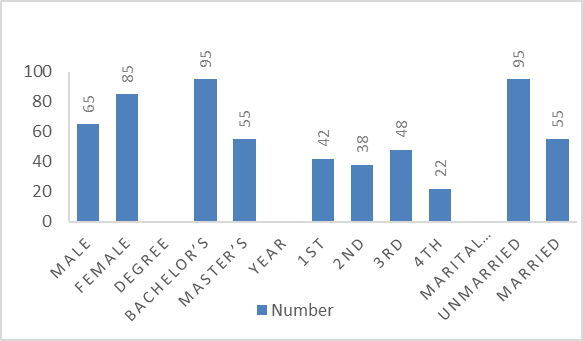
Table 1 shows that there were 65 males and 85 females. 95 were in bachelor’s degree and 55 were in master’s degree. 42 were in first year, 38 in second, 48 in third, 22 in 4th year. 95 were unmarried, and 55 were married. The difference was significant (P< 0.05).


Table 2 shows that mean PSS score of students was 19.31. Brief COPE: Adaptive score was 45.3, brief COPE: Maladaptive score was 24.5 and EEEIT score was 129.2.


Table 1: Distribution of patients

Variables

Number

P value

Gender


Male

65

0.14

Female

85

Degree


Bachelor’s

95

0.05

Master’s

55

Year


1st

42

0.18

2nd

38

3rd

48

4th

22

Marital status


Unmarried

95

0.05

Married

55


Figure 1: Distribution of patients


Table 2: Means, Standard Deviations, Minima, Maxima, and Cronbach’s Alpha by Measures

Measure

Mean

SD

Min

Max

PSS

19.31

7.10

5

37

Brief COPE:Adaptive

45.3

8.81

27

70

Subscale


Brief COPE:Maladaptive

24.5

6.80

14.2

39

Subscale


SSEIT

129.2

14.4

94

169


Table 3: Bivariate correlations among measures

Measure

Brief COPE: Adaptive Subscale

Brief COPE: Maladaptive Subscale

SSEIT

PSS

-0.26

0.54

-0.44

Brief COPE:Adaptive Subscale

-

0.03

0.54

Brief COPE:Maladaptive Subscale

-

-

-0.28

Table 3 shows bivariate correlations between scores onthe SSEIT, PSS, and adaptive and maladaptive coping. Perceived stress was positively correlated with maladaptive coping and negatively associated with adaptive coping. EI was negatively correlated with perceived stress and with maladaptive coping and positively correlated with adaptive coping. There were significant paths between emotional intelligence and both adaptive coping and maladaptive coping. The b paths were significant between perceived stress and both adaptive coping responses and maladaptive coping. Adaptive coping (z = 3.20, p < .05) and maladaptive coping (z = 4.13, p < .01) were both significant statistical mediators.

DISCUSSION

The ability to regulate stress is one particular emotional competency that this study specifically addresses and links to success in the profession of medicine. This can also be referred to as resilience and the capacity for effective coping. The ability to cope with stress is a key component of medical students' success because medical school can be demanding [8]. To sustain wellbeing and academic achievement, it can be challenging to reconcile personal and academic experiences. Performance improvement is positively connected with effective stress management. What determines a leader's success is becoming a less enigmatized question thanks to emotional intelligence (EI) [9]. It has been proposed as an explanation for how people handle high levels of strain at work and how their moods recover more quickly from negative mood induction. Additionally, research indicates that emotional intelligence can develop with time and experience. If emotional intelligence can be raised, it follows that leadership, success, stress tolerance, and other emotional intelligence-related traits may also be enhanced [10]. The goal of the current study was to evaluate nursing students' perceptions of stress, coping mechanisms, and emotional intelligence.


Enns et al.'s [11] study of 150 high school students examined the connections between age, gender, emotional intelligence, academic achievement, and reported stress. Questionnaires on emotional intelligence and perceived stress were used. The findings indicated that emotional intelligence varied significantly by gender, with women demonstrating higher EI than men. However, there was no statistically significant difference between men and women when it came to felt stress. In the fall, there was some evidence that emotional intelligence might predict GPA quite well; however, this accuracy diminished in the spring. Age and emotional intelligence showed some accuracy in foretelling subjective stress in the autumn. Emotional intelligence, however, demonstrated great accuracy in predicting experienced stress throughout the spring semester. In the autumn of 2013, as people got better at controlling their own emotions, GPA went up and perceived stress went down. GPA fell as people become better at handling other people's feelings. Although there were no age differences, females had higher AES scores than males. In the Spring of 2013, older people with higher AES scores and improved emotion regulation had lower reported stress.


We discovered that pupils' mean PSS scores were 18.34. discovered that higher EI was related with decreased perceived stress, and this association was partially mediated by both adaptive and maladaptive coping responses (short COPE: Adaptive score: 44.7, brief COPE: Maladaptive score: 23.9, and EEEIT score: 128.1). Higher EI was linked to more adaptive coping and less maladaptive coping, which were connected to perceived stress in a negative and positive (respectively) way, respectively. According to our research, nursing students used avoidance and transference more frequently during the COVID-19 pandemic than they had before, as well as other coping mechanisms in general. The use of problem-solving or maintaining optimism as coping mechanisms among nursing students was not statistically different, nevertheless, according to our study. This runs counter to a recent study that discovered nursing students were more receptive to using coping mechanisms that prioritised problem-solving [12]. Gan and Liu's [13] study, which found that undergraduate students were more likely to use problem-focused coping mechanisms when they believed stressful events were under their control, can be used to explain our study's results. However, because COVID-related events were uncontrollable during the study period, students may have resorted to emotion-focused coping mechanisms like avoidance and transference, which contradict some earlier studies [14,15]. According to research done prior to the pandemic, transference, optimism, and problem-solving were nursing students' go-to coping mechanisms, whereas avoidance was the least common [16]. 
CONCLUSION

Authors found that interventions aimed at increasing emotional intelligence may help to lessen perceived stress for students in the helping disciplines. These findings are important for both nursing schools and hospitals, where they must focus on providing psychological support to nurses as well as training them in all available coping strategies to improve their ability to manage their emotions and effective coping tools to improve the lives of the nursing student, their families, and ultimately their patients.

REFERENCE
  1. Van Rooy, D.L., and C. Viswesvaran. “Emotional Intelligence: A Meta-Analytic Investigation of Predictive Validity and Nomological Net.” Journal of Vocational Behavior, vol. 65, 2004, pp. 71–95. https://doi.org/10.1016/S0001-8791(03)00076-9.

  2. Wagner, P.J., et al. “Physicians’ Emotional Intelligence and Patient Satisfaction.” Family Medicine, vol. 34, no. 10, 2002, pp. 750–754.

  3. Amendolair, D. “Emotional Intelligence: Essential for Developing Nurse Leaders.” Nurse Leader, vol. 1, no. 6, 2003, pp. 25–27. https://doi.org/10.1016/S1541-4612(03)80118-6.

  4. Cadman, C., and J. Brewer. “Emotional Intelligence: A Vital Prerequisite for Recruitment in Nursing.” Journal of Nursing Management, vol. 9, no. 6, 2001, pp. 321–324. https://doi.org/10.1046/j.1365-2834.2001.00262.x.

  5. Lazarus, R.S., and S. Folkman. Stress, Appraisal, and Coping. Springer Publishing Company, 1984.

  6. Madian, A., et al. “Level of Stress and Coping Strategies among Nursing Students at Damanhour University, Egypt.” American Journal of Nursing Research, vol. 7, 2019, pp. 684–696. https://doi.org/10.12691/ajnr-7-5-18.

  7. Aedh, A.I., et al. “Factors Associated with Stress among Nursing Students (Najran University–Saudi Arabia).” IOSR Journal of Nursing and Health Science (IOSR-JNHS), vol. 4, 2015, pp. 33–38. https://doi.org/10.9790/1959-04323338.

  8. Pau, A.K.H., and R. Croucher. “Emotional Intelligence and Perceived Stress in Dental Undergraduates.” Journal of Dental Education, vol. 67, no. 9, 2003, pp. 1023–1028. https://doi.org/10.1002/j.0022-0337.2003.67.9.tb03686.x.

  9. Moffat, K.J., et al. “First Year Medical Student Stress and Coping in a Problem Based Learning Medical Curriculum.” Medical Education, vol. 38, no. 5, 2004, pp. 482–491. https://doi.org/10.1046/j.1365-2929.2004.01814.x.

  10. Shapiro, S., et al. “Stress Management in Medical Education: A Review of the Literature.” Academic Medicine, vol. 75, no. 7, 2000, pp. 748–759. https://doi.org/10.1097/00001888-200007000-00023.

  11. Enns, A., et al. “Perceived Stress, Coping Strategies, and Emotional Intelligence: A Cross-Sectional Study of University Students in Helping Disciplines.” Nurse Education Today, vol. 68, September 2018, pp. 226–231. https://doi.org/10.1016/j.nedt.2018.06.012.

  12. Ebrahimi, A. “The Relationship between Emotional Intelligence, Perceived Stress and Academic Performance among Iranian High School Students.” European Online Journal of Natural and Social Sciences, vol. 2, no. 2s, August 2013, pp. 509–515.

  13. Huang, L., et al. “Emotional Responses and Coping Strategies in Nurses and Nursing Students during Covid-19 Outbreak: A Comparative Study.” PLoS ONE, vol. 15, 2020, e0237303. https://doi.org/10.1371/journal.pone.0237303.

  14. Gan, Y., et al. “Flexible Coping Responses to Severe Acute Respiratory Syndrome-Related and Daily Life Stressful Events.” Asian Journal of Social Psychology, vol. 7, 2004, pp. 55–66. https://doi.org/10.1111/j.1467-839X.2004.00134.x.

  15. Labrague, L.J., et al. “A Literature Review on Stress and Coping Strategies in Nursing Students.” Journal of Mental Health, vol. 26, 2017, pp. 471–480. https://doi.org/10.1080/09638237.2016.1244721.

  16. Savitsky, B., et al. “Anxiety and Coping Strategies among Nursing Students during the Covid-19 Pandemic.” Nurse Education in Practice, vol. 46, 2020, 102809. https://doi.org/10.1016/j.nepr.2020.102809.

  17.  

License
CC BY-NC-ND
Creative Commons Attribution-NonCommercial-NoDerivatives 4.0 International License
Valuation of perceived stress, coping strategies and emotional intelligence among nursing students: A Questionnaire based study © 2026 by Pramod Kumar Sharma licensed under CC BY-NC-ND 4.0
All papers should be submitted electronically. All submitted manuscripts must be original work that is not under submission at another journal or under consideration for publication in another form, such as a monograph or chapter of a book. Authors of submitted papers are obligated not to submit their paper for publication elsewhere until an editorial decision is rendered on their submission. Further, authors of accepted papers are prohibited from publishing the results in other publications that appear before the paper is published in the Journal unless they receive approval for doing so from the Editor-In-Chief.
Himalayan Journal of Nursing and Midwifery open access articles are licensed under a Creative Commons Attribution-Share A like 4.0 International License. This license lets the audience to give appropriate credit, provide a link to the license, and indicate if changes were made and if they remix, transform, or build upon the material, they must distribute contributions under the same license as the original.
Recommended Articles
Research Article
General public Knowledge, Attitude and Practices Regarding COVID-19: a Cross-Sectional study in Himachal Pradesh
...
Published: 10/07/2022
Download PDF
Research Article
Self-Care Practices in Primary Dysmenorrhea among Nursing Students at AL- Diwaniyah Governorate
Published: 30/03/2024
Download PDF
Review Article
Prevention of Extravasation Non-Cytotoxic Agents (Review Study)
Published: 20/10/2022
Download PDF
Research Article
Knowledge Regarding Cardio Pulmonary Resuscitation in Pregnant Women among Registered Nurses Working in Selected Hospitals of Shimla
Published: 18/02/2022
Download PDF
Flowbite Logo
Najmal Complex,
Opposite Farwaniya,
Kuwait.
Email: support@himjournals.com

Useful Links
Order Hard Copy
Privacy policy
Terms and Conditions
Refund Policy
Others
About Us
Team Members
Contact Us
Online Payments
Join as Editor
Join as Reviewer
Subscribe to our Newsletter
Follow us
MOST SEARCHED KEYWORDS
scientific journal
 | 
business journal
 | 
medical journals
 | 
Scientific Journals
 | 
Academic Publisher
 | 
Peer-reviewed Journals
 | 
Open Access Journals
 | 
Impact Factor
 | 
Indexing Services
 | 
Journal Citation Reports
 | 
Publication Process
 | 
Impact factor of journals
 | 
Finding reputable journals for publication
 | 
Submitting a manuscript for publication
 | 
Copyright and licensing of published papers
 | 
Writing an abstract for a research paper
 | 
Manuscript formatting guidelines
 | 
Promoting published research
 | 
Publication in high-impact journals
Copyright © Himalayan Journals . All Rights Reserved.