Background: The present study was undertaken to evaluate the effect of Vedic chants on APGAR score in Laboring Parturients with Ambulatory Epidural Labor Analgesia. Material & Methods: A total of 38 patients with full term live cephalic singleton pregnancy in active labor with cervical dilatation 0-4 cm with a request for ambulatory labor analgesia admitted in department of Obstetrics and Gynaecology at Dr. RPGMC Kangra at Tanda were participated in this study. We randomized the patients in two groups A and B. Both groups received epidural labor analgesia with 0.1% ropivacaine and 1.5ug/ml of fentanyl. Patients in group A were made to listen Vedic chants (Gayatri mantra) in 4 sessions of 30min each with 15mins break in between the sessions. In group B, patients received only ambulatory epidural labor analgesia without any Vedic chants listening. These two groups were observed for APGAR scores. Results: In our study, Mean fetal Heart rate (beats per minute) of the patients in group A was comparable to that in group B (136.8±3.2 vs. 136.4±3; p = 0.77). Mean APGAR score at 1-minute of the neonates born to patients in group A was comparable to that in group B (6.8±0.6 vs. 6.8±0.8; p = 0.920). Mean APGAR score at 5minutes of the neonates born to patients in group A was comparable to that in group B (7.8±0.5 vs. 8±0.8; p = 0.538). Conclusion: So our study concluded that ambulatory epidural labor analgesia has no side effects on the APGAR scores of the neonates and was within normal range in both groups.
Due to well-known limitations and serious side effects of painkillers, nowadays non-pharmacological methods such as music therapies are being broadly recommended. There are a few studies that analyze the effect of Vedic chants on anxiety and pain during labor. Listening to Vedic chants and Indian classical instrumental music has beneficial effects on alleviating anxiety levels induced by apprehension of invasive procedures and can be of therapeutic use. Chanting and deep breathing experiences as music therapy during the latent stage of labor may reduce pain perception and pain behaviors and had positive effect on the birthing process as well as on fetal wellbeing [1,2]
APGAR is a quick test performed on a baby at 1 and 5 minutes after birth. The 1-minute score determines how well the baby tolerated the birthing process. The 5minute score tells the health care provider how well the baby is doing outside the mother's womb. In Apgar test, the provider examines the baby's, Breathing effort, Heart rate, Muscle tone, Reflexes and Skin color. Each category is scored with 0, 1, or 2, depending on the observed condition [3].
There is insufficient evidence to make a judgment about whether or not Vedic chants are effective for fetal wellbeing. In the present study, we aimed to evaluate the effect of Vedic chants on APGAR score in Laboring Parturients with Ambulatory Epidural Labor Analgesia.
Aim and Objectives
To evaluate the effect of Vedic chants on APGAR score in Laboring Parturients with Ambulatory Epidural Labor Analgesia.
Study Site
Departments of Anaesthesia, and Obstetrics and Gynaecology, Dr RPGMC Kangraat Tanda (rural), Himachal Pradesh, India.
Study Design
Prospective randomized controlled study.
Study Duration
The study was conducted over the period of 18 months including data collection, data organization, presentation, analysis, and interpretation.
Sample Size
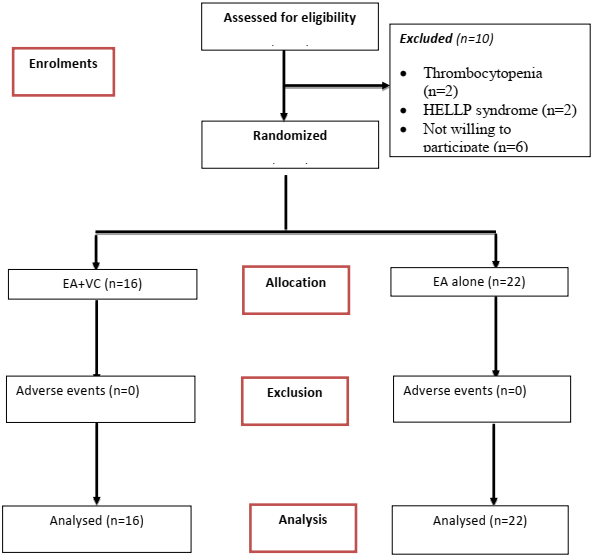
Sample size was calculated to a total of 80 patients (40 patients in each group). But due to COVID-19 pandemic limitations, only 38 patients (16 in Group A and 22 in Group B) were included in the study.
Inclusion Criteria
Term live cephalic singleton pregnancy in active labor who were having contractions at least once in 5 min with cervical dilation 0–4 cm with a request for ambulatory labor analgesia were included in the study.
Exclusion Criteria
Patient refusal for the procedure.
Local infection at site of epidural catheter placement.
Thrombocytopenia.
Coagulopathies.
HELLP syndrome.
Sepsis.
Deafness.
Spinal column deformities and spine surgery.
Patient having hypersensitivity to the study drug.
In case of Intrathecal catheter placement.
In case of accidental dural puncture.
Non-assuring fetal heart rate.
Prematurity and post-maturity.
Methodology
After the intimation from obstetrician, the information regarding the epidural labor analgesia was explained to the laboring parturient and thereafter written consent for epidural labor analgesia was taken by the anaesthetist on duty. Before commencing the procedure, a case record form was filled for each patient. After that patient was taken to labor analgesia room in maternity complex. Patients were coloaded with 10 ml/kg of ringer lactate over 15 minutes, after securing intravenous line and all standard monitors like BP, SPO2, ECG attached, and vitals were recorded in case record sheet. Patient was positioned in the left lateral or sitting position and the procedure was carried out under all aseptic precaution. Skin was infiltrated with 2ml of 2% xylocaine at L2-3 or L3-4 intervertebral space. Epidural space was identified using a loss of resistance technique to normal saline with an 18G Tuohy’s needle and 20-gauge multi-orifice catheter was threaded through the cephalad directed tip of the epidural needle to a depth of 5 cm into the epidural space. The catheter was secured and the patient was placed in the supine position.
Drug Preparation for Epidural Activation
Epidural drug was prepared by taking two, 10 ml of syringes. In each syringe 5ml of 0.2% ropivacaine with 3.5ml of 0.9% normal saline and 1.5 ml of fentanyl (10µg/ml) was added to it. Thus, a total of 20ml of drug was prepared with a final concentration of 0.1% ropivacaine and 1.5ug/ml of fentanyl in it for loading the epidural space.
Activation of Epidural Catheter for Labor Analgesia
The prepared drug was given in increments of 3ml and each increment was considered as the test dose given after negative aspiration for blood and CSF and time was noted every time the increment given. The adequacy of analgesia was assessed 5min after the increment of drug administered. Analgesia was considered adequate if pain score was <3.
Onset of analgesia was defined as from time of test dose to time of achieving VAS <3. If analgesia would not be adequate within 10mins after the increment given, then another increment of 3ml was given in order to achieve the VAS <3.
Sensory block height was assessed by loss of sensation to pin prick (blunt head of a pin). Onset of analgesia was defined as duration from injection of first test dose to attainment of VAS <3.
Presence of motor block in lower extremities was assessed using a modified Bromage scale (MBS).
Patient was instructed to pass the urine as and when required by her, accompanied by attendants.
Vedic Chanting Procedure
Randomization was done by computer generated random sequence number method to randomly divide them in two groups A and B. In group A, 16 and in group B, 22 patients were taken due to covid-19 pandemic limitations.
Group A
All the patients listened to an already downloaded Vedic chants (Gayatri mantra) in mobile phone [Moto G2 (which belong to primary investigator) by earphones or by playing it in the background depending upon the patient’s choice] in 4 sessions of 30minutes each with 15minutes break in between after established epidural labor analgesia and consent of the patients.
Group B
All the patients got only epidural labor analgesia and did not listen to Vedic chants (Gayatri mantra).
Labor was managed according to Obstetric department’s standard protocol. Mode of delivery (normal/instrumental delivery/caesarean delivery) was noted. Total amount of the epidural dose until the delivery was noted. Fetal heart rate was monitored throughout the study by using a cardiotocograph and any evidence of fetal heart rate decelerations was recorded. Neonatal assessment was performed by assessing the Apgar score at 1 and 5min as well as NICU admissions were recorded. The epidural catheter was removed after normal or cesarean delivery.
Outcome Assessment
In Apgar test we examined the baby's:
Breathing effort
Heart rate
Muscle tone
Reflexes
Skin color
Each category was scored with 0, 1, or 2, depending on the observed condition.
Breathing Effort
If the infant is not breathing, the respiratory score is 0.
If the respirations are slow or irregular, the infant scores 1 for respiratory effort.
If the infant cries well, the respiratory score is 2.
Heart Rate is Evaluated by Stethoscope
This is the most important assessment:
If there is no heartbeat, the infant scores 0 for heart rate.
If heart rate is less than 100 beats per minute, the infant scores 1 for heart rate.
If heart rate is greater than 100 beats per minute, the infant scores 2 for heart rate.
Muscle Tone
If muscles are loose and floppy, the infant scores 0 for muscle tone.
If there is some muscle tone, the infant scores 1.
If there is active motion, the infant scores 2 for muscle tone.
Grimace Response or Reflex Irritability is a Term Describing Response to Stimulation, Such as a Mild Pinch
If there is no reaction, the infant scores 0 for reflex irritability.
If there is grimacing, the infant scores 1 for reflex irritability.
If there is grimacing and a cough, sneeze, or vigorous cry, the infant scores 2 for reflex irritability.
Skin Color
If the skin color is pale blue, the infant scores 0 for color.
If the body is pink and the extremities are blue, the infant scores 1 for color.
If the entire body is pink, the infant scores 2 for color.
Ethical Consideration
The study was initiated following approval from Institutional Ethics Committee (IEC) at Dr. RPGMC Kangra at Tanda. Consent form was collected from each enrolled study subject.
Statistical Analysis
The data was entered in Microsoft excel spreadsheet. Statistical analysis was done using Microsoft excel and exported into SPSSv21.0 and online ‘social science statistics’ software. The quantitative data was analyzed and expressed as mean±SD and percentages. Student’s t-test was used for comparing continuous variables between the two groups. Chi square and Fisher’s exact test was used for comparing the categorical data between the two groups
The present study compared the effect of ambulatory epidural labor analgesia with Vedic chants (EA+VC) and ambulatory epidural labor analgesia (EA) alone in parturients on APGAR score. A total of 38 patients were included in the study at Department of Anaesthesiology and Department of Obstetrics & Gynaecology, Dr. Rajendra Prasad Government Medical College, Kangra at Tanda. Results of the study have been presented in Figure 1.

Figure 1: Assessed for Eligibility
Treatment Arms
Patients were randomly divided into two groups. The patients in group A were made to listen to Vedic chants (Gayatri mantra) after established epidural labor analgesia and patients in group B received only epidural labor analgesia. (Table 1)
Table 1: Treatment arms
Group | Description | Frequency |
A | Epidural labor analgesia + Vedic chants | 16 |
B | Epidural labor analgesia | 22 |
Mean age of the patients in group A (25.1±4.8) was comparable to that in group B (25.6±3.3); p = 0.69. Mean height of the patients in group A was comparable to that in group B (156.9±3.5 vs. 157±3.2; p = 0.955), (Table 2). Mean weight of the patients in group A was comparable to that in group B (61.4±7.9vs. 62.6±6.5; p = 0.623). Mean BMI of the patients in group A was comparable to that in group B (22.5±4.4 vs. 21.1±4.2; p = 0.170). Mean POG of the patients in group A was comparable to that in group B (39.1±0.8 vs. 39.1±0.9; p = 0.914).
Table 2: Comparison of socio-clinical variables between two groups
Parameters | Group A (n=16) | Group B (n=22) | p-value* |
Age(years) | 25.1±4.8 | 25.6±3.3 | 0.69 |
Height (In cm) | 156.9±3.5 | 157±3.2 | 0.955 |
Weight (In Kg) | 61.4±7.9 | 62.6±6.5 | 0.623 |
BMI | 24.9±2.8 | 25.4±2.6 | 0.595 |
POG | 39.1±0.8 | 39.1±0.9 | 0.914 |
Mean fetal Heart rate (beats per minute) of the patients in group A was comparable to that in group B (136.8±3.2 vs. 136.4±3; p = 0.77). (Table 3)
Mean APGAR score at 1-minute of the neonates born to patients in group A was comparable to that in group B (6.8±0.6 vs. 6.8±0.8; p = 0.920). Mean APGAR score at 5-minutes of the neonates born to patients in group A was comparable to that in group B (7.8±0.5 vs. 8±0.8; p = 0.538).
Table 3: Comparison of mean FHR between two groups
Parameters | Group A (n=16) | Group B (n=22) | p-value* |
FHR | 136.8±3.2 | 136.4±3 | 0.77 |
Table 4: Comparison of mean APGAR score at 1 minute & 5 minutes between two groups
Parameters | Group A (n=16) | Group B (n=22) | p-value* |
APGAR score at 1 minute | 6.8±0.6 | 6.8±0.8 | 0.920 |
APGAR score at 5 minutes | 7.8±0.5 | 8±0.8 | 0.538 |
In our study mean fetal HR (beats per minute) in the patients of group A was 136.8±3.2and in group B was 136.4±3 and the difference was non-significant (p>0.77). So we concluded that there was no side effect of the drug used in the study on the fetal heart rate.
Simavli S et al., [4] in their study concluded that FHR were higher in music group 135.97±8.93 versus non music group 131.23±7.07 (p = 0.001). But in their study the parturients did not receive epidural analgesia.
In our study Mean APGAR score at 1-minute of the neonates born to patients in group A was 6.8±0.6 and in group B it was 6.8±0.8; p = 0.920 and at 5-minutes it was 7.8±0.5 in Group A and 8±0.8 in Group B; p = 0.538, difference between two was non-significant. So we concluded that ambulatory epidural labor analgesia has no side effects on the APGAR scores of the neonates and were within normal range.
Our study correlated with Drzymalski et al. [5] study, in which laboring parturients received epidural labor analgesia in both groups and music as experimental group. They found that APGAR scores at 1 and 5 minutes were no different between the two groups.
Deshmukh VL et al., [6] studied50 women with epidural analgesia for relief of labor pain at 3–4 cm and 50 women served as control without epidural analgesia. In their study there were a higher number of neonates with APGAR score of >8 min in both the study and control groups. There was no increase in the rate of NICU admissions in both the study and control groups.
So our study concluded that ambulatory epidural labor analgesia has no side effects on the APGAR scores of the neonates and was within normal range in both groups.
Ramesh, B. et al. “Effects of Culture-Based Chants on Labor Pain During the Latent Stage of Labor in Primigravidae Mothers: A Randomized Controlled Trial.” SBV Journal of Basic, Clinical and Applied Health Science, vol. 2, 2018, pp. 31–35.
Padam, A. et al. “Effect of Listening to Vedic Chants and Indian Classical Instrumental Music on Patients Undergoing Upper Gastrointestinal Endoscopy: A Randomized Control Trial.” Indian Journal of Psychiatry, vol. 59, no. 2, April 2017, pp. 214–218. https://doi.org/10.4103/psychiatry.IndianJPsychiatry_175_17.
“APGAR.” MedlinePlus, U.S. National Library of Medicine, https://medlineplus.gov/ency/article/003402.htm. Accessed 15 July 2022.
Simavli, S. et al. “Effect of Music on Labor Pain Relief, Anxiety Level and Postpartum Analgesic Requirement: A Randomized Controlled Clinical Trial.” Gynecologic and Obstetric Investigation, vol. 78, no. 4, 2014, pp. 244–250. https://doi.org/10.1159/000365085.
Drzymalski, D.M. et al. “A Randomized Controlled Trial of Music Use During Epidural Catheter Placement on Laboring Parturient Anxiety, Pain, and Satisfaction.” Anesthesia & Analgesia, vol. 124, no. 2, February 2017, pp. 542–547. https://doi.org/10.1213/ANE.0000000000001668.
Deshmukh, V.L. et al. “Effects of Epidural Labour Analgesia in Mother and Foetus.” The Journal of Obstetrics and Gynecology of India, vol. 68, no. 2, April 2018, pp. 111–116. https://doi.org/10.1007/s13224-017-1037-0