Contents
Download PDF
pdf Download XML
1315 Views
233 Downloads
Share this article
Research Article | Volume 1 Issue 2 (July-Dec, 2022) | Pages 1 - 5
Evaluation of the Effect of Vedic Chants on Haemodynamic Parameters in Laboring Parturients with Ambulatory Epidural Labor Analgesia
 ,
 ,
 ,
1
Department of Anaesthesiology, Civil Hospital, Karsog, Mandi, (H. P.), India
2
Department of Anaesthesiology, Civil Hospital, Tauni Devi, Hamirpur, (H. P.), India
3
Department of Anaesthesiology, Regional Hospital, Reckong Peo, Kinnaur, (H. P.), India
4
Department of Pharmacology, Dr. Rajendra Prasad Govt. Medical College, Kangra At Tanda, (H. P.), India
Under a Creative Commons license
Open Access
Received
April 4, 2022
Revised
May 19, 2022
Accepted
June 9, 2022
Published
July 30, 2022
Abstract

Background: The present study was undertaken to evaluate the effect of Vedic chants on Haemodynamic parameters in Laboring Parturients with Ambulatory Epidural Labor Analgesia. Material & Methods: A total of 38 patients with full term live cephalic singleton pregnancy in active labor with cervical dilatation 0-4cm with a request for ambulatory labor analgesia admitted in department of Obstetrics and Gynaecology at Dr. RPGMC Kangra at Tanda were participated in this study. We randomized the patients in two groups A and B. Both groups received epidural labor analgesia with 0.1% ropivacaine and 1.5ug/ml of fentanyl. Patients in group A were made to listen Vedic chants (Gayatri mantra) in 4 sessions of 30 min each with 15mins break in between the sessions. In group B, patients received only ambulatory epidural labor analgesia without any Vedic chants listening. These two groups were observed for the Haemodynamic parameters till the delivery of the baby. Results: In our study there was no episode of hypotension, bradycardia in any of the patients after epidural labor analgesia. The difference in mean MAP between two groups was statistically non-significant (p = 0.09). There was no difference in mean HR of the patient between the two groups and was statistically non-significant (p = 0.7). The difference in mean oxygen saturation was also non-significant (p = 0.434) between the two groups. These hemodynamic variables were comparable at all-time intervals taken. Conclusion: In our study, all hemodynamic variables including Mean arterial pressure, mean Heart rate and mean oxygen saturation were comparable at all-time intervals between the two groups.

Keywords
INTRODUCTION

Labor has been portrayed as a painful, life-threatening and fearsome event in woman’s life since the earliest recorded history and has held that status until the last century. It is very difficult to quantify pain but many women describe it as worst pain they have experienced in their lives thus, making their memories of childbirth sour and bitter [1,2].


Medical science has made a continuous effort in this field to find a better method to alleviate the pain of labor. Since the historical use of ether for labor analgesia various pharmacological and non-pharmacological methods for labor analgesia have been evolved, each having its own merits and demerits. But even today the hunt by medical science continues to find an ideal method for labor analgesia (simple, cheap, effective, easily available, and free of side effects). To date, central neuraxial analgesia is the most versatile method of labor analgesia and the gold standard technique for pain control in obstetrics that is currently available [1,2].


Labor pain can be modified through psychological and physiological mechanisms. Among the options of complementary and alternative therapies for pain management during labor, music intervention is emerging with increasing popularity as an additional treatment to routine obstetric practices. One of the psychological effects of music therapy is relaxation, which can decrease heart rate, respiratory rate and metabolism. Music therapy has also been shown to improve physical signs, decrease stress hormones and stabilize vital signs [3-6].


There is insufficient evidence to make a judgment about whether or not Vedic chants have any effect on Haemodynamic parameters in labor. In the present study, we aimed to evaluate the effect of Vedic chants on Haemodynamic parameters in Laboring Parturients with Ambulatory Epidural Labor Analgesia .


Aim and Objectives

To evaluate the effect of Vedic chants on Haemodynamic parameters in Laboring Parturients with Ambulatory Epidural Labor Analgesia.

MATERIALS AND METHODS

Study Site

Departments of Anaesthesia, and Obstetrics & Gynaecology, Dr. RPGMC Kangraat Tanda (rural), Himachal Pradesh.


Study Design

Prospective randomized controlled study.


Study Duration

The study was conducted over the period of 18 months including data collection, data organization, presentation, analysis, and interpretation.


Sample Size

Sample size was calculated to a total of 80 patients (40 patients in each group). But due to COVID-19 pandemic limitations, only 38 patients (16 in Group A and 22 in Group B) were included in the study. 


Inclusion Criteria

Term live cephalic singleton pregnancy in active labor who were having contractions at least once in 5min with cervical dilation 0–4 cm with a request for ambulatory labor analgesia were included in the study.


Exclusion Criteria


  • Patient refusal for the procedure.

  • Local infection at site of epidural catheter placement.

  • Thrombocytopenia.

  • Coagulopathies.

  • HELLP syndrome.

  • Sepsis.

  • Deafness.

  • Spinal column deformities and spine surgery.

  • Patient having hypersensitivity to the study drug.

  • In case of Intrathecal catheter placement.

  • In case of accidental dural puncture.

  • Non-assuring fetal heart rate.

  • Prematurity and post-maturity.


Methodology

After the intimation from obstetrician, the information regarding the epidural labor analgesia was explained to the laboring parturient and thereafter written consent for epidural labor analgesia was taken by the anaesthetist on duty. Before commencing the procedure, a case record form was filled for each patient. After that patient was taken to labor analgesia room in maternity complex. Patients were coloaded with 10 ml/kg of ringer lactate over 15minutes, after securing intravenous line and all standard monitors like BP, SPO2, ECG attached, and vitals were recorded in case record sheet. Patient was positioned in the left lateral or sitting position and the procedure was carried out under all aseptic precaution. Skin was infiltrated with 2ml of 2% xylocaine at L2-3 or L3-4 intervertebral space. Epidural space was identified using a loss of resistance technique to normal saline with an 18G Tuohy’s needle and 20-gauge multi-orifice catheter was threaded through the cephalad directed tip of the epidural needle to a depth of 5 cm into the epidural space. The catheter was secured and the patient was placed in the supine position.


Drug Preparation for Epidural Activation

Epidural drug was prepared by taking two, 10ml of syringes. In each syringe 5ml of 0.2% ropivacaine with 3.5ml of 0.9% normal saline and 1.5 ml of fentanyl (10µg/ml) was added to it. Thus, a total of 20ml of drug was prepared with a final concentration of 0.1% ropivacaine and 1.5ug/ml of fentanyl in it for loading the epidural space.


Activation of Epidural Catheter for Labor Analgesia

The prepared drug was given in increments of 3ml and each increment was considered as the test dose given after negative aspiration for blood and CSF and time was noted every time the increment given. The adequacy of analgesia was assessed 5min after the increment of drug administered. Analgesia was considered adequate if pain score was <3. 


Vedic Chanting Procedure

Randomization was done by computer generated random sequence number method to randomly divide them in two groups A and B. In group A, 16 and in group B, 22 patients were taken due to covid-19 pandemic limitations.


Group A

All the patients listened to an already downloaded Vedic chants (Gayatri mantra) in mobile phone [Moto G2 (which belong to primary investigator) by earphones or by playing it in the background depending upon the patient’s choice] in 4 sessions of 30minutes each with 15minutes break in between after established epidural labor analgesia and consent of the patients.


Group B

All the patients got only epidural labor analgesia and did not listen to Vedic chants (Gayatri mantra).


Labor was managed according to Obstetric department’s standard protocol. Mode of delivery (normal/instrumental delivery/caesarean delivery) was noted. Total amount of the epidural dose until the delivery was noted. Fetal heart rate was monitored throughout the study by using a cardiotocograph and any evidence of fetal heart rate decelerations was recorded. Neonatal assessment was performed by assessing the Apgar score at 1 and 5min as well as NICU admissions was recorded. The epidural catheter was removed after normal or cesarean delivery.


Ethical Consideration

The study was initiated following approval from Institutional Ethics Committee (IEC) at Dr. RPGMC Kangra at Tanda. Consent form was collected from each enrolled study subject. 


Statistical Analysis

The data was entered in Microsoft excel spreadsheet. Statistical analysis was done using Microsoft excel and exported into SPSSv21.0 and online ‘social science statistics’ software. The quantitative data was analyzed and expressed as mean ±SD and percentages. Student’s t-test was used for comparing continuous variables between the two groups. Chi square and Fisher’s exact test was used for comparing the categorical data between the two groups.

RESULTS

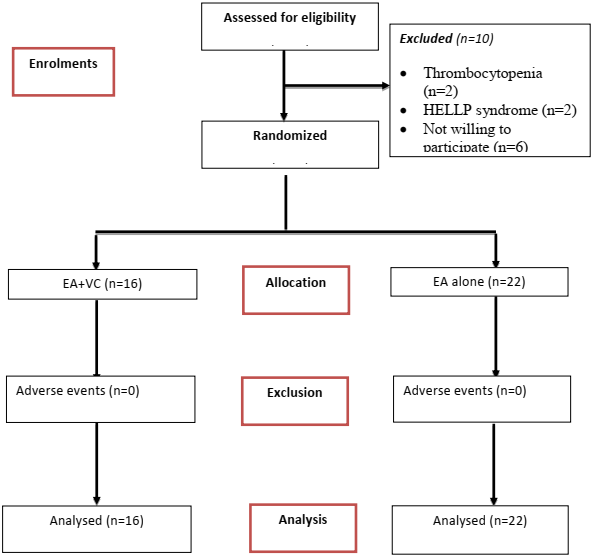
The present study compared the effect of ambulatory epidural labor analgesia with Vedic chants (EA+VC) and ambulatory epidural labor analgesia (EA) alone in parturients on Haemodynamic parameters. A total of 38 patients were included in the study at Department of Anaesthesiology and Department of Obstetrics & Gynaecology, Dr. Rajendra Prasad Government Medical College, Kangra at Tanda. Results of the study have been presented in Figure 1. 


Figure 1: Assessed for Eligibility


Treatment Arms

Patients were randomly divided into two groups. The patients in group A were made to listen to Vedic chants (Gayatri mantra) after established epidural labor analgesia and patients in group B received only epidural labor analgesia. 


Mean age of the patients in group A (25.1±4.8) was comparable to that in group B (25.6±3.3); p = 0.69. Mean height of the patients in group A was comparable to that in group B (156.9±3.5 vs. 157±3.2; p = 0.955). Mean weight of the patients in group A was comparable to that in group B (61.4±7.9vs. 62.6±6.5; p = 0.623). Mean BMI of the patients in group A was comparable to that in group B (22.5±4.4 vs. 21.1±4.2; p = 0.170). Mean POG of the patients in group A was comparable to that in group B (39.1±0.8 vs. 39.1±0.9; p = 0.914). (Table 2)


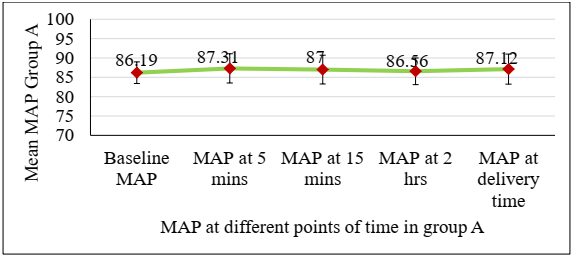
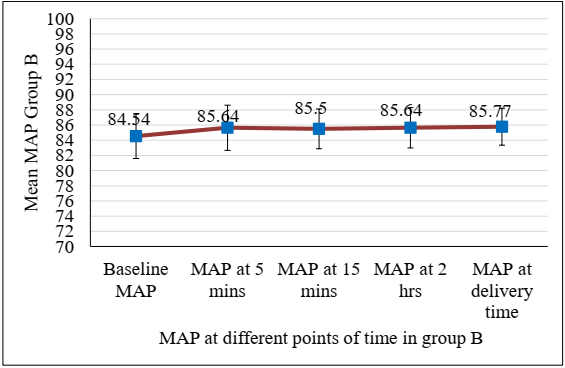
Mean arterial pressure (MAP) of the patients in group A was comparable to that in group B (86.2±2.8 vs. 84.6±2.9; p = 0.09). (Table 3)


The variation was statistically insignificant and the MAP remained within normal limits in both Group A and Group B (Figure 2,3)


Table 1: Treatment arms

Group

Description

Frequency

A

Epidural labor analgesia + Vedic chants

16

B

Epidural labor analgesia 

22


Table 2: Comparison of socio-clinical variables between two groups


Group A (n = 16)

Group B (n = 22)

p-value*

Age(years)

25.1±4.8

25.6±3.3

0.69

Height (In cm)

156.9±3.5

157±3.2

0.955

Weight (In Kg)

61.4±7.9

62.6±6.5

0.623

BMI

24.9±2.8

25.4±2.6

0.595

POG

39.1±0.8

39.1±0.9

0.914


Figure 2: Map at Different Points of Time in Group A


Figure 3: Map at Different Points of Time in Group B


Table 3: Comparison of Mean Baseline Map Between two Groups


Group A (n = 16)

Group B (n = 22) 

p-value*

Baseline MAP

86.2±2.8

84.6±2.9

0.09


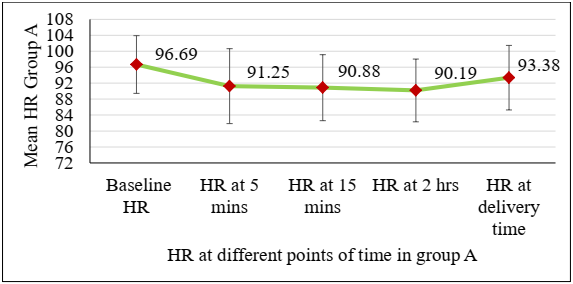
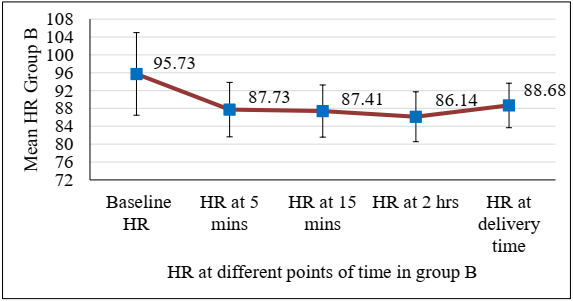
The variation in mean heart rate was statistically insignificant in both groups A & B 


Mean maternal baseline Heart rate (HR) (beats per minute) of the patients in group A was comparable to that in group B (96.7±7.2 vs. 95.7±9.2; p = 0.7).


Mean Peripheral oxygen saturation (SPO2%) of the patients in group A was comparable to that in group B (96.7±7.2 vs. 95.7±9.2; p = 0.7). (Table 4)


Table 4: Comparison of Mean Maternal Baseline Heart Rate between Two Groups


Group A (n = 16)

Group B (n = 22) 

p-value*

Mean baseline heart rate (bpm)

96.7±7.2

95.7±9.2

0.7

DISCUSSION

Hypotension as a side effect of epidural labor analgesia was not noticed in any of the patients of both groups. In our study MAP in group A was 86.2±2.8 and in group B was 84.6±2.9. The difference between two was statistically non-significant (p = 0.09). Our results were well supported by Drzymalski et al., [7] who studied the systolic blood pressure and diastolic blood pressure were no different between the music and control groups before placement or at any of three time points during the initial hour after placement of epidural catheter.


In a study by Simalvi S et al., [8] they found that systolic blood pressure and diastolic blood pressure were significantly higher in control group which received routine care only as compared to music group which received music and routine care.


There was no episode of bradycardia in any of the patients in two groups in our study mean heart rate in group A was 96.7±7.2 and in group B was 95.7±9.2.The difference between twowasnot statistically significant (p = 0.7) . Our results correlated with the study done by Drzymalski et al., [7], they found no difference in the heart rate of the patients between the music and control groups before placement or at any of three time points during the initial hour after placement of epidural catheter.


In a study by Simalvi S et al. [8], they found that heart rate was significantly higher in the control group (78.65±5.86 ), than the music group (75.96±4.76) (p = 0.004).In his study the control group received only routine care and music group received routine care along with self-chosen music.


In our study the difference in mean oxygen saturation was non-significant (p = 0.434) between the two groups which also correlated with the study done by Drzymalski et al. [7], found no difference in oxygen saturation of the patients between the music and control groups before placement or at any of three time points the initial hour after placement of epidural catheter. (Table 5)


Figure 4: HR at Different Points of Time in Group A


Figure 5: HR at Different Points of Time in Group B


Table 5: Comparison of Mean SPO2 (%) between Two Groups


Group A (n = 16)

Group B (n = 22) 

p-value*

SPO2 (%)

97.4±0.6

97.6±0.8

0.434


CONCLUSION

In our study, all hemodynamic variables including Mean arterial pressure, mean Heart rate and mean oxygen saturation were comparable at all-time intervals between the two groups.

REFERENCE
  1. Hawkins, J.L. “Epidural Analgesia for Labor and Delivery.” New England Journal of Medicine, vol. 362, no. 16, April 2010, pp. 1503–1510. https://doi.org/10.1056/NEJMra0909630.

  2. Bandyopadhyay, K.H. et al. “Labor Epidural Analgesia: Past, Present and Future.” Indian Journal of Pain, vol. 28, no. 2, May 2014, pp. 71–76. https://doi.org/10.4103/0970-5333.132843.

  3. Lowe, N.K. “The Nature of Labor Pain.” American Journal of Obstetrics and Gynecology, vol. 186, no. 5, May 2002, pp. S16–S24. https://doi.org/10.1067/mob.2002.121427.

  4. Mok, E. and K.Y.Wong. “Effects of Music on Patient Anxiety.” AORN Journal, vol. 77, no. 2, February 2003, pp. 396–410. https://doi.org/10.1016/S0001-2092(06)61307-2.

  5. Chuang, C.H. et al. “Music Intervention for Pain and Anxiety Management of the Primiparous Women during Labour: A Systematic Review and Meta‐Analysis.” Journal of Advanced Nursing, vol. 75, no. 4, April 2019, pp. 723–733. https://doi.org/10.1111/jan.13847.

  6. Hoffman, J. “Tuning in to the Power of Music.” RN, vol. 60, no. 6, June 1997, pp. 52–55.

  7. Drzymalski, D.M. et al. “A Randomized Controlled Trial of Music Use during Epidural Catheter Placement on Laboring Parturient Anxiety, Pain, and Satisfaction.” Anesthesia & Analgesia, vol. 124, no. 2, February 2017, pp. 542–547. https://doi.org/10.1213/ANE.0000000000001668.

  8. Simavli, S. et al. “Effect of Music on Labor Pain Relief, Anxiety Level and Postpartum Analgesic Requirement: A Randomized Controlled Clinical Trial.” Gynecologic and Obstetric Investigation, vol. 78, no. 4, 2014, pp. 244–250. https://doi.org/10.1159/000365085.


License
CC BY-NC-ND
Creative Commons Attribution-NonCommercial-NoDerivatives 4.0 International License
Evaluation of the Effect of Vedic Chants on Haemodynamic Parameters in Laboring Parturients with Ambulatory Epidural Labor Analgesia © 2026 by Shelly, Poonam, Chander Mohan Negi, Nitin Patiyal licensed under CC BY-NC-ND 4.0
All papers should be submitted electronically. All submitted manuscripts must be original work that is not under submission at another journal or under consideration for publication in another form, such as a monograph or chapter of a book. Authors of submitted papers are obligated not to submit their paper for publication elsewhere until an editorial decision is rendered on their submission. Further, authors of accepted papers are prohibited from publishing the results in other publications that appear before the paper is published in the Journal unless they receive approval for doing so from the Editor-In-Chief.
Himalayan Journal of Nursing and Midwifery open access articles are licensed under a Creative Commons Attribution-Share A like 4.0 International License. This license lets the audience to give appropriate credit, provide a link to the license, and indicate if changes were made and if they remix, transform, or build upon the material, they must distribute contributions under the same license as the original.
Recommended Articles
Research Article
General public Knowledge, Attitude and Practices Regarding COVID-19: a Cross-Sectional study in Himachal Pradesh
...
Published: 10/07/2022
Download PDF
Research Article
Self-Care Practices in Primary Dysmenorrhea among Nursing Students at AL- Diwaniyah Governorate
Published: 30/03/2024
Download PDF
Review Article
Prevention of Extravasation Non-Cytotoxic Agents (Review Study)
Published: 20/10/2022
Download PDF
Research Article
Knowledge Regarding Cardio Pulmonary Resuscitation in Pregnant Women among Registered Nurses Working in Selected Hospitals of Shimla
Published: 18/02/2022
Download PDF
Flowbite Logo
Najmal Complex,
Opposite Farwaniya,
Kuwait.
Email: support@himjournals.com

Useful Links
Order Hard Copy
Privacy policy
Terms and Conditions
Refund Policy
Others
About Us
Team Members
Contact Us
Online Payments
Join as Editor
Join as Reviewer
Subscribe to our Newsletter
Follow us
MOST SEARCHED KEYWORDS
scientific journal
 | 
business journal
 | 
medical journals
 | 
Scientific Journals
 | 
Academic Publisher
 | 
Peer-reviewed Journals
 | 
Open Access Journals
 | 
Impact Factor
 | 
Indexing Services
 | 
Journal Citation Reports
 | 
Publication Process
 | 
Impact factor of journals
 | 
Finding reputable journals for publication
 | 
Submitting a manuscript for publication
 | 
Copyright and licensing of published papers
 | 
Writing an abstract for a research paper
 | 
Manuscript formatting guidelines
 | 
Promoting published research
 | 
Publication in high-impact journals
Copyright © Himalayan Journals . All Rights Reserved.